
What Is Options Trading? Calls and Puts Explained
JustWolves is an educational platform and is not a SEBI-registered investment advisor. Trading financial instruments involves significant risk of loss and may not be suitable for all investors. Past performance is not indicative of future results. Read our full disclaimer →
What you'll learn
- An option gives the buyer the right, but not the obligation, to buy (call) or sell (put) at a set strike price until expiry
- The buyer pays a premium; the seller receives it and takes on the obligation
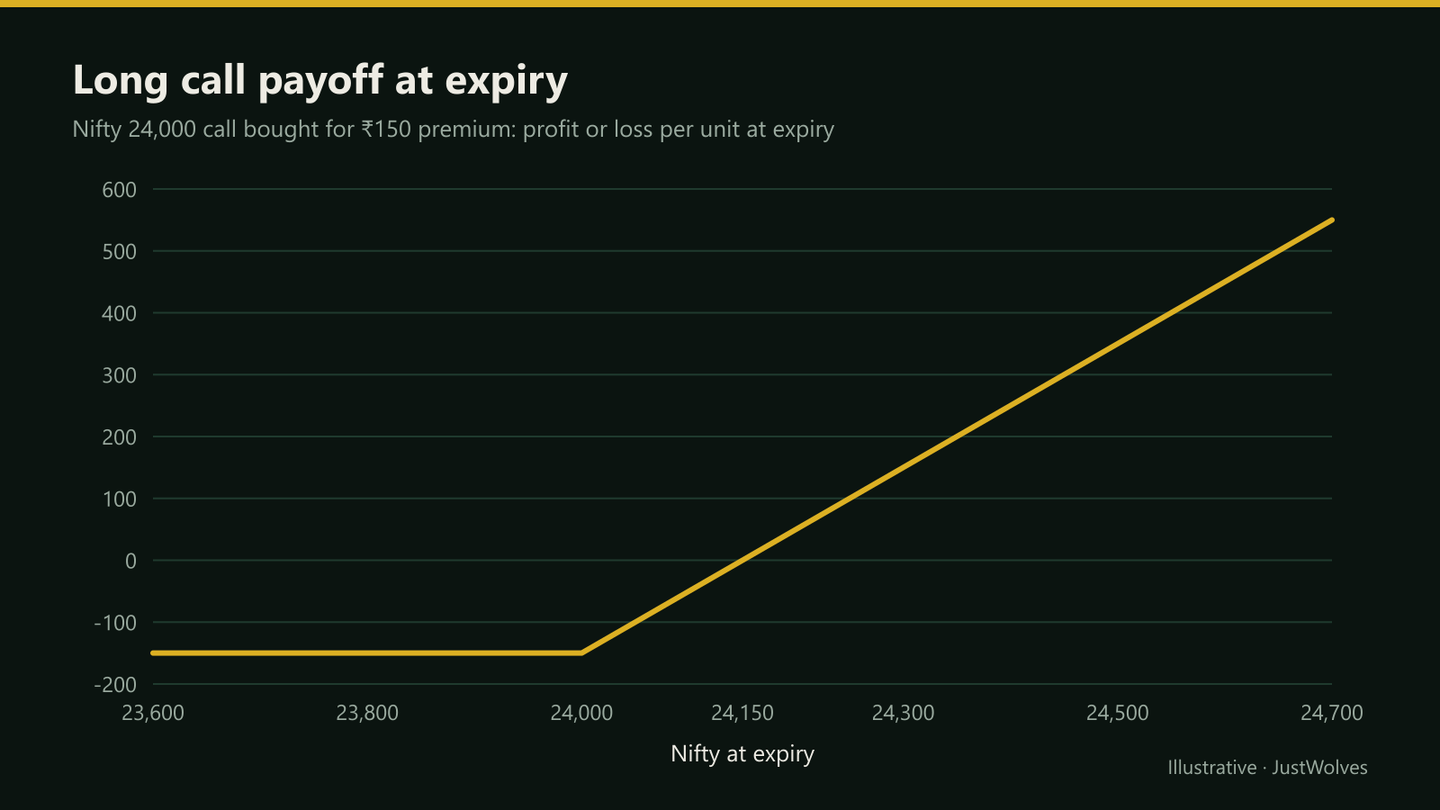
- A call buyer profits if the underlying rises above strike + premium; a put buyer if it falls below strike − premium
- Option buyers can lose at most the premium; option sellers can lose much more
- Nifty and Bank Nifty options are European-style and cash-settled
In this article · 16 sections
Options are the most widely traded derivatives in India by number of contracts. They work differently from futures: the buyer gets a choice, not an obligation, and pays for it upfront. That choice is what gives options their unusual payoff shapes. This lesson explains calls and puts, the roles of buyer and seller, and how a basic option trade makes or loses money, using Nifty examples.
What You Will Learn
- What call and put options are
- The rights and obligations of buyers and sellers
- Premium, strike and expiry
- How basic option trades make or lose money
Before You Start
Read What Are Derivatives? and Contract Specifications first.
What an Option Is
An option is a contract that gives its buyer the right, but not the obligation, to buy or sell the underlying at a fixed price, the strike price, on or before a set date, the expiry. The buyer pays the premium for this right.
The seller (or writer) receives the premium and takes on the obligation: if the buyer exercises, the seller must fulfil the contract.
Calls and Puts
| Call option | Put option | |
|---|---|---|
| Buyer's right | To buy at the strike | To sell at the strike |
| Buyer's view | Underlying will rise | Underlying will fall |
| Seller's obligation | To sell at the strike if exercised | To buy at the strike if exercised |
| Buyer's maximum loss | The premium paid | The premium paid |
| Buyer's breakeven at expiry | Strike + premium | Strike − premium |
Indian Index Options
- European-style: Nifty and Bank Nifty options can only be exercised at expiry, though they can be bought and sold any time before.
- Cash-settled: at expiry, in-the-money index options are settled in cash for their intrinsic value; no shares change hands.
- Lot-based: one Nifty option lot is 65 units (from the January 2026 series), so a premium of ₹150 costs 150 × 65 = ₹9,750 per lot.
Stock options in India are also European-style but are physically settled if exercised, which is covered in 06.05.
Buyers vs Sellers
The buyer's risk is limited to the premium; their potential profit on a call is open-ended. The seller's position is the reverse: their maximum profit is the premium received, and their potential loss can be large, unlimited in the case of a call.
Because of this, exchanges require option sellers to post margin similar to futures, while buyers simply pay the premium. Option selling is covered in its own course, Option Selling Strategies.
Three Ways a Trade Ends
- Sell before expiry: most traders close option positions in the market, profiting or losing on the change in premium.
- Held to expiry in the money: index options are settled in cash for their intrinsic value.
- Held to expiry out of the money: the option expires worthless; the buyer loses the premium and the seller keeps it.
Real Prices, Modelled Premiums: Two Weekly Call Purchases
The chart below uses real NIFTY 50 daily prices from September and October 2026. Historical option prices are not part of our dataset, so the premiums are modelled from recent volatility; the index moves are real. Step through two weekly call purchases with the same rules and very different outcomes.
Real NIFTY prices, modelled premiums: two weekly call purchases, September–October 2026
Step 1 of 4
Trade 1: buy a weekly call
On 28 September 2026 NIFTY closes at 22,780. A trader buys the 22,800 call for five trading days. Using recent volatility, a fair premium is modelled at about 147 points (about ₹9,560 per lot), so the breakeven is 22,947.
- What to observe
- The index must rise 167 points just to break even.
- Condition
- Premiums here are modelled, not traded prices.
Why Traders Use Options
Options let traders shape risk in ways shares and futures can't. A buyer can take a directional view with a known maximum loss. An investor can insure a portfolio with puts. More advanced traders combine calls and puts into spreads that profit from a range, a breakout or a change in volatility. All of those start from the two building blocks in this lesson: the right to buy and the right to sell.
Practical Example
Hypothetically, Nifty is at 23,950. Kiran buys one lot of the 24,000 call at ₹150, paying ₹9,750. Her breakeven at expiry is 24,150.
If Nifty is at 24,400 at expiry, the call's intrinsic value is 400, so she gains (400 − 150) × 65 = ₹16,250. If Nifty is at 23,900, the call expires worthless and she loses ₹9,750. Had she bought a 24,000 put at ₹170 instead, she would profit if Nifty finished below 23,830.
How Often Do Option Buyers Win? Our Test
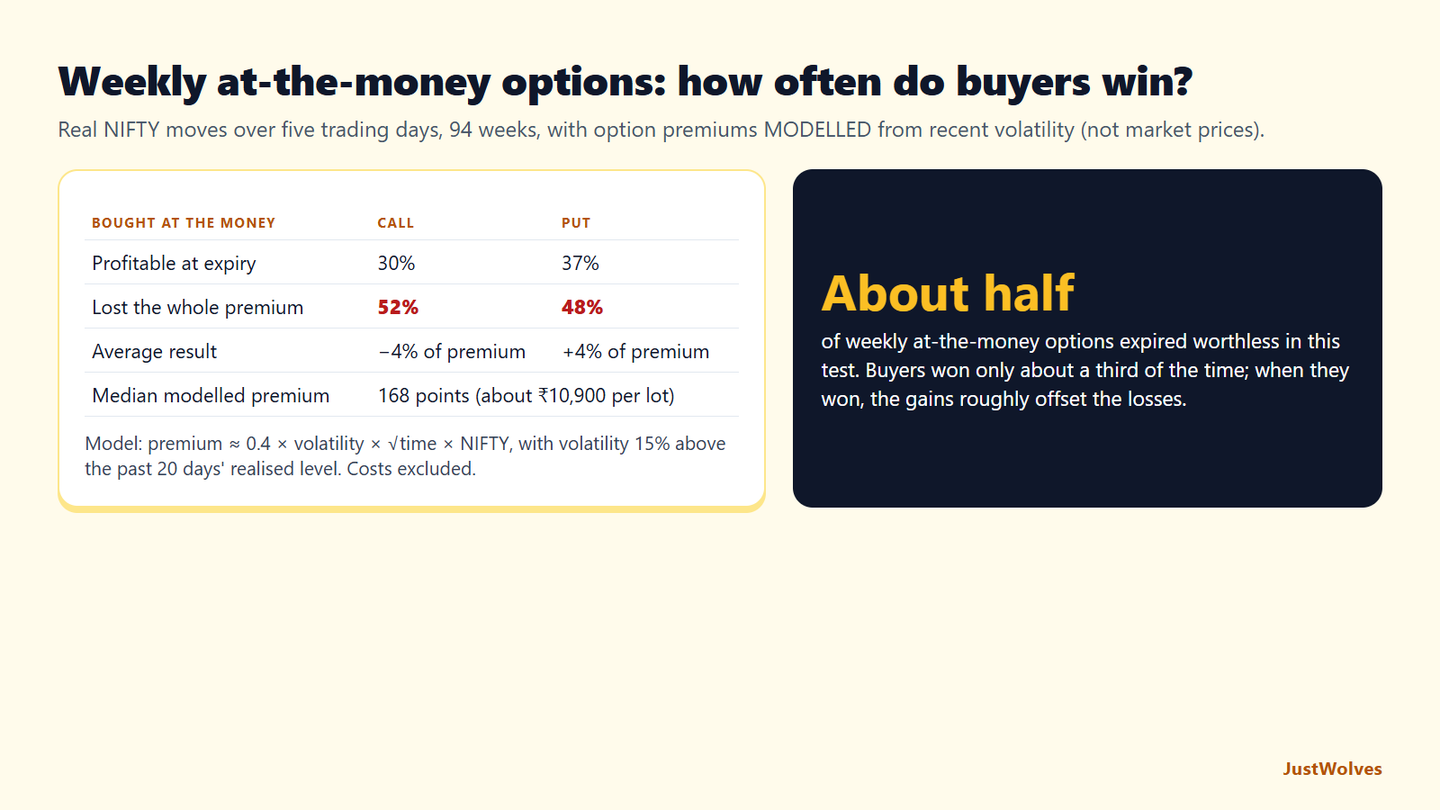
JustWolves tested the simplest option trade, buying a weekly at-the-money NIFTY call or put and holding it to expiry, on 94 weeks of real NIFTY 50 prices (November 2024 to November 2026). Strike: the nearest 50 points to the index. Holding period: five trading days. Premium (modelled): about 0.4 × volatility × √time × index level, the standard approximation for an at-the-money option, with volatility set 15% above the previous 20 days' realised volatility, since option prices usually carry a premium over recent movement. Result: intrinsic value at the end minus the premium.
| Call | Put | |
|---|---|---|
| Weeks tested | 94 | 94 |
| Profitable at expiry | 30% | 37% |
| Lost the whole premium | 52% | 48% |
| Average result | −4% of the premium | +4% of the premium |
| Median modelled premium | 168 points (about ₹10,900 per lot) | 168 points |
This makes the callout in this lesson concrete: limited risk is not low risk. In about half of all weeks, the at-the-money option bought at the start expired worthless, and the buyer lost the full premium. Buyers came out ahead only about a third of the time; the winning weeks were larger than the losing ones, so on average the results were close to zero before costs.
That near-zero average is not a coincidence. A fairly priced option is, roughly, a bet with an average result near zero before costs: the premium reflects how far the market typically moves. Buyers profit when the market moves more than the premium expected; sellers profit when it moves less. Adding brokerage, taxes and spreads tilts the average below zero for frequent traders on either side. The next module explains how premium, volatility and time interact, and why the price you pay matters as much as the direction you choose.
Common Mistakes
- Confusing the right (buyer) with the obligation (seller).
- Ignoring breakeven: the underlying must move past strike plus or minus premium.
- Buying cheap, far out-of-the-money options that rarely pay off.
- Forgetting lot size when calculating cost and risk.
- Selling options without understanding the open-ended risk.
Professional Insight
Professionals think of an option's premium as the price of a specific payoff shape. The questions they ask are whether that price is fair given volatility and time, and whether the shape fits their view. Those questions are the subject of the next module.
Risk Considerations
- Buyers often lose the full premium.
- Sellers face large or unlimited losses.
- Short-dated options move very fast in either direction.
Important Terminology
| Term | Meaning |
|---|---|
| Call option | The right to buy at the strike. |
| Put option | The right to sell at the strike. |
| Strike price | The price at which the option can be exercised. |
| Premium | The price paid for the option. |
| European-style | Exercisable only at expiry. |
What is options trading?
Buying and selling contracts that give the right to buy (call) or sell (put) an underlying at a set price before expiry.
What is the difference between a call and a put?
A call gives the right to buy and benefits from rising prices; a put gives the right to sell and benefits from falling prices.
How much can I lose buying options?
At most the premium you paid, though losing all of it is common.
Are Nifty options American or European?
European-style: they're exercised only at expiry, and settled in cash.
Do I have to hold an option until expiry?
No. Most traders buy and sell options before expiry to capture changes in premium.
What percentage of option buyers make money?
In our test of weekly at-the-money NIFTY options on 94 weeks of real prices with modelled premiums, calls were profitable at expiry 30% of the time and puts 37%, and about half expired worthless. Studies of actual trader accounts in India have also found most F&O traders lose money.
Practical Exercise
Calculate breakevens.
Your task
Step 1: Open an option chain
For the nearest Nifty expiry.
Step 2: Pick two calls and two puts
Near the current Nifty level.
Step 3: Calculate
Cost per lot and breakeven at expiry for each.
Step 4: Compare
How far must Nifty move for each to break even?
Check Your Understanding
A put option gives its buyer:
Related Lessons
Previous: Contract Specifications. Next: Futures vs Options. Later: Strike Price, Expiry and Moneyness.