
Strike Price, Expiry and Moneyness: ITM, ATM and OTM
JustWolves is an educational platform and is not a SEBI-registered investment advisor. Trading financial instruments involves significant risk of loss and may not be suitable for all investors. Past performance is not indicative of future results. Read our full disclaimer →
What you'll learn
- The strike is the price at which the option can be exercised; expiry is when it ends
- A call is in the money (ITM) when the underlying is above the strike; a put when it's below
- At the money (ATM) means the strike is closest to the current price
- Out of the money (OTM) options have no intrinsic value, only time value
- ITM options cost more and move more like the underlying; OTM options are cheaper but need a bigger move
In this article · 16 sections
Every option chain lists dozens of strike prices across several expiries. Choosing between them starts with one idea: moneyness, the relationship between the strike and the current price of the underlying. This lesson explains strike and expiry, defines in the money, at the money and out of the money for calls and puts, and shows how the choice changes cost, probability and behaviour.
What You Will Learn
- What strike price and expiry mean
- How to classify options as ITM, ATM or OTM
- How moneyness affects premium
- How strike choice changes risk and reward
Before You Start
Read What Is Options Trading? and Futures vs Options first.
Strike and Expiry
The strike price is the price at which the option holder can buy (call) or sell (put) the underlying. Exchanges list strikes at fixed intervals around the current price.
The expiry is the last day of the contract. For Nifty options, weekly and monthly expiries fall on Tuesdays (as of November 2026; see Contract Specifications). Options with more time to expiry generally cost more, because there's more time for the underlying to move.
Moneyness
| Term | Calls | Puts | Example |
|---|---|---|---|
| In the money (ITM) | Strike below the current price | Strike above the current price | 23,700 call; 24,300 put |
| At the money (ATM) | Strike nearest the current price | Strike nearest the current price | 24,000 call or put |
| Out of the money (OTM) | Strike above the current price | Strike below the current price | 24,300 call; 23,700 put |
A quick check: an option is in the money if exercising it right now would be worth something. A 23,700 call with Nifty at 24,000 lets you buy 300 points below the market; a 24,300 call would let you buy above it, which is worthless today.
How Moneyness Affects Premium
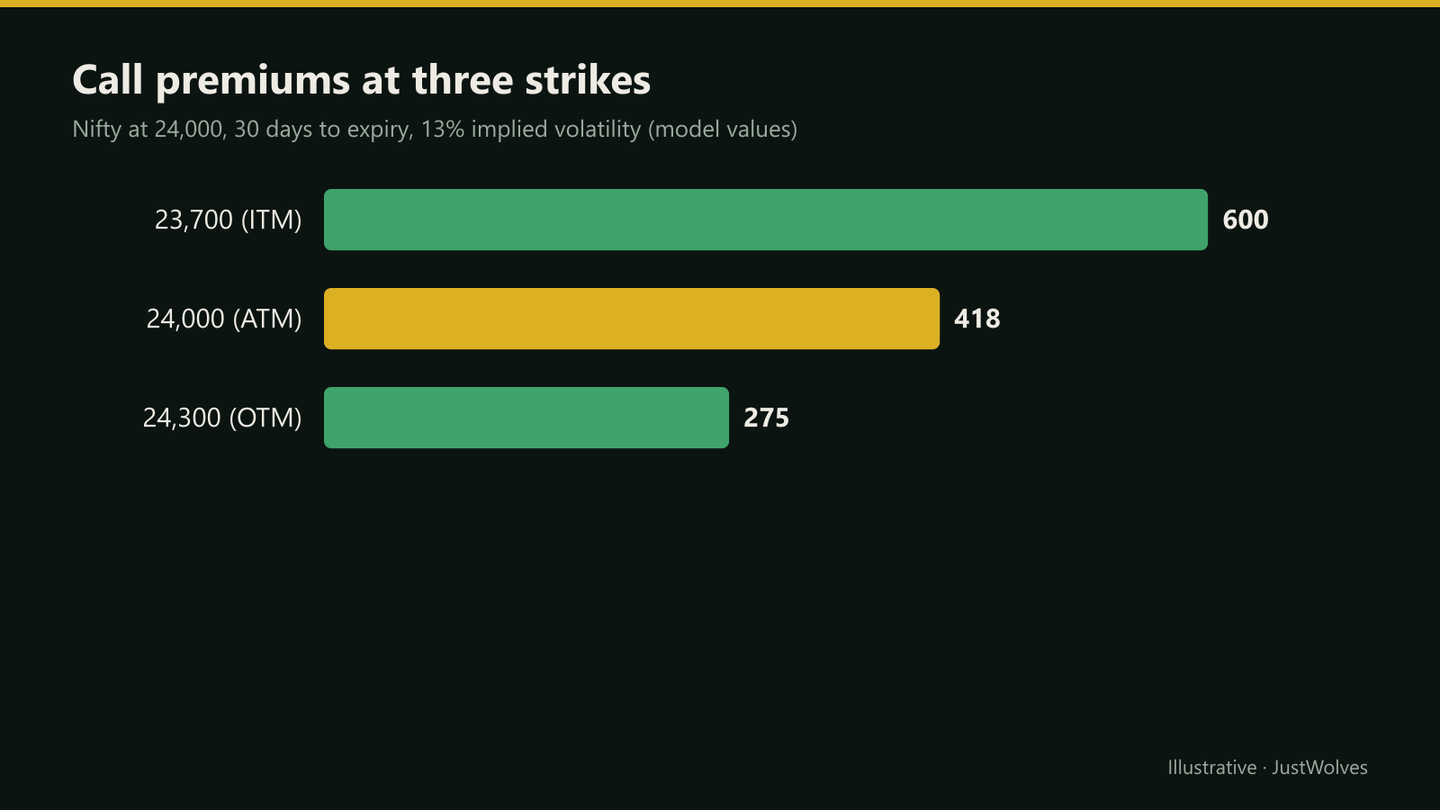
ITM options cost more because they already contain intrinsic value, the amount they're in the money. OTM options are cheaper because their whole premium is time value, the price of the chance that they'll move into the money. The next lesson separates these two parts.
Choosing a Strike
| Strike | Cost | Chance of finishing ITM | Behaviour |
|---|---|---|---|
| ITM | Highest | Higher | Moves most like the underlying |
| ATM | Medium | Around half | Most sensitive to time decay and volatility |
| OTM | Lowest | Lower | Needs a larger move; often expires worthless |
Real Prices: Three Strikes, One Week
The chart below uses real NIFTY 50 prices from November 2025. It repeats Nisha's three-strike comparison from this lesson on a real week, with premiums modelled from the volatility at the time.
Real NIFTY prices: three strikes, one week, November 2025
Step 1 of 3
Three calls
On 12 November 2025 NIFTY closes at 25,876. With recent volatility near 9%, modelled premiums for one-week calls are about 294 points for the 25,650 strike (in the money), 131 for 25,900 (at the money) and 55 for 26,100 (out of the money).
- What to observe
- The ITM call costs more because it already has 226 points of intrinsic value.
- Condition
- Premiums modelled, not traded.
Moneyness Changes as Price Moves
Moneyness isn't fixed. If Nifty rises from 24,000 to 24,400, the 24,300 call moves from OTM to ITM, and the 24,000 call moves from ATM to ITM. Options traders track this continuously, because an option's behaviour changes as its moneyness changes, a theme the Greeks lessons build on.
Choosing an Expiry
Expiry choice matters as much as strike choice. A weekly option is cheaper, but it gives the move very little time and decays fastest. A monthly option costs more but leaves room for the move to develop.
A practical approach is to estimate how long your trade idea needs, then choose an expiry that comfortably exceeds it. If you expect a move within a week, an option with two to four weeks left gives the idea time to work without paying for months you don't need.
Practical Example
Hypothetically, with Nifty at 24,000 and 30 days to expiry, Nisha compares three calls: 23,700 at ₹600, 24,000 at ₹418 and 24,300 at ₹275. At expiry, their breakevens are 24,300, 24,418 and 24,575.
If Nifty finishes at 24,500, the 23,700 call is worth 800 (gain ₹200 per unit), the 24,000 call is worth 500 (gain ₹82) and the 24,300 call is worth 200 (loss ₹75). The cheapest option lost money even though Nifty rose 500 points.
How Often Does Each Strike Pay Off? Our Test
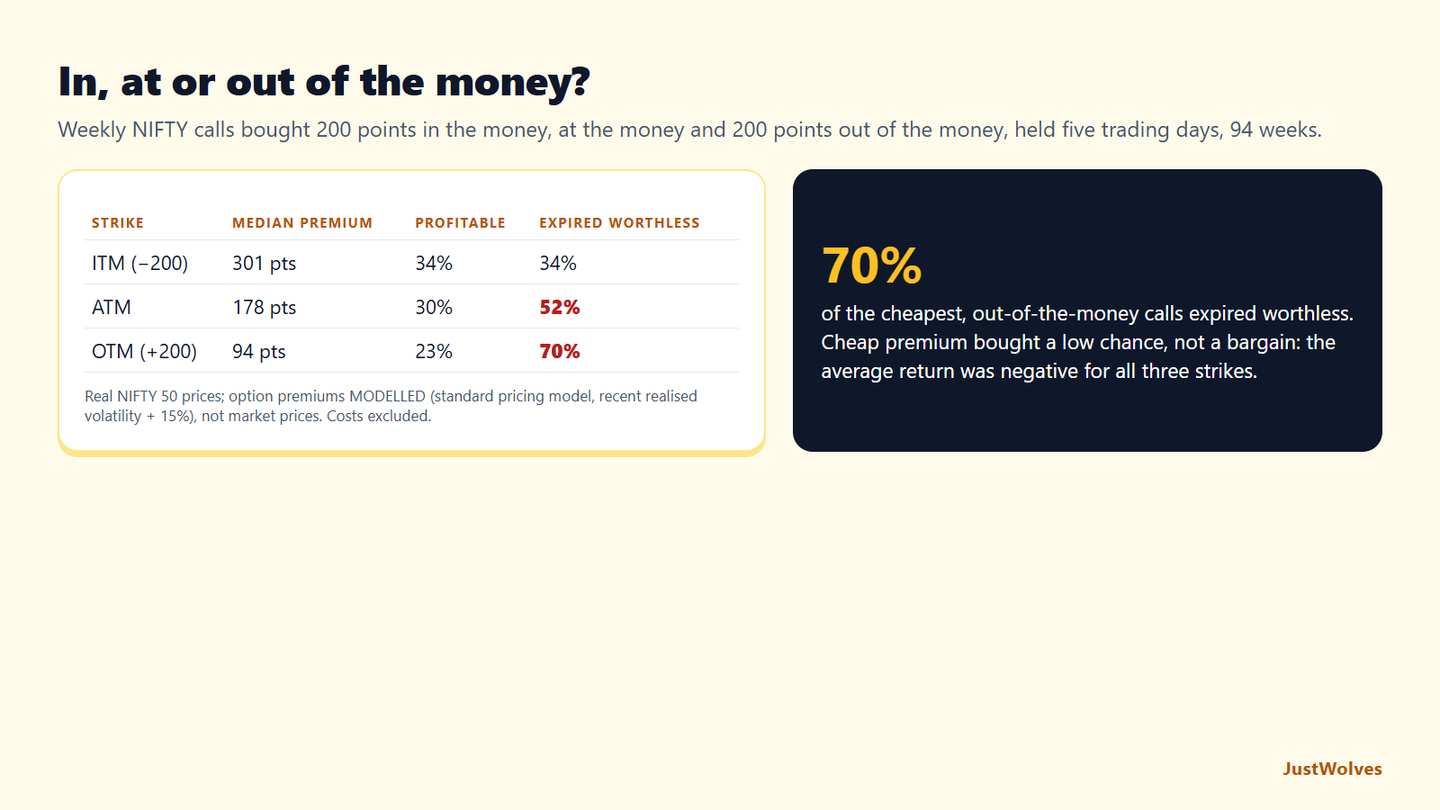
JustWolves tested weekly NIFTY calls at three strikes on 94 weeks of real prices (November 2024 to November 2026): 200 points in the money, at the money and 200 points out of the money, each bought and held for five trading days. Premiums were modelled with a standard option-pricing model from recent realised volatility plus 15%, because historical option prices are not in our dataset.
| Strike | Median premium | Profitable | Expired worthless | Average return on premium |
|---|---|---|---|---|
| 200 points in the money | 301 points | 34% | 34% | −12% |
| At the money | 178 points | 30% | 52% | −11% |
| 200 points out of the money | 94 points | 23% | 70% | −9% |
The pattern matches this lesson's trade-off table. The further out of the money, the more often the option expired worthless: 70% for the cheap OTM calls, against 34% for the ITM calls. ITM calls were profitable most often, because their intrinsic value cushioned small moves, but each one risked about three times as many rupees as the OTM call.
The averages were negative for all three strikes, and within a few percentage points of each other. That is what a fairly priced option looks like: lower probability is compensated by larger percentage gains when it works, so the cheap option is not a bargain and the expensive one is not a sure thing. Strike choice changes the shape of the outcome, how often you win and how much you lose when you are wrong, rather than the long-run average. Choose the strike that matches the move you expect, as this lesson's professional insight says, and size so that a string of worthless OTM expiries is affordable.
Common Mistakes
- Mixing up put moneyness: a put is ITM when the strike is above the price.
- Buying far OTM options because they're cheap.
- Ignoring breakeven when comparing strikes.
- Forgetting that moneyness changes as price moves.
- Choosing expiry without thinking about how long the move needs.
Professional Insight
Professionals choose strikes to match a view: how far they expect the underlying to move, and how quickly. A modest move expected soon suits an ATM or slightly ITM option; a large move over a longer period can justify OTM strikes.
Risk Considerations
- OTM options frequently expire worthless.
- ITM options cost more, so each lot risks more rupees.
- Illiquid strikes can have wide bid-ask spreads.
Important Terminology
| Term | Meaning |
|---|---|
| Strike price | The price at which an option can be exercised. |
| ITM | In the money: has intrinsic value. |
| ATM | At the money: strike nearest the current price. |
| OTM | Out of the money: no intrinsic value. |
| Moneyness | The relationship between strike and current price. |
What does ITM, ATM and OTM mean?
In the money, at the money and out of the money: whether an option would have value if exercised now.
When is a put option in the money?
When the underlying's price is below the put's strike price.
Which strike should a beginner buy?
There's no single answer. ATM and slightly ITM options need smaller moves to profit than far OTM options, at a higher cost.
Why are OTM options cheap?
Their premium is only time value, reflecting a lower probability of finishing in the money.
Can an OTM option make money?
Yes, if the underlying moves far enough and fast enough, or if implied volatility rises, before you sell it.
How do I compare strikes fairly?
Compare their breakevens and how much each risks per lot, not just the premium. Work out how far the underlying must move for each strike to profit by expiry, then ask whether you expect a move that large in the time available. Size each position from its premium so the rupee risk is the same.
Does moneyness change after I buy an option?
Yes. As the underlying moves, an at-the-money option can become in the money or out of the money, and its behaviour changes with it. That is why traders review their positions as price moves rather than only at expiry.
Should I buy ITM or OTM options?
It depends on the move you expect. In our test of weekly NIFTY calls on real prices with modelled premiums, ITM calls were profitable 34% of the time and OTM calls 23%, while 70% of OTM calls expired worthless. Average returns were similar and slightly negative for both.
Practical Exercise
Classify strikes.
Your task
Step 1: Open the Nifty option chain
For the nearest monthly expiry.
Step 2: Classify
Mark five calls and five puts as ITM, ATM or OTM.
Step 3: Calculate breakevens
For each of the calls.
Step 4: Compare
How far must Nifty move for each to break even?
Check Your Understanding
Nifty at 24,000. A 23,700 call is:
Related Lessons
Previous module: Futures vs Options. Next: Option Premium: Intrinsic and Extrinsic Value. See also How to Read an Option Chain.