
Hedging with Futures and Options
JustWolves is an educational platform and is not a SEBI-registered investment advisor. Trading financial instruments involves significant risk of loss and may not be suitable for all investors. Past performance is not indicative of future results. Read our full disclaimer →
What you'll learn
- Hedging reduces the risk of an existing position; it isn't a way to make money on its own
- Selling index futures hedges both losses and gains; buying puts limits losses while keeping upside, for a premium
- The hedge size depends on portfolio value and beta relative to the index
- A collar (buy a put, sell a call) reduces the cost of protection by giving up some upside
- Index hedges don't remove stock-specific risk
In this article · 16 sections
Derivatives were created largely for hedging: reducing the risk of a position you already hold. An investor with a portfolio of Indian shares can protect it against a market fall without selling a single share, using Nifty futures or options. This lesson covers the main hedging methods, how to size a hedge, what it costs and what it can't protect against.
What You Will Learn
- What hedging is and isn't
- Hedging with index futures
- Protective puts and collars
- How to size a hedge using beta
Before You Start
Read Futures Contracts Explained and Bear Put Spread first.
What Hedging Is
A hedge is a position that gains when your existing position loses. Its purpose is to reduce risk, not to add profit. A perfect hedge would make your combined position insensitive to market moves; real hedges are partial, because portfolios never move exactly like the hedging instrument.
Method 1: Sell Index Futures
Selling Nifty futures against a portfolio that moves with the Nifty offsets market moves in both directions. If the market falls, the short futures gain; if it rises, they lose, offsetting the portfolio's gain.
It's cheap apart from margin and trading costs, but it removes upside as well as downside for as long as the hedge is on.
Method 2: Buy Protective Puts
Buying Nifty puts works like insurance. Below the put's strike, the put gains as the market falls, offsetting portfolio losses; above it, the portfolio keeps its gains. The premium is the cost of that insurance, paid whether or not it's needed.

Method 3: Collars
A collar buys a put and sells an OTM call. The call premium pays for part or all of the put, in exchange for capping upside above the call strike. It suits an investor willing to give up gains above a certain level to protect against a fall below another.
Sizing the Hedge
Most portfolios don't move exactly with the Nifty. Beta measures how much a portfolio tends to move relative to the index: a beta of 1.2 means it has historically moved about 1.2% for each 1% move in the Nifty.
Hedge value = portfolio value × beta. Number of lots = hedge value ÷ (Nifty level × lot size). A ₹20 lakh portfolio with beta 1.2 needs about ₹24 lakh of hedge; at Nifty 24,000 and a lot of 65 (₹15.6 lakh per lot), that's about 1.5 lots, so one or two lots, depending on how much protection you want.
Hedging a Single Stock
If a large part of your portfolio is in one stock that trades in the F&O segment, you can hedge it directly with that stock's futures or options rather than the index. A protective put on the stock covers stock-specific risk, such as a disappointing quarterly result, which an index hedge can't.
Stock options are often less liquid than Nifty options and are physically settled at expiry, so check the bid-ask spread and plan to close the hedge before expiry.
Practical Example
Hypothetically, Geeta holds a ₹16 lakh portfolio of large-cap stocks with a beta close to 1, and is worried about a two-week period of global uncertainty. Nifty is at 24,000. She buys one lot of the 30-day 24,000 put at ₹300, costing ₹19,500 (about 1.2% of the portfolio).
If Nifty falls 5% to 22,800, her portfolio loses about ₹80,000 and the put gains (1,200 − 300) × 65 = ₹58,500, cutting the net loss to about ₹21,500. If Nifty rises instead, she keeps her gains minus the ₹19,500 premium.
Real Prices: A Protective Put Through a 10% Fall
Geeta's example uses round numbers. The chart below runs the same idea on real NIFTY 50 prices from February and March 2026, one of the sharpest falls in our two years of data, with the put valued each day by a standard pricing model.
Real NIFTY prices: a protective put through a 10% fall, February–March 2026
Step 1 of 4
Buying insurance
On 20 February 2026 NIFTY closes at 25,571. An investor with about ₹16.6 lakh in shares that move with the index, one lot's worth, buys one lot of the 25,550 put expiring on 24 March, modelled at 402 points: ₹26,130, about 1.6% of the portfolio.
- What to observe
- The cost is known and paid upfront.
- Condition
- Like Geeta in this lesson, but on a real month.
What Did Hedging Cost and Save? Our Tests
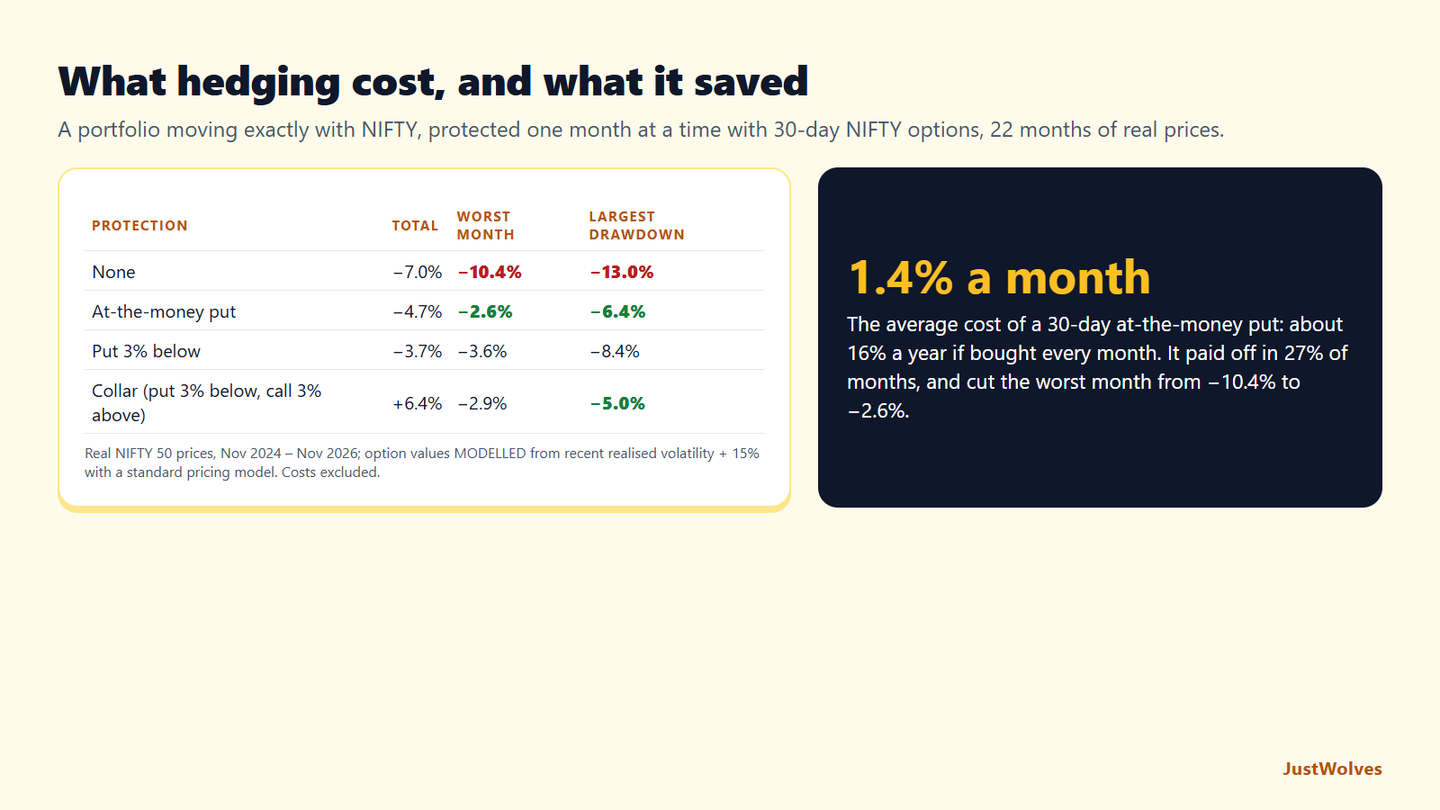
JustWolves ran two tests on about two years of real data (November 2024 to November 2026). The first protected a portfolio that moves exactly with NIFTY one month at a time, with 30-day NIFTY options bought at the start of each month and held to expiry: 22 months in all. The second measured how much of each of 20 large NSE stocks' daily movement a NIFTY hedge, sized at that stock's own beta, actually removed.
| Protection each month | Total over 22 months | Worst month | Largest drawdown |
|---|---|---|---|
| None | −7.0% | −10.4% | −13.0% |
| At-the-money put | −4.7% | −2.6% | −6.4% |
| Put 3% below the index | −3.7% | −3.6% | −8.4% |
| Collar: put 3% below, call 3% above | +6.4% | −2.9% | −5.0% |
Protection did what this lesson says it does. The at-the-money put cut the worst month from −10.4% to −2.6% and halved the largest drawdown. It cost about 1.4% of the portfolio a month on average, roughly 16% a year if bought continuously, and paid off in only 27% of months. That is why this lesson's mistakes list warns against hedging all year: as permanent insurance, the cost would swamp most portfolios' returns. Bought for a specific risk period, it is affordable.
The collar did best in this period, because the call it sold paid for the put in months when NIFTY was flat or rising less than 3%. That result depends on the period: in a strong bull run, the sold call would have capped the gains repeatedly. The put 3% below the index was cheaper than the at-the-money put but let more of each fall through, as a deductible does on insurance.
| Measure | Result |
|---|---|
| Daily volatility removed, median stock | 18% |
| Range across the 20 stocks | 7% to 32% |
| Median correlation with NIFTY | 0.57 |
| Beta changing by more than 0.2 between the two years | About half the stocks |
| For comparison: equal-weight basket of all 20 | 78% of volatility removed |
On a single stock, an index hedge removed only about a fifth of the daily movement. Most of a single stock's day-to-day risk is its own news, which this lesson's callout says an index hedge cannot cover. Spread across 20 stocks, the stock-specific parts largely cancel out and the same hedge removed 78% of the basket's volatility, as the futures lessons showed. Beta also moved: for about half of the 20 stocks it changed by more than 0.2 between the first and second year, so a hedge sized from last year's beta can easily be 20% too large or too small.
Common Mistakes
- Hedging continuously, paying for protection all year.
- Ignoring beta and over- or under-hedging.
- Expecting index hedges to cover stock-specific risk.
- Forgetting to remove a futures hedge when the risk period ends.
- Treating the hedge as a trade to be judged on its own profit.
Professional Insight
Institutional investors hedge selectively, often around identifiable risk periods, and judge hedges by how much they reduced portfolio volatility rather than whether they made money. A hedge that expires worthless did its job if the protection was needed at the time it was bought.
Risk Considerations
- Hedging costs reduce long-term returns.
- Basis risk: the portfolio and index don't move exactly together.
- Futures hedges need margin and remove upside.
Important Terminology
| Term | Meaning |
|---|---|
| Hedge | A position that offsets risk in another. |
| Protective put | A bought put that limits a portfolio's downside. |
| Collar | A bought put plus a sold call. |
| Beta | A portfolio's sensitivity to index moves. |
| Basis risk | The mismatch between a hedge and what it protects. |
How do I hedge my stock portfolio in India?
Commonly by selling Nifty futures or buying Nifty puts, sized using the portfolio's value and beta.
What is a protective put?
A put bought to limit losses on a portfolio or stock while keeping upside, in exchange for the premium.
How many lots do I need to hedge?
Portfolio value × beta ÷ (index level × lot size), rounded to whole lots.
What is a collar?
Buying a put and selling an OTM call to reduce the cost of protection, while capping upside.
Can I hedge individual stocks?
Yes, using that stock's futures or options if it's in the F&O segment. Index hedges don't cover stock-specific risk.
How much does it cost to hedge a portfolio with NIFTY puts?
In our test on two years of real NIFTY prices with modelled premiums, a 30-day at-the-money put cost about 1.4% of the portfolio a month on average, roughly 16% a year if renewed every month. Puts further below the index cost less but protect less.
Does a NIFTY hedge protect a single stock?
Only partly. In our test of 20 large NSE stocks, a NIFTY hedge sized at each stock's beta removed a median of about 18% of the stock's daily volatility. For a concentrated position, that stock's own options or futures give much closer protection.
Practical Exercise
Size a hedge.
Your task
Step 1: Value a portfolio
Real or hypothetical.
Step 2: Estimate beta
From a stock screener or your broker's analytics.
Step 3: Calculate lots
Using today's Nifty level and lot size.
Step 4: Price protection
Cost of a one-month ATM put hedge as a percentage of the portfolio.
Check Your Understanding
The main purpose of a hedge is to:
Related Lessons
Previous: Long Straddle and Long Strangle. Next module: Expiry Day Behaviour. See also Correlation Risk.