
Settlement, Exercise, Assignment and STT in India
JustWolves is an educational platform and is not a SEBI-registered investment advisor. Trading financial instruments involves significant risk of loss and may not be suitable for all investors. Past performance is not indicative of future results. Read our full disclaimer →
What you'll learn
- Index futures and options are cash-settled; stock futures and options are physically settled if held to expiry
- Indian equity options are European-style; ITM options are exercised automatically at expiry
- Option sellers are assigned at expiry when their options finish ITM
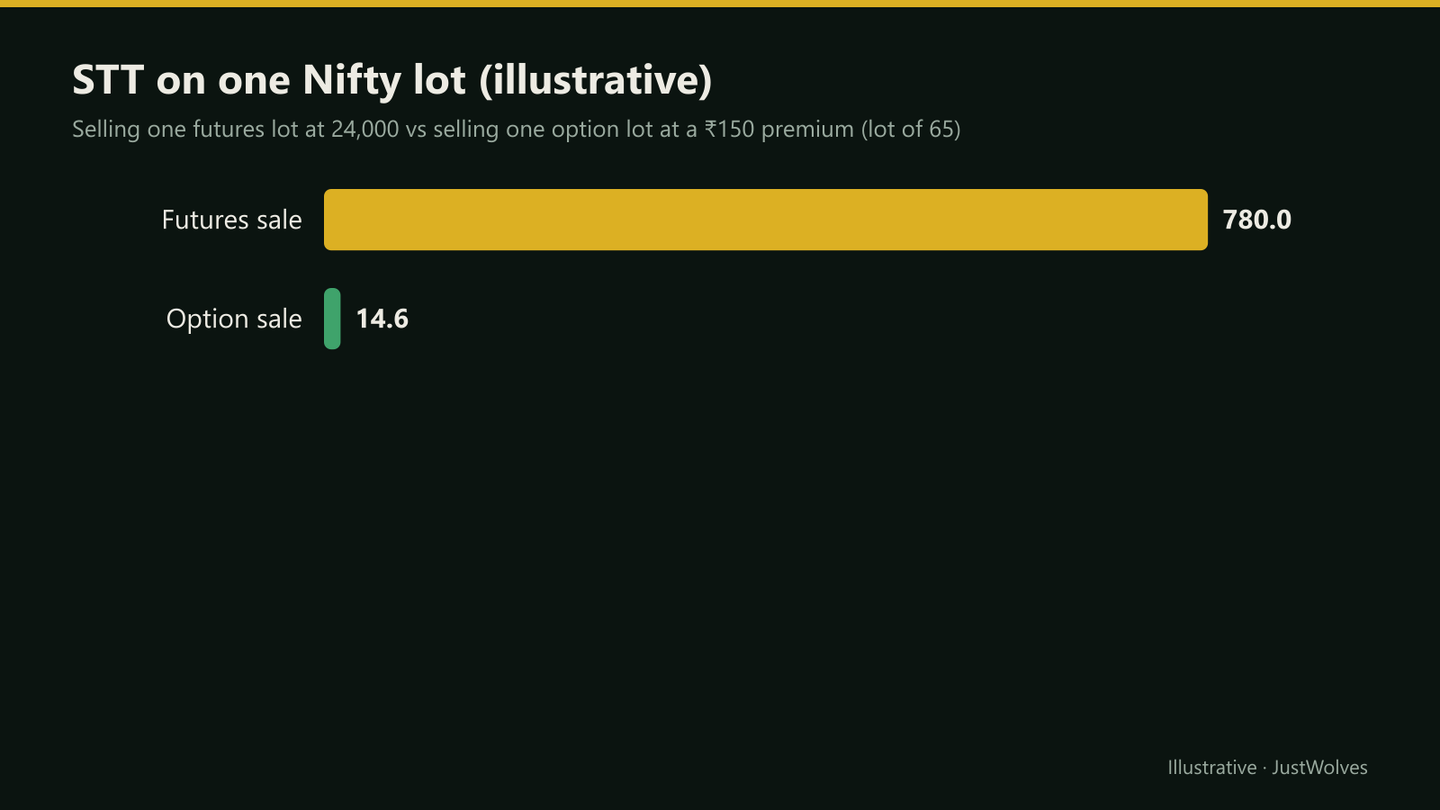
- From 1 April 2026, STT is 0.05% on the sale of futures and 0.15% on the premium of options sold
- STT on exercised options is charged on their intrinsic value, so it cannot exceed the payoff, but other charges can make small payoffs not worth holding for
In this article · 15 sections
Most F&O positions are closed before expiry, but understanding what happens if they aren't is essential. Index contracts settle in cash; stock contracts settle by delivery of shares. Options are exercised automatically if they finish in the money, and securities transaction tax (STT) applies differently to each kind of transaction. This lesson explains the mechanics and costs as they stand in November 2026.
What You Will Learn
- Cash versus physical settlement
- How exercise and assignment work
- STT rates on futures and options
- Other trading costs to account for
Before You Start
Read Expiry Day Behaviour first.
Cash vs Physical Settlement
| Contract | Settlement | What it means |
|---|---|---|
| Index futures and options | Cash | Profit or loss paid in cash against the final settlement price |
| Stock futures | Physical | Longs take delivery of shares; shorts must deliver them |
| Stock options (ITM at expiry) | Physical | Long calls and short puts buy shares; long puts and short calls deliver shares |
| Stock options (OTM at expiry) | None | Expire worthless |
Physical settlement requires the full value of the shares (for buyers) or the shares themselves (for sellers). Brokers typically ask for higher margins in the days before expiry and may close positions whose holders haven't arranged funds or shares. Each broker publishes its own physical-settlement policy; read it before holding stock F&O near expiry.
Exercise and Assignment
- European-style: Indian equity options are exercised only at expiry.
- Automatic exercise: ITM options are exercised automatically at expiry; you don't need to instruct your broker.
- Assignment: sellers of options that finish ITM are assigned, meaning they must settle the obligation in cash (index) or by delivery (stock).
STT on F&O
| Transaction | Rate | Charged on | Paid by |
|---|---|---|---|
| Sale of futures | 0.05% | Traded value | Seller |
| Sale of options | 0.15% | Option premium | Seller |
| Options exercised at expiry | 0.15% (as reported) | Settlement value of the exercised option | Buyer (holder) |
The Union Budget 2026 raised these rates from 0.02% (futures) and 0.10% (options premium). Some sources describe the base for exercised options differently, so check your broker's contract note for the exact calculation.
Exercise STT and Small Payoffs
Older articles describe an 'exercise STT trap', in which an option finishing slightly ITM paid tax on the full contract value and could owe more tax than it was worth. Since 2016, STT on exercised options has been charged on the option's intrinsic value at settlement, so the tax itself can no longer exceed the payoff. A small payoff can still be eaten up by brokerage and any exercise or settlement fee your broker charges, and a stock option that finishes ITM leads to physical delivery. Those are the reasons many traders square off ITM options before the close on expiry day instead of letting them be exercised.
Real Prices: Settled Just in the Money
Leela's example in this lesson uses round numbers. The chart below shows the same situation on real hourly NIFTY 50 prices from an expiry in September 2026: a call that was worth thousands of rupees at midday settled for a few hundred, just above its strike.
Real NIFTY prices: an option that settled just in the money, 31 August – 1 September 2026 (IST)
Step 1 of 4
Around the strike
On Monday 31 August 2026 NIFTY spends the day between about 23,995 and 24,115 and closes at 24,080, just above the 24,050 strike. Tuesday is expiry day.
- What to observe
- The 24,050 call is close to the money.
- Condition
- Its value will be decided in the last few hours.
Other Costs
- Brokerage: per order or per lot, depending on your broker.
- Exchange transaction charges and SEBI turnover fees.
- Stamp duty on the buy side.
- GST on brokerage and transaction charges.
Your contract note itemises every charge. For frequent traders, the total can be a meaningful share of gross profit, so track it in your trading journal every month alongside your results.
Practical Example
Hypothetically, Leela holds one lot of a Nifty 24,000 call bought at ₹40. On expiry, Nifty closes at 24,012, so the call settles at ₹12 intrinsic value: ₹780 for the lot. STT on exercise at 0.15% of the settlement value is small here, but her overall result is still a loss of (40 − 12) × 65 = ₹1,820 before other charges.
Had she sold the call at ₹18 in the final hour, she would have received ₹1,170, paid STT of 0.15% on that premium (under ₹2), and avoided exercise altogether, reducing her loss to ₹1,430 plus charges.
How Big Is STT Next to Real NIFTY Moves? Our Data
Rates in percent are hard to judge. JustWolves converted the April 2026 STT rates into NIFTY points and compared them with how far NIFTY actually moved in our data: the last 120 sessions of daily prices and six months of hourly prices, up to November 2026, with NIFTY averaging about 23,750.
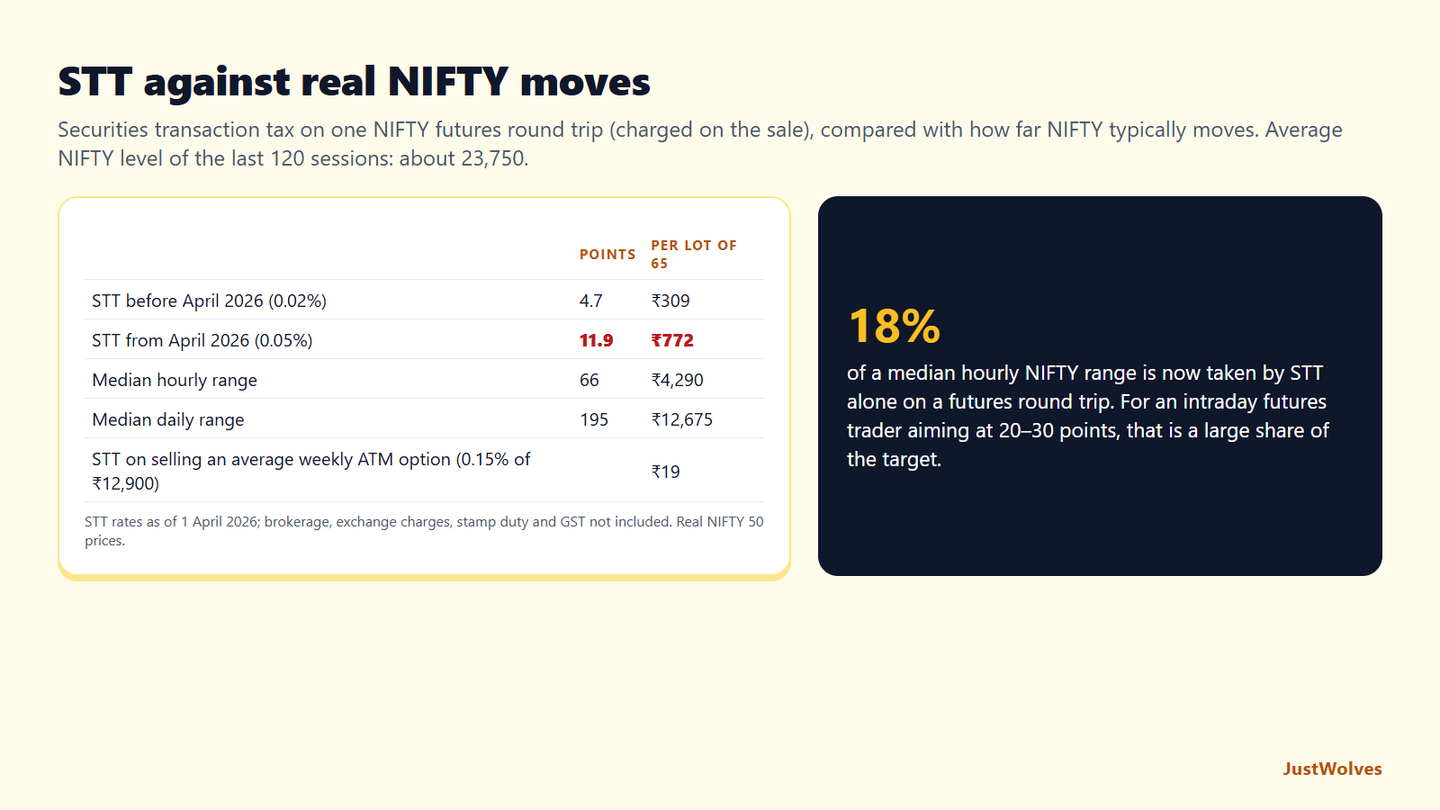
| Points | Per lot of 65 | |
|---|---|---|
| Futures STT per round trip, before April 2026 (0.02%) | 4.7 | ₹309 |
| Futures STT per round trip, from April 2026 (0.05%) | 11.9 | ₹772 |
| Median hourly NIFTY range | 66 | ₹4,290 |
| Median daily NIFTY range | 195 | ₹12,675 |
| STT on selling an average weekly ATM option (0.15% of ₹12,900) | 0.3 | ₹19 |
For futures, the April 2026 increase matters most to short-term traders. STT on one NIFTY futures round trip is now about 12 points, 18% of a median hourly range and 6% of a median daily range. A trader aiming for 20 or 30 points intraday gives up a large part of the target before brokerage and other charges. A positional trader aiming for several hundred points barely notices it.
For options, STT is small in rupees because it is charged on the premium: about ₹19 on selling an average weekly at-the-money NIFTY option in our data. What matters more for option traders is the decision this lesson's trap section describes. In our data, weekly at-the-money calls held to expiry finished in the money 48% of the time, and 18% of the time they finished in the money but below their cost, the zone where a small settlement payoff is all that is left and charges take a larger share. Deciding before the close, as in the chart above, usually beats leaving it to settlement.
Common Mistakes
- Holding stock F&O into expiry without funds or shares for delivery.
- Letting marginally ITM options be exercised without checking costs.
- Ignoring the April 2026 STT increase when planning frequent trades.
- Not reading the contract note.
- Assuming options can be exercised early in India.
Professional Insight
Experienced F&O traders usually close or roll positions before expiry and treat settlement as something to avoid rather than rely on. They also include all transaction costs in their backtests, because a small edge before costs can disappear after them.
Risk Considerations
- Delivery obligations can be large.
- Charges can exceed small expiry payoffs.
- Rate changes alter the economics of frequent trading.
Important Terminology
| Term | Meaning |
|---|---|
| Cash settlement | Settling profit or loss in cash. |
| Physical settlement | Settling by delivering the underlying shares. |
| Exercise | Using the option's right, automatic for ITM options at expiry. |
| Assignment | The seller's obligation being triggered. |
| STT | Securities transaction tax. |
Are Nifty options cash-settled?
Yes. Index options settle in cash against the final settlement price.
What is physical settlement in F&O?
Stock futures and ITM stock options held to expiry are settled by delivering or receiving the underlying shares.
What is the STT on options in India?
From 1 April 2026, 0.15% on the premium when options are sold, paid by the seller. Exercised options attract STT on their settlement value.
What is the STT on futures?
From 1 April 2026, 0.05% of the traded value on the sale side.
Can I exercise an option early in India?
No. Indian equity options are European-style and are exercised only at expiry.
How much STT do I pay on a NIFTY futures trade?
From 1 April 2026, STT is 0.05% of the traded value on the sale. With NIFTY near 23,750 and a lot of 65, that is about ₹770 per round trip, roughly 12 index points, before brokerage and other charges.
Is STT on exercised options still a trap?
Not in the way older articles describe. Since 2016, STT on exercised options has been charged on intrinsic value at settlement, so it cannot exceed the payoff. Brokerage, exchange fees and physical settlement for stock options can still make a small in-the-money payoff not worth waiting for.
Practical Exercise
Read a contract note.
Your task
Step 1: Find a recent F&O contract note
Or your broker's sample note.
Step 2: List every charge
Brokerage, STT, exchange fees, SEBI fees, stamp duty, GST.
Step 3: Total them
As a percentage of the trade's profit or loss.
Step 4: Read your broker's policy
On physical settlement of stock F&O.
Check Your Understanding
Stock futures held to expiry are settled:
Related Lessons
Previous: Expiry Day Behaviour. Next: NSE Contract Rules and SEBI F&O Regulations.