
Option Premium: Intrinsic and Extrinsic Value
JustWolves is an educational platform and is not a SEBI-registered investment advisor. Trading financial instruments involves significant risk of loss and may not be suitable for all investors. Past performance is not indicative of future results. Read our full disclaimer →
What you'll learn
- Premium = intrinsic value + extrinsic (time) value
- Call intrinsic value = max(0, underlying − strike); put intrinsic value = max(0, strike − underlying)
- Extrinsic value reflects time remaining and expected volatility
- Extrinsic value is highest for ATM options and falls to zero at expiry
- Option buyers pay extrinsic value; option sellers collect it
In this article · 15 sections
An option's premium has two parts. One is what the option would be worth if exercised right now. The other is what traders are willing to pay for the chance of more. Separating the two, intrinsic and extrinsic value, explains why options lose value over time, why ATM options decay fastest, and what exactly a buyer is paying for.
What You Will Learn
- How premium splits into intrinsic and extrinsic value
- How to calculate each for calls and puts
- What drives extrinsic value
- What happens to each at expiry
Before You Start
Read Strike Price, Expiry and Moneyness first.
Two Parts of the Premium
Premium = intrinsic value + extrinsic value. Extrinsic value is also called time value.
| Option | Intrinsic value | Example (Nifty 24,000) |
|---|---|---|
| Call | max(0, underlying − strike) | 23,700 call: 300 |
| Put | max(0, strike − underlying) | 24,300 put: 300 |
| Any OTM option | 0 | 24,300 call: 0 |
Extrinsic value = premium − intrinsic value. If the 23,700 call trades at ₹600 with Nifty at 24,000, its intrinsic value is 300 and its extrinsic value is 300.
What Drives Extrinsic Value
- Time to expiry: more time means more chance of a favourable move, so more extrinsic value.
- Implied volatility: when the market expects bigger moves, options cost more.
- Moneyness: extrinsic value is largest at the money, where the outcome is most uncertain, and smaller deep ITM or far OTM.
- Interest rates and dividends: smaller effects, covered in Option Pricing Basics.
At Expiry
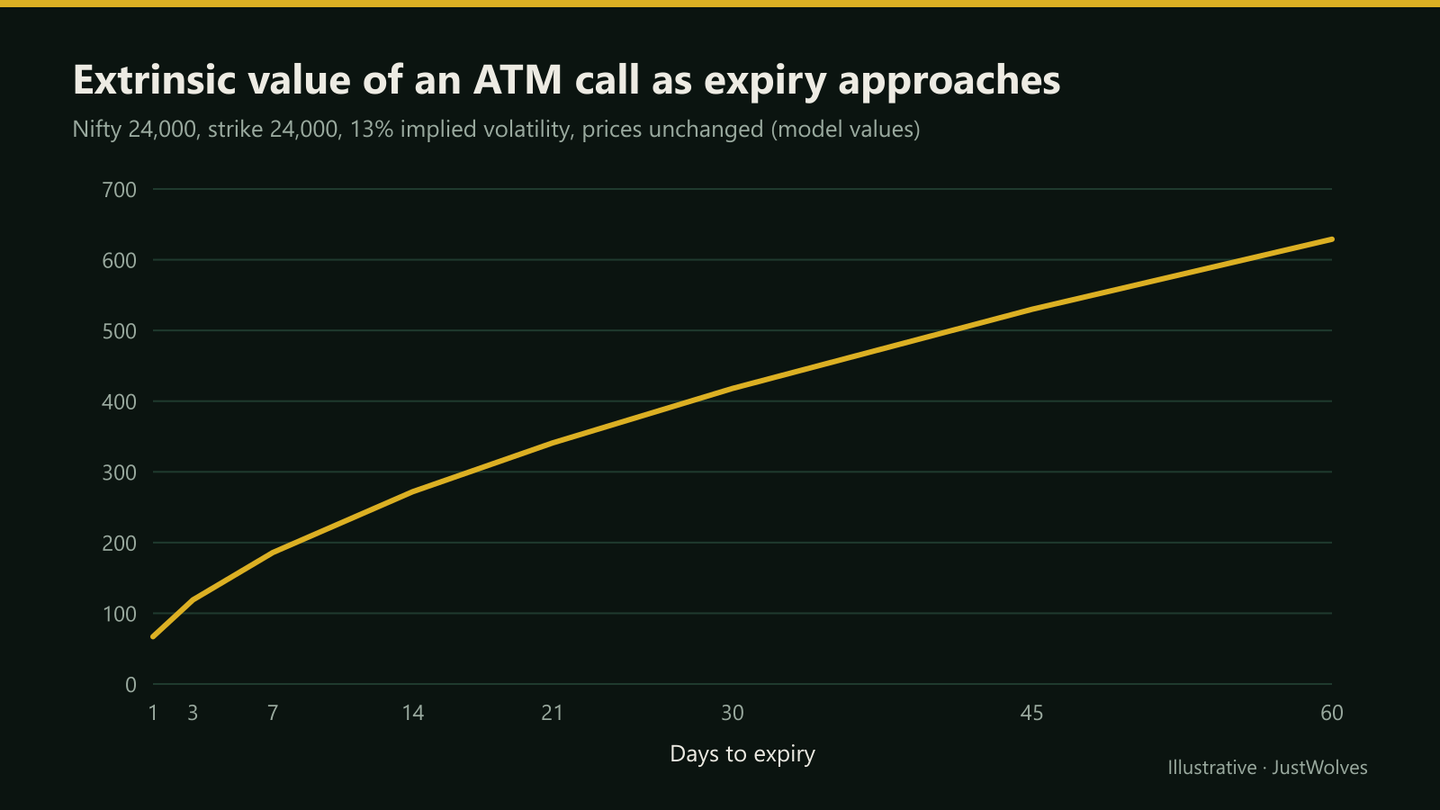
At expiry, there's no time left, so extrinsic value is zero and the option is worth exactly its intrinsic value. An ITM option settles for its intrinsic value; an OTM option is worthless.
This is why an option buyer can be right about direction and still lose: if the move is too small to cover the extrinsic value paid, the option is worth less at expiry than its cost.
Real Prices: A Month of Time Value Draining Away
The chart below follows a real month of NIFTY 50 prices, December 2025 to January 2026, with the value of a one-month at-the-money call modelled from the volatility at the time. It shows the point this lesson makes about expiry: a buyer can be right about direction and still lose.
Real NIFTY prices: a month of time value draining away, December 2025 – January 2026
Step 1 of 4
Buying a month of time
On 5 December 2025 NIFTY closes at 26,186. A one-month 26,200 call is almost exactly at the money, so its intrinsic value is zero and its whole modelled premium, about 309 points (₹20,100 per lot), is extrinsic value.
- What to observe
- All time value, no intrinsic value.
- Condition
- Premium modelled from recent volatility of about 8%.
Extrinsic Value Across Strikes
If you list the extrinsic value of every strike on an option chain, it forms a hill: low for deep ITM strikes, peaking at the money, and falling again for far OTM strikes. Deep ITM options behave almost like the underlying, so traders pay little extra for them. Far OTM options are unlikely to finish in the money, so their small premium is all extrinsic value, but small in rupees.
ATM options carry the most extrinsic value because their outcome is the most uncertain: a modest move either way decides whether they finish with value or expire worthless. That's also why ATM options lose the most rupees to time decay as expiry approaches.
Early Exit and Extrinsic Value
Because Nifty options are European-style, you can't exercise them early, but you can sell them. Selling before expiry captures any remaining extrinsic value; holding to expiry gives it up. That's one reason many option buyers close positions well before expiry rather than waiting for settlement, especially once the move they expected has happened and the remaining time value is still worth collecting by selling.
Practical Example
Hypothetically, Nifty is at 24,000 and Rohit looks at three 30-day calls: 23,700 at ₹600, 24,000 at ₹418 and 24,300 at ₹275. Their intrinsic values are 300, 0 and 0; their extrinsic values are 300, 418 and 275. The ATM option carries the most extrinsic value.
If Nifty is still at 24,000 at expiry, the 23,700 call is worth 300 (loss ₹300 per unit, all extrinsic value), the 24,000 call is worth 0 (loss ₹418) and the 24,300 call is worth 0 (loss ₹275). Per lot of 65, the ATM call's loss is ₹27,170.
Does the Market Move Enough to Pay for Time Value? Our Data
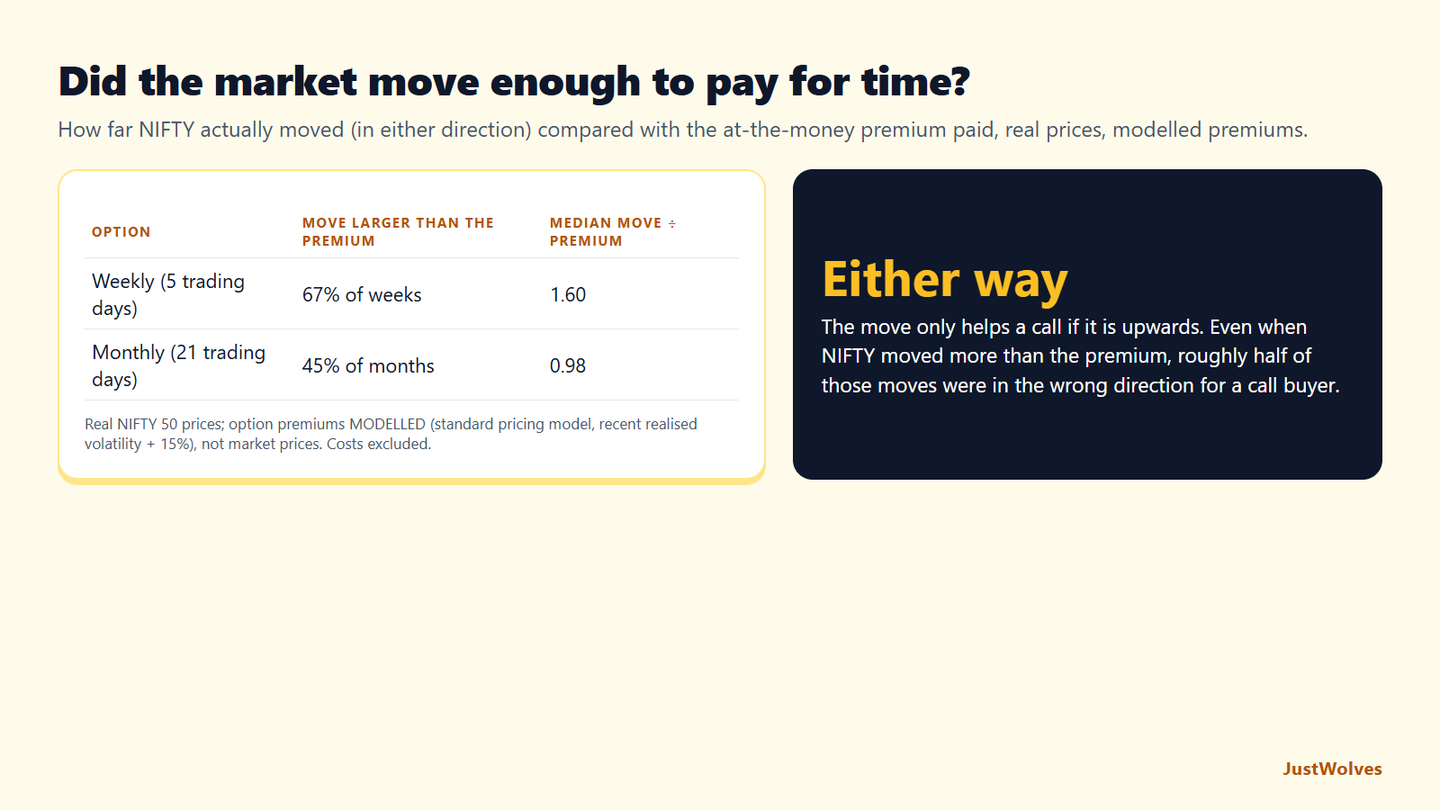
An at-the-money option's premium is all extrinsic value, so its buyer needs a move larger than the premium, in the right direction, to profit. JustWolves compared the actual NIFTY move with the modelled at-the-money premium over about two years of real prices (November 2024 to November 2026), for weekly and monthly options.
| Option | Periods | Move (either way) larger than the premium | Median move ÷ premium |
|---|---|---|---|
| Weekly (5 trading days) | 94 | 67% | 1.60 |
| Monthly (21 trading days) | 22 | 45% | 0.98 |
Two things stand out. Weekly moves usually exceeded the time value paid, in one direction or the other: two weeks in three. But a call only profits from the upward ones, which is why, in What Is Options Trading?, weekly calls were profitable only about 30% of the time. Monthly options were priced closer to the actual move: the typical month moved about as much as the premium, and less than half of months covered it.
For a buyer, the practical question from this lesson's professional insight, "do I expect a move larger than the time value I'm paying?", has a concrete benchmark: in this period, the market alone delivered such a move, in either direction, only about half to two thirds of the time. A direction view has to add a lot on top of that to make buying options worthwhile. For a seller, the same numbers show why collecting time value works often but not always: the moves that exceed the premium are the ones that hurt.
Common Mistakes
- Thinking a cheap OTM option has 'value' beyond the chance of a move.
- Forgetting extrinsic value at expiry is zero.
- Ignoring how much extrinsic value you're paying for.
- Getting put intrinsic value backwards.
- Holding bought options through quiet markets while extrinsic value decays.
Professional Insight
Experienced option buyers look at extrinsic value as a cost to be justified: 'I'm paying ₹418 of time value; do I expect a move larger than that before expiry?' Experienced sellers ask the reverse: is the time value collected enough to compensate for the risk of a large move?
Risk Considerations
- Decay accelerates in the final days.
- Volatility drops can cut extrinsic value without any price move.
- Sellers face large losses if the underlying moves sharply.
Important Terminology
| Term | Meaning |
|---|---|
| Intrinsic value | The value if exercised now; never below zero. |
| Extrinsic value | Premium minus intrinsic value; also called time value. |
| Time decay | The fall in extrinsic value as expiry approaches. |
| Implied volatility | The market's expected volatility, reflected in premiums. |
| Settlement value | What an option is worth at expiry: its intrinsic value. |
What is the intrinsic value of an option?
The amount it's in the money: for a call, underlying minus strike; for a put, strike minus underlying; never below zero.
What is extrinsic value?
The part of the premium above intrinsic value, reflecting time remaining and expected volatility.
Why do options lose value over time?
Because extrinsic value shrinks as there's less time for the underlying to move, reaching zero at expiry.
Do ITM options have time value?
Yes, usually some, though less than ATM options. Deep ITM options have very little.
What is an option worth at expiry?
Exactly its intrinsic value.
How often does NIFTY move more than an at-the-money option's premium?
In our two years of real data with modelled premiums, the five-day move exceeded the weekly at-the-money premium in 67% of weeks, in either direction, and the 21-day move exceeded the monthly premium in 45% of months. A call or put needs the move in its own direction, so it profits less often.
Practical Exercise
Split premiums.
Your task
Step 1: Note the Nifty level
And five call and five put premiums at different strikes.
Step 2: Calculate
Intrinsic and extrinsic value for each.
Step 3: Find the peak
Which strike has the most extrinsic value?
Step 4: Repeat a week later
How much extrinsic value has decayed?
Check Your Understanding
Nifty 24,000. Intrinsic value of a 23,700 call:
Related Lessons
Previous: Strike Price, Expiry and Moneyness. Next: Option Pricing Basics.