
Option Greeks: Delta and Gamma
JustWolves is an educational platform and is not a SEBI-registered investment advisor. Trading financial instruments involves significant risk of loss and may not be suitable for all investors. Past performance is not indicative of future results. Read our full disclaimer →
What you'll learn
- Delta estimates how much an option's price changes for a one-point move in the underlying
- Call deltas run from 0 to 1, put deltas from 0 to −1; ATM options are near ±0.5
- Delta × lot size gives a position's equivalent exposure in units of the underlying
- Gamma measures how fast delta changes; it's highest for ATM options near expiry
- High gamma makes short-dated ATM options swing sharply, for both buyers and sellers
In this article · 15 sections
The Greeks are measures of how an option's price responds to changes in its inputs. Delta and gamma deal with the most important input, the underlying's price. Delta tells you how much an option moves when the underlying moves one point. Gamma tells you how quickly that changes. Together they explain why short-dated options can double or collapse within hours.
What You Will Learn
- What delta measures and its typical values
- How to use delta for exposure
- What gamma measures
- Why gamma matters most near expiry
Before You Start
Read Implied Volatility vs Historical Volatility first.
Delta
Delta estimates the change in an option's price for a one-point change in the underlying. A call with delta 0.5 gains about ₹0.50 when Nifty rises one point.
Calls have positive delta, between 0 and 1. Puts have negative delta, between 0 and −1: they gain when the underlying falls.
| Moneyness | Typical call delta | Behaviour |
|---|---|---|
| Deep ITM | Close to 1 | Moves almost like the underlying |
| ATM | Around 0.5 | Moves about half as much |
| Far OTM | Close to 0 | Barely responds to small moves |
Delta is also sometimes read as a rough estimate of the probability that the option finishes in the money. It's a convenient approximation, not an exact probability.
Delta as Exposure
Multiply delta by the lot size to see a position's equivalent exposure. One lot of a Nifty call with delta 0.4 behaves, for small moves, like 0.4 × 65 = 26 units of Nifty. That makes delta useful for comparing and combining positions: a portfolio's total delta tells you how much it gains or loses per point.
Gamma
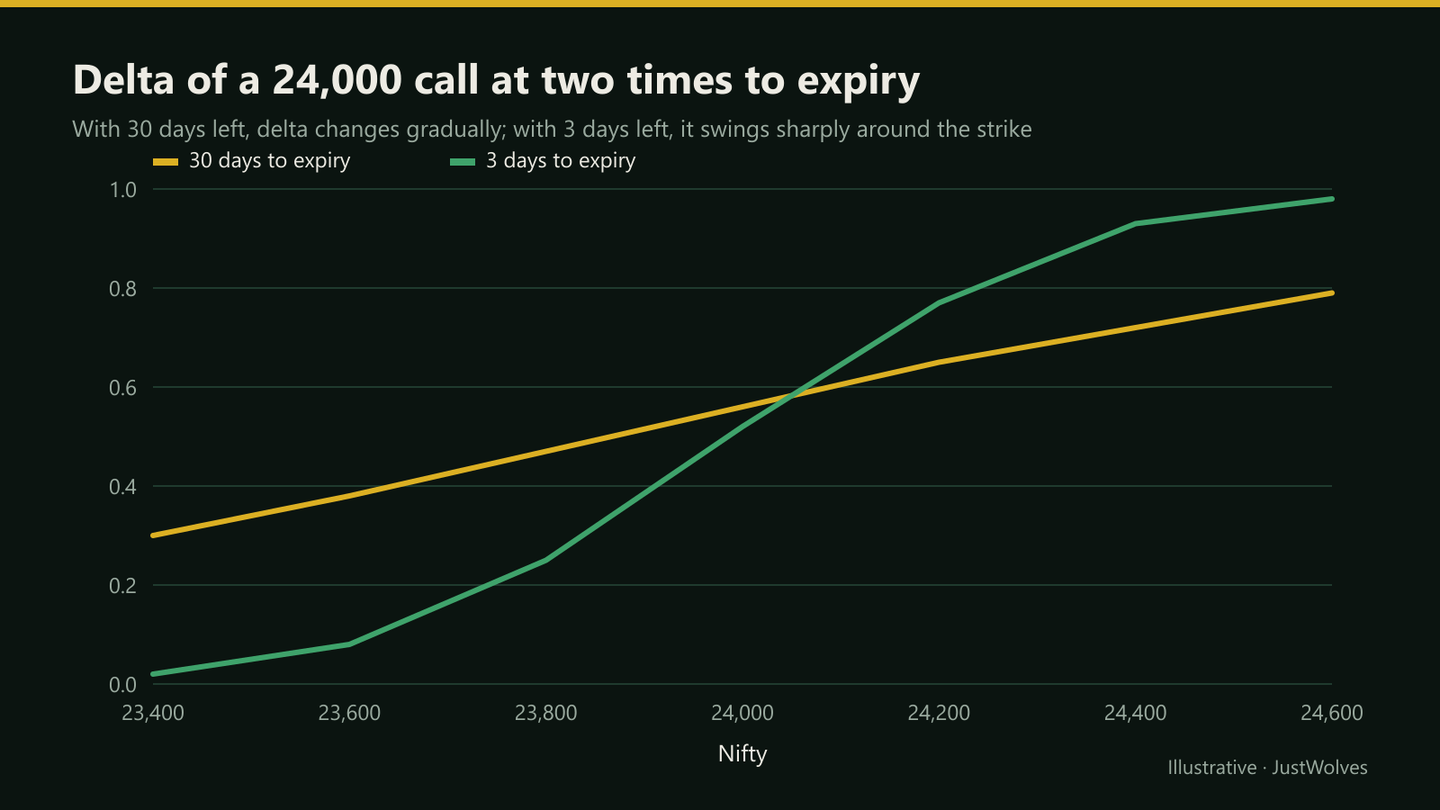
Gamma measures how much delta changes for a one-point move in the underlying. If a call has delta 0.50 and gamma 0.001, a 100-point rise lifts delta to about 0.60.
Gamma is highest for ATM options and rises sharply as expiry approaches. Far from expiry, delta changes gradually as price moves. Close to expiry, an ATM option's delta can swing from near 0 to near 1 over a modest move.
Real Prices: Gamma on an Expiry Day
The chart below uses real hourly NIFTY 50 prices from 6–7 July 2026, the day before and the day of a weekly expiry, with the delta and value of the 24,450 call modelled at each hourly close. It shows this lesson's point about gamma near expiry: an at-the-money option's delta can swing from near 0 to near 1 on a modest move.
Real NIFTY prices: gamma on an expiry day, 6–7 July 2026 (IST)
Step 1 of 4
The day before expiry
On Monday 6 July 2026 NIFTY closes at 24,424, just below the 24,450 strike. With about a day left and recent volatility near 13%, the 24,450 call's modelled delta is about 0.47: close to a coin flip.
- What to observe
- An at-the-money option on the last day has very high gamma.
- Condition
- Small moves will swing delta sharply.
Delta Hedging
Because delta measures directional exposure, it can be offset. A trader who is long one Nifty call lot with delta 0.5 has an exposure of about 32.5 units. Adding positions with a combined delta of about −32.5, such as bought puts, makes the combined position roughly delta-neutral: small moves in either direction barely change its value.
Gamma is why this neutrality doesn't last. As the underlying moves, delta changes, and the hedge has to be adjusted. Market makers and institutional desks do this continuously; for most retail traders, the main lesson is that an option position's directional exposure is never fixed.
Delta for Puts
A put with delta −0.4 gains about ₹0.40 for each point the underlying falls. One lot (65 units) behaves like a short position of about 26 units. Buying puts is therefore a way to reduce a portfolio's delta without selling the shares, which is the basis of hedging with options.
Practical Example
Hypothetically, with Nifty at 24,000 and 7 days to expiry, a 24,000 call trades at ₹186 with delta 0.53 and gamma about 0.001. If Nifty rises 100 points, a first estimate is a gain of about 53 points; because gamma lifts delta along the way, the actual gain is a little more, around 58 points.
Megha holds two lots: her position delta is 0.53 × 65 × 2 ≈ 69 units, roughly like holding 69 units of Nifty for small moves. If she wants exposure equal to one futures lot (65 units), one lot of a deep ITM call with delta near 1 gets closer.
Is Delta a Good Estimate of Probability? Our Test
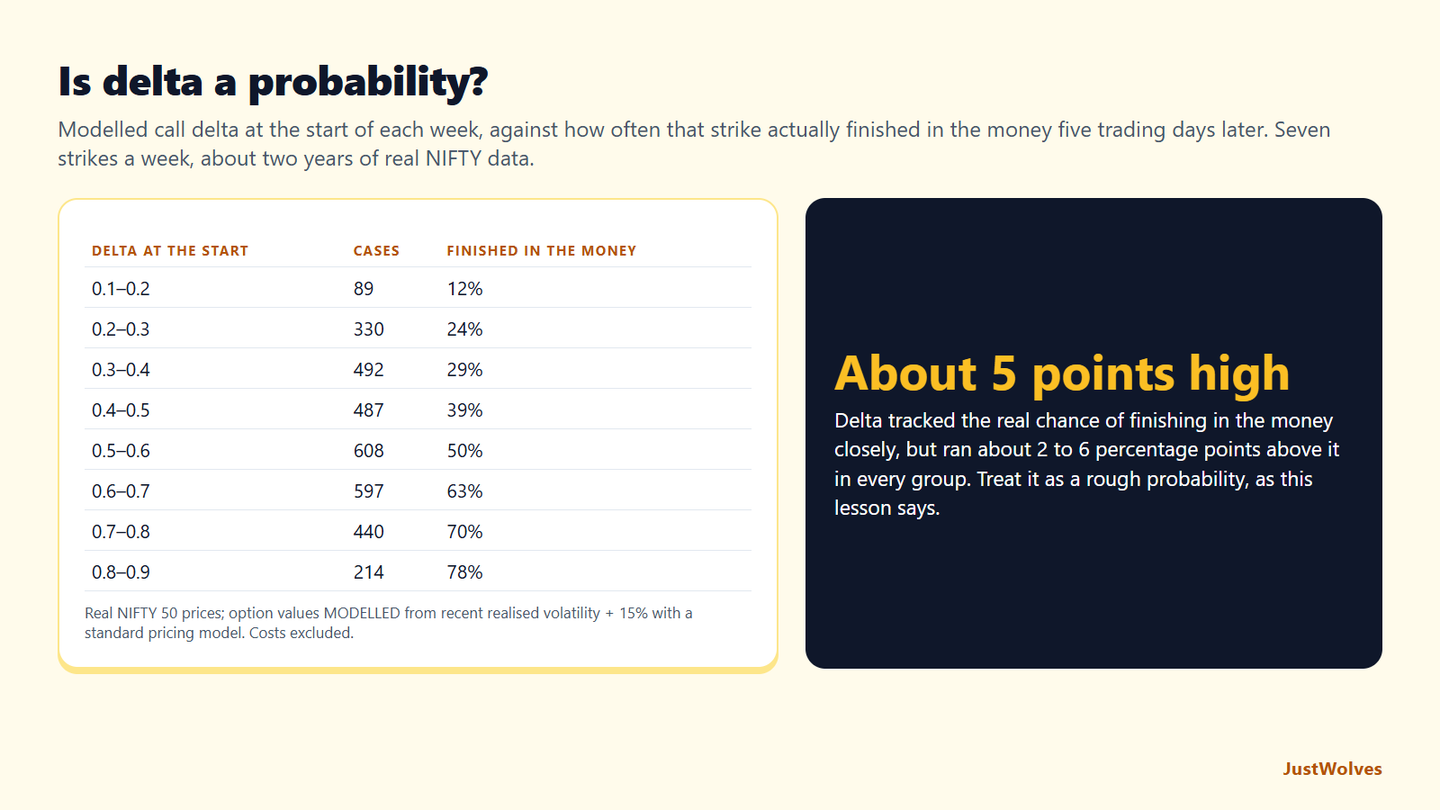
This lesson says delta is sometimes read as a rough estimate of the chance an option finishes in the money. JustWolves tested that on about two years of real NIFTY 50 prices (November 2024 to November 2026). On every trading day we modelled the delta of seven weekly calls, from 300 points in the money to 300 points out of the money, then checked whether each strike actually finished in the money five trading days later.
| Delta at the start of the week | Cases | Average delta | Actually finished in the money |
|---|---|---|---|
| 0.1–0.2 | 89 | 0.18 | 12% |
| 0.2–0.3 | 330 | 0.26 | 24% |
| 0.3–0.4 | 492 | 0.35 | 29% |
| 0.4–0.5 | 487 | 0.44 | 39% |
| 0.5–0.6 | 608 | 0.54 | 50% |
| 0.6–0.7 | 597 | 0.65 | 63% |
| 0.7–0.8 | 440 | 0.75 | 70% |
| 0.8–0.9 | 214 | 0.84 | 78% |
Delta was a useful rough guide: higher delta reliably meant a higher chance of finishing in the money, and the numbers were close. But delta ran about 2 to 6 percentage points above the real frequency in every group. Part of that is mathematical: delta is slightly larger than the model's own in-the-money probability. Part of it is the volatility used: option prices usually include a premium over recent movement, which pushes out-of-the-money deltas up.
The practical reading matches this lesson's mistakes list: delta is not an exact probability. A 0.30-delta call finished in the money closer to 25–30% of the time in our data, and a 0.80-delta call closer to 75%. For position sizing and exposure, which is what delta is mainly for, those differences are small; for anyone selling options on the assumption that "0.2 delta means 80% safe", they are worth knowing.
Common Mistakes
- Treating delta as constant over large moves.
- Ignoring gamma in short-dated options.
- Comparing positions by lots instead of by delta.
- Reading delta as an exact probability.
- Forgetting put deltas are negative.
Professional Insight
Professional options desks manage risk in Greeks, not in lots. They track total delta to know their directional exposure and total gamma to know how fast that exposure will change, and adjust positions to keep both within limits.
Risk Considerations
- Gamma risk is highest near expiry.
- Delta changes with time and volatility as well as price.
- Large gaps move positions beyond what delta predicts.
Important Terminology
| Term | Meaning |
|---|---|
| Delta | Option price change per one-point move in the underlying. |
| Gamma | Change in delta per one-point move. |
| Position delta | Delta × lot size × number of lots. |
| Delta-neutral | A position with total delta near zero. |
| Gamma risk | The risk of rapid delta changes, highest near expiry. |
What is option delta?
The estimated change in an option's price for a one-point move in the underlying.
What does a delta of 0.5 mean?
The option gains about ₹0.50 per one-point rise in the underlying (for a call).
What is gamma in options?
The rate at which delta changes as the underlying moves.
Why is gamma high near expiry?
With little time left, an ATM option's outcome flips between worthless and in the money over small moves, so delta changes quickly.
Is delta the probability of profit?
It's often used as a rough estimate of the probability of finishing in the money, which isn't the same as the probability of profit.
Is option delta the probability of expiring in the money?
Roughly. In our test of weekly NIFTY calls on two years of real prices, delta tracked the share that finished in the money but ran 2 to 6 percentage points high: calls with delta 0.4–0.5 finished in the money 39% of the time.
Practical Exercise
Watch delta move.
Your task
Step 1: Pick three strikes
ITM, ATM and OTM calls on Nifty, nearest expiry.
Step 2: Record delta
From your broker's option chain or Greeks view.
Step 3: Repeat
After a 100-point move in Nifty.
Step 4: Compare
Which delta changed most? That strike had the highest gamma.
Check Your Understanding
A call with delta 0.4. Nifty rises 50 points. The call gains about: