
Futures Margin and Mark-to-Market Settlement
JustWolves is an educational platform and is not a SEBI-registered investment advisor. Trading financial instruments involves significant risk of loss and may not be suitable for all investors. Past performance is not indicative of future results. Read our full disclaimer →
What you'll learn
- Futures margin is a deposit against possible losses, not the price of the contract
- In India, initial margin is mainly SPAN plus exposure margin, collected upfront before the trade
- Mark-to-market (MTM) settles profits and losses in cash every trading day
- If losses reduce your funds below the required margin, you must add money or the broker may close positions
- Losses are calculated on the full contract value and can exceed the margin deposited
In this article · 15 sections
When you buy a futures contract, you don't pay its full value. You deposit a margin, and every evening the exchange settles the day's gain or loss in cash. Understanding how margin and mark-to-market work explains why futures can be so capital-efficient, and why a few bad days can wipe out an account faster than most beginners expect.
What You Will Learn
- What futures margin is and how it's calculated in India
- How daily mark-to-market settlement works
- What happens when margin runs short
- How to size positions with margin in mind
Before You Start
Read Futures Contracts Explained first.
What Margin Is
Margin is money (or approved collateral) you must keep with your broker to hold a futures position. It's a performance deposit, collected so the clearing corporation is protected if the position loses money.
It's not a fee and not the price of the contract. Your profit or loss is on the full contract value; the margin just needs to be large enough to cover likely losses over a short period.
How Initial Margin Is Set in India
- SPAN margin: calculated by the clearing corporation using a risk model that estimates the worst likely one-day loss on the position under a range of price and volatility scenarios.
- Exposure margin: an additional buffer on top of SPAN, set as a percentage of the contract value.
- Total initial margin = SPAN + exposure margin, which must be available before you place the trade.
Margin requirements change with volatility and are published daily. Your broker's margin calculator shows the current figure for any contract. Some brokers ask for more than the exchange minimum.
Mark-to-Market Settlement
Every trading day, open futures positions are valued at that day's settlement price. The difference from the previous day's value is paid out or collected in cash. This is mark-to-market (MTM).
If you're long and the price rises, your account is credited. If it falls, your account is debited. Your effective entry price for the next day becomes that day's settlement price.
Real Data: Five Days of MTM
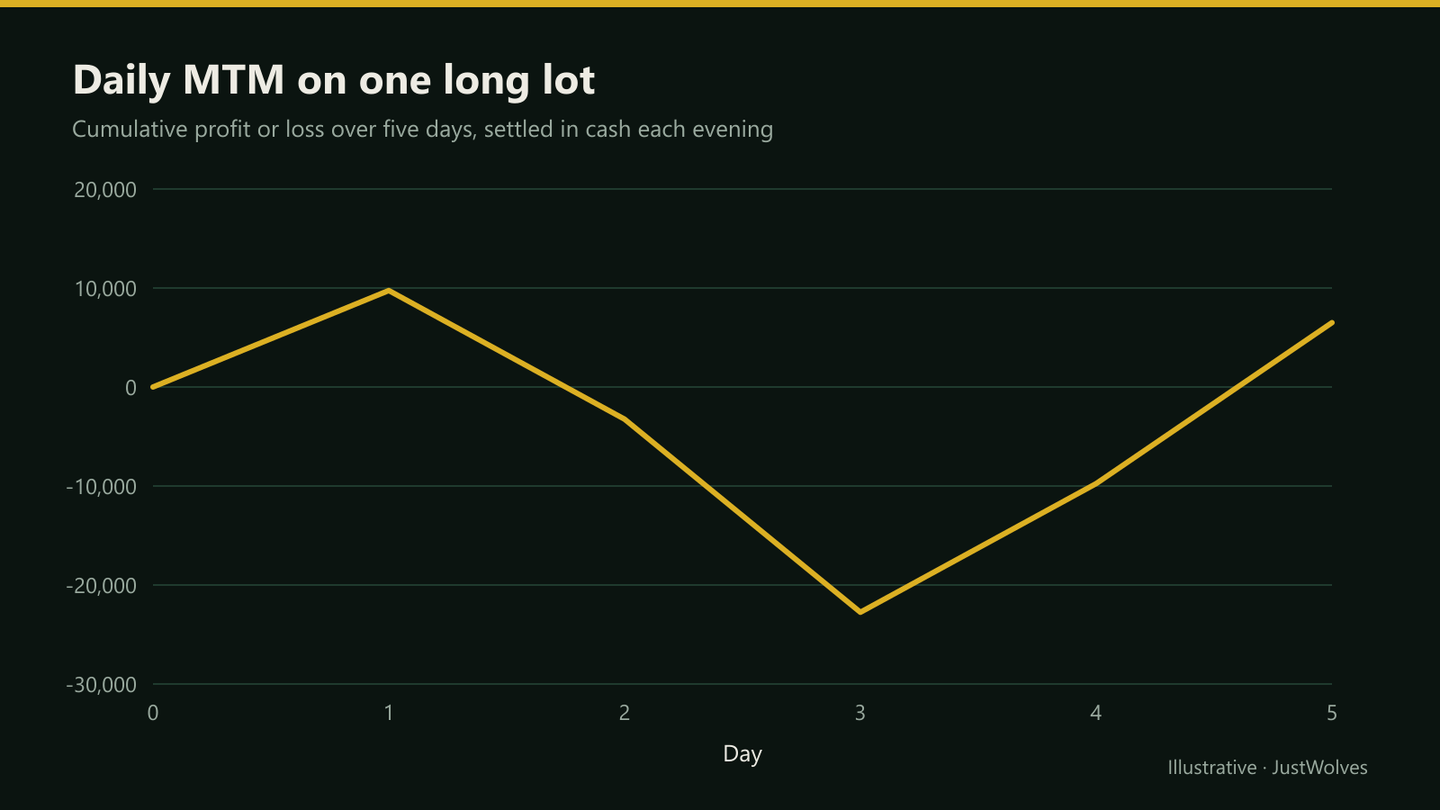
Shalini's example in this lesson uses hypothetical prices. The chart below uses real NIFTY 50 closes from May 2025, a week with unusually large swings in both directions, to show the same daily settlement on one futures lot.
Real data: five days of mark-to-market on one NIFTY lot, May 2025
Step 1 of 5
The position
A trader buys one NIFTY futures lot (65 units) at the close of 8 May 2025, 24,274. Each day the position is marked to market at the settlement price.
- What to observe
- A ₹15.8 lakh exposure.
- Condition
- Watch the daily cash flows.
When Margin Runs Short
MTM losses reduce the funds in your account. If what remains falls below the margin required for your open positions, you have a margin shortfall. You must add funds, typically by the next trading day, or reduce positions.
If you don't, the broker can close your positions, often at an unfavourable time, and shortfalls can attract penalties under exchange rules. In a sharp move, a position can lose more than the entire margin, leaving you owing the broker money.
Margin for Option Sellers
The same margin system applies to anyone who sells options. Because a short option can lose far more than the premium received, the seller must post SPAN and exposure margin much like a futures trader, and the position is valued daily. Option buyers, by contrast, pay the full premium upfront and don't face margin calls on that position.
Combining positions can reduce margin. A short option hedged with a bought option further out, a spread, has a smaller maximum loss than a naked short option, and the SPAN system recognises this with a lower requirement.
Practical Example
Hypothetically, Shalini buys one Nifty futures lot (65 units) at 24,000, with ₹3,00,000 in her account and a margin requirement of about ₹2,20,000. The settlement prices over the next five days are 24,150, 23,950, 23,650, 23,850 and 24,100.
Her daily MTM is +₹9,750, −₹13,000, −₹19,500, +₹13,000 and +₹16,250. On day 3, her cumulative loss is ₹22,750, leaving ₹2,77,250, still above the margin. Had she bought two lots with the same ₹3,00,000, the day-3 loss of ₹45,500 would have left ₹2,54,500 against a requirement of about ₹4,40,000: a large shortfall.
How Big Are Daily MTM Swings? Our Data
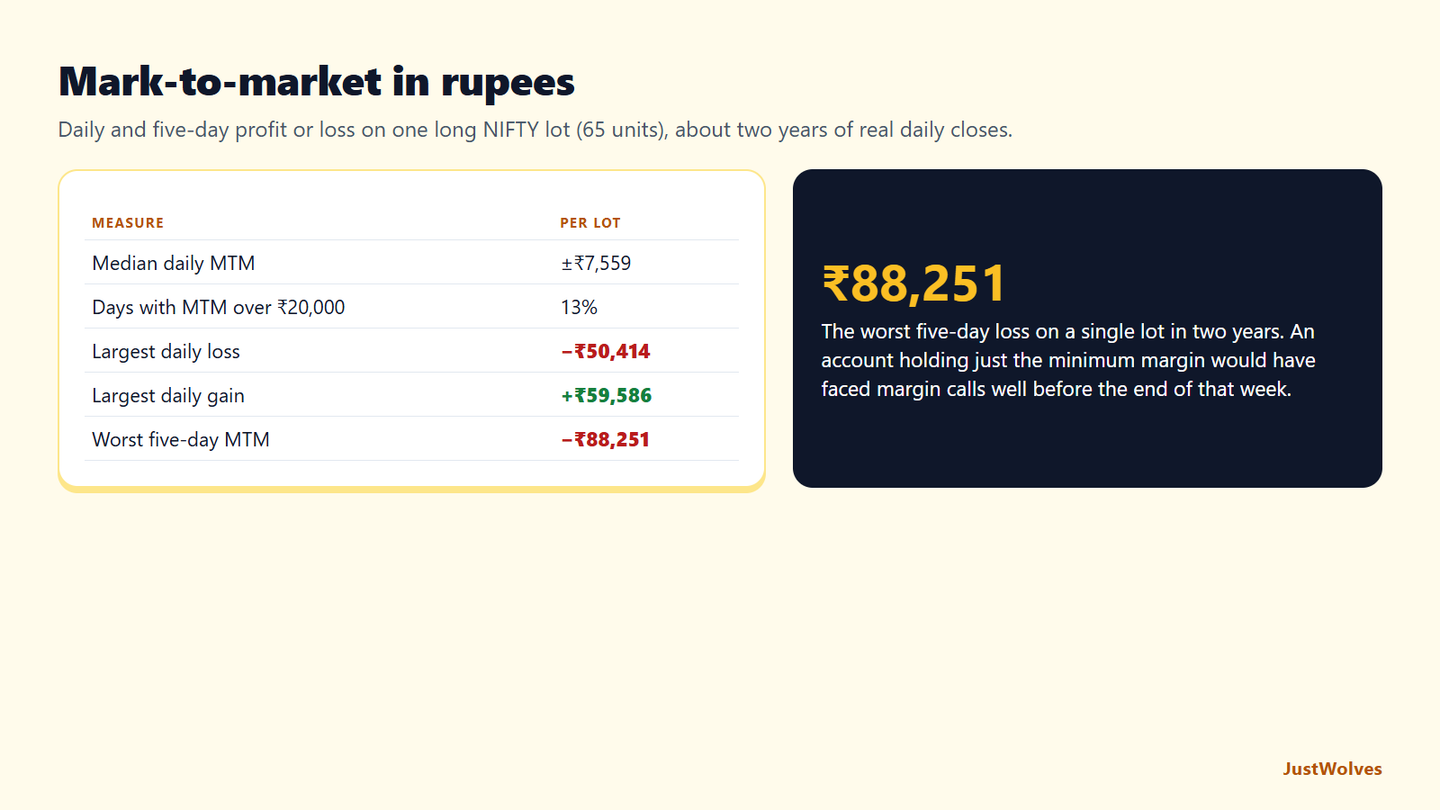
JustWolves calculated the daily mark-to-market on one long NIFTY futures lot of 65 units for every trading day over about two years of real data (November 2024 to November 2026), using index closes as an approximation of settlement prices.
| Measure | Amount per lot |
|---|---|
| Median daily MTM | ±₹7,559 |
| Days with MTM over ₹20,000 either way | 13% (about one day in eight) |
| Largest daily loss | −₹50,414 (19 Mar 2026) |
| Largest daily gain | +₹59,586 (12 May 2025) |
| Worst five-day MTM | −₹88,251 (28 Mar – 7 Apr 2025) |
| Five-day periods losing more than ₹50,000 | 3% |
Compare these with Shalini's numbers. Her buffer above the margin (₹3,00,000 in the account against about ₹2,20,000 required) is about ₹80,000. The worst real five-day MTM on one lot, about ₹88,000, would not quite have fitted: she would have faced a shortfall of roughly ₹8,000, more if margins rose during the fall. With two lots, the worst week would have cost about ₹1.76 lakh, far more than her buffer, and the broker would have required more funds or closed the position.
A day of more than ₹20,000 MTM came about once every eight trading days, so it is not a rare event; and five-day losses of more than ₹50,000 happened in about 3% of all periods. The practical rule from this lesson's professional insight, keeping well over the required margin in the account, has a simple number behind it: at least enough to absorb a bad week on every lot you hold.
| Buffer per lot | Covers | How often it would have been exceeded |
|---|---|---|
| about ₹7,600 | a median day | about half of all days |
| about ₹20,000 | a large day | about one day in eight |
| about ₹50,000 | the worst single day in two years | never, in a single day, in our data |
| about ₹90,000 | the worst five days in two years | never, over five days, in our data |
Choosing a buffer is a decision about which past moves you want to survive without adding money or being forced out. Covering only a median day leaves you exposed on half of all days; covering the worst week in the data is a sensible minimum for anyone holding positions overnight.
Common Mistakes
- Using all available margin, leaving no room for MTM swings.
- Treating margin as the risk, rather than the full contract value.
- Ignoring margin increases during volatile periods.
- Holding through events without extra funds.
- Not checking the next-day funds position after a losing day.
Professional Insight
Professional traders size futures positions from the stop-loss distance and their risk per trade, then check that margin is comfortably available, not the other way round. Many keep well over the required margin in the account so that normal daily swings never force a sale.
Risk Considerations
- Losses can exceed margin.
- Margins can rise suddenly when volatility jumps.
- Forced closures happen at the worst times.
Important Terminology
| Term | Meaning |
|---|---|
| Initial margin | Funds required before opening a futures position. |
| SPAN margin | A risk-based margin estimating the worst likely one-day loss. |
| Exposure margin | An additional margin on top of SPAN. |
| Mark-to-market | Daily cash settlement of gains and losses. |
| Margin shortfall | Funds below the required margin. |
What is futures margin?
A deposit required to hold a futures position, protecting the clearing system against losses.
What is SPAN margin?
A risk-based margin calculated by the clearing corporation to cover the worst likely one-day loss across scenarios.
What is mark-to-market in futures?
The daily settlement of gains and losses in cash, based on that day's settlement price.
What happens if I can't meet a margin call?
Your broker may close positions, and penalties may apply. You remain liable for any losses beyond your funds.
How much margin do I need for Nifty futures?
It changes with volatility. Check your broker's margin calculator for the current requirement.
How much does mark-to-market change on a NIFTY futures lot each day?
In our two years of real data, the median daily MTM on one 65-unit lot was about ±₹7,600, about one day in eight moved more than ₹20,000, and the worst five-day period lost about ₹88,000.
Practical Exercise
Simulate MTM.
Your task
Step 1: Pick a past week
Note Nifty futures closing prices for five days.
Step 2: Assume one long lot
Bought at the first day's close.
Step 3: Calculate daily MTM
Price change × lot size.
Step 4: Check margin
Using today's margin requirement, when would two lots have caused a shortfall?
Check Your Understanding
Futures margin is:
Related Lessons
Previous: Futures Contracts Explained. Next: Contract Specifications. See also Leverage and Margin Risk.