
Option Greeks: Theta, Vega and Rho
JustWolves is an educational platform and is not a SEBI-registered investment advisor. Trading financial instruments involves significant risk of loss and may not be suitable for all investors. Past performance is not indicative of future results. Read our full disclaimer →
What you'll learn
- Theta estimates how much an option loses per day from the passage of time; it's negative for buyers
- Time decay accelerates as expiry approaches, especially for ATM options
- Vega estimates the price change for a one-point change in implied volatility; longer-dated options have more vega
- Rho measures sensitivity to interest rates and is usually small for short-dated options
- An option's daily P&L comes from delta, gamma, theta and vega together
In this article · 16 sections
Delta and gamma describe how an option responds to price. The remaining Greeks describe everything else: theta for the passage of time, vega for changes in implied volatility, and rho for interest rates. Theta and vega in particular explain the two most common frustrations of option buyers: losing money while waiting, and losing money after being right.
What You Will Learn
- What theta measures and how time decay behaves
- What vega measures and how it explains volatility crush
- What rho measures
- How the Greeks combine into daily P&L
Before You Start
Theta: Time Decay
Theta estimates how much an option's price falls per day, with everything else unchanged. It's negative for option buyers and positive for sellers.
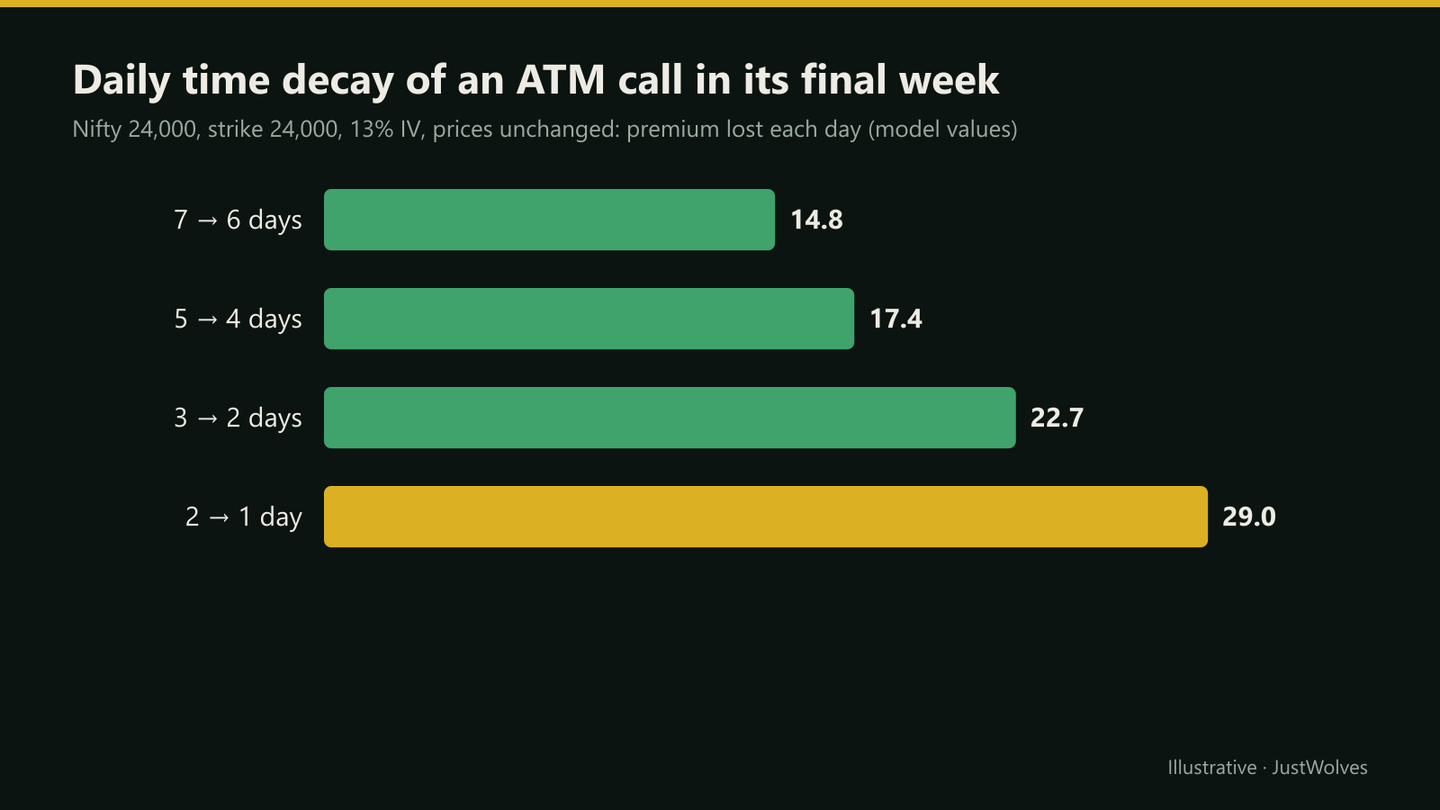
Decay isn't linear. An ATM option loses time value slowly when expiry is far away and much faster in the final days. Deep ITM and far OTM options have less time value, so their theta is smaller.
Vega: Volatility Sensitivity
Vega estimates how much an option's price changes for a one-percentage-point change in implied volatility. Bought options have positive vega: they gain when IV rises and lose when it falls.
Vega is largest for ATM options and grows with time to expiry. A 30-day ATM Nifty call has roughly twice the vega of a 7-day one, so longer-dated options are more exposed to volatility changes.
Rho: Interest Rates
Rho measures sensitivity to interest rates. Higher rates slightly increase call prices and slightly decrease put prices. For weekly and monthly index options, rho is small and rarely matters; it becomes more relevant for long-dated options.
Putting the Greeks Together
| Source | Greek | Helps the buyer when |
|---|---|---|
| Price move | Delta (and gamma) | The underlying moves in the right direction |
| Time passing | Theta | Never; it's a daily cost |
| Volatility change | Vega | Implied volatility rises |
| Interest rates | Rho | Small effect for short-dated options |
An option buyer needs the price move (delta and gamma) to outweigh time decay (theta) and any volatility change (vega). An option seller wants the reverse.
Weekends, Holidays and Theta
Option models count calendar days, so time passes over weekends and market holidays even though no trading happens. In practice, traders anticipate this: premiums on Friday often already reflect part of the weekend's decay.
For buyers of short-dated options, a long weekend can mean a noticeable loss of time value between one session and the next. For sellers, it's part of the theta they collect. Either way, it's worth knowing how many calendar days, not just trading days, remain until expiry.
Real Prices: Right Direction, Still a Loss
The chart below uses real NIFTY 50 prices from late June and early July 2025, with a one-week at-the-money call valued each day by a standard pricing model. It reproduces Aakash's example from this lesson on a real week, including the weekend effect described above.
Real NIFTY prices: right direction, still a loss, July 2025
Step 1 of 4
Buying a week of time
On Wednesday 2 July 2025 NIFTY closes at 25,453. A 25,450 call with seven days left is modelled at about 179 points (₹11,600 per lot), with recent volatility near 11.6%.
- What to observe
- All time value: the strike is at the money.
- Condition
- Watch theta, not just price.
Vega and Expiry Choice
If you expect implied volatility to rise, for example ahead of a known event weeks away, longer-dated options give more exposure to that rise because their vega is larger. If you expect IV to fall, short-dated options are less exposed. Matching expiry to your volatility view is as important as matching strike to your price view, and it is one of the most overlooked decisions in option buying by beginners and experienced traders alike.
Practical Example
Hypothetically, with Nifty at 24,000, Aakash buys a 7-day 24,000 call at ₹186 with theta of about −14 per day and vega of about 13. Over the next two days, Nifty rises 40 points and IV falls from 13% to 12%.
A rough estimate: delta adds about 0.53 × 40 ≈ 21 points, theta takes away about 2 × 15 ≈ 30, and vega takes away about 13. Net, the option is down roughly 22 points, around ₹1,430 per lot, despite Nifty rising.
Does the Price Move Beat Time Decay? Our Test
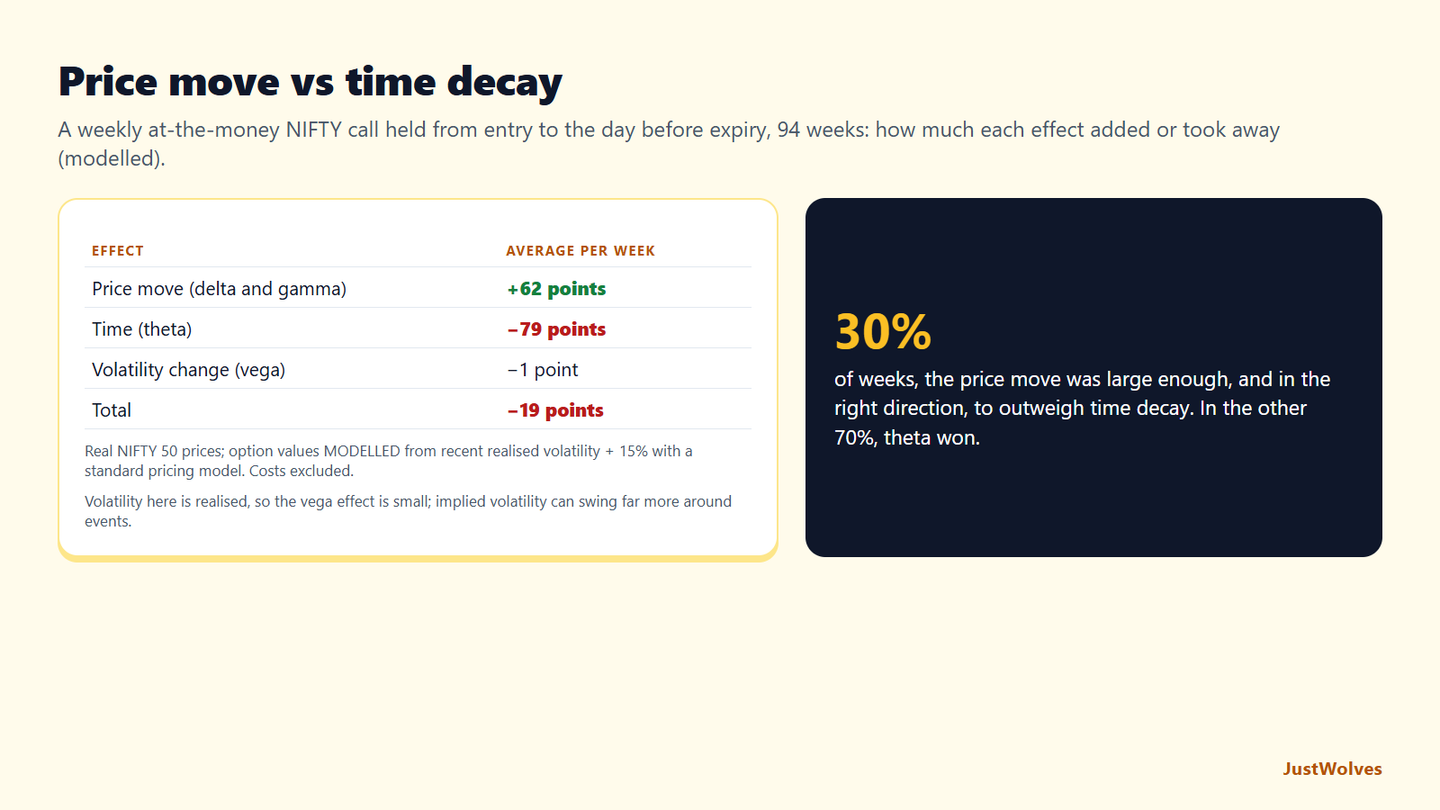
An option buyer needs the price move to outweigh theta and any fall in volatility. JustWolves tested how often that happened on 94 weeks of real NIFTY 50 prices (November 2024 to November 2026). Each week: a call at the money with seven days left, valued at entry and again with one day left, four trading days later. We split the change in its modelled value into three parts: the price move (delta and gamma), the passage of time (theta) and the change in volatility (vega).
| Effect | Average per week | What it measures |
|---|---|---|
| Price move | +62 points | Delta and gamma: the index moving |
| Time | −79 points | Theta: four trading days and the calendar days between |
| Volatility change | −1 point | Vega: change in volatility |
| Total | −19 points | About ₹1,200 per lot per week |
The price effect was positive on average, because a bought option gains more from moves in its favour than it loses from moves against it (gamma). But time decay was larger, about 79 points a week against 62 from price. The price move won in only 30% of weeks, the same share as the profitable weeks in What Is Options Trading?, which is no coincidence: for a buyer, those are the weeks the move was large enough and in the right direction.
The volatility effect was tiny here, but that is a limit of the data, not good news. We used realised volatility, which changes slowly from week to week. Real implied volatility can rise several points before an event and fall just as fast afterwards, and with vega of around 13 points per volatility point on a short-dated at-the-money option, as this lesson's callout shows, that can matter as much as theta. Our dataset does not include historical implied volatility, so treat the vega row as the minimum, not the typical, effect.
Common Mistakes
- Ignoring theta when holding options over weekends and holidays.
- Buying high-vega options right before events.
- Assuming decay is linear.
- Selling options only for theta without respecting gamma risk.
- Overthinking rho on short-dated options.
Professional Insight
Option sellers and buyers are, in effect, trading theta against gamma. Sellers collect theta every day but carry gamma risk; buyers pay theta for gamma's potential. Neither side has a free edge; the outcome depends on whether the actual move is bigger or smaller than the market priced in.
Risk Considerations
- Time decay is relentless for buyers.
- Vega losses can be large after events.
- Sellers' theta income can be wiped out by one large move.
Important Terminology
| Term | Meaning |
|---|---|
| Theta | Price change per day from time passing. |
| Vega | Price change per one-point change in IV. |
| Rho | Price change per change in interest rates. |
| Time decay | The loss of extrinsic value over time. |
| Volatility crush | A sharp fall in IV after an event. |
What is theta in options?
The estimated amount an option's price falls per day from the passage of time, all else equal.
Why does time decay speed up near expiry?
The remaining time value of an ATM option shrinks faster as fewer days remain for a move.
What is vega?
The estimated change in an option's price for a one-point change in implied volatility.
Does theta work on weekends?
Calendar time passes over weekends and holidays, so option prices usually reflect that decay around those days.
Does rho matter for Nifty weekly options?
Very little; it matters more for long-dated options.
Which Greek matters most for an option buyer?
For short-dated options, theta and delta usually dominate: the buyer needs the price move (delta) to outweigh daily decay (theta). Around scheduled events, vega can matter as much, because implied volatility can fall sharply once the news is out.
How much time decay does a weekly NIFTY option lose?
In our test on real NIFTY prices with modelled values, a weekly at-the-money call lost about 79 points to time decay between entry and the day before expiry, more than the 62 points it gained from price moves on average.
Practical Exercise
Decompose a P&L.
Your task
Step 1: Pick an ATM option
Note its price, delta, theta and vega today.
Step 2: Record tomorrow
The new option price, Nifty move and IV change.
Step 3: Estimate
Delta × move, plus theta, plus vega × IV change.
Step 4: Compare
How close was the estimate to the actual change?
Check Your Understanding
For an option buyer, theta is:
Related Lessons
Previous: Option Greeks: Delta and Gamma. Next: How to Read an Option Payoff Diagram.