
NSE Contract Rules and SEBI F&O Regulations
JustWolves is an educational platform and is not a SEBI-registered investment advisor. Trading financial instruments involves significant risk of loss and may not be suitable for all investors. Past performance is not indicative of future results. Read our full disclaimer →
What you'll learn
- SEBI's October 2024 circular raised index contract sizes, limited weekly expiries and tightened expiry-day margins
- Option buyers must pay the full premium upfront; calendar-spread margin benefits don't apply to expiring contracts on expiry day
- Position limits for index derivatives are monitored intraday, and open interest is measured on a delta-adjusted (FutEq) basis
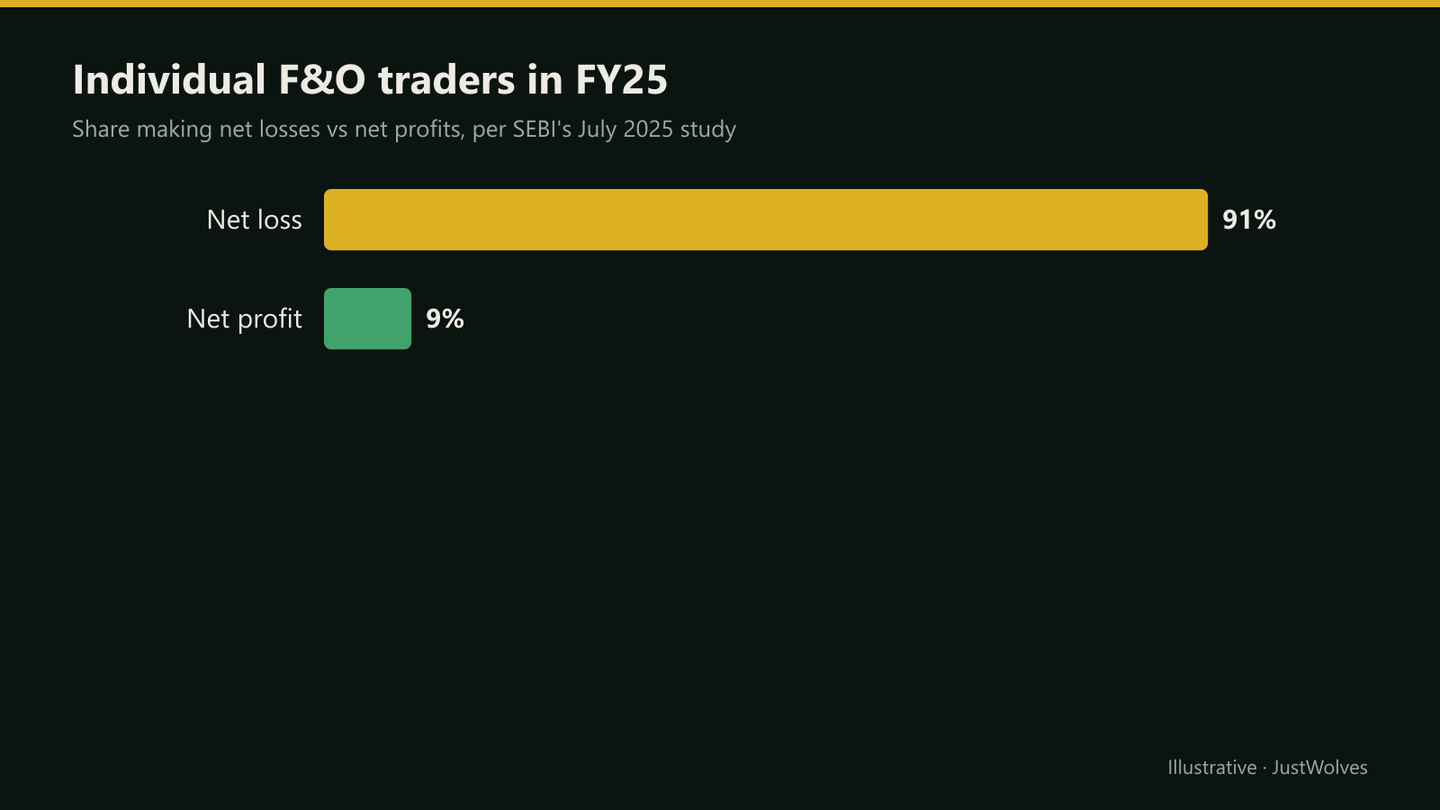
- SEBI's July 2025 study found that about 91% of individual traders in equity F&O made net losses in FY25
- Rules change; check SEBI circulars and NSE notices for the current position
In this article · 15 sections
Derivatives trading in India runs inside a framework set by SEBI and implemented by the exchanges. Between late 2024 and late 2025, SEBI introduced a series of measures aimed at reducing excessive speculation in index options, especially on expiry days. This lesson summarises the rules that most affect retail traders, and what SEBI's own research says about outcomes.
What You Will Learn
- The main SEBI measures on index derivatives since 2024
- How they affect margins, expiries and contract sizes
- Position limits and open interest measurement
- What SEBI's studies found about trader outcomes
Before You Start
Read Contract Specifications and Settlement, Exercise, Assignment and STT first.
The October 2024 Measures
SEBI's circular of 1 October 2024, on strengthening the equity index derivatives framework, introduced six measures in phases:
| Measure | What changed | Effective |
|---|---|---|
| Minimum contract size | Index derivative contracts set at about ₹15 lakh minimum on introduction, kept roughly in a ₹15–20 lakh band through lot-size reviews | 20 November 2024 |
| Weekly expiries | Each exchange offers weekly index options on only one benchmark index | 20 November 2024 |
| Expiry-day tail risk margin | Additional extreme loss margin on short options on expiry day | 20 November 2024 |
| Upfront premium | Option buyers' premium collected upfront by brokers | 1 February 2025 |
| Calendar spreads on expiry day | No margin benefit for spreads involving contracts expiring that day | 1 February 2025 |
| Intraday position monitoring | Position limits for index derivatives monitored during the day, not just at the close | 1 April 2025 |
Later Changes
- Expiry days: NSE moved its equity derivatives expiries to Tuesdays from 1 September 2025.
- Future-equivalent open interest: SEBI's circular of 29 May 2025 changed how open interest is measured for position limits and market-wide limits, using delta-adjusted ('future equivalent', or FutEq) positions across futures and options rather than notional values.
- Pre-open session: the same circular introduced a pre-open session for equity derivatives, from December 2025, to support price discovery and rollovers.
What It Means for Retail Traders
- Bigger minimum trade size: one lot of Nifty is worth roughly ₹15 lakh or more, so even one lot is a large position for small accounts.
- Fewer weekly expiries: on NSE, only Nifty has weekly options; Bank Nifty and other indices are monthly.
- More capital for selling on expiry day: extra margin and no calendar-spread relief.
- Buyers can't use leverage on premium: the full premium must be available upfront.
Real Prices: What One Lot Does to a Small Account
SEBI's larger contract sizes are easiest to understand in rupees. The chart below uses real NIFTY 50 prices from March and April 2026, a volatile stretch but not an extreme one, and converts each move into the gain or loss on one lot of 65 against a ₹2 lakh account like Ankit's in this lesson's example.
Real NIFTY prices: one lot's swings against a ₹2 lakh account, March–April 2026
Step 1 of 4
Two bad days
On 27 and 30 March 2026 NIFTY falls about 487 and 488 points. For one lot of 65, each day costs about ₹31,700: together about ₹63,400, nearly a third of a ₹2 lakh account like Ankit's in this lesson.
- What to observe
- Two ordinary sessions of a volatile month.
- Condition
- One lot is not a small position.
Stock F&O and the Ban Period
For individual stocks in the F&O segment, exchanges set a market-wide position limit. When open interest in a stock approaches that limit, the stock enters a ban period: traders may only reduce existing positions, not open new ones, until open interest falls back. Exchanges publish the list of stocks in the ban period daily.
What SEBI's Studies Found
SEBI has published several studies of individual traders' results in equity derivatives. Its study released in July 2025 found that about 91% of individual traders in equity F&O made net losses in FY25, with aggregate net losses of roughly ₹1.06 lakh crore after transaction costs.
These findings were a major reason for the measures above. They're also the most important context for anyone starting in F&O: the typical outcome for individual traders has been a loss.
Practical Example
Hypothetically, Ankit has ₹2,00,000 and wants to trade Nifty options on expiry days by selling OTM options. Under the current rules, one lot carries roughly ₹15 lakh of exposure, expiry-day margins on short options are higher, and his margin can't benefit from calendar spreads with the expiring contract.
He realises that his account would be fully committed to a single short position, with losses that could exceed his capital on a sharp move. He decides to learn with defined-risk spreads in small size, and to start with the Risk Management course.
How Large Is One Lot Now? Our Data
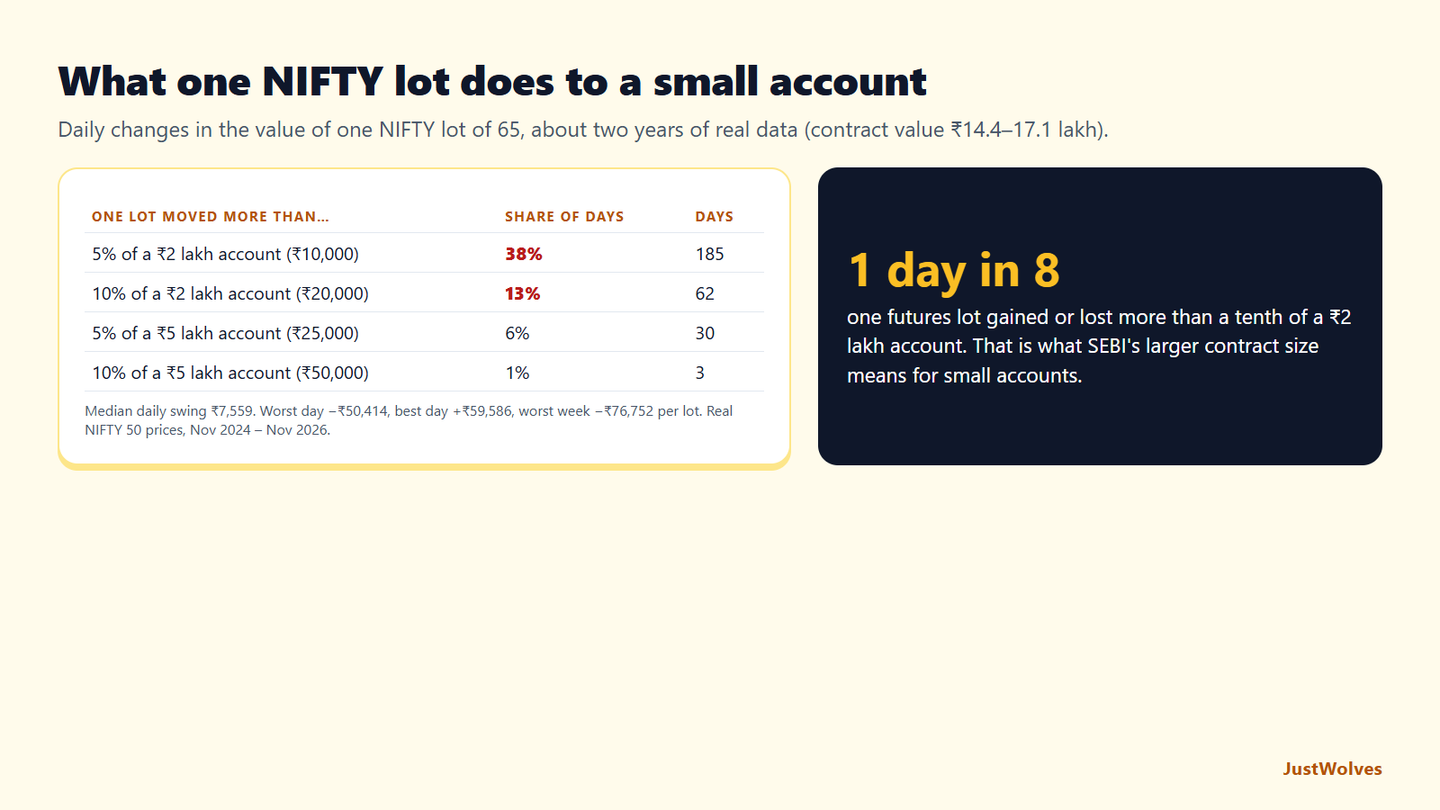
JustWolves measured every daily change in the value of one NIFTY lot of 65 over about two years of real prices (November 2024 to November 2026), and compared it with two account sizes. Over the period, one lot was worth between about ₹14.4 lakh and ₹17.1 lakh, in line with the contract size SEBI's October 2024 circular set.
| One lot moved more than… | Share of days | Days |
|---|---|---|
| 5% of a ₹2 lakh account (₹10,000) | 38% | 185 |
| 10% of a ₹2 lakh account (₹20,000) | 13% | 62 |
| 5% of a ₹5 lakh account (₹25,000) | 6% | 30 |
| 10% of a ₹5 lakh account (₹50,000) | 1% | 3 |
For a ₹2 lakh account, one NIFTY futures lot or one short option position moved more than 10% of the account on about one day in eight, and more than 5% on more than a third of days. A trader risking 1–2% per trade, as the Risk Management course recommends, simply cannot hold a full lot with a stop on most days; the normal daily swing, about ₹7,600, is already close to 4% of the account. With ₹5 lakh, the same lot crossed 10% of the account on only three days in two years.
This is the practical effect of the rules in this lesson. SEBI's measures raised the minimum trade size and the margin for expiry-day selling, partly in response to its own finding that about 91% of individual F&O traders lost money. For small accounts, the realistic choices are defined-risk structures sized in rupees, such as bought options and debit spreads, or waiting until the account is large enough for one lot to be a normal position. That is the conclusion Ankit reaches in this lesson's example, and our numbers support it.
Common Mistakes
- Relying on old lot sizes or expiry days.
- Assuming spread margin benefits apply on expiry day.
- Ignoring the ban list for stock F&O.
- Believing rules no longer matter once a broker accepts the order.
- Overlooking SEBI's findings on typical outcomes.
Professional Insight
Professional traders treat regulatory changes as part of the market: they re-check margins, contract sizes and expiries whenever a circular takes effect, and adjust strategies that depended on the old rules. Strategies built around very cheap expiry-day leverage have been the most affected.
Risk Considerations
- Rules change with relatively short notice.
- Large contract sizes concentrate risk in small accounts.
- Most individual traders lose money, according to SEBI's studies.
Important Terminology
| Term | Meaning |
|---|---|
| SEBI circular | A formal regulatory instruction from SEBI. |
| Extreme loss margin | An additional margin layer above SPAN. |
| FutEq | Future-equivalent, delta-adjusted open interest. |
| Ban period | A period when no new positions are allowed in a stock's F&O. |
| Market-wide position limit | The cap on total open interest in a stock's derivatives. |
What are SEBI's new F&O rules?
Measures from October 2024 onward: larger contract sizes, one weekly index expiry per exchange, upfront premium collection, higher expiry-day margins, no calendar-spread benefit on expiry day, and intraday position monitoring.
Why did SEBI change F&O rules?
Its studies showed most individual traders lose money, with heavy speculation in short-dated index options.
Which index has weekly options on NSE?
Only the Nifty 50, as of November 2026.
What is an F&O ban period?
When a stock's derivatives open interest nears the market-wide limit, new positions are barred until it falls back.
How many F&O traders lose money?
SEBI's July 2025 study found about 91% of individual traders in equity F&O made net losses in FY25.
How much can one NIFTY lot gain or lose in a day?
In our two years of real NIFTY data with a lot of 65, the median daily swing was about ₹7,600, the worst day lost about ₹50,400 and the best gained about ₹59,600. The worst week lost about ₹76,800 per lot.
Can I trade NIFTY futures with ₹2 lakh?
Brokers may allow it if margin is available, but one lot moved more than 10% of a ₹2 lakh account on about 13% of trading days in our data. With such an account, defined-risk option structures sized in rupees are usually a more realistic way to learn.
Practical Exercise
Check the current rules.
Your task
Step 1: Visit NSE
Note current lot sizes and the next expiries for Nifty and Bank Nifty.
Step 2: Check the ban list
Which stocks are in the F&O ban period today?
Step 3: Check margins
Your broker's margin for one short ATM Nifty option on a non-expiry day and on expiry day.
Step 4: Read SEBI's latest study
Summary of trader outcomes.
Check Your Understanding
Under SEBI's 2024 measures, each exchange may offer weekly options on:
Related Lessons
Previous: Settlement, Exercise, Assignment and STT. Next: F&O Risk Management.