
Contract Specifications: Lot Size, Tick Size and Expiry
JustWolves is an educational platform and is not a SEBI-registered investment advisor. Trading financial instruments involves significant risk of loss and may not be suitable for all investors. Past performance is not indicative of future results. Read our full disclaimer →
What you'll learn
- Every exchange-traded derivative has fixed specifications: underlying, lot size, tick size, expiry and settlement
- From the January 2026 series, the Nifty 50 lot is 65 units and the Nifty Bank lot is 30 units
- Lot sizes are periodically revised to keep contract values in a band set under SEBI rules
- Nifty 50 has weekly and monthly contracts expiring on Tuesdays; Nifty Bank has monthly contracts only
- Specifications change, so always check NSE's current contract specifications before trading
In this article · 16 sections
Before trading any futures or options contract, you need to know exactly what you're trading: how many units one contract covers, the smallest price step, when it expires and how it settles. These are the contract specifications. This lesson explains each one using the main Indian index contracts, and shows how to calculate what a position is really worth.
What You Will Learn
- The main parts of a contract specification
- Current lot sizes for the main index contracts
- How tick size and contract value work
- Expiry schedules for weekly and monthly contracts
Before You Start
Read Futures Margin and Mark-to-Market Settlement first.
The Parts of a Specification
| Specification | Meaning |
|---|---|
| Underlying | The index or stock the contract is based on |
| Lot size | The number of units in one contract |
| Tick size | The smallest allowed price change |
| Expiry | The date the contract ends |
| Settlement | Cash or physical delivery at expiry |
| Strike interval (options) | The gap between available strike prices |
Lot Size and Contract Value
You can only trade whole lots. From the January 2026 contract series, NSE set the Nifty 50 lot at 65 units (previously 75) and the Nifty Bank lot at 30 units (previously 35).
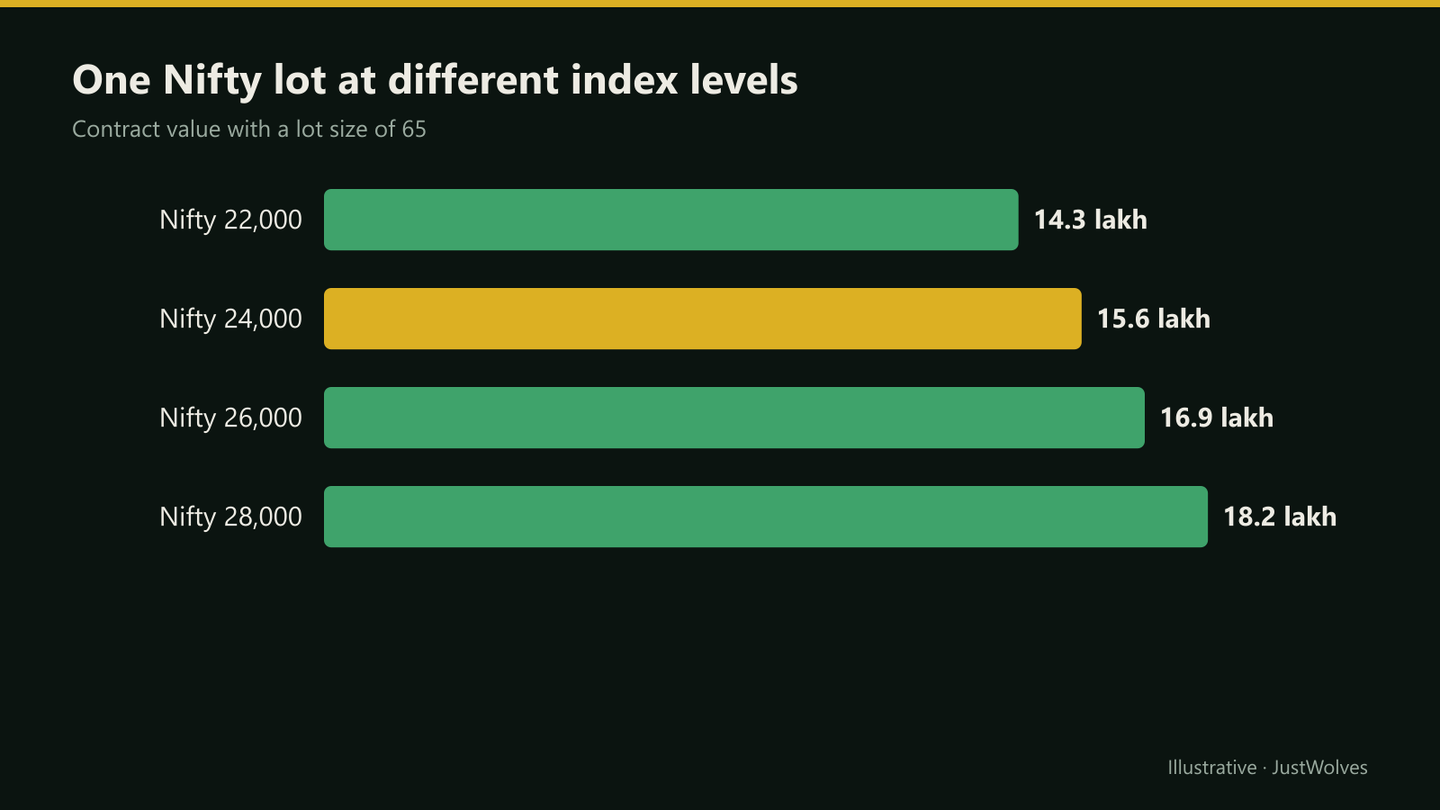
Contract value = index level × lot size. At a Nifty level of 24,000, one lot is worth 24,000 × 65 = ₹15,60,000. Under SEBI's framework for index derivatives, lot sizes are set so that contract values at review sit roughly in a ₹15–20 lakh range, so lot sizes change as index levels move.
Real Data: Three Days of NIFTY in Rupees per Lot
The chart below uses real hourly NIFTY 50 data for 4–6 November 2026. Step through it to translate index points into rupees on one 65-unit lot, the habit this lesson's professional insight recommends.
Real data: three days of NIFTY, point by point and rupee by rupee, 4–6 November 2026
Step 1 of 3
An ordinary session
On Wednesday 4 November 2026, NIFTY trades between 23,737 and 23,961: a 224-point range, close to the median day in our data. On one lot of 65 units, that range is worth about ₹14,500.
- What to observe
- One point = ₹65 per lot.
- Condition
- A ₹10,000 risk limit allows a stop of about 154 points on one lot.
Tick Size
The tick size is the minimum price step. Nifty options trade in steps of ₹0.05. For index futures, NSE uses a tiered tick size that depends on the index level; check the current table on NSE's website.
Your profit or loss per tick is the tick size × lot size. On a Nifty option, one ₹0.05 tick on one lot is 0.05 × 65 = ₹3.25.
Expiry Schedule
| Contract | Weekly options | Monthly contracts | Expiry day |
|---|---|---|---|
| Nifty 50 | Yes | Yes | Tuesday (monthly: last Tuesday of the month) |
| Nifty Bank | No | Yes | Last Tuesday of the month |
Under SEBI rules introduced in November 2024, each exchange offers weekly index options on only one benchmark index. On NSE, that's the Nifty 50. If an expiry day is a trading holiday, the expiry moves to the previous trading day.
Stock Contracts
Stock futures and options have their own lot sizes, set per stock and revised periodically, and expire monthly. Unlike index contracts, they're physically settled if held to expiry, as covered in Futures Contracts Explained.
Strike Intervals and Contract Months
Options are listed at a range of strike prices spaced at fixed intervals, for example every 50 points for Nifty near the current level, with wider spacing further away. NSE adds new strikes as the index moves, so there are always strikes near the current price.
Exchanges also list several expiries at once: for Nifty, a number of weekly expiries plus monthly and longer-dated contracts. Liquidity is usually concentrated in the nearest expiries and the strikes closest to the current price, which matters when you need to enter or exit quickly.
Practical Example
Hypothetically, Nifty is at 24,200 and Bank Nifty at 52,000. One Nifty lot is worth 24,200 × 65 = ₹15,73,000; one Bank Nifty lot is worth 52,000 × 30 = ₹15,60,000.
A 1% move is about ₹15,730 on the Nifty lot and ₹15,600 on the Bank Nifty lot. Mohan, who risks ₹10,000 per trade, sees that a stop more than about 154 Nifty points away would exceed his risk with even one lot (₹10,000 ÷ 65 ≈ 154 points).
What One Lot Means in Real Moves: Our Data
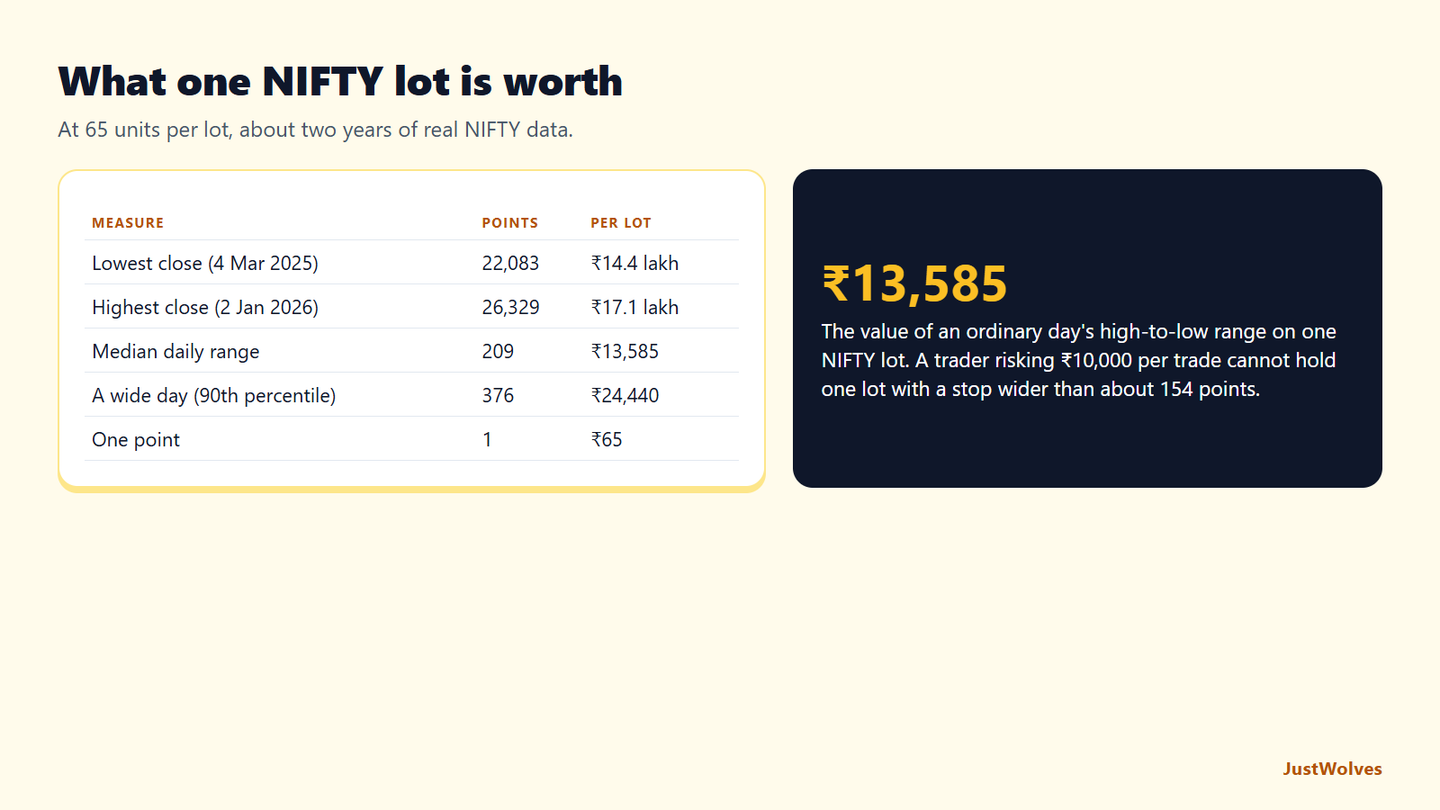
JustWolves measured about two years of real daily NIFTY 50 data (November 2024 to November 2026) and expressed it in terms of one lot at the current size of 65 units.
| Measure | Index points | Per lot |
|---|---|---|
| Lowest close (4 March 2025) | 22,083 | contract value ₹14.4 lakh |
| Highest close (2 January 2026) | 26,329 | contract value ₹17.1 lakh |
| Median daily high-to-low range | 209 | ₹13,585 |
| A wide day (90th percentile range) | 376 | ₹24,440 |
| Widest day in six months of hourly data (6 Nov 2026) | 642 | ₹41,730 |
Two points connect to this lesson. Contract values stayed close to the ₹15–20 lakh band but not always inside it: at the March 2025 low, a 65-unit lot would have been worth about ₹14.4 lakh. That is why exchanges review lot sizes periodically, and why you should use the current specification rather than a remembered one.
An ordinary day's range is already larger than many traders' risk per trade. The median daily range on one lot, about ₹13,600, is more than Mohan's ₹10,000 risk limit in the example below. A trader with that limit cannot hold even one lot with a stop wider than about 154 points, and a normal day's range is 209. For small accounts, that is the strongest argument for smaller instruments, spreads with defined risk, or simply waiting until the account can carry the contract.
| Move | Per lot |
|---|---|
| One index point | ₹65 |
| One option tick (₹0.05) | ₹3.25 |
| 50 points (one strike interval near the money) | ₹3,250 |
| 100 points | ₹6,500 |
| Median daily range in our data (209 points) | about ₹13,600 |
Keep conversions like these next to your order screen. Before every trade, turn the stop distance into rupees per lot, compare it with your risk per trade, and only then decide how many lots, if any, the account can carry. Recalculate whenever the exchange changes the lot size.
Common Mistakes
- Using an old lot size in calculations.
- Confusing weekly and monthly expiries.
- Forgetting that holiday weeks move expiry days.
- Ignoring physical settlement for stock contracts.
- Calculating risk on premium or margin instead of contract value.
Professional Insight
Experienced traders start every position calculation with the contract value and the value of one point. Knowing that one Nifty point is worth ₹65 per lot makes it immediately obvious whether a stop is affordable.
Risk Considerations
- Large contract values make even one lot a big position for small accounts.
- Specification changes can catch out automated strategies.
- Expiry-day volatility is covered in 06.05.
Important Terminology
| Term | Meaning |
|---|---|
| Lot size | Units per contract. |
| Contract value | Price × lot size. |
| Tick size | The minimum price change. |
| Expiry | The last day of the contract. |
| Point value | Rupees per one-point move per lot (equal to the lot size for index contracts). |
What is the Nifty lot size?
65 units, from the January 2026 contract series. Lot sizes are revised periodically, so check NSE's current specifications.
What is the Bank Nifty lot size?
30 units, from the January 2026 contract series.
When do Nifty options expire?
Weekly contracts expire on Tuesdays; the monthly contract expires on the last Tuesday of the month. Holidays move expiry to the previous trading day.
Does Bank Nifty have weekly options?
No. Since November 2024, NSE offers weekly options only on the Nifty 50; Bank Nifty has monthly contracts.
Why do lot sizes change?
To keep contract values within the range set under SEBI's framework as index levels move.
How do I work out the rupee value of a NIFTY move?
Multiply the number of index points by the lot size. At 65 units per lot, each NIFTY point is worth ₹65, so a 100-point move is ₹6,500 per lot and a 209-point day, the median range in our data, is about ₹13,600. For options, multiply the change in premium by 65 in the same way.
How much does one NIFTY lot move in a day?
In our two years of real data, NIFTY's median daily high-to-low range was about 209 points, worth about ₹13,600 on one 65-unit lot. A wide day (the top 10%) was 376 points or more, about ₹24,400.
Practical Exercise
Build a contract sheet.
Your task
Step 1: Open NSE's specifications
For Nifty 50 and Nifty Bank.
Step 2: Record
Current lot size, tick size and next three expiries for each.
Step 3: Calculate
Contract value and rupee value of one point at today's level.
Step 4: Size
With your risk per trade, what's the widest stop you could use with one lot?
Check Your Understanding
Contract value equals:
Related Lessons
Previous: Futures Margin and Mark-to-Market Settlement. Next: What Is Options Trading?. See also NSE Contract Rules and SEBI F&O Regulations.