
Long Straddle and Long Strangle
JustWolves is an educational platform and is not a SEBI-registered investment advisor. Trading financial instruments involves significant risk of loss and may not be suitable for all investors. Past performance is not indicative of future results. Read our full disclaimer →
What you'll learn
- A long straddle buys a call and a put at the same strike; a long strangle buys an OTM call and an OTM put
- Both profit from a large move in either direction; maximum loss is the total premium paid
- Breakevens are the strike(s) plus and minus the total premium
- The strangle is cheaper but needs a bigger move
- Both suffer from time decay and falling implied volatility, so entry timing and IV matter
In this article · 15 sections
Sometimes you expect a big move but don't know which way. A long straddle or strangle buys both a call and a put, so a large move in either direction can pay off. The catch is cost: you pay two premiums, both decaying, and the move has to be big enough to cover them. This lesson explains both strategies, their breakevens, and the role implied volatility plays.
What You Will Learn
- How long straddles and strangles are built
- Breakevens and maximum loss
- How the two compare
- Why IV and timing decide the outcome
Before You Start
The Structures
| Long straddle | Long strangle | |
|---|---|---|
| Legs | Buy 24,000 call (₹418) + buy 24,000 put (₹300) | Buy 24,300 call (₹275) + buy 23,700 put (₹184) |
| Total premium | ₹718 | ₹459 |
| Lower breakeven | 23,282 | 23,241 |
| Upper breakeven | 24,718 | 24,759 |
| Maximum loss | ₹718, at 24,000 | ₹459, between 23,700 and 24,300 |
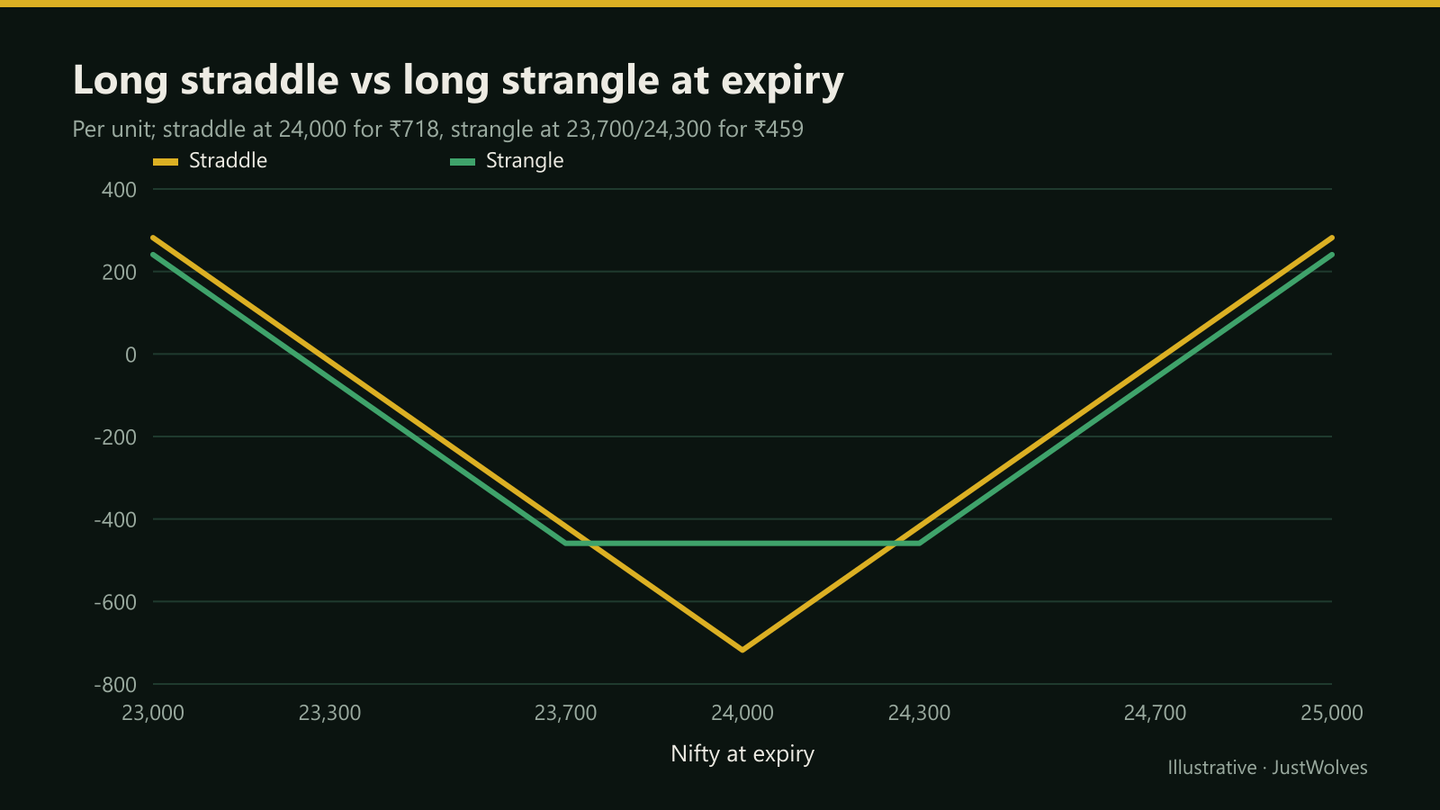
Straddle vs Strangle
- Straddle: more expensive, but starts gaining as soon as the price moves away from the strike.
- Strangle: cheaper and loses less if nothing happens, but needs a larger move to profit.
- Both have open-ended profit potential, larger on the upside, and a maximum loss equal to the premium paid.
IV and Timing
These strategies are long vega: they benefit when implied volatility rises and suffer when it falls. Ahead of known events, IV is usually already elevated, so the options are expensive. After the event, IV typically drops sharply, which can make the position lose value even after a decent move.
That's the central problem with event straddles: the market already prices in an expected move. You profit only if the actual move is larger than what the premium implies.
Managing the Position
- Exit both legs together once the move happens, rather than waiting for expiry.
- Time stop: if no move comes within a set period, exit before decay accelerates.
- Avoid legging out on hope; closing one leg turns the position into a directional bet.
Real Prices: Quiet Weeks, Then a Breakout
The chart below follows a 30-day NIFTY straddle through real prices from October and November 2026, with its value modelled each day. It shows both halves of this lesson: the early gain, the decay while nothing happens, and the large payoff when the move finally arrives. It is the best of the 91 entries in our test, chosen to show the payoff, not as a typical result.
Real NIFTY prices: a long straddle through a quiet patch and a breakout, October–November 2026
Step 1 of 4
Buying the straddle
On 12 October 2026 NIFTY closes at 22,363. A trader buys the 22,350 call and put expiring on 12 November, modelled at 807 points together (₹52,455 per lot), with volatility near 15%. Breakevens at expiry: about 21,543 and 23,157.
- What to observe
- NIFTY must move about 800 points either way by expiry just to break even.
- Condition
- The lower breakeven is below this chart's range.
Choosing Between Them
A straddle suits a view that a large move is likely and imminent, because it starts gaining as soon as price leaves the strike. A strangle suits a view that a very large move is possible but less certain, accepting a wider dead zone in exchange for a lower cost.
Expiry matters too. Short-dated straddles are cheap but decay fast; longer-dated ones cost more but give the move time to happen. Many traders prefer at least two to four weeks to expiry so that a slow start doesn't destroy the position before the expected move arrives.
Practical Example
Hypothetically, with Nifty at 24,000 and IV at 13%, Harish expects a breakout from a long range but doesn't know the direction. He buys a 30-day straddle for ₹718 per unit, ₹46,670 per lot. The expected move implied by 13% IV over 30 calendar days (about 21 trading days) is roughly 900 points, while his breakevens are 718 points away.
Ten days later, Nifty is still at 24,000 and the straddle is worth about ₹585, a loss of ₹8,645 per lot from time decay alone. He exits on his time stop. If Nifty had instead jumped to 24,700 by that point, the straddle would have been worth about ₹890, a gain of about ₹11,180.
Is the Move Big Enough? Our Two-Year Test
This lesson's callout says a straddle is a bet that the real move will be bigger than the one priced in. JustWolves tested that on about two years of real NIFTY 50 prices (November 2024 to November 2026). Each week we bought an at-the-money straddle and a strangle 300 points either side, with about 30 days to expiry and values modelled from recent volatility. We compared the results at expiry and when closed after 5 or 10 trading days; 91 entries in all.
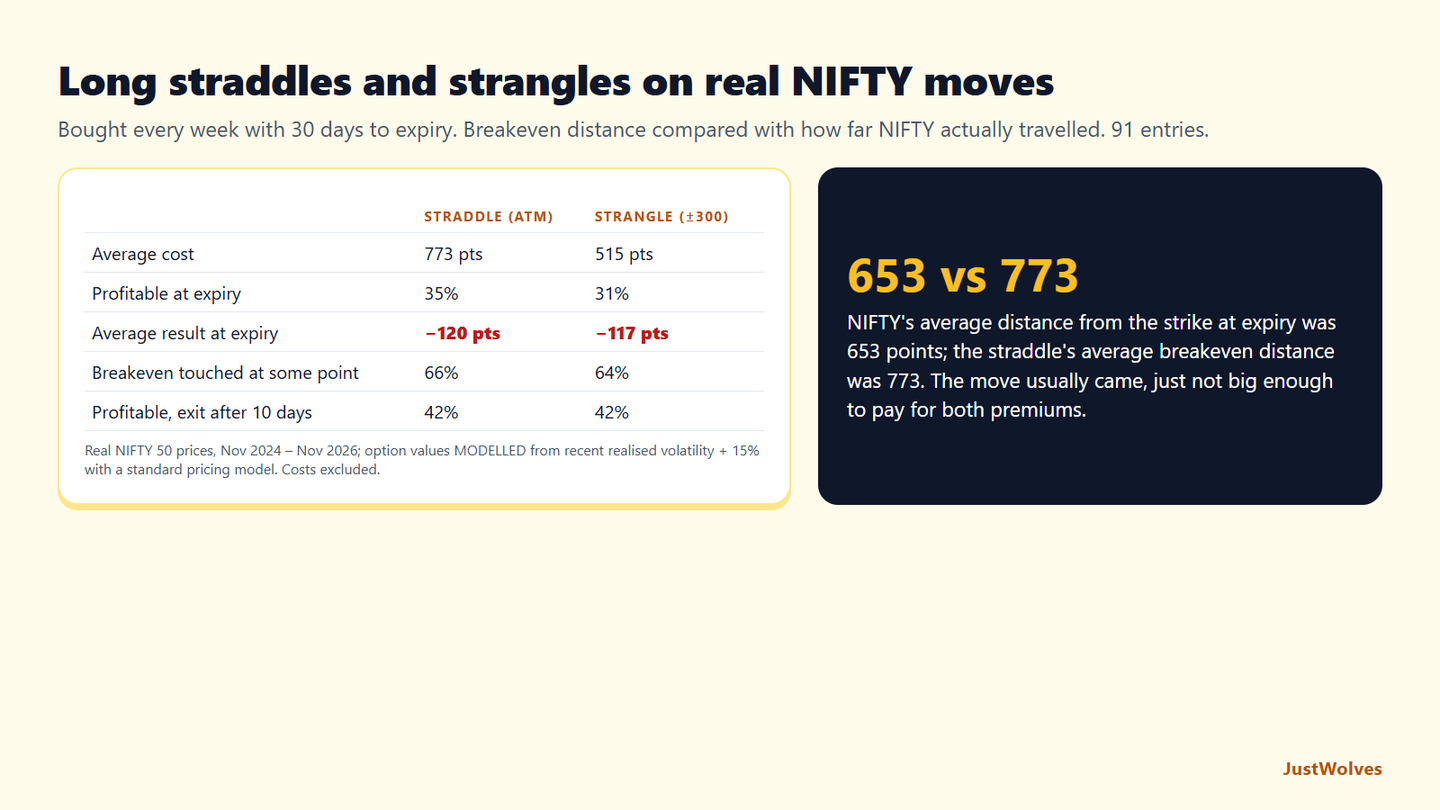
| Straddle (ATM) | Strangle (±300) | |
|---|---|---|
| Average cost | 773 points | 515 points |
| Profitable at expiry | 35% | 31% |
| Average result at expiry | −120 points | −117 points |
| Breakeven touched at some point before expiry | 66% | 64% |
| Profitable when closed after 10 trading days | 42% | 42% |
| Average result when closed after 10 trading days | −40 points | −41 points |
Both strategies lost money in about two-thirds of entries held to expiry. On average, NIFTY finished 653 points from the strike, a real move, but the straddle's breakeven was 773 points away. The strangle was cheaper but needed a bigger move, so it did no better. This is the central problem in this lesson's section on IV and timing: the premium already prices in the expected move, and buyers profit only when the real move is larger.
The move often came, but not at expiry. NIFTY touched a breakeven at some point before expiry in about two-thirds of entries, roughly twice as often as it finished beyond one. That supports this lesson's management advice: exit both legs once the move happens rather than waiting for expiry. Closing after 10 trading days lifted the share of profitable trades from 35% to 42% and cut the average loss to about a third.
One limitation matters here. Our model prices options from recent realised volatility, so it cannot show event effects: in the market, implied volatility rises before results or policy announcements and falls sharply afterwards. That IV crush would make event straddles look worse than this test, which is why this lesson warns against buying them just before scheduled events.
Common Mistakes
- Buying straddles just before events when IV is at its peak.
- Holding through quiet periods while both legs decay.
- Ignoring the cost of two premiums.
- Closing the profitable leg and hoping on the other.
- Sizing as if the loss were small; the whole premium can be lost.
Professional Insight
Professionals buy straddles and strangles mainly when they think implied volatility is too low relative to the likely move, for example after a long quiet period when IV has compressed. They're betting on volatility, not on an event headline.
Risk Considerations
- Double time decay if the market stays quiet.
- IV crush after events.
- The entire premium can be lost.
Important Terminology
| Term | Meaning |
|---|---|
| Long straddle | Buying a call and a put at the same strike. |
| Long strangle | Buying an OTM call and an OTM put. |
| Long vega | A position that gains when IV rises. |
| Breakevens | Strike(s) ± total premium. |
| IV crush | A sharp fall in IV after an event. |
What is a long straddle?
Buying a call and a put at the same strike and expiry to profit from a large move in either direction.
What is the difference between a straddle and a strangle?
A straddle uses the same strike for both options; a strangle uses an OTM call and an OTM put, which is cheaper but needs a larger move.
When does a long straddle lose money?
When the underlying doesn't move beyond the breakevens, or when IV falls enough to offset the move.
Should I buy a straddle before results?
Only if you expect a move larger than the one already priced in; IV is usually high before results and falls afterwards.
What is the maximum loss on a long strangle?
The total premium paid for both options.
How often does a long straddle make money?
In our test of 30-day at-the-money NIFTY straddles on two years of real prices with modelled premiums, 35% were profitable at expiry and 42% when closed after 10 trading days. Costs were excluded.
Should I hold a long straddle until expiry?
Usually not. In our NIFTY test, the index touched a straddle breakeven at some point in about two-thirds of entries, but finished beyond one in only about a third. Exiting both legs once the move happens captured more of those gains than holding to expiry.
Practical Exercise
Compare priced and actual moves.
Your task
Step 1: Pick five events
Results or policy announcements over past months.
Step 2: Note the ATM straddle price
The day before each event.
Step 3: Note the actual move
By the next day's close.
Step 4: Compare
How often did the move exceed the straddle price?
Check Your Understanding
A long straddle buys:
Related Lessons
Previous: Bear Put Spread. Next: Hedging with Futures and Options. Selling straddles and strangles is covered in Option Selling Strategies.