
What Is Option Selling? Option Writing Explained
JustWolves is an educational platform and is not a SEBI-registered investment advisor. Trading financial instruments involves significant risk of loss and may not be suitable for all investors. Past performance is not indicative of future results. Read our full disclaimer →
What you'll learn
- An option seller (writer) receives the premium and takes on the obligation to settle if the option finishes in the money
- Maximum profit is the premium received; maximum loss is unlimited for a short call and very large for a short put
- Sellers profit when the underlying stays away from the strike, when time passes and when implied volatility falls
- Sellers must post margin and can face margin calls; losses can exceed the margin
- Option selling is not passive or guaranteed income; it trades frequent small gains for occasional large losses
In this article · 16 sections
Every option that's bought is also sold by someone. Option sellers, also called writers, collect the premium upfront and take on the obligation that comes with it. Many option sellers win more often than they lose, but their losses, when they come, can be many times larger than their typical gains. This first lesson of the Option Selling course explains what selling options involves, what it can earn and what it can cost.
What You Will Learn
- What it means to sell (write) an option
- The payoff of short calls and short puts
- What sellers profit from
- The risks: unlimited loss, margin and gaps
Before You Start
This course assumes you've completed the Futures & Options course, especially Option Greeks: Theta, Vega and Rho and F&O Risk Management.
What Selling Means
When you sell (or write) an option, you receive the premium immediately. In exchange, you accept the obligation: if the option finishes in the money, you must settle it, in cash for index options, or by delivering or taking delivery of shares for stock options.
You don't need to own the underlying to sell an option. Selling without a protective position is called naked selling; selling with a protective option bought further out creates a spread, covered later in this course.
Short Call and Short Put
| Position | Profits when | Maximum profit | Maximum loss | Breakeven at expiry |
|---|---|---|---|---|
| Short call | Underlying stays at or below the strike | Premium (418) | Unlimited | 24,418 |
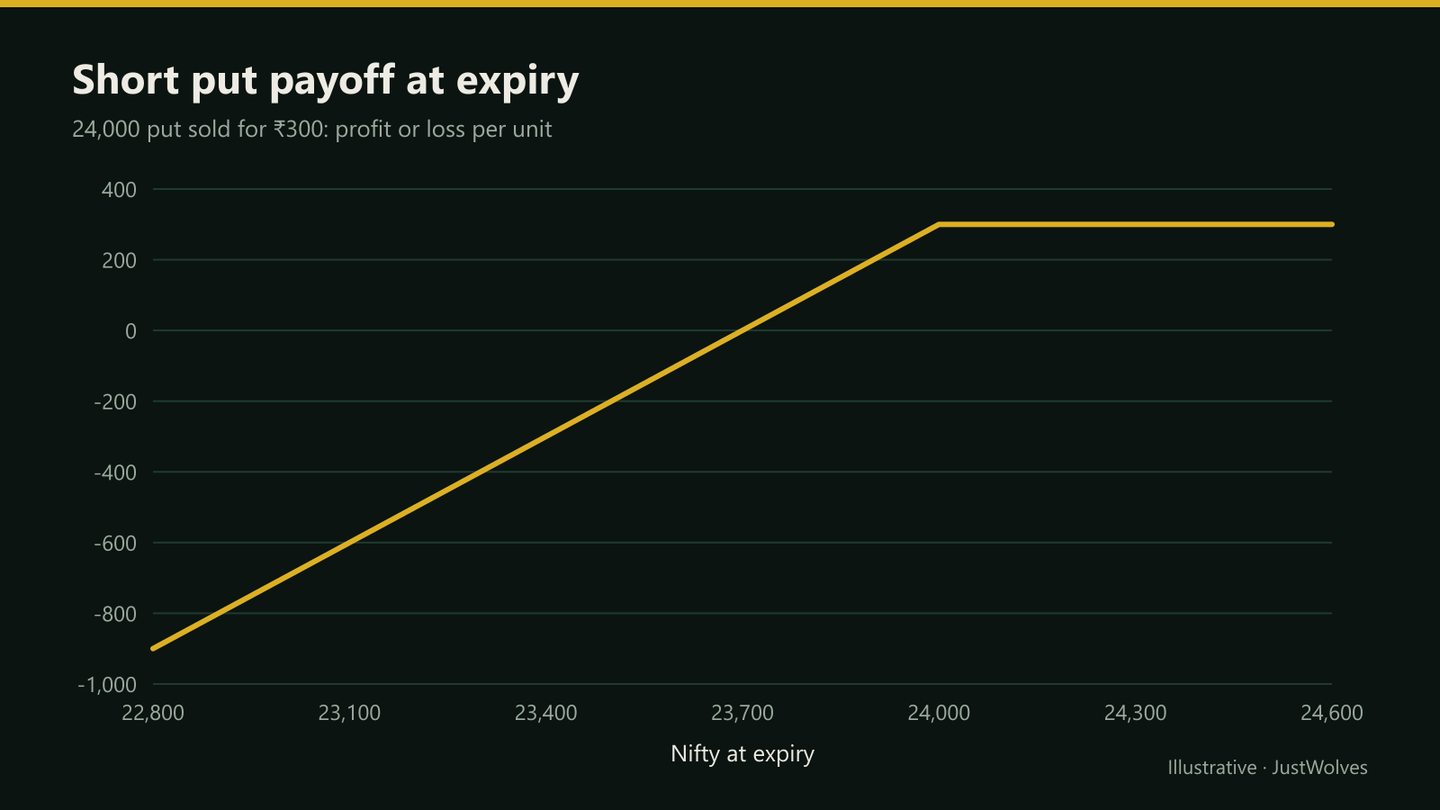
| Short put | Underlying stays at or above the strike | Premium (300) | 23,700 per unit if the index went to zero | 23,700 |
What Sellers Profit From
- Price staying away from the strike: OTM options expire worthless.
- Time decay (theta): each day, the option's time value shrinks.
- Falling implied volatility (vega): lower IV reduces premiums.
- The volatility risk premium: implied volatility has often been higher than the volatility that followed, which is the economic basis many sellers rely on. It isn't guaranteed, and it reverses sharply in crises.
The Asymmetry
Option selling typically produces many small gains and a few large losses. A seller might collect premium successfully for weeks, then lose several months' gains in one sharp move or gap.
That shape is easy to underestimate, because the losses are rare. A strategy that wins most of the time can still lose money overall if its occasional losses are large enough.
Real Prices: A Quiet Week, Then a Bad One
The asymmetry is easiest to see on a real chart. The one below uses NIFTY 50 prices from December 2024: a calm week of the kind sellers enjoy, followed by a short at-the-money put through a week of falls. The put's value is modelled each day; the index moves are real.
Real NIFTY prices: a quiet week, then a short put's bad week, December 2024
Step 1 of 4
A seller's kind of week
From 9 to 13 December 2024 NIFTY closes between 24,549 and 24,768. A seller of an out-of-the-money option in a week like this keeps most or all of the premium: the many small wins this lesson describes.
- What to observe
- Quiet markets pay sellers.
- Condition
- Weeks like this make the next sale feel safe.
Margin and Obligations
Because a seller can lose more than the premium, the exchange requires margin, calculated like futures margin, plus extra on expiry day. Losses are marked to market daily, and a large move can trigger a margin shortfall that forces positions to be closed. The margin lesson in this module covers the details.
Who Sells Options
Option sellers include market makers, who quote prices on both sides and hedge their exposure continuously; institutions selling options against holdings they already own; and individual traders running strategies such as spreads and condors. The first two groups have hedging systems and large capital. Individual traders who sell options need to think carefully about which of those advantages they lack.
Practical Example
Hypothetically, with Nifty at 24,000, Rakesh sells one lot of the 30-day 24,000 put for ₹300, collecting ₹19,500. If Nifty is above 24,000 at expiry, the put expires worthless and he keeps ₹19,500.
If a sharp fall takes Nifty to 22,800, the put is worth 1,200 at expiry and he loses (1,200 − 300) × 65 = ₹58,500, three times what he could have made. A 10% fall to 21,600 would cost (2,400 − 300) × 65 = ₹1,36,500.
How Often Do Short Options Win, and How Much Do They Lose? Our Test
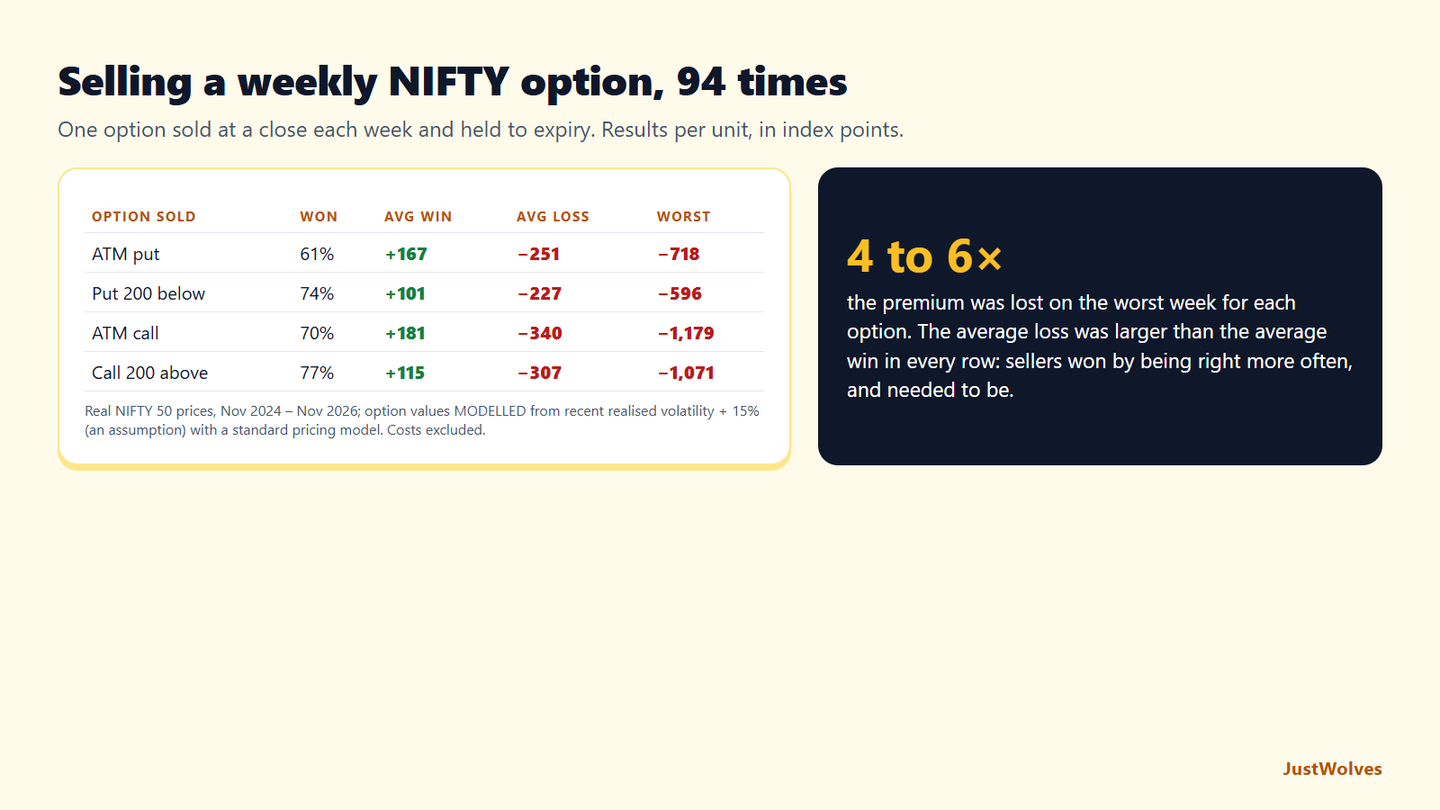
JustWolves sold NIFTY options on about two years of real prices (November 2024 to November 2026) and held each one to expiry. Weekly: one option sold at a close every week, 94 trades per option. 30-day: one option sold every month, 22 trades per option. Premiums were modelled from recent realised volatility plus 15%. That markup is an assumption standing in for the extra that option buyers usually pay; real implied volatility is sometimes higher and sometimes lower.
| Option sold | Won | Average win | Average loss | Worst (× premium) |
|---|---|---|---|---|
| Weekly ATM put | 61% | +167 | −251 | −718 (4.0×) |
| Weekly put 200 points below | 74% | +101 | −227 | −596 (5.9×) |
| Weekly ATM call | 70% | +181 | −340 | −1,179 (4.3×) |
| Weekly call 200 points above | 77% | +115 | −307 | −1,071 (5.8×) |
| 30-day ATM put | 73% | +298 | −879 | −2,236 (5.6×) |
| 30-day put 200 points below | 77% | +239 | −924 | −2,120 (6.7×) |
Sellers won most of the time, as this lesson says: between 61% and 77% of weekly trades, and up to 77% of monthly put sales. But in every row the average loss was larger than the average win, and the worst trade cost four to almost seven times the premium. The out-of-the-money options won more often and lost more, relative to what they paid, when they lost: the worst week for the put 200 points below cost 5.9 times its premium.
The 30-day short puts lost money overall despite winning about three months in four. Six losing months, led by the March 2026 fall (−2,236 points), cost more than the sixteen winning months earned. That is the pattern in Rakesh's example, on real prices: the premium is a payment for carrying exactly this risk.
Our results lean towards sellers for one reason worth stating: the 15% volatility markup we assumed gives every sale a small built-in edge. Without it, the short options in this test would have done noticeably worse. The next lesson, Option Buying vs Option Selling, measures how much of a seller's result came from that assumption.
Common Mistakes
- Treating premium as income rather than payment for risk.
- Judging a strategy by its win rate.
- Selling with a small account and no hedge.
- Ignoring gap risk over weekends and events.
- Using all available margin.
Professional Insight
Professional option sellers think of themselves as insurers: they collect premiums and must survive the claims. Their survival depends less on clever entries and more on position size, hedges and limits that cap the damage from a rare large move. That's why this course treats sizing and hedging as part of every strategy, not as optional extras.
Risk Considerations
- Unlimited loss on short calls; very large on short puts.
- Margin calls and forced exits.
- Gaps that skip stop-losses.
Important Terminology
| Term | Meaning |
|---|---|
| Option writer | The seller of an option. |
| Naked option | A short option without a protective position. |
| Premium received | The seller's maximum profit. |
| Assignment | The seller's obligation being triggered. |
| Volatility risk premium | The tendency for implied volatility to exceed realised volatility. |
What is option selling?
Writing an option: receiving the premium and taking on the obligation to settle if the option finishes in the money.
Is option selling profitable?
It can be for disciplined, well-capitalised traders, but its occasional large losses can outweigh many small gains.
What is the maximum loss in option selling?
Unlimited for a naked short call; very large for a naked short put. Spreads cap the loss.
Do I need margin to sell options?
Yes. Sellers post margin similar to futures, with extra requirements on expiry day.
Is option selling passive income?
No. It's an active, risk-bearing strategy that needs constant monitoring.
How often do option sellers win?
In our test of weekly NIFTY options on two years of real prices with modelled premiums, short options held to expiry won between 61% (at-the-money puts) and 77% (calls 200 points out of the money) of the time. Their average loss was larger than their average win in every case.
How much can a short option lose in a week?
In our NIFTY test, the worst week for a short at-the-money put lost 718 points, about ₹46,700 per lot and four times the premium collected. The worst week for a short at-the-money call lost 1,179 points, more than ₹76,000 per lot.
Practical Exercise
Size the worst case.
Your task
Step 1: Pick a short put
On Nifty, one month out, near the money.
Step 2: Calculate
Premium received per lot.
Step 3: Stress it
Loss per lot if Nifty falls 5%, 10% and 15% by expiry.
Step 4: Compare
With your account size. Could you survive the 15% case?
Check Your Understanding
An option seller's maximum profit is:
Related Lessons
Next: Option Buying vs Option Selling. See also F&O Risk Management.