
Bear Call Spread: A Bearish Credit Spread
JustWolves is an educational platform and is not a SEBI-registered investment advisor. Trading financial instruments involves significant risk of loss and may not be suitable for all investors. Past performance is not indicative of future results. Read our full disclaimer →
What you'll learn
- A bear call spread sells a call and buys a higher-strike call with the same expiry, for a net credit
- It profits if the underlying stays below the short strike; it doesn't need a fall
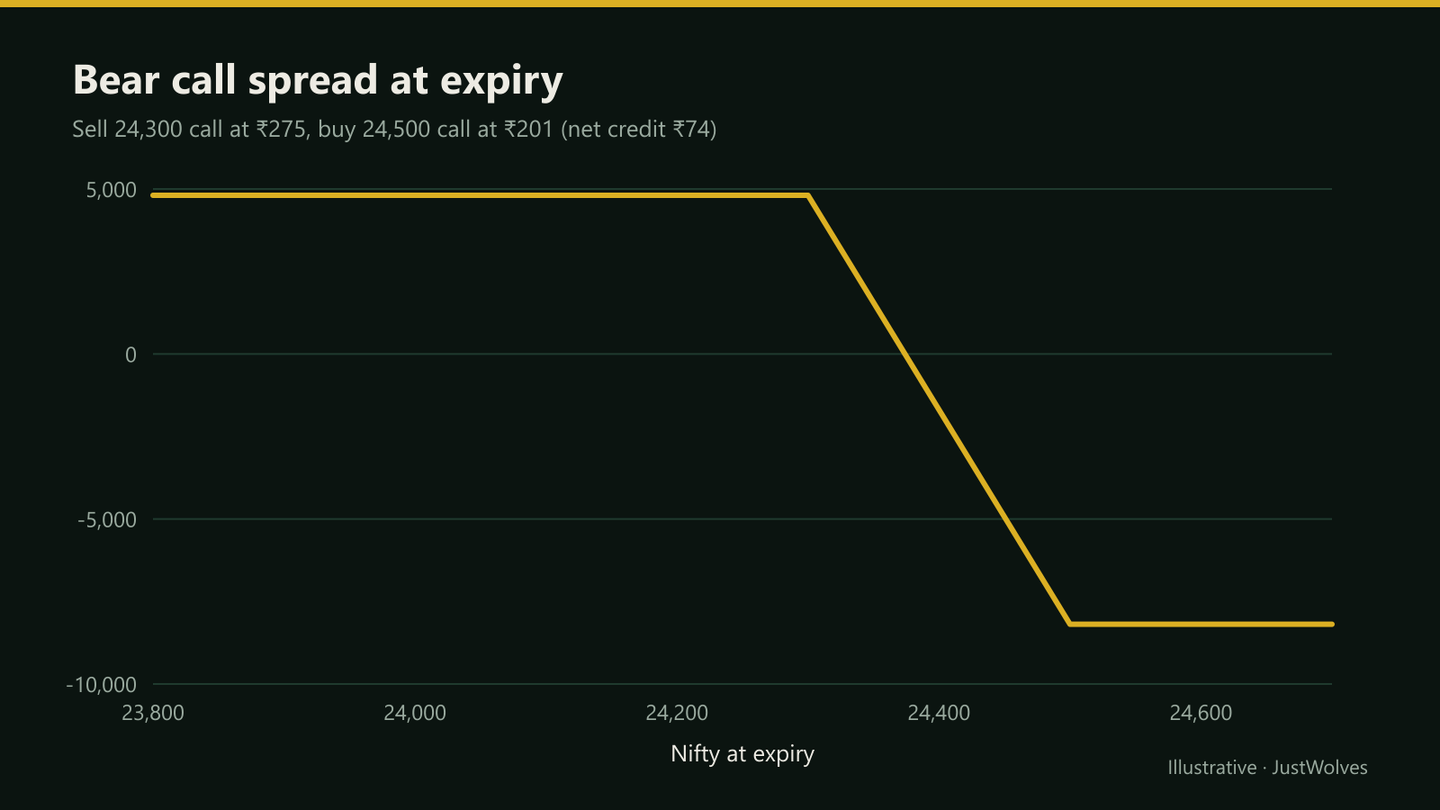
- Maximum profit = net credit; maximum loss = width − credit; breakeven = short strike + credit
- Short strikes above meaningful resistance give the trade a structural reason to work
- Steady rallies and short covering are its main risks
In this article · 17 sections
The bear call spread is the mirror image of the bull put spread. You sell a call above the current price and buy a cheaper call further up. If the market stays below your short strike, both calls expire worthless and you keep the credit. It's a common way to express a view that a market won't break above resistance, with a defined maximum loss if it does.
What You Will Learn
- How a bear call spread is built
- Its profit, loss and breakeven
- Choosing strikes around resistance
- Risks specific to selling calls
Before You Start
Read Credit Spreads Explained and Bull Put Spread first.
How It's Built
- Sell a call at a strike above the current price (the short strike).
- Buy a call at a higher strike (the long strike), same expiry, same quantity.
- Receive a net credit.
The Numbers
| Measure | Per unit | Per lot (65) |
|---|---|---|
| Net credit (maximum profit) | ₹74 | ₹4,810 |
| Maximum loss | ₹126 | ₹8,190 |
| Breakeven | 24,374 | — |
| Distance from Nifty to short strike | 300 points (1.25%) | — |
Choosing Strikes
- Short strike above resistance: a level where sellers have appeared before, such as a prior swing high.
- Outside the expected move implied by IV.
- Width set by your maximum acceptable loss.
Risks Specific to Call Spreads
Index call premiums are usually smaller than put premiums at the same distance, because of volatility skew. That means less credit for the same width, and a less favourable payoff ratio.
The main danger is a steady, persistent rally, often helped by short covering, that pushes through resistance and keeps going. Unlike a crash, it can happen without a volatility spike, so the spread loses value gradually and then quickly as the short strike is breached.
Managing the Spread
Close at 50–75% of the credit when the market falls away. Exit at a loss limit, such as twice the credit, or if Nifty closes above the short strike's resistance level. Don't hold into expiry week with the short strike under pressure.
Real Prices: A Quiet Month, Then a Rally
The chart below follows a bear call spread through a real month of NIFTY 50 prices, February to March 2025. It shows both halves of this lesson's management advice: most of the credit was available early, and a persistent rally took everything in the final week.
Real NIFTY prices: a bear call spread, a quiet month and a rally, February–March 2025
Step 1 of 4
Selling above the market
On 24 February 2025 NIFTY closes at 22,553. A trader sells the 23,250/23,450 bear call spread expiring on 27 March, the short call about 0.25 delta, for a modelled credit of about 40 points: ₹2,590 per lot. Maximum loss: 160 points, about ₹10,400.
- What to observe
- NIFTY needs to stay below 23,250, about 700 points away.
- Condition
- Like Leena in this lesson, on a real month.
Compared with a Bear Put Spread
The bear put spread from the F&O course is the debit alternative for a bearish view. It costs money upfront, needs the market to fall toward the lower strike to pay off, and has a favourable payoff ratio but a lower chance of success. The bear call spread collects money upfront, needs only that the market doesn't rise past the short strike, and has a higher chance of success but an unfavourable payoff ratio.
Implied volatility often decides between them. When IV is high, selling the call spread collects relatively expensive premium. When IV is low, buying the put spread is relatively cheap. The view matters too: a firm expectation of a decline suits the debit spread; a view that a rally will stall at resistance suits the credit spread.
Choosing Expiry and Rolling
As with bull put spreads, two to six weeks to expiry is common. Short-dated call spreads can be overrun by a single strong session; longer-dated ones give the resistance level more time to prove itself.
If a rally pushes toward the short strike, rolling up and out (to higher strikes and a later expiry) can buy time, but usually at a cost, and it extends exposure to a market that has already shown strength. A pre-set loss limit is generally a cleaner response than repeated rolling.
Practical Example
Hypothetically, Nifty has failed twice near 24,250 and trades at 24,000. Leena sells the 24,300/24,500 bear call spread for ₹74, collecting ₹4,810 per lot, with a maximum loss of ₹8,190.
Her loss limit is a spread value of ₹150 or a daily close above 24,300. Nifty drifts to 23,850 over two weeks and the spread falls to ₹22; she closes for (74 − 22) × 65 = ₹3,380.
Do Bear Call Spreads Need a Downtrend? Our Test
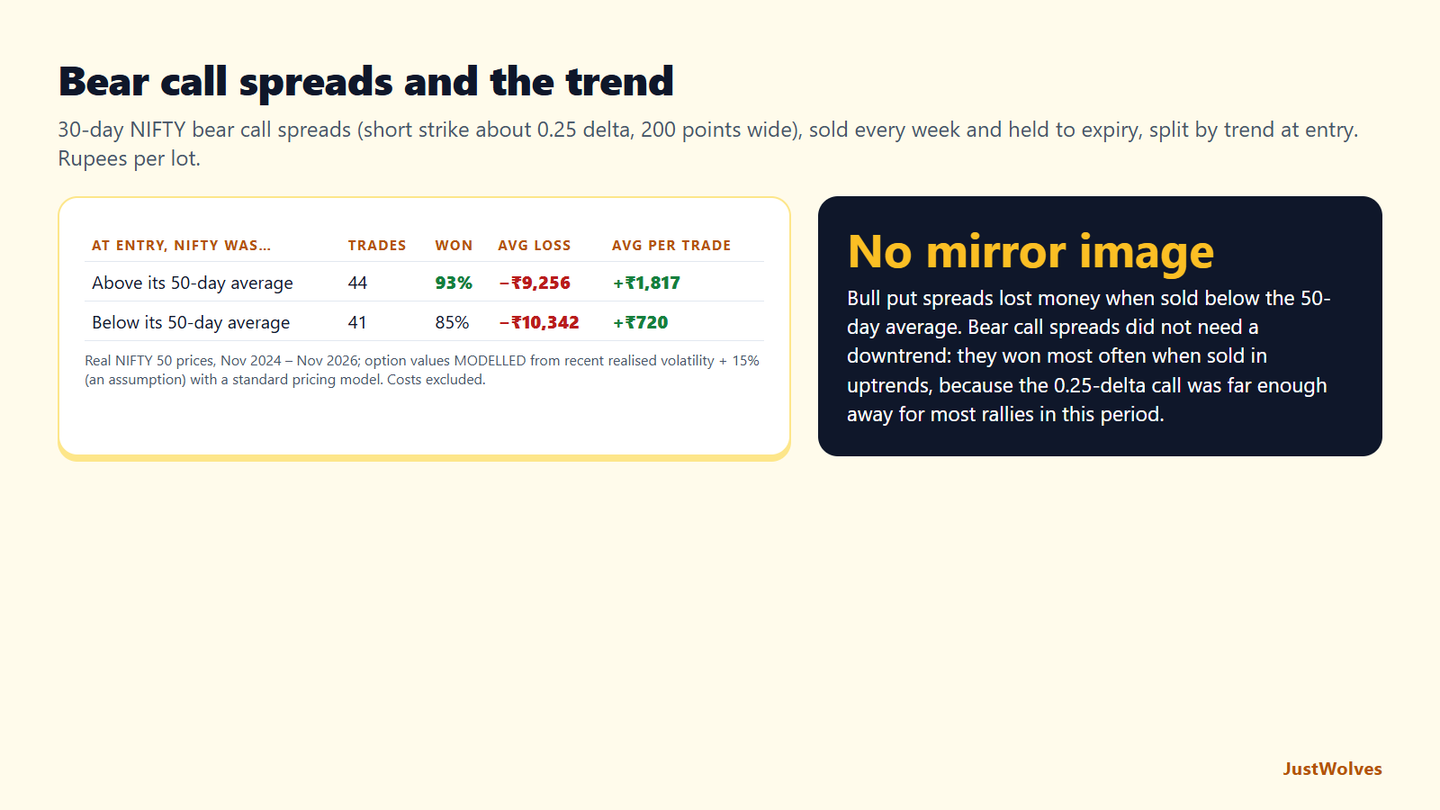
The Bull Put Spread lesson found that a simple trend filter, NIFTY above or below its 50-day average, split results cleanly. JustWolves ran the mirror test for bear call spreads on the same two years of real NIFTY 50 prices (November 2024 to November 2026): each week, a 30-day bear call spread with the short strike at about 0.25 delta and the long strike 200 points higher, held to expiry, split by trend at entry. Values were modelled from recent realised volatility plus 15%.
| At entry | Trades | Won | Average win | Average loss | Average per trade |
|---|---|---|---|---|---|
| NIFTY above its 50-day average | 44 | 93% | ₹2,627 | −₹9,256 | +₹1,817 |
| NIFTY below its 50-day average | 41 | 85% | ₹2,616 | −₹10,342 | +₹720 |
The trend result was not a mirror image. Bull put spreads sold below the 50-day average lost money; bear call spreads sold above it, against the uptrend, won 93% of the time and made the most. A call strike at 0.25 delta was usually far enough above the market for the rallies of this period, while the 2025–26 falls came quickly enough to catch puts sold below the trend.
That does not overturn this lesson's warning about selling call spreads in strong uptrends. Losses, when they came, were still almost the full width, about ₹9,000 to ₹10,000 against wins of about ₹2,600, and the chart above shows how a calm month can end in a maximum loss in six sessions. What the data suggests is that a strike above a real resistance level and a firm profit target matter more for bear call spreads than the trend label on the day of entry.
The profit target mattered in the chart above. About 80% of the credit was available after eight days. Holding for the remainder risked four times the credit for about a fifth of it.
Common Mistakes
- Selling call spreads in strong uptrends.
- Short strikes just above the price with no resistance behind them.
- Accepting tiny credits because calls are cheap.
- Holding through breakouts above resistance.
- Ignoring event risk such as policy announcements.
Professional Insight
Many experienced spread sellers combine bear call spreads with bull put spreads, creating an iron condor that profits if the market stays in a range. Selling only one side means relying on a directional view; combining both relies on a range view, covered in the next module.
Risk Considerations
- Maximum loss exceeds maximum profit.
- Persistent rallies breach short strikes.
- Low call premiums reduce the credit.
Important Terminology
| Term | Meaning |
|---|---|
| Bear call spread | Short lower-strike call, long higher-strike call. |
| Net credit | Premium received minus premium paid. |
| Short covering | Short sellers buying back, often fuelling rallies. |
| Volatility skew | Higher IV for OTM puts than OTM calls. |
| Iron condor | A bull put spread plus a bear call spread. |
What is a bear call spread?
A credit spread that sells a call and buys a higher-strike call, profiting if the underlying stays below the short strike.
Does a bear call spread need the market to fall?
No. It profits if the market stays below the short strike, whether it falls, stays flat or rises slightly.
What is the maximum loss?
The width between strikes minus the net credit received.
What is the breakeven?
The short strike plus the net credit.
When does a bear call spread fail?
When the market rallies through the short strike, especially in a persistent uptrend.
Should I only sell bear call spreads in a downtrend?
Not necessarily, on our data. In two years of real NIFTY prices with modelled premiums, 30-day bear call spreads at 0.25 delta won 93% of the time when sold with NIFTY above its 50-day average and 85% when sold below it. A strike above resistance and a profit target mattered more.
How often does a bear call spread make money?
In our test of 30-day NIFTY bear call spreads, short strike at about 0.25 delta and 200 points wide, about 89% made money when held to expiry. The losing trades lost close to the full width, about four times the average win.
Practical Exercise
Plan a bear call spread.
Your task
Step 1: Find resistance
A level Nifty has failed at recently.
Step 2: Choose strikes
Short above resistance; long 100–200 points higher.
Step 3: Calculate
Credit, maximum loss and breakeven per lot.
Step 4: Set rules
Profit target, loss limit and event rule.
Check Your Understanding
A bear call spread sells:
Related Lessons
Previous: Bull Put Spread. Next module: Short Straddle. Later: Iron Condor.