
Expiry-Day, Gap and Assignment Risk for Option Sellers
JustWolves is an educational platform and is not a SEBI-registered investment advisor. Trading financial instruments involves significant risk of loss and may not be suitable for all investors. Past performance is not indicative of future results. Read our full disclaimer →
What you'll learn
- On expiry day, short options carry extreme gamma and attract extra margin under SEBI rules
- Gaps open beyond stop-loss levels; only bought options protect against them
- Weekends, holidays and scheduled events are the most common sources of large gaps
- Short stock options that finish in the money are physically settled: you must deliver or buy shares
- Most sellers close or roll before expiry day and reduce naked exposure before events
In this article · 15 sections
Three risks cause a large share of option sellers' worst losses: the extreme behaviour of options on expiry day, gaps that skip stop-losses, and the obligations created by assignment and physical settlement. None of them shows up in a strategy's average results, and all of them can be planned for. This lesson explains each risk and the rules sellers use to contain it.
What You Will Learn
- Why expiry day is dangerous for sellers
- How gaps defeat stop-losses
- Assignment and physical settlement for short options
- Practical rules to contain all three
Before You Start
Read Expiry Day Behaviour, Settlement, Exercise, Assignment and STT and Hedged vs Naked Selling first.
Expiry-Day Risk
On expiry day, near-the-money options have extreme gamma. A short option worth a few rupees in the morning can be worth many times that by the afternoon after a modest index move. Sellers who hold to the close for the last few rupees of premium take on this risk for very little reward.
SEBI's rules add an extra extreme loss margin on short options on expiry day and remove calendar-spread margin benefits for expiring contracts. Positions that were comfortable the day before can therefore need more margin on expiry day itself.
Gap Risk
A gap is when the market opens well away from the previous close, usually because of overnight news. A stop-loss order can only execute at the prices available, so a gap can turn a planned ₹10,000 loss into a far larger one before the first trade.
Common sources of large gaps include weekends and holidays, global market moves overnight, and scheduled events such as election results, the Union Budget and RBI decisions.
Real Prices: A Weekend Gap Through a Stop
Pradeep's story in this lesson is hypothetical. The chart below shows the same sequence on real NIFTY 50 prices from March 2026: a weekly strangle sold on a Thursday with a stop-loss, and the Monday gap that went straight through it. Option values are modelled each day.
Real NIFTY prices: a weekend gap through a stop-loss, March 2026
Step 1 of 4
A nervous market
In late February 2026 NIFTY falls from about 25,500 to 24,481 by 4 March, with a 500-point gap down on 2 March. Volatility is rising.
- What to observe
- Sellers are being paid more, for good reason.
- Condition
- 3 March is a holiday: gaps are more likely around breaks.
Assignment and Physical Settlement
- Index options (Nifty, Bank Nifty): short options that finish ITM are settled in cash at the final settlement price.
- Stock options: short options that finish ITM are physically settled. A short call obliges you to deliver shares; a short put obliges you to buy them, at the strike.
- Funds and shares: brokers require the full value or the shares ahead of expiry and may close positions that aren't covered.
Indian equity options are European-style, so assignment happens only at expiry. There's no early assignment risk, but the settlement obligation at expiry is real and can be large.
Rules That Contain These Risks
- Close or roll before expiry day unless the position is fully hedged and small.
- Hedge before weekends and events, or reduce size.
- Size for gaps, not for stop distances: assume a gap beyond your stop is possible.
- Close stock options before expiry unless you've planned for delivery.
- Keep a margin buffer for expiry-day increases.
Liquidity in Stress
Gaps and expiry-day spikes often come with poor liquidity. Bid-ask spreads widen sharply, especially for far OTM options, so closing a threatened short leg can cost far more than its quoted last price. When planning exits, assume you'll pay a wider spread in exactly the conditions where you most need to act, and favour liquid strikes near the current price for any hedges you may need to add quickly during a fast-moving session, when every second of delay costs money.
Practical Example
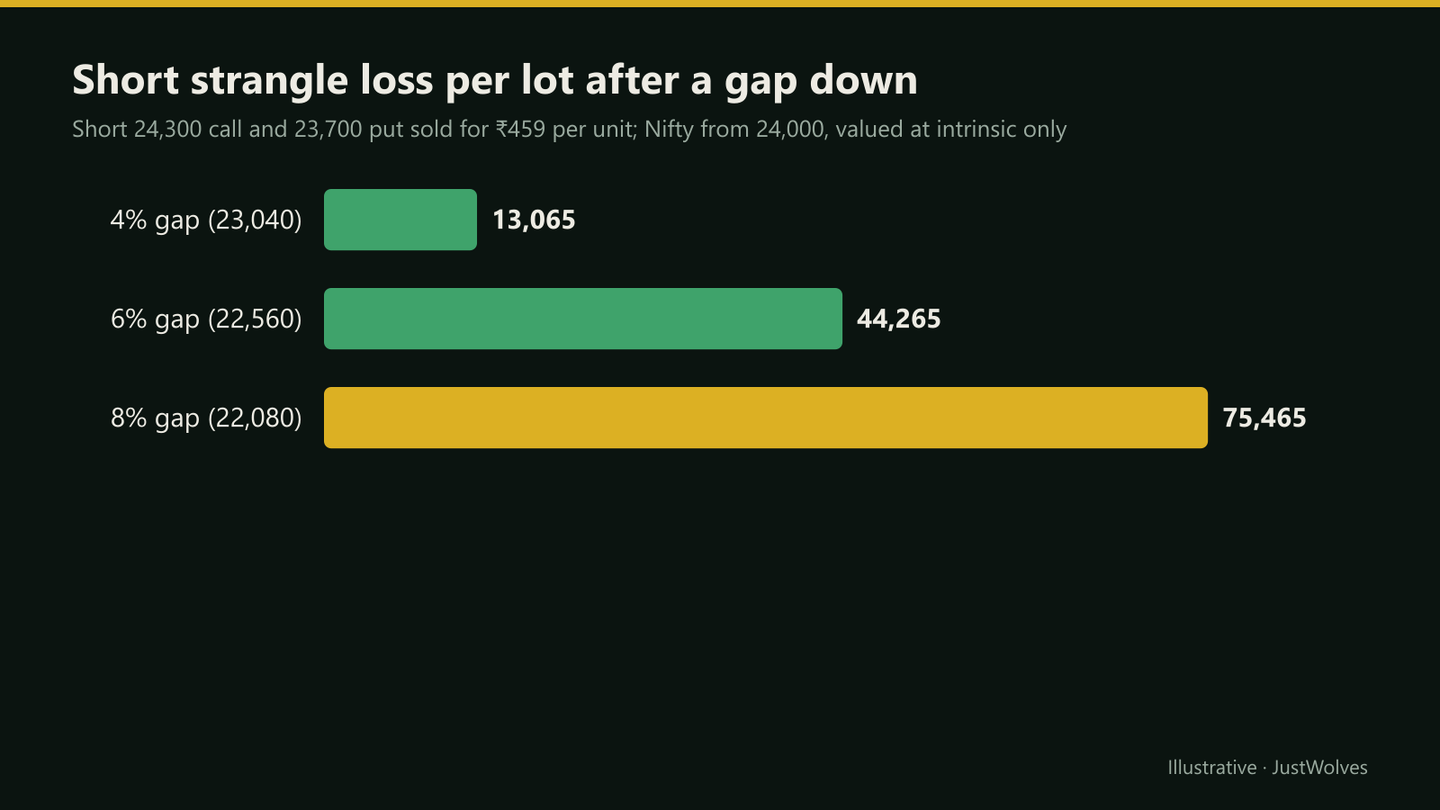
Hypothetically, Pradeep sells a naked Nifty strangle on Thursday with a stop-loss at twice the premium. Over the weekend, an unexpected global event leads to a 4% gap down on Monday.
His stop triggers at the open, but at a price far beyond its level: the loss is several times his planned maximum. His friend Kiran holds the same short strikes as an iron condor. Her loss is capped at the condor's maximum, and she has no margin shortfall.
How Often Do Gaps Hit Sellers? Our Data
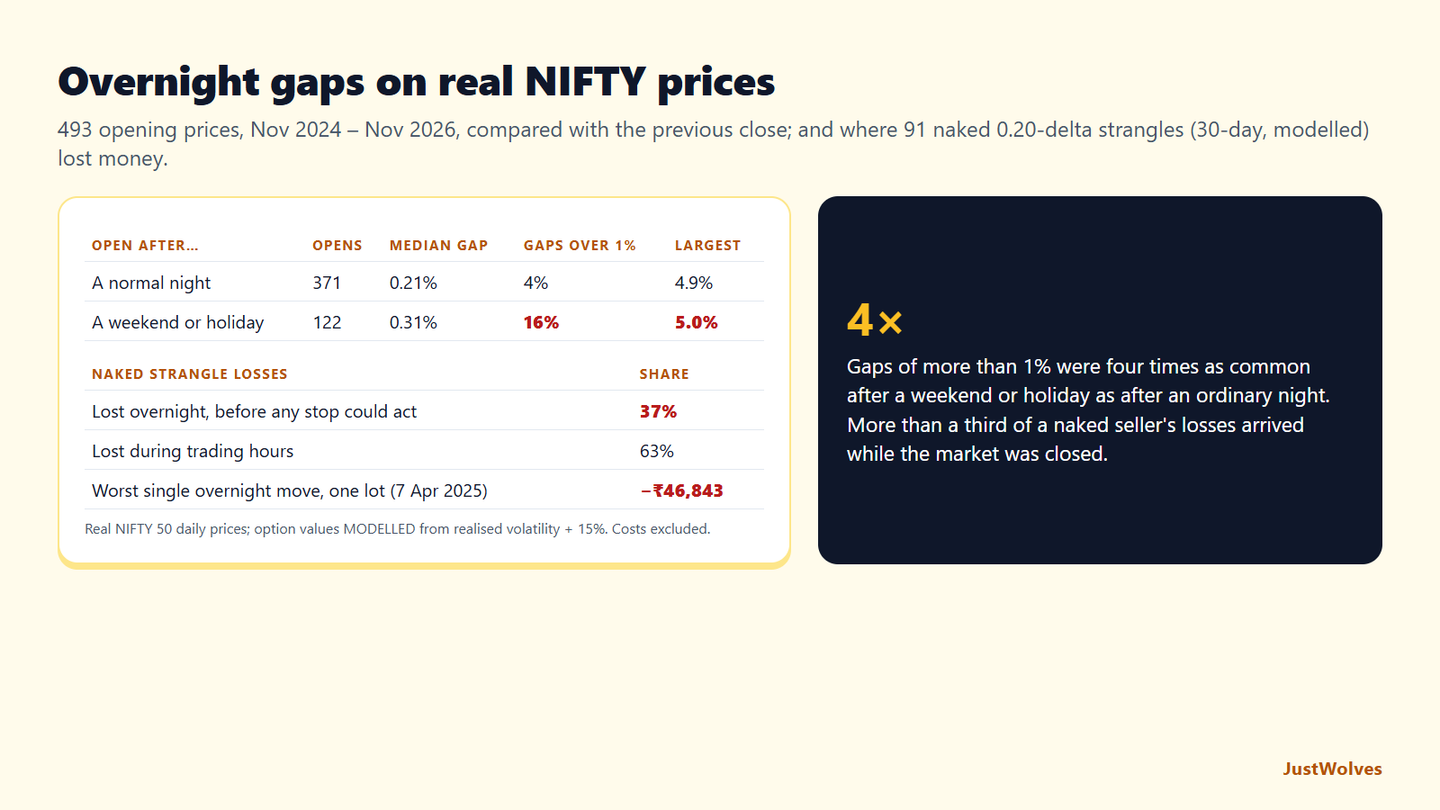
JustWolves measured every NIFTY 50 opening price for about two years (November 2024 to November 2026), 493 in all, against the previous close, and split them by whether the market had been closed for a normal night or for a weekend or holiday. We then followed 91 naked 30-day strangles, call and put each at about 0.20 delta, and split their daily losses into the part that happened overnight, from close to open, and the part that happened during trading hours. Option values were modelled from recent realised volatility plus 15%.
| Open after… | Opens | Median gap | Gaps over 1% | Largest |
|---|---|---|---|---|
| A normal night | 371 | 0.21% | 4% | 4.9% |
| A weekend or holiday | 122 | 0.31% | 16% | 5.0% |
| Result | |
|---|---|
| Share of losses that arrived overnight, close to open | 37% |
| Share of losses during trading hours | 63% |
| Worst single overnight move, one lot | −₹46,843 (7 April 2025) |
| Other large overnight losses, one lot | −₹37,500 (9 March 2026), −₹37,200 (19 March 2026) |
Weekends and holidays were where the large gaps lived. After an ordinary night, NIFTY opened more than 1% away from the previous close only 4% of the time; after a weekend or holiday, 16% of the time. This lesson's list of gap sources, weekends, holidays and global news, matches the data: the chart above is one of those weekend gaps.
More than a third of a naked seller's losses arrived while the market was closed. No stop-loss can act on those, as this lesson's callout says. On the worst single night, one naked strangle lot lost about ₹46,800 before the open. That is the arithmetic behind this lesson's rule to size for gaps, not for stop distances: if a position cannot survive the worst overnight move in the last two years, the stop beside it is not protection.
For expiry-day risk, see the Expiry Day Behaviour lesson's test: in our hourly data, the last 75 minutes of NIFTY expiry days moved about 60% more than the same stretch on other days. Closing short options before the final hour removes most of that risk at little cost.
Common Mistakes
- Holding naked shorts over weekends before major events.
- Relying on stop-losses for gap protection.
- Holding to the expiry close for the last few rupees.
- Forgetting physical settlement on stock options.
- Using all margin the day before expiry.
Professional Insight
Experienced sellers often keep an 'event calendar' and reduce or hedge positions ahead of every scheduled risk. They also treat expiry day as a day to finish positions, not to start new short ones. Small, routine habits like these prevent most catastrophic losses.
Risk Considerations
- Gaps can exceed any planned loss.
- Expiry-day margins can force exits.
- Delivery obligations on stock options can be large.
Important Terminology
| Term | Meaning |
|---|---|
| Gap | An open well away from the previous close. |
| Gap risk | The risk of losses beyond stop levels due to gaps. |
| Assignment | The seller's obligation being triggered at expiry. |
| Physical settlement | Delivery of shares for stock options. |
| Event calendar | A list of scheduled market-moving events. |
What is gap risk in option selling?
The risk that the market opens far beyond your stop-loss, causing losses larger than planned.
Do stop-losses protect against gaps?
No. They execute at the first available price after the gap.
Is there early assignment in India?
No. Indian equity options are European-style and are settled only at expiry.
What happens to a short stock option ITM at expiry?
It's physically settled: you deliver shares for a short call or buy shares for a short put, at the strike.
Should I sell options on expiry day?
It's high-risk because of extreme gamma and higher margin; many sellers avoid opening new short positions then.
Are gaps more likely after weekends?
Yes, in our data. Over two years of real NIFTY prices, the index opened more than 1% away from the previous close after 16% of weekends and holidays, compared with 4% of ordinary weeknights. The largest gaps were about 5%.
How much of an option seller's losses come from gaps?
A large share. In our test of naked 0.20-delta NIFTY strangles with modelled premiums, about 37% of losses arrived overnight, between one close and the next open, when no stop-loss could act. The worst single night cost about ₹46,800 per lot.
Practical Exercise
Build an event calendar.
Your task
Step 1: List events
RBI meetings, budget, major results and holidays for the next three months.
Step 2: Set rules
What you'll do with open positions before each.
Step 3: Stress-test
Your current or planned positions for a 5% gap.
Step 4: Plan expiries
When you'll close positions before each expiry.
Check Your Understanding
What protects against gaps?
Related Lessons
Previous: Hedged vs Naked Selling. Next: Position Sizing, Maximum Loss and Stress Testing.