
Hedged vs Naked Selling: Defined vs Undefined Risk
JustWolves is an educational platform and is not a SEBI-registered investment advisor. Trading financial instruments involves significant risk of loss and may not be suitable for all investors. Past performance is not indicative of future results. Read our full disclaimer →
What you'll learn
- Naked selling has undefined risk; hedged selling (spreads, condors, butterflies) has a known maximum loss
- Hedges cost part of the premium but cut margin and cap the tail
- Return on margin can look similar or better for hedged trades because margin is lower
- In crashes and gaps, the difference between the two can be the difference between a bad month and a wiped-out account
- For most individual traders, defined-risk structures are the sensible default
In this article · 17 sections
Every option-selling strategy in this course comes in two forms: naked, where the short options stand alone, and hedged, where bought options cap the loss. Naked versions collect more premium and look more profitable in quiet markets. Hedged versions give up some premium for a known worst case. This lesson compares the two directly and explains why defined risk is the default for most traders.
What You Will Learn
- The difference between defined and undefined risk
- How hedges change premium, margin and returns
- How each behaves in a crash or gap
- How to choose between them
Before You Start
Read Iron Condor and Adjusting Short Option Positions first.
Defined vs Undefined Risk
| Naked (undefined risk) | Hedged (defined risk) |
|---|---|
| Short call | Bear call spread |
| Short put | Bull put spread |
| Short strangle | Iron condor |
| Short straddle | Iron butterfly |
| Ratio spread | Broken-wing butterfly |
Payoffs Compared
Premium, Margin and Return on Capital
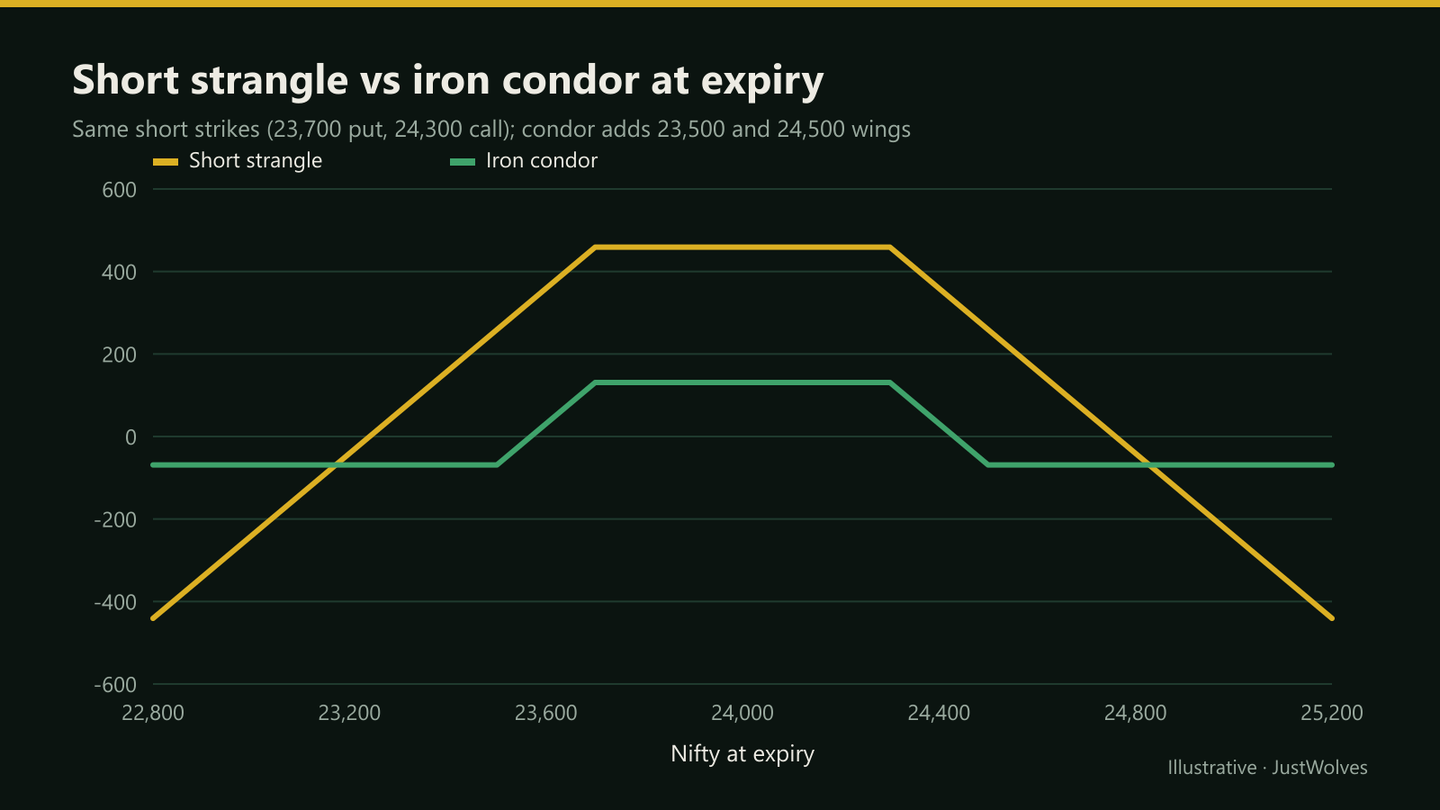
The naked strangle collects ₹459 per unit; the condor ₹131. On premium alone, naked looks far better. But the condor's margin is much lower, close to its maximum loss, while the naked strangle requires substantial margin and a large buffer for adverse moves.
Measured as a return on the capital actually at risk, the two can be much closer than the raw premiums suggest, and the condor's worst case is known in advance.
In a Crash or Gap
Tail events are where the two diverge. If Nifty gaps 8% lower overnight, from 24,000 to 22,080, the naked strangle's put is worth at least 1,620 in intrinsic value, a loss of over ₹1,161 per unit (₹75,465 per lot) before any rise in implied volatility. The condor's loss is capped at ₹69 per unit (₹4,485 per lot).
No stop-loss protects a naked position from a gap; it can only limit losses during continuous trading. The bought wings work at all times, including overnight and over weekends.
Real Prices: Sanjay and Usha in One Month
Sanjay's and Usha's year in this lesson is hypothetical. The chart below runs their two approaches through one real month of NIFTY 50 prices, December 2024 to January 2025, with both positions valued each day by a standard pricing model.
Real NIFTY prices: three naked strangles vs five sized condors, December 2024 – January 2025
Step 1 of 4
Same strikes, different structure
On 16 December 2024 NIFTY closes at 24,668. Like Sanjay in this lesson, one trader with ₹10 lakh sells three naked 25,700/23,950 strangles, about 0.20 delta each side, for about 238 points: ₹46,300. Like Usha, another sells the same short strikes as condors with wings at 25,900 and 23,750, sized so the maximum loss is about ₹42,000: five lots, ₹22,900 of credit.
- What to observe
- Naked collects about twice as much.
- Condition
- The condor's worst case is known today.
Choosing Between Them
- Account size: small and medium accounts can't absorb naked tail losses; use defined risk.
- Experience: naked selling requires active management, Greek limits and stress testing.
- Monitoring: if you can't watch positions during market hours, defined risk is essential.
- Events and gaps: hold only defined-risk positions through them.
Choosing Wing Distance
How far away to buy the wings is a trade-off. Wings close to the short strikes cost more, leaving a smaller net credit, but cap the loss tightly. Wings further away cost little, preserving most of the premium, but allow a larger loss before they start to protect.
A practical approach is to choose the wing distance from your maximum acceptable loss per lot. If you can accept losing ₹10,000 per lot, the wing width minus the credit, times 65, should not exceed that. The wings then do exactly what you need: they turn the worst case into a number you've already decided you can afford.
Hedging Doesn't Remove All Risk
A defined-risk position can still lose its maximum often if it's poorly placed, too large or held through repeated tests. Costs on four legs add up, and the maximum loss of a condor is usually larger than its maximum profit. The hedge removes the catastrophic outcome; good strike selection, sizing and exits still decide whether the strategy works.
Practical Example
Hypothetically, two traders each have ₹10,00,000. Sanjay sells three naked strangles a month; Usha sells condors sized so that her total maximum loss is 5% of capital.
For eleven months, Sanjay earns more. In the twelfth, an overnight 8% gap costs him over ₹2,26,000 on three lots before volatility effects, wiping out most of the year's gains. Usha's worst case that month is her preset ₹50,000, and she continues trading the next month.
Naked vs Hedged Over 22 Real Months: Our Test
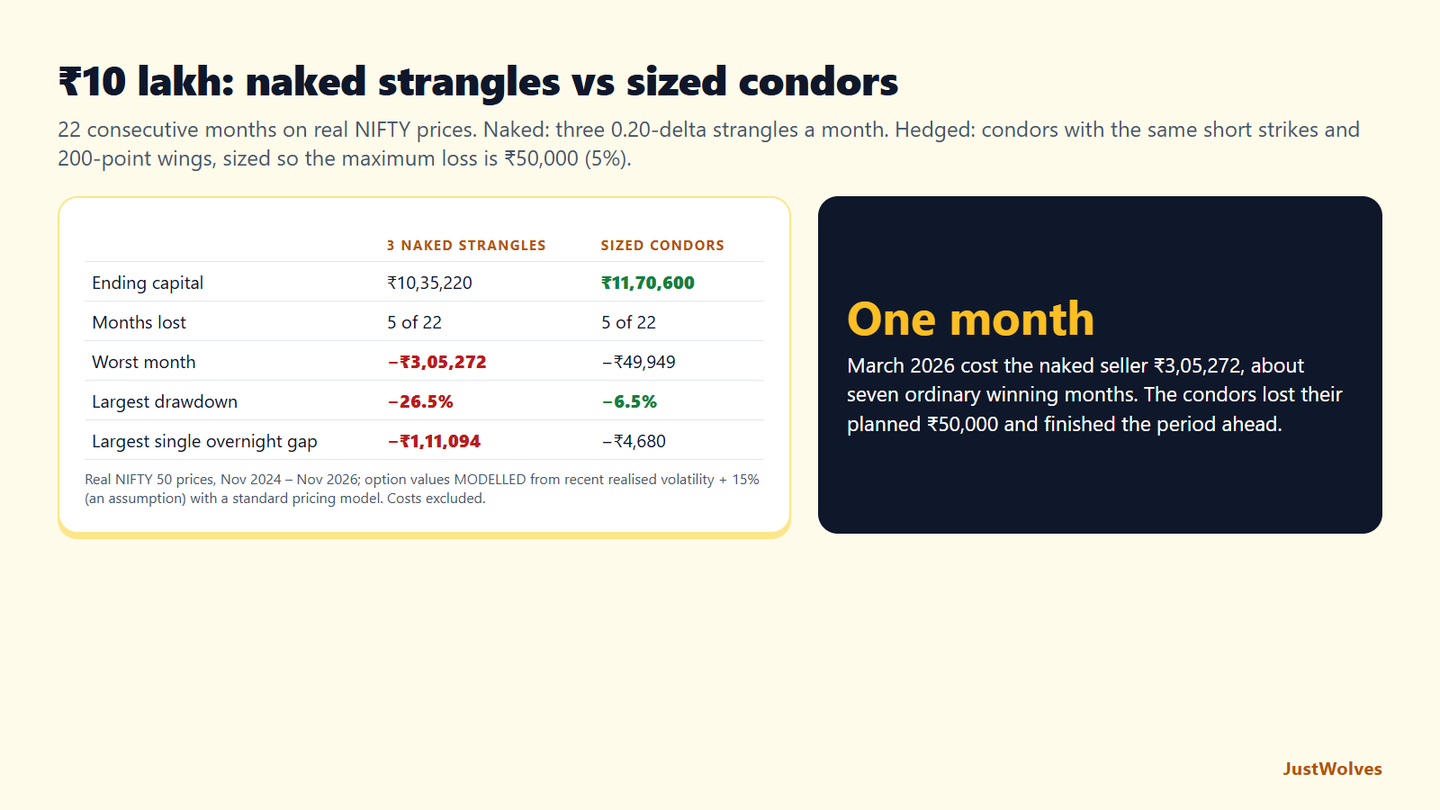
JustWolves ran this lesson's example on about two years of real NIFTY 50 prices (December 2024 to October 2026), 22 consecutive months, each starting with ₹10 lakh of capital. Sanjay's approach: three naked 30-day strangles each month, call and put at about 0.20 delta. Usha's approach: iron condors with the same short strikes and wings 200 points further out, with the number of lots set so the maximum loss is about ₹50,000, 5% of capital. Both were held to expiry. We also measured each approach's largest single loss from an overnight gap. Values were modelled from recent realised volatility plus 15%.
| Three naked strangles a month | Condors sized to a ₹50,000 maximum loss | |
|---|---|---|
| Ending capital | ₹10,35,220 | ₹11,70,600 |
| Months lost | 5 of 22 | 5 of 22 |
| Typical winning month | ₹25,000–₹80,000 | ₹20,000–₹29,000 |
| Worst month | −₹3,05,272 (February–March 2026) | −₹49,949 |
| Largest drawdown | −26.5% | −6.5% |
| Largest single overnight gap loss | −₹1,11,094 (19 March 2026) | −₹4,680 |
This lesson's story played out on real prices, with one difference: Usha also made more money. The naked strangles earned more in most winning months, as expected, but one month, the February–March 2026 fall, cost ₹3,05,272, about seven ordinary winning months. Over 22 months, the sized condors ended about ₹1,35,000 ahead, with a largest drawdown of 6.5% against 26.5%.
Gaps were where the structures differed most. On 19 March 2026, a single overnight gap cost the three naked strangles about ₹1,11,000 before any stop could act. The condors lost about ₹4,700 on the same open. This lesson's point that no stop-loss protects against a gap, and that wings work overnight, is the clearest result in the test.
Two cautions keep this in proportion. The test covers one two-year period with two large falls; in a calmer period the naked approach would likely have finished ahead, until its own bad month arrived. And Usha's advantage came from sizing as much as from the wings: she chose her number of lots from the maximum loss, which is the habit this lesson's practical example describes.
Common Mistakes
- Comparing strategies by premium rather than risk.
- Removing wings to collect a little more.
- Relying on stop-losses for gap protection.
- Naked selling with a small account.
- Treating years of gains as proof that the tail risk isn't real.
Professional Insight
Institutions that sell naked options do so inside portfolios with hedges, stress limits and capital far larger than any single loss. For individual traders, buying the wings is the equivalent of that institutional risk system, and is usually money well spent. The premium given up for the wings is the price of staying in business through the inevitable bad month.
Risk Considerations
- Naked: unlimited or very large losses.
- Hedged: maximum loss is defined but often larger than maximum profit.
- Both: costs and execution risk.
Important Terminology
| Term | Meaning |
|---|---|
| Defined risk | A maximum loss known in advance. |
| Undefined risk | No fixed maximum loss. |
| Wings | Bought options that cap the loss. |
| Return on margin | Profit relative to margin used. |
| Tail event | A rare, extreme market move. |
What is naked option selling?
Selling options without a protective position, so the maximum loss isn't defined.
Is hedged option selling safer?
It has a known maximum loss and lower margin, which protects against tail events.
Does hedging reduce profits?
It reduces premium collected, but because margin is also lower, returns on capital can be comparable.
Can a stop-loss replace a hedge?
No. Stops don't protect against gaps; bought options do.
Should beginners sell naked options?
No. Defined-risk structures are the appropriate starting point.
Does hedged option selling make less money than naked selling?
Not necessarily over time. In our 22-month test on real NIFTY prices with modelled premiums, condors sized to a 5% maximum loss finished about ₹1,35,000 ahead of three naked strangles a month on ₹10 lakh, because one bad month cost the naked approach more than its extra premium earned.
How much can an overnight gap cost a naked option seller?
In our NIFTY test, a single overnight gap on 19 March 2026 cost three naked 0.20-delta strangles about ₹1,11,000. Condors with the same short strikes lost about ₹4,700 on the same open, because the bought wings work even when the market is closed.
Practical Exercise
Compare in a stress scenario.
Your task
Step 1: Price a strangle and a condor
With the same short strikes.
Step 2: Check margin
For each in your broker's calculator.
Step 3: Stress
Loss per lot for each at 5% and 10% gaps.
Step 4: Compare
With your account size and risk limits.
Check Your Understanding
The defined-risk version of a short strangle is:
Related Lessons
Previous: Adjusting Short Option Positions. Next: Expiry-Day, Gap and Assignment Risk.