
Covered Calls: Selling Calls Against Shares You Own
JustWolves is an educational platform and is not a SEBI-registered investment advisor. Trading financial instruments involves significant risk of loss and may not be suitable for all investors. Past performance is not indicative of future results. Read our full disclaimer →
What you'll learn
- A covered call combines owning shares with selling a call option on the same shares
- The premium adds income and a small cushion against falls, but caps upside above the strike
- Downside risk is almost the same as owning the shares; the premium only offsets a little
- In India, stock options are physically settled, so an ITM short call at expiry means delivering the shares
- Covered calls suit investors who'd be content selling at the strike
In this article · 16 sections
A covered call is often the first option-selling strategy long-term investors use. You already own the shares; you sell a call option against them and collect the premium. If the stock stays below the strike, you keep the premium and the shares. If it rises above, you sell the shares at the strike. This lesson explains the trade-offs, how physical settlement works in India, and where covered calls fit.
What You Will Learn
- How a covered call is built
- Its payoff compared with holding shares
- How to choose strike and expiry
- Physical settlement and other practicalities in India
Before You Start
Read Short Calls and Short Puts and Settlement, Exercise, Assignment and STT first.
How It Works
- Own shares equal to one lot (or multiples) of the stock's option contract.
- Sell one call option per lot, usually OTM.
- Collect the premium.
The call is 'covered' because if it's exercised, you deliver shares you already hold, rather than having to buy them at the market price. That removes the unlimited risk of a naked short call.
The Payoff
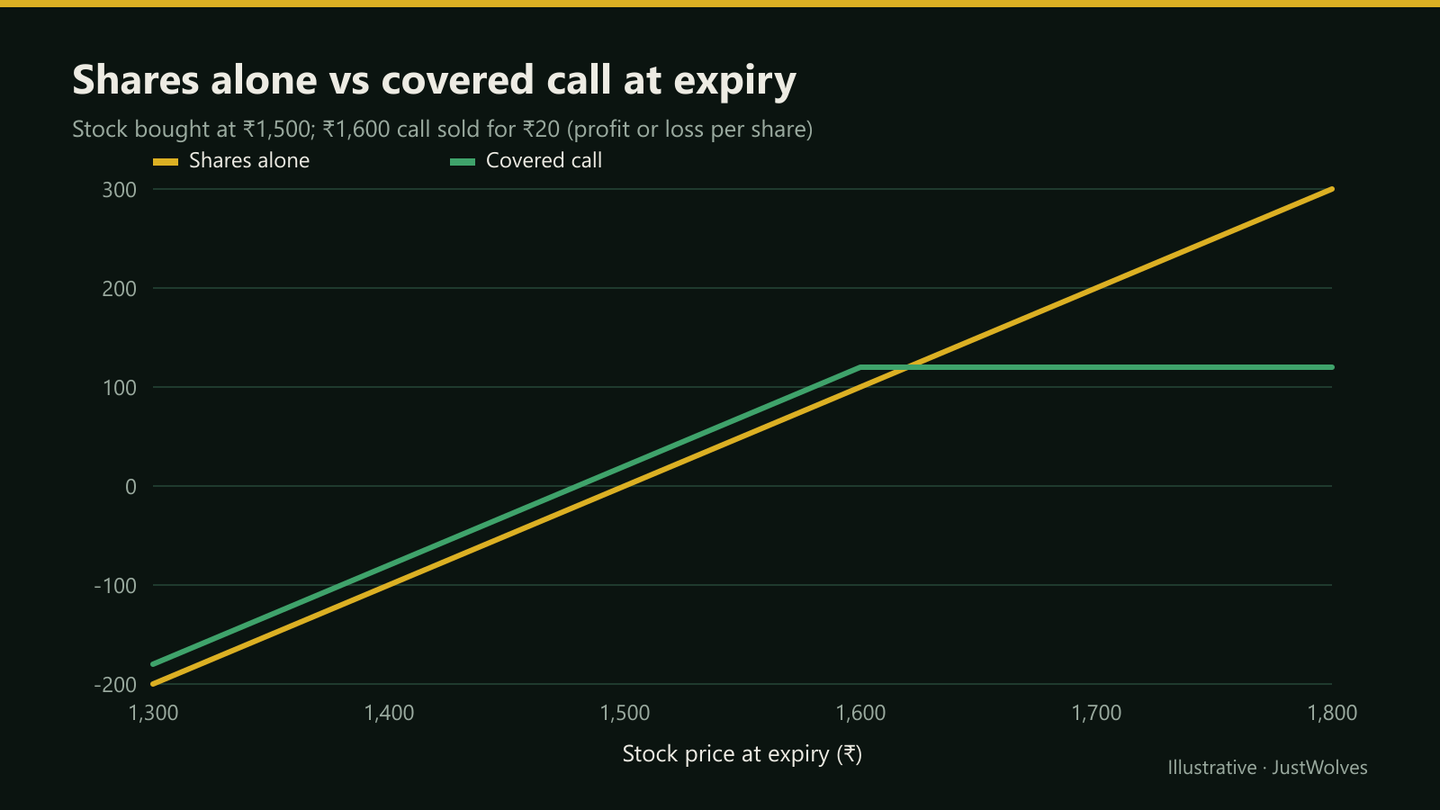
| Measure | Covered call |
|---|---|
| Maximum profit | Strike − purchase price + premium = ₹120 |
| Breakeven | Purchase price − premium = ₹1,480 |
| Maximum loss | Purchase price − premium if the stock went to zero = ₹1,480 |
Choosing Strike and Expiry
- Strike: a price you'd be content to sell at, often above a resistance level.
- Distance: closer strikes collect more but cap upside sooner; further strikes leave room to rise but collect less.
- Expiry: monthly stock options; avoid holding through results unless you accept the possibility of being called away.
Physical Settlement in India
Stock options in India are physically settled. If your short call finishes ITM at expiry, you'll deliver your shares at the strike price. Brokers handle this using the shares in your demat account, and some block those shares as collateral throughout.
If you want to keep the shares, buy back the call before expiry, or roll it to a later expiry and higher strike, usually at a cost.
Managing the Call Before Expiry
If the stock rises toward the strike and you'd rather keep the shares, you can buy back the call and sell a new one at a higher strike or later expiry. This is a roll. It usually costs money when the stock has risen, because the call you're buying back has gained value. Rolling repeatedly to avoid assignment can turn a modest income strategy into a series of losses on the options.
If the stock falls, the call loses value quickly. Some investors buy it back cheaply and sell another call at a lower strike to collect more premium, but that lowers the price at which they'd sell. Decide in advance what you'll do in each case, so the decision isn't made under pressure.
Taxes and Costs
In India, option premiums and share sales are taxed differently. Premium income from F&O is generally treated as business income, while shares delivered on assignment create a capital gain or loss on the shares. The interaction can be complex, so keep records of every leg and consult a tax professional about your own situation.
Practical Example
Hypothetically, Asha owns 500 shares of a large-cap company bought at ₹1,500, and the stock's option lot is 500 shares. She sells one lot of the monthly ₹1,600 call at ₹20, collecting ₹10,000.
If the stock ends the month at ₹1,560, the call expires worthless; she keeps the ₹10,000 and her shares. If it ends at ₹1,680, she delivers the shares at ₹1,600, making ₹100 per share on the stock plus ₹20 premium: ₹60,000 in total, but missing the extra ₹40,000 she'd have made by just holding.
Real Prices: When the Cap Binds
Asha's example uses a hypothetical stock. The chart below shows a covered call on real State Bank of India prices from January and February 2026, a month in which the stock rallied well through the strike. The call is valued each day by a standard pricing model.
Real SBI prices: a covered call capped by a rally, January–February 2026
Step 1 of 4
Writing the call
On 22 January 2026 SBI closes at ₹1,048. An investor who owns the shares sells a call about 5% above the price, at about ₹1,100, expiring on 23 February. With the stock's recent volatility near 14%, the call is modelled at about ₹4.90 per share: 0.5% of the share price.
- What to observe
- A small premium for capping the upside at ₹1,100.
- Condition
- Like Asha in this lesson, on a real stock.
Do Covered Calls Beat Holding? Our Test on 17 NSE Stocks
JustWolves ran a covered call on 17 large NSE stocks for about two years (November 2024 to November 2026). Each month we held the shares and sold a call 5% above the price, with about a month to expiry, and compared the result with simply holding: 374 stock-months in all. Premiums were modelled from each stock's recent realised volatility plus 15%. Real stock options usually price out-of-the-money options somewhat differently, so treat the premium as indicative.
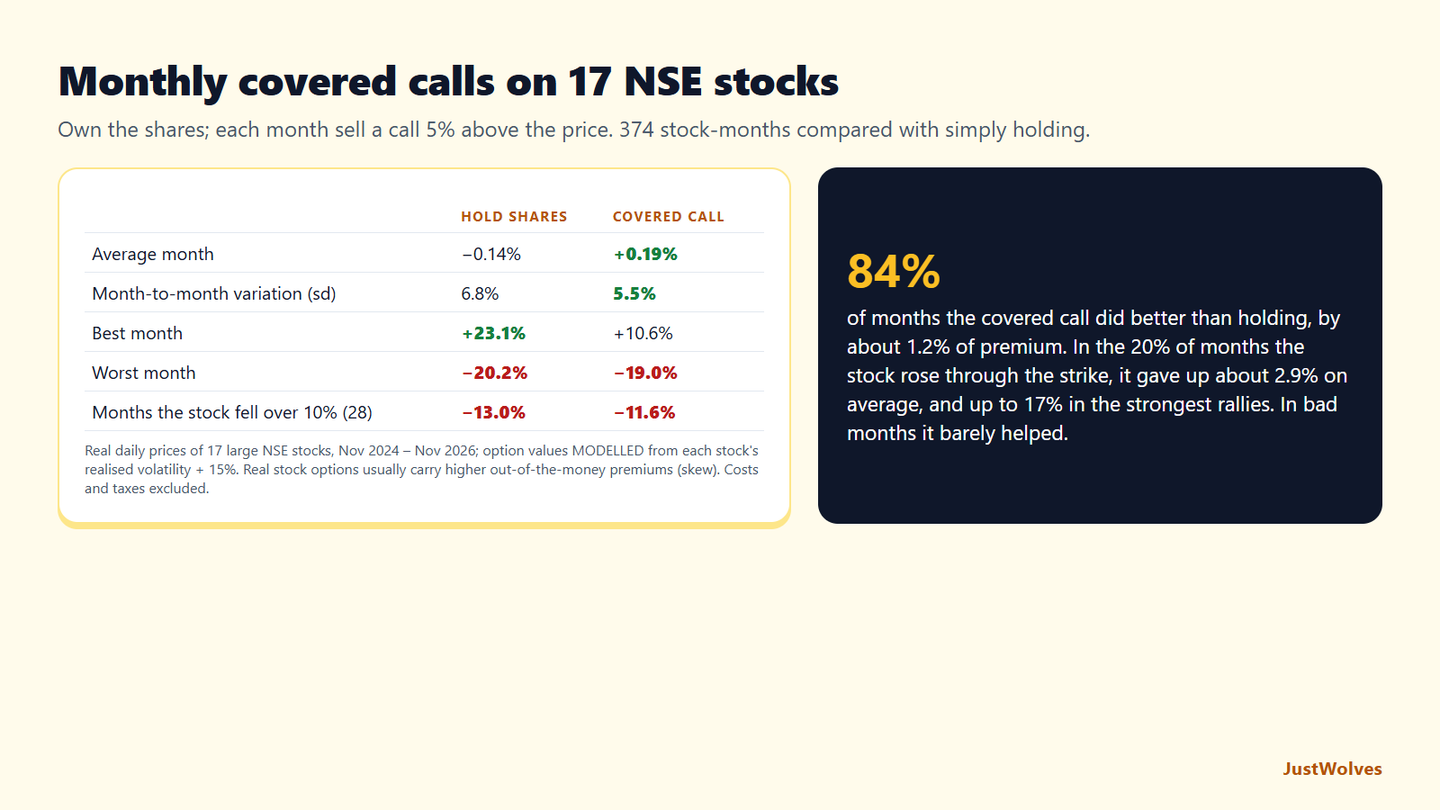
| Hold shares | Covered call | |
|---|---|---|
| Average month | −0.14% | +0.19% |
| Month-to-month variation (standard deviation) | 6.8% | 5.5% |
| Best month | +23.1% | +10.6% |
| Worst month | −20.2% | −19.0% |
| Average of the 28 months a stock fell more than 10% | −13.0% | −11.6% |
| Months the covered call did better | 84% | |
| Months the stock rose through the strike | 20%, giving up 2.9% on average |
Covered calls did better than holding in 84% of months, by the premium, about 1.2% a month on average in our model. That is the income this lesson describes, and over the whole period it lifted the average month from slightly negative to slightly positive.
The price was the best months. In the 20% of months when the stock rallied through the strike, the covered call gave up about 2.9% on average, and up to 17% in the strongest rallies, as in the SBI chart above. The best covered-call month was +10.6% against +23.1% for holding.
And the premium was not protection. In the 28 months when a stock fell more than 10%, the covered call lost 11.6% against 13.0% for holding: a cushion of about a percentage point and a half. This is the callout in this lesson, on real prices: the downside is almost entirely the shares' downside. Covered calls suit holdings you would happily sell at the strike, in stocks you expect to move sideways, not stocks you expect to rally.
Common Mistakes
- Selling calls below a price you'd be happy to sell at.
- Treating premium as protection against large falls.
- Forgetting physical settlement and delivery.
- Writing calls through results without accepting assignment.
- Ignoring tax consequences of shares being sold.
Professional Insight
Institutional investors use covered calls on positions where they'd welcome a sale at a higher price, effectively getting paid to place a sell order. The strategy works best on stable holdings rather than stocks expected to rally sharply.
Risk Considerations
- Full downside of the shares, less the premium.
- Capped upside.
- Delivery obligations at expiry.
Important Terminology
| Term | Meaning |
|---|---|
| Covered call | Owning shares and selling calls against them. |
| Called away | Shares delivered because the short call was exercised. |
| Roll | Buying back the call and selling a later one. |
| Income overlay | Option selling added to an existing holding. |
| Physical settlement | Delivery of shares at expiry. |
What is a covered call?
Owning shares and selling a call option on them to collect premium, capping upside at the strike.
Is a covered call safe?
It removes the unlimited risk of a naked call, but you still bear almost all the downside of owning the shares.
What happens if the call finishes in the money?
In India, stock options are physically settled, so you deliver your shares at the strike price.
Can I write covered calls on Nifty?
Only if you hold a matching long position, such as Nifty futures or an index-tracking portfolio; index options settle in cash, so the 'cover' is economic rather than delivery-based.
When do covered calls work best?
When the stock stays flat or rises modestly, up to the strike.
Do covered calls make more money than holding shares?
In quiet or falling months, slightly. In our test on 17 large NSE stocks with modelled premiums, monthly covered calls 5% out of the money beat holding in 84% of months, but gave up an average of 2.9%, and up to 17%, in the months the stock rallied through the strike.
How much does a covered call protect against a fall?
Very little. In our test, in months when a stock fell more than 10%, the covered call lost 11.6% on average against 13.0% for simply holding the shares. The premium is a small cushion, not a hedge.
Practical Exercise
Plan a covered call.
Your task
Step 1: Pick a stock you'd hold
In the F&O segment; note its lot size.
Step 2: Choose a strike
Above resistance, at a price you'd sell.
Step 3: Calculate
Premium income, maximum profit and breakeven.
Step 4: Plan
What you'll do if it's ITM near expiry.
Check Your Understanding
A covered call combines:
Related Lessons
Previous: Short Calls and Short Puts. Next: Cash-Secured Puts.