
Time Decay (Theta) for Option Sellers
JustWolves is an educational platform and is not a SEBI-registered investment advisor. Trading financial instruments involves significant risk of loss and may not be suitable for all investors. Past performance is not indicative of future results. Read our full disclaimer →
What you'll learn
- Sellers earn theta: the daily loss of time value in the options they've sold
- Decay is slow far from expiry and accelerates in the final days, especially for ATM options
- Theta and gamma rise together: the fastest decay comes with the highest risk of sharp losses
- Earning theta requires the underlying not to move too far; one large move can erase weeks of decay
- Sellers choose expiries by balancing decay speed against gamma risk
In this article · 16 sections
Time decay is the engine of option selling. Every day an option loses some of its time value, and that loss is the seller's gain. But decay isn't free money: the days when decay is fastest are also the days when options are most sensitive to price moves. This lesson looks at theta from the seller's side, and the trade-off with gamma that every seller manages.
What You Will Learn
- How sellers earn time decay
- How decay speed changes over an option's life
- The theta–gamma trade-off
- How decay influences expiry choice
Before You Start
Read Option Greeks: Theta, Vega and Rho and Option Buying vs Option Selling first.
The Seller's View of Decay
When you sell an option, you receive its full premium. If the underlying doesn't move, the option's value falls each day as time value decays, and your unrealised profit grows. By expiry, an OTM option is worth zero and you keep the full premium.
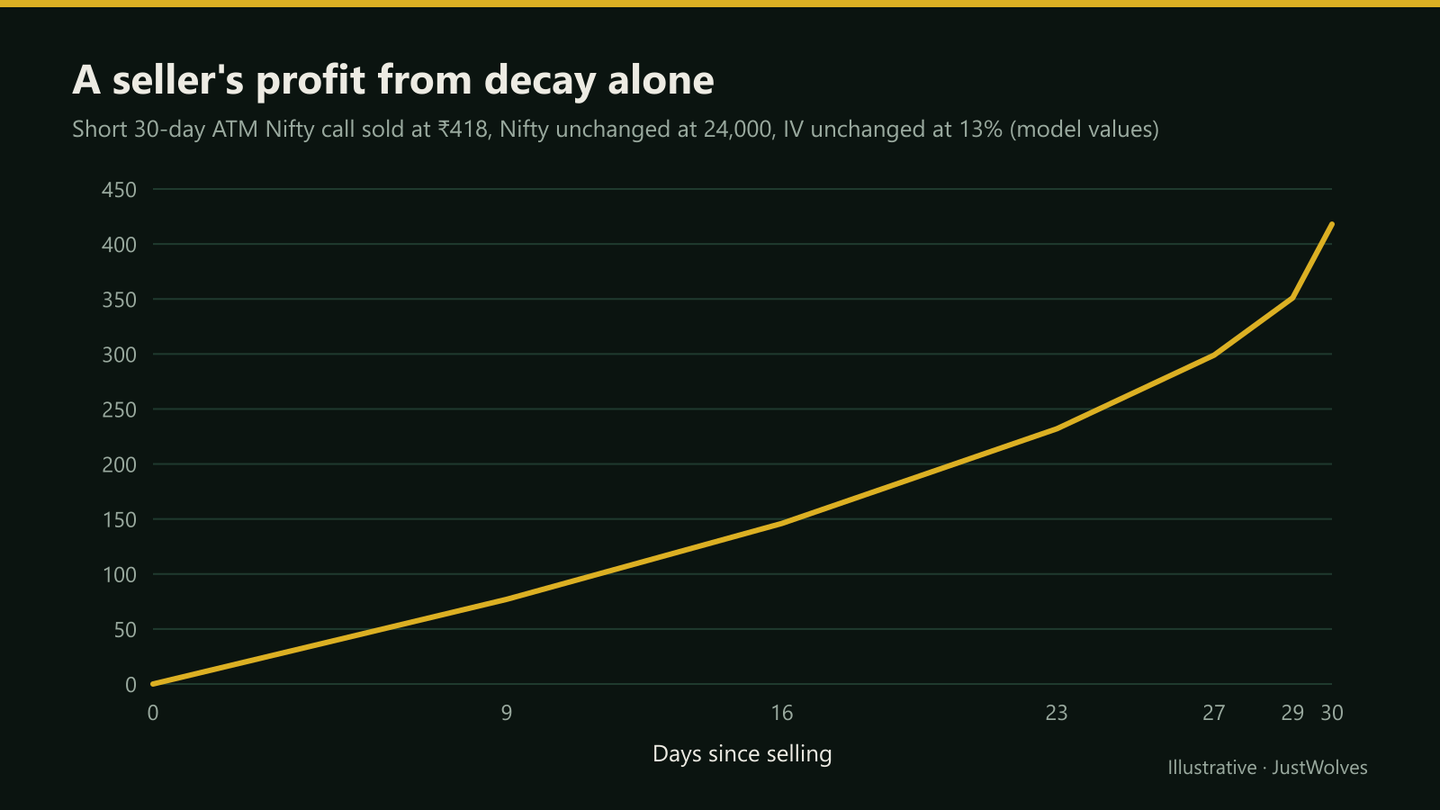
Decay Accelerates
In the example, the first nine days earn about ₹77 per unit; the final seven days earn about ₹186. Decay of an ATM option speeds up as expiry nears, roughly in line with the square root of time remaining.
OTM options decay differently: their value is smaller and falls away more steadily, approaching zero well before expiry if the price stays far from the strike.
The Theta–Gamma Trade-Off
The same conditions that make theta large make gamma large: an ATM option close to expiry. High gamma means delta changes quickly, so a modest move against a short position can turn a small profit into a large loss within hours.
Put simply, sellers are paid theta for carrying gamma risk. The faster the decay, the more dangerous the position.
Real Prices: Decay and Gamma in One Month
The decay chart above assumes NIFTY stands still. The chart below shows the same short at-the-money call on a real month, November to December 2025, when NIFTY wandered above and below the strike and finished almost exactly on it. The call is valued each day by a standard pricing model.
Real NIFTY prices: a short call's decay and gamma, November–December 2025
Step 1 of 4
Selling a month of time
On 12 November 2025 NIFTY closes at 25,876. A seller writes one lot of the 25,900 call expiring on 11 December, modelled at about 314 points: ₹20,400, like Sunil in this lesson.
- What to observe
- Almost all of it is time value.
- Condition
- The seller needs time to pass without a rally.
Choosing Expiry as a Seller
| Expiry | Decay per day | Gamma risk | Typical use |
|---|---|---|---|
| Weekly, last few days | Fastest | Highest | Experienced sellers, small sizes, tight risk rules |
| Two to four weeks | Moderate | Moderate | Many spread and condor sellers |
| One to two months | Slower | Lower | Smoother P&L, more time for adjustments |
Weekends and Holidays
Calendar days pass over weekends and holidays, so decay continues even when markets are closed. Premiums usually reflect this ahead of time, so sellers don't collect a free 'weekend bonus'. Meanwhile, gap risk over the closure is real.
OTM Options Decay Differently
Sellers often prefer OTM options because the underlying has to move further before the position loses money. Their decay profile is different from ATM options: an OTM option's small premium tends to bleed away steadily, and it can lose most of its value well before expiry if the price stays away.
The trade-off is that OTM premiums are small. A seller collecting ₹40 per unit on a far OTM option needs only a modest adverse move for the option to double or triple in value, wiping out many weeks of similar small gains. Decay feels reliable until the move arrives.
Practical Example
Hypothetically, Sunil sells one lot of a 30-day ATM Nifty call at ₹418, collecting ₹27,170. After 23 days with Nifty unchanged, it's worth about ₹186: an unrealised profit of ₹15,080.
With seven days left, he faces a choice: hold for the remaining ₹186 of decay, now with much higher gamma, or close and lock in most of the profit. He closes, reasoning that the remaining reward doesn't justify the increased risk of a sharp move.
When Do Sellers Actually Earn Decay? Our Test
JustWolves sold a 30-day at-the-money NIFTY straddle every week on about two years of real prices (November 2024 to November 2026), with values modelled from recent realised volatility plus 15%, and split each trade's result into its four weeks. We also compared holding to expiry with closing once 50% of the premium had been captured, the habit this lesson's professional insight describes. The average premium collected was 773 points.
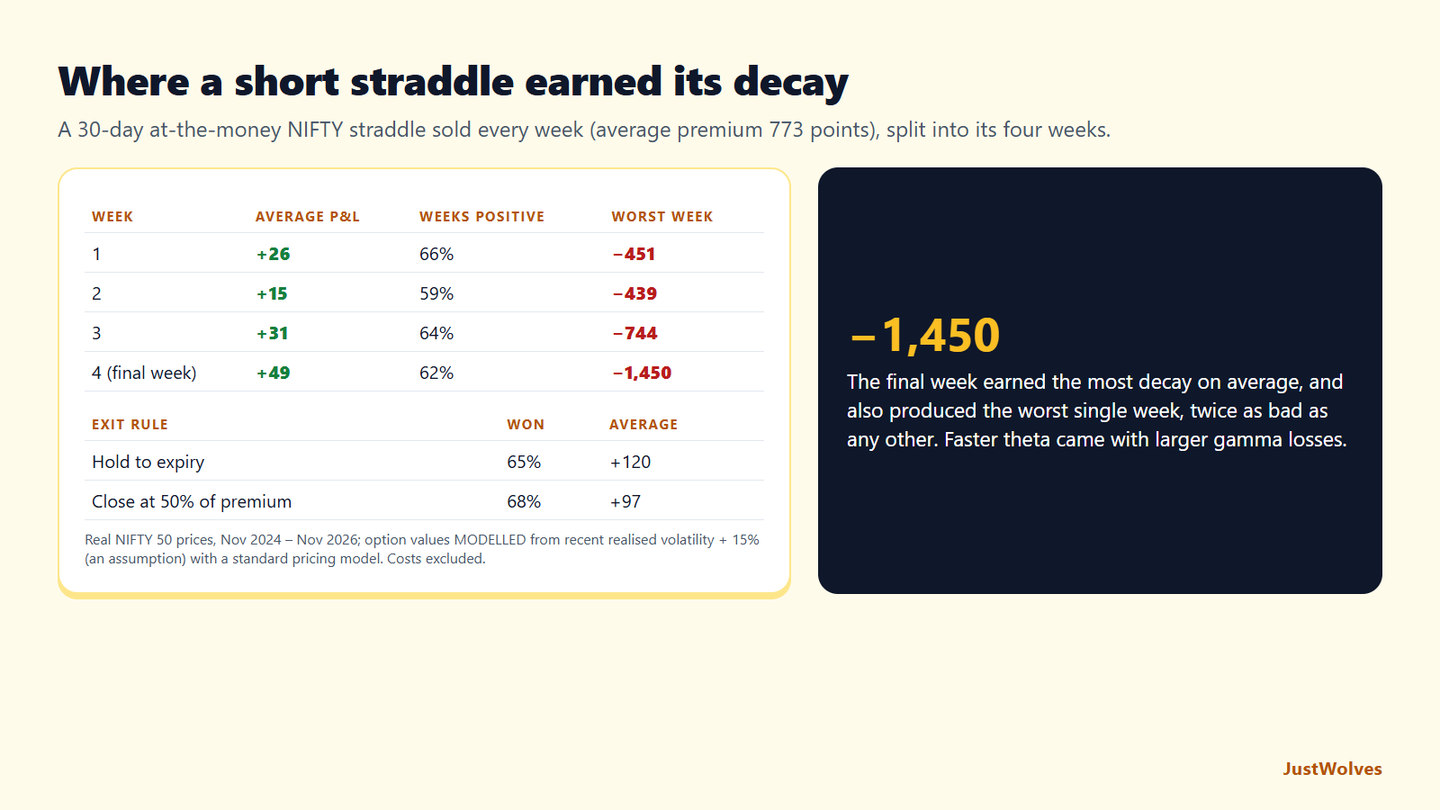
| Week | Average P&L | Weeks positive | Worst week |
|---|---|---|---|
| 1 | +26 | 66% | −451 |
| 2 | +15 | 59% | −439 |
| 3 | +31 | 64% | −744 |
| 4 (final week) | +49 | 62% | −1,450 |
| Exit rule | Won | Average | Worst |
|---|---|---|---|
| Hold to expiry | 65% | +120 points | −2,143 |
| Close when 50% of the premium is captured | 68% | +97 points | −2,143 |
Decay did accelerate: the final week earned more on average, +49 points, than any other. So did the risk. The worst final week lost 1,450 points, twice the worst loss in any earlier week, and the share of profitable weeks did not rise. That is the theta–gamma trade-off in this lesson, measured: the seller was paid more for the last week because it was the most dangerous week to hold.
Taking profit at 50% changed the shape, not the danger. It won slightly more often and gave up some average profit, about 23 points a trade, because winners were cut short. But it did nothing for the worst trade, which never reached the target before going wrong. Closing early protects profits that already exist; it is not a stop-loss. Sunil's decision in this lesson, to close with a week left, is a reasonable trade-off, but it needs a separate rule for when the trade moves against him.
Common Mistakes
- Selling only the last days of weekly expiry because decay is fastest.
- Holding to the final day for the last few rupees.
- Ignoring gamma while focusing on theta.
- Assuming weekends are free decay.
- Selling large size in high-gamma periods.
Professional Insight
Many experienced sellers close positions once they've captured a large share of the available premium, often 50–75%, rather than holding to expiry. The remaining decay is small compared with the gamma risk of the final days. They also avoid opening new short positions in the final day or two unless the position is hedged, because the risk per rupee of remaining premium is at its highest then. Profit targets, rather than expiry, decide when most of their trades end, which keeps the theta they collect from being handed back in a single late move.
Risk Considerations
- Gamma risk peaks when decay is fastest.
- Gaps skip stops over weekends and holidays.
- Large moves erase accumulated decay.
Important Terminology
| Term | Meaning |
|---|---|
| Theta | Daily change in option value from time passing. |
| Gamma | How fast delta changes. |
| Short gamma | A position hurt by large moves. |
| Time value | The part of premium that decays. |
| Profit target (sellers) | Closing once a set share of premium is captured. |
How do option sellers make money from time decay?
They receive the full premium upfront; as time value decays, the option's value falls and they can buy it back cheaper or let it expire.
When is theta decay fastest?
For ATM options in the final days before expiry.
Why not always sell options on the last day?
Because gamma is extreme then, so small moves can cause large losses.
Do options decay over weekends?
Calendar time passes, but premiums usually anticipate it, so there's no guaranteed weekend gain.
Should I hold short options to expiry?
Many sellers close early after capturing most of the premium, because the remaining decay is small relative to the risk.
Is it better to take profit at 50% on short options?
In our NIFTY test, closing short straddles at 50% of the premium won slightly more often than holding (68% vs 65%) but earned less on average (97 vs 120 points). It did not reduce the worst loss, so it needs a separate stop or adjustment rule.
Which week of an option's life earns the most decay?
The last one. In our test of 30-day NIFTY straddles, the final week earned an average of 49 points against 15 to 31 in earlier weeks. It also produced the worst single week, a loss of 1,450 points, because gamma is highest then.
Practical Exercise
Track decay and gamma.
Your task
Step 1: Paper-sell an ATM option
With about 30 days to expiry.
Step 2: Record daily
Its price, theta and gamma.
Step 3: Note
When theta doubles from its starting level, what has gamma done?
Step 4: Decide
At what point would you have closed?
Check Your Understanding
Option sellers benefit from:
Related Lessons
Previous: Option Buying vs Option Selling. Next: Implied Volatility and Volatility Crush.