
Iron Condor: A Defined-Risk Range Strategy
JustWolves is an educational platform and is not a SEBI-registered investment advisor. Trading financial instruments involves significant risk of loss and may not be suitable for all investors. Past performance is not indicative of future results. Read our full disclaimer →
What you'll learn
- An iron condor combines a bull put spread and a bear call spread with the same expiry
- It profits if the underlying stays between the two short strikes
- Maximum profit = total credit; maximum loss = width of one spread − total credit
- It's the defined-risk version of a short strangle, with much lower margin
- Only one side can lose at expiry, but the loss is usually larger than the credit
In this article · 16 sections
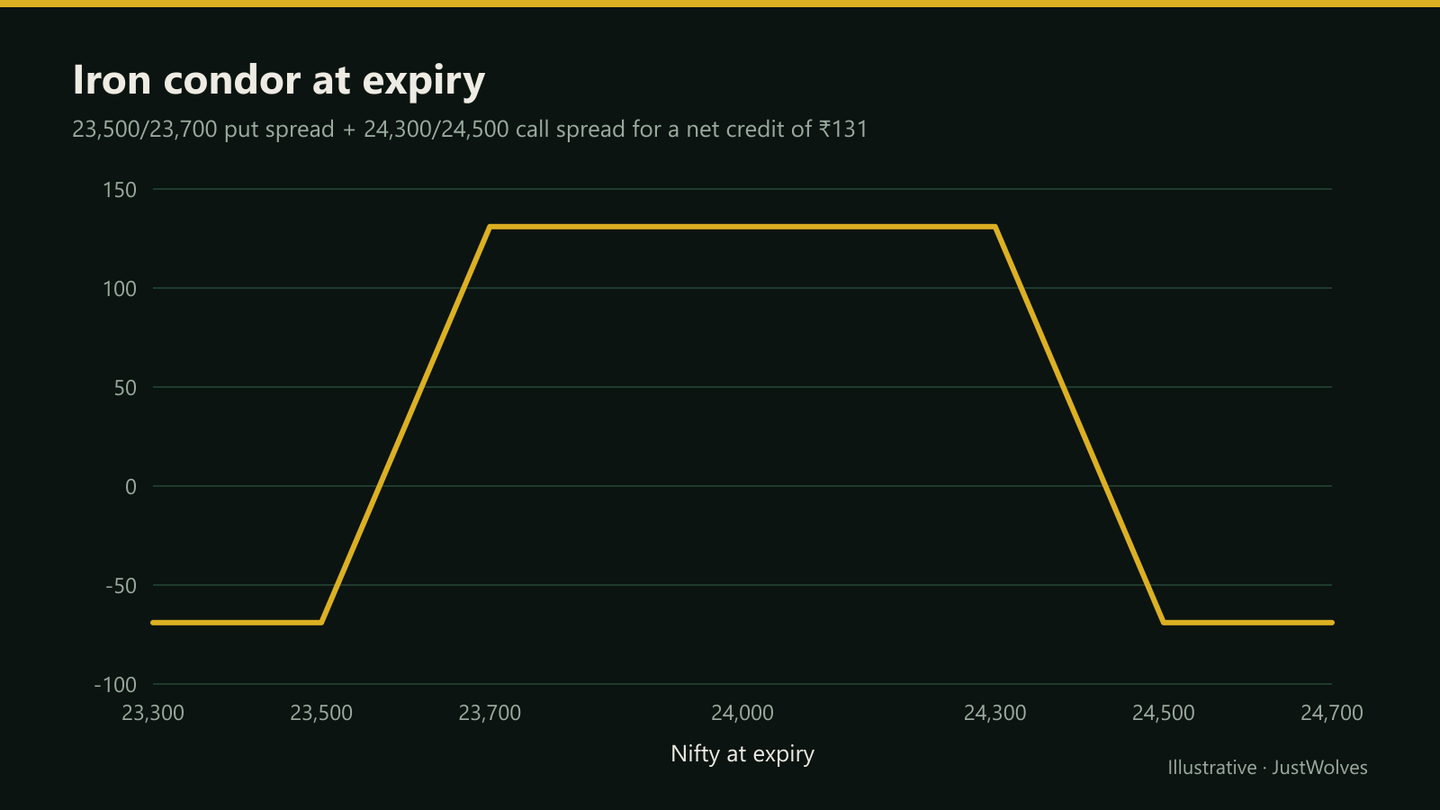
An iron condor sells a strangle and buys protection on both sides. It's two credit spreads at once: a bull put spread below the market and a bear call spread above it. If the market stays between the short strikes, all four options expire worthless and you keep the credit. If it breaks out, the bought options cap the loss. That defined risk makes the iron condor the most widely used range strategy among disciplined option sellers.
What You Will Learn
- How an iron condor is built
- Its maximum profit, maximum loss and breakevens
- How to choose strikes and wing width
- How to manage it
Before You Start
Read Credit Spreads Explained and Short Strangle first.
How It's Built
| Leg | Action | Premium |
|---|---|---|
| 23,500 put | Buy | −127 |
| 23,700 put | Sell | +184 |
| 24,300 call | Sell | +275 |
| 24,500 call | Buy | −201 |
| Net credit | +131 |
The Numbers
| Measure | Per unit | Per lot |
|---|---|---|
| Maximum profit | ₹131 | ₹8,515 |
| Maximum loss | ₹69 (200 − 131) | ₹4,485 |
| Lower breakeven | 23,569 | — |
| Upper breakeven | 24,431 | — |
Choosing Strikes and Width
- Short strikes: outside the expected move, or beyond support and resistance.
- Wing width: wider wings collect more credit but raise the maximum loss; narrower wings do the opposite.
- Credit relative to width: many sellers look for a total credit of about a quarter to a third of one wing's width.
- Balance: some sellers place the put side further away, because sharp falls are more common than sharp rallies.
Why Only One Side Can Lose
At expiry, Nifty can't be below the put spread and above the call spread at the same time, so the maximum loss is the width of one spread minus the credit, not both. That's why brokers often charge margin close to a single spread's requirement for a balanced condor. Before expiry, though, a sharp move can still produce large mark-to-market losses on the threatened side.
Managing an Iron Condor
- Profit target: close at 50% of the credit; the last half is slow and risky to collect.
- Loss limit: close if the condor's value reaches, for example, twice the credit, or if a short strike is breached.
- Close the threatened side: some traders close only the spread under pressure and leave the other to expire.
- Time: avoid holding into the final days with the market near a short strike.
Iron Condor vs Short Strangle
The condor gives up part of the strangle's premium to buy the wings. In return, its worst case is known in advance and its margin is much lower, so the same capital can support a smaller position with far less tail risk.
The wings also reduce vega exposure. When implied volatility spikes, a condor loses less than a strangle with the same short strikes, because the bought options gain value too. That protection is most valuable in exactly the conditions that do the most damage to naked sellers.
Real Prices: Tested and Kept
The chart below follows an iron condor through a real month of NIFTY 50 prices, July to August 2026, in which the market rallied straight through the short call before turning back. The condor is valued each day by a standard pricing model.
Real NIFTY prices: an iron condor tested and kept, July–August 2026
Step 1 of 4
Building the condor
On 23 July 2026 NIFTY closes at 23,870. A trader sells the 24,750 call and 23,250 put, each about 0.20 delta, and buys the 24,950 call and 23,050 put as wings, expiring on 21 August. Net credit about 67 points, ₹4,350 per lot; maximum loss 133 points, about ₹8,650.
- What to observe
- Like Arjun in this lesson, on a real month.
- Condition
- Loss limit: a condor value of twice the credit, about 134.
Practical Example
Hypothetically, Nifty has ranged between 23,750 and 24,250 for a month. Arjun sells the 30-day 23,500/23,700/24,300/24,500 iron condor for ₹131, collecting ₹8,515 per lot, with a maximum loss of ₹4,485.
His target is a condor value of ₹65; his loss limit is ₹200. After 18 days, Nifty is at 24,050 but the condor still trades near ₹97, because time value decays slowly at first. Six days later, with six days left, it reaches about ₹66 and he closes for (131 − 66) × 65 = ₹4,225 per lot.
Iron Condor vs Strangle: Our Two-Year Test
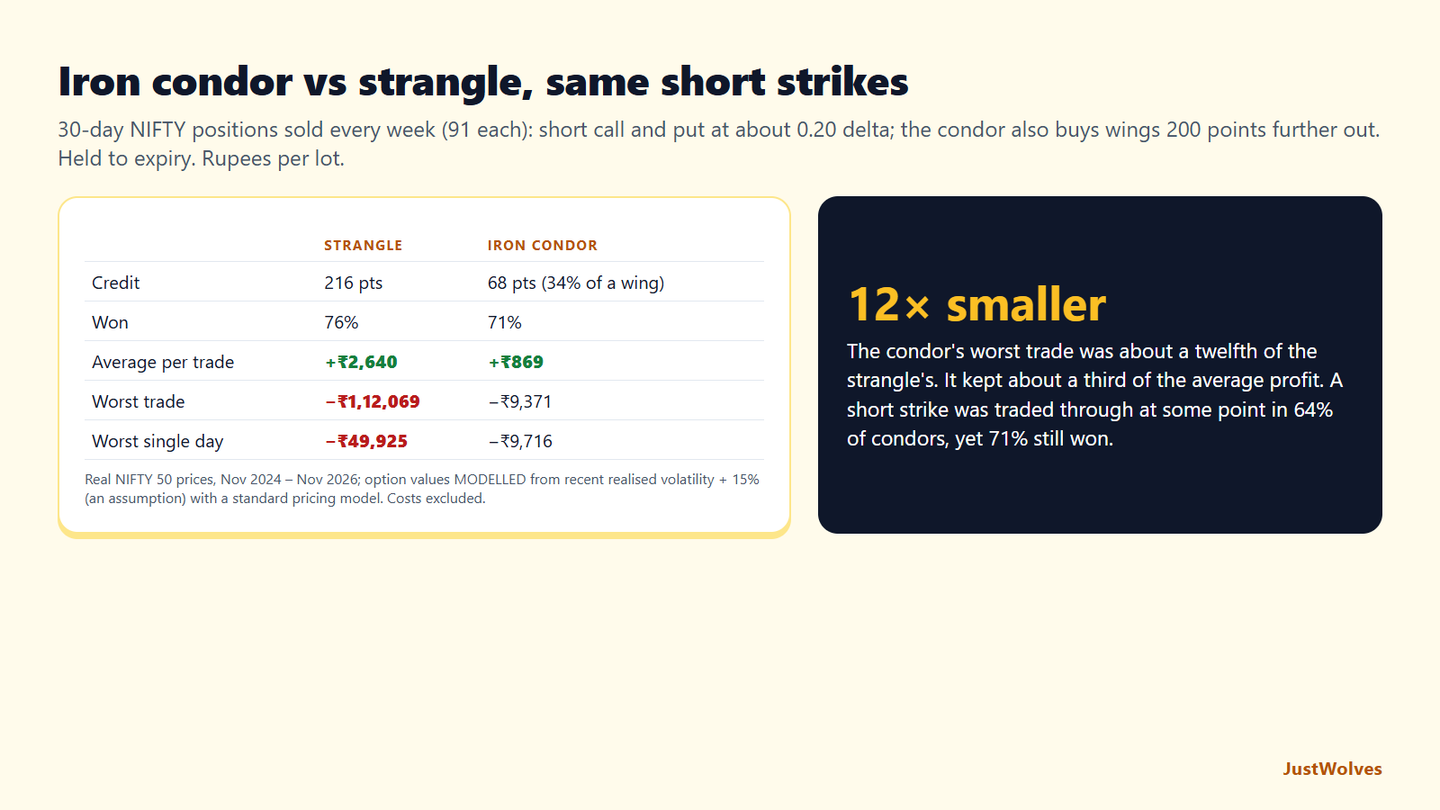
To measure what the wings buy, JustWolves sold two positions every week for about two years of real NIFTY 50 prices (November 2024 to November 2026): a 30-day short strangle with the call and put each at about 0.20 delta, and an iron condor with the same short strikes plus wings 200 points further out. Both were held to expiry, 91 trades each, and we also ran the condor with a 50% target and a loss limit at twice the credit. Values were modelled from recent realised volatility plus 15%.
| Short strangle | Iron condor | Iron condor, 50% target and 2× limit | |
|---|---|---|---|
| Credit | 216 points | 68 points | 68 points |
| Won | 76% | 71% | 73% |
| Average per trade | +₹2,640 | +₹869 | +₹499 |
| Worst trade | −₹1,12,069 | −₹9,371 | −₹7,904 |
| Worst single day | −₹49,925 | −₹9,716 | −₹8,191 |
The wings did exactly what this lesson says. With the same short strikes, the condor's worst trade lost about ₹9,400 against ₹1,12,000 for the strangle, and its worst day about ₹9,700 against ₹50,000. It kept about a third of the strangle's average profit and won almost as often. That is the trade-off in the comparison section of this lesson: a smaller, known worst case for a smaller credit.
Being tested was normal. NIFTY traded through one of the short strikes at some point in 64% of condors, yet 71% still finished profitable at expiry, as in the chart above. A condor whose short strike is touched is not automatically a losing trade; the loss limit and the wings decide how much a real break costs.
One assumption in this lesson's strike section did not hold in our data. It suggests placing the put side further away because sharp falls are more common than sharp rallies. In our two years, NIFTY had 20 five-day rises of more than 4% and only 6 five-day falls of that size, so condors were tested on the call side as often as the put side. Over longer histories, falls have often been the faster move; a balanced condor was the better fit for this period.
Common Mistakes
- Tiny credits for very wide ranges, where costs eat the profit.
- Holding to maximum loss instead of exiting at a limit.
- Ignoring trend: condors in strongly trending markets get tested quickly.
- Removing wings to collect more premium.
- Legging in and out with naked short exposure.
Professional Insight
Experienced condor traders treat each trade as one of many. Their focus is on consistent entry criteria (IV, distance, credit) and strict exits, so that the frequent small wins and occasional capped losses produce a positive result over a large number of trades, after costs.
Risk Considerations
- Maximum loss usually exceeds maximum profit in real markets.
- Sharp trends test one side quickly.
- Four legs mean four sets of costs.
Important Terminology
| Term | Meaning |
|---|---|
| Iron condor | A bull put spread plus a bear call spread. |
| Wings | The bought options that cap the loss. |
| Body | The short strikes. |
| Wing width | Distance between short and long strikes. |
| Net credit | Total premium received minus paid. |
What is an iron condor?
A four-leg strategy combining a bull put spread and a bear call spread, profiting if the market stays between the short strikes.
What is the maximum loss on an iron condor?
The width of one spread minus the total credit received.
Is an iron condor safer than a short strangle?
It has a defined maximum loss and lower margin, at the cost of a smaller credit.
When should I close an iron condor?
Many traders close at about 50% of the credit, or at a set loss limit.
Can both sides lose?
Not at expiry, but both sides can show mark-to-market losses before expiry if volatility rises.
How much does an iron condor reduce risk compared with a strangle?
In our test on two years of real NIFTY prices, an iron condor with 200-point wings and the same 0.20-delta short strikes had a worst trade of about ₹9,400 per lot, against ₹1,12,000 for the strangle, and a worst day of ₹9,700 against ₹50,000.
Should I close an iron condor when a short strike is touched?
Not automatically. In our NIFTY test, a short strike was traded through at some point in 64% of 30-day condors, yet 71% still made money at expiry. Use a pre-set loss limit, such as twice the credit, rather than the touch alone.
Practical Exercise
Build an iron condor.
Your task
Step 1: Find the range
Recent support and resistance for Nifty.
Step 2: Choose strikes
Short strikes beyond the range; wings 100–200 points further.
Step 3: Calculate
Credit, maximum loss and breakevens per lot.
Step 4: Size
Lots that keep maximum loss within your risk limit.
Check Your Understanding
An iron condor combines:
Related Lessons
Previous: Short Strangle. Next: Iron Butterfly. See also Credit Spreads Explained.