
Iron Butterfly: A Hedged Short Straddle
JustWolves is an educational platform and is not a SEBI-registered investment advisor. Trading financial instruments involves significant risk of loss and may not be suitable for all investors. Past performance is not indicative of future results. Read our full disclaimer →
What you'll learn
- An iron butterfly sells an ATM call and put and buys an OTM call and put as wings
- It's a short straddle with a capped loss: maximum loss = wing width − net credit
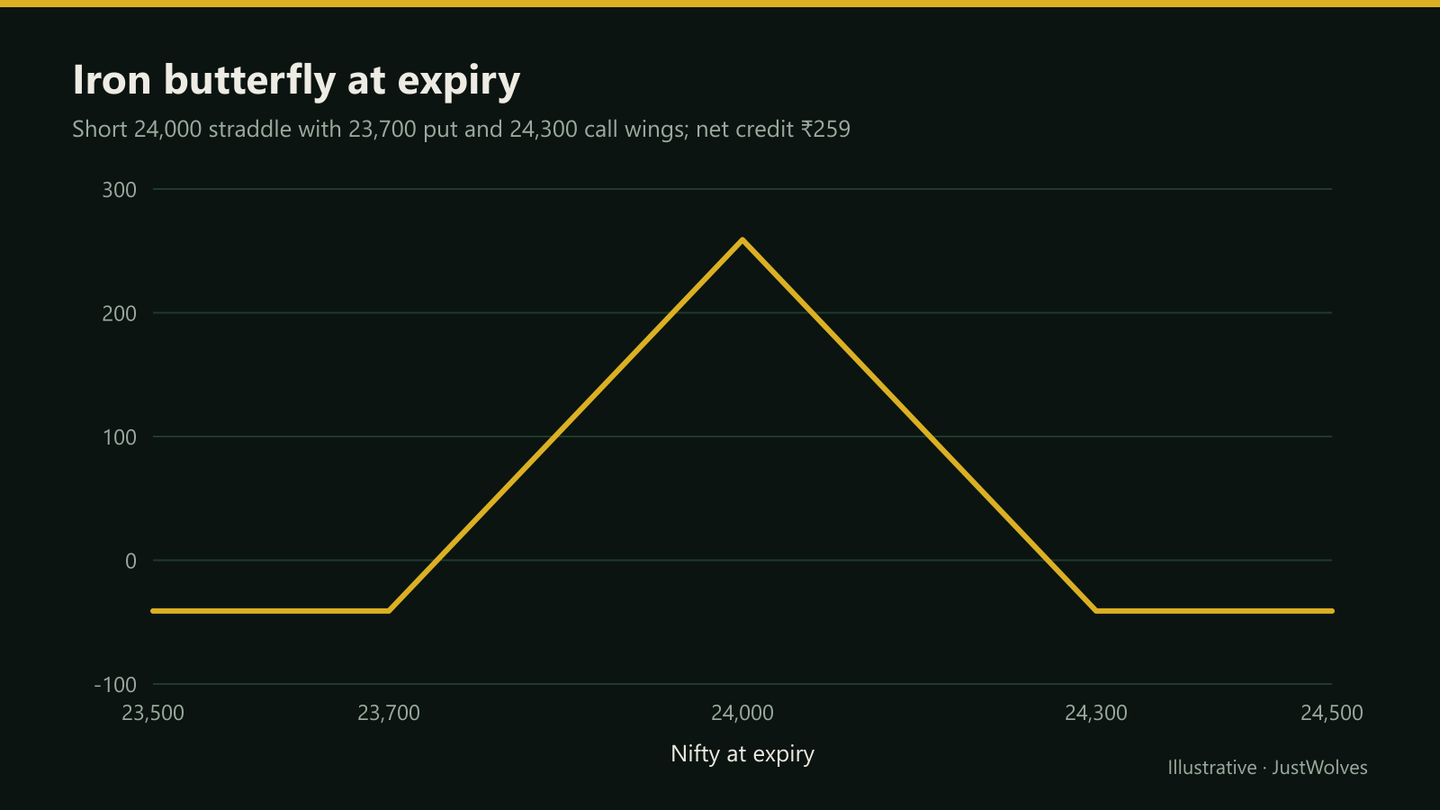
- Maximum profit is the net credit, reached only if the underlying finishes at the short strike
- It collects a larger credit than an iron condor but has a narrower profit zone
- In practice, it's usually closed early for a share of the credit rather than held for maximum profit
In this article · 17 sections
The iron butterfly takes the short straddle, the highest-premium selling strategy, and adds protection on both sides. You sell the at-the-money call and put, then buy an out-of-the-money call and put as wings. The wings cost part of the premium but cap the loss, turning an unlimited-risk trade into a defined-risk one. This lesson explains the structure, its numbers and how it compares with the iron condor.
What You Will Learn
- How an iron butterfly is built
- Its profit, loss and breakevens
- How it compares with a short straddle and an iron condor
- How to manage it
Before You Start
Read Short Straddle and Iron Condor first.
How It's Built
| Leg | Action | Premium |
|---|---|---|
| 23,700 put | Buy | −184 |
| 24,000 put | Sell | +300 |
| 24,000 call | Sell | +418 |
| 24,300 call | Buy | −275 |
| Net credit | +259 |
The Numbers
| Measure | Per unit | Per lot |
|---|---|---|
| Maximum profit (at 24,000) | ₹259 | ₹16,835 |
| Maximum loss (beyond a wing) | ₹41 (300 − 259) | ₹2,665 |
| Lower breakeven | 23,741 | — |
| Upper breakeven | 24,259 | — |
Compared with Its Relatives
| Short straddle | Iron butterfly | Iron condor | |
|---|---|---|---|
| Maximum loss | Unlimited / very large | Wing width − credit | Wing width − credit |
| Credit | Largest | Large | Smaller |
| Profit zone | Narrow | Narrow | Wider, flat top |
| Margin | Highest | Low | Low |
Managing an Iron Butterfly
Because maximum profit requires a finish exactly at the short strike, iron butterflies are almost always closed before expiry. Note that most of their value change comes late: the wings offset much of the early decay, so profits build slowly for the first weeks. Common rules are to take profit at 20–40% of the credit, and to exit if the underlying moves outside the breakevens before expiry.
As expiry approaches, the profit zone narrows sharply in practice: small moves cause large swings in the position's value. Many traders avoid holding iron butterflies into the final two or three days.
Real Prices: Paid Late, and Only at the Body
This lesson says iron butterflies change value slowly at first and quickly near expiry. The chart below shows that on real NIFTY 50 prices from May and June 2025, in one of the most favourable months in our test, with the position valued each day by a standard pricing model.
Real NIFTY prices: an iron butterfly that paid late, May–June 2025
Step 1 of 4
Selling the butterfly
On 21 May 2025 NIFTY closes at 24,813, after a volatile spring: recent volatility is about 17.5%. A trader sells the 24,800 call and put and buys the 25,100 call and 24,500 put, expiring on 19 June, for a modelled credit of about 273 points: ₹17,770 per lot. Maximum loss: 27 points, about ₹1,750.
- What to observe
- The model, without skew, makes the credit a large share of the width.
- Condition
- Like Ramesh in this lesson: elevated volatility, a market that has settled.
When It Fits
Iron butterflies suit a view that the market will stay close to its current level, often after a large move has exhausted itself, or when implied volatility is high and expected to fall. They're less suitable in trending markets, where the narrow profit zone is quickly left behind.
The Greeks of an Iron Butterfly
Like the short straddle, an iron butterfly starts close to delta-neutral, with negative gamma, positive theta and negative vega. The wings reduce all three: the bought options have their own gamma, theta and vega, which partly offset the short straddle's.
That offset is why the position changes value slowly at first and quickly in the final days. Early on, the wings and the body decay at similar rates. Near expiry, the ATM short options lose time value much faster than the OTM wings, and the position's sensitivity to price moves rises sharply. Traders who understand this tend to plan exits around the last week rather than the first.
Skewed or Broken-Wing Versions
Some traders place one wing further away than the other, creating a broken-wing butterfly. Moving the call wing further out, for example, collects a little more credit and leaves more room for a rally, at the cost of a larger maximum loss on that side. It's a way to tilt the position toward a mild directional view while keeping the loss defined.
Practical Example
Hypothetically, after a sharp rally, Nifty has settled at 24,000 and India VIX is elevated. Ramesh sells the 30-day 23,700/24,000/24,300 iron butterfly for ₹259, collecting ₹16,835 per lot, with a maximum loss of ₹2,665.
His target is 30% of the credit, a value of about ₹181. Ten days later, Nifty is at 24,040 but the butterfly still trades near ₹248: the bought wings offset much of the decay, so the position gains slowly at first. Only with three days left does it reach about ₹185. Ramesh closes then for (259 − 185) × 65 = ₹4,810, rather than holding through the highest-gamma days.
When Do Iron Butterflies Pay? Our Test
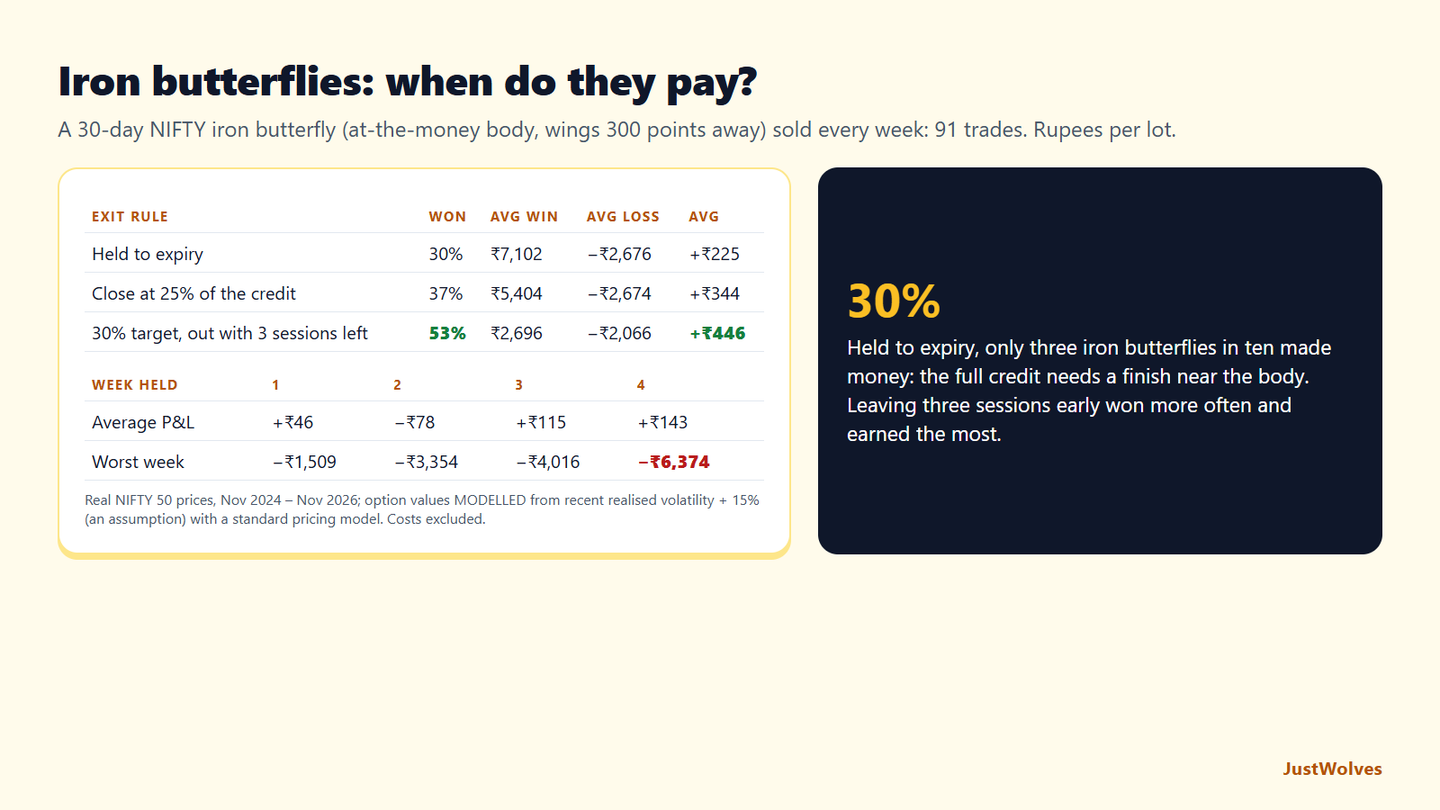
JustWolves sold a 30-day NIFTY iron butterfly every week for about two years (November 2024 to November 2026): an at-the-money body with wings 300 points away, 91 trades. We compared holding to expiry with closing at a 25% target, and with a 30% target plus closing with three sessions left, and split the results by week. The model has no volatility skew, so its credits were about 86% of the wing width on average, larger than real markets usually offer; the maximum loss in this test was therefore small, about ₹2,700 per lot.
| Exit rule | Won | Average win | Average loss | Average per trade |
|---|---|---|---|---|
| Held to expiry | 30% | ₹7,102 | −₹2,676 | +₹225 |
| Close at 25% of the credit | 37% | ₹5,404 | −₹2,674 | +₹344 |
| 30% target, close with three sessions left | 53% | ₹2,696 | −₹2,066 | +₹446 |
| Week | 1 | 2 | 3 | 4 |
|---|---|---|---|---|
| Average P&L | +₹46 | −₹78 | +₹115 | +₹143 |
| Weeks positive | 58% | 54% | 53% | 26% |
| Worst week | −₹1,509 | −₹3,354 | −₹4,016 | −₹6,374 |
Held to expiry, only 30% of iron butterflies made money. As this lesson's callout says, the full credit needs a finish close to the body, and in most months NIFTY ended more than a few hundred points away. The winners were large and the losers small, which kept the average slightly positive, but the strategy lost far more often than it won.
The final week decided most trades. It produced the largest average gain and the largest swings: it was positive in only 26% of trades, and its worst week lost more than any earlier one. That matches this lesson's advice to avoid holding into the final days. Leaving with three sessions to go raised the win rate to 53% and produced the best average result. The profit gave up near expiry was smaller than the losses avoided.
Remember the skew caveat: with real market prices, credits are a smaller share of the width, so the maximum loss is larger than in this test and the case for early exits is stronger still.
Common Mistakes
- Holding for the full credit, which requires an exact pin.
- Using it in strong trends.
- Wings too wide, inflating the maximum loss.
- Holding into the final days when the value swings sharply.
- Ignoring costs on four legs.
Professional Insight
Many experienced traders see the iron butterfly as the responsible way to express a short-straddle view. The wings cost a little premium, but they remove the scenario that ends careers: a single, unhedged, unlimited loss.
Risk Considerations
- Narrow profit zone.
- Maximum loss reached on modest moves near expiry.
- Execution risk across four legs.
Important Terminology
| Term | Meaning |
|---|---|
| Iron butterfly | Short ATM straddle plus long OTM wings. |
| Body | The short ATM call and put. |
| Wings | The bought OTM call and put. |
| Pin | Finishing exactly at a strike. |
| Net credit | Premium received minus premium paid. |
What is an iron butterfly?
A four-leg strategy that sells an ATM call and put and buys OTM call and put wings, for a net credit.
What is the maximum loss?
The wing width minus the net credit received.
Iron butterfly or iron condor?
The butterfly collects more but needs the market to stay closer to the strike; the condor profits over a wider range.
When is maximum profit earned?
Only if the underlying finishes exactly at the short strike at expiry.
When should I close an iron butterfly?
Many traders close at 20–40% of the credit, well before expiry.
How often does an iron butterfly make money?
Held to expiry, not often. In our test of 30-day NIFTY iron butterflies with wings 300 points away, 30% made money at expiry. Closing at a 30% target or with three sessions left raised that to 53%.
Why does an iron butterfly gain so slowly at first?
Because the bought wings decay too, offsetting much of the body's time decay in the early weeks. In our NIFTY test, the first two weeks earned almost nothing on average; most of the change in value came in the final week.
Practical Exercise
Compare three structures.
Your task
Step 1: Price three trades
A short straddle, an iron butterfly with 300-point wings, and an iron condor, all on Nifty.
Step 2: Calculate
Credit, maximum loss and breakevens for each.
Step 3: Check margin
For each in your broker's calculator.
Step 4: Decide
Which fits your risk limit per lot?
Check Your Understanding
An iron butterfly is:
Related Lessons
Previous: Iron Condor. Next: Calendar Spreads.