
Short Strangle: Selling OTM Calls and Puts
JustWolves is an educational platform and is not a SEBI-registered investment advisor. Trading financial instruments involves significant risk of loss and may not be suitable for all investors. Past performance is not indicative of future results. Read our full disclaimer →
What you'll learn
- A short strangle sells an OTM call and an OTM put with the same expiry
- It profits across a range between the two strikes, wider than a straddle's peak
- It collects less premium than a straddle and has unlimited (upside) and very large (downside) risk
- Strikes are commonly chosen outside the expected move or beyond support and resistance
- The hedged version, the iron condor, caps the loss and is the practical choice for most traders
In this article · 17 sections
A short strangle sells an out-of-the-money call and an out-of-the-money put. Compared with a straddle, it collects less premium but profits across a wider range, which makes it one of the most popular range-bound selling strategies. Like the straddle, it carries unlimited risk on the upside and very large risk on the downside. This lesson explains the trade-offs and the rules that keep it survivable.
What You Will Learn
- How a short strangle is built
- Its profit range, breakevens and maximum loss
- How to choose strikes
- Management rules and the hedged alternative
Before You Start
Read Short Straddle first.
How It's Built
- Sell one OTM call above the current price.
- Sell one OTM put below the current price, same expiry.
- Receive the combined premium.
The Numbers
| Measure | Per unit | Per lot (65) |
|---|---|---|
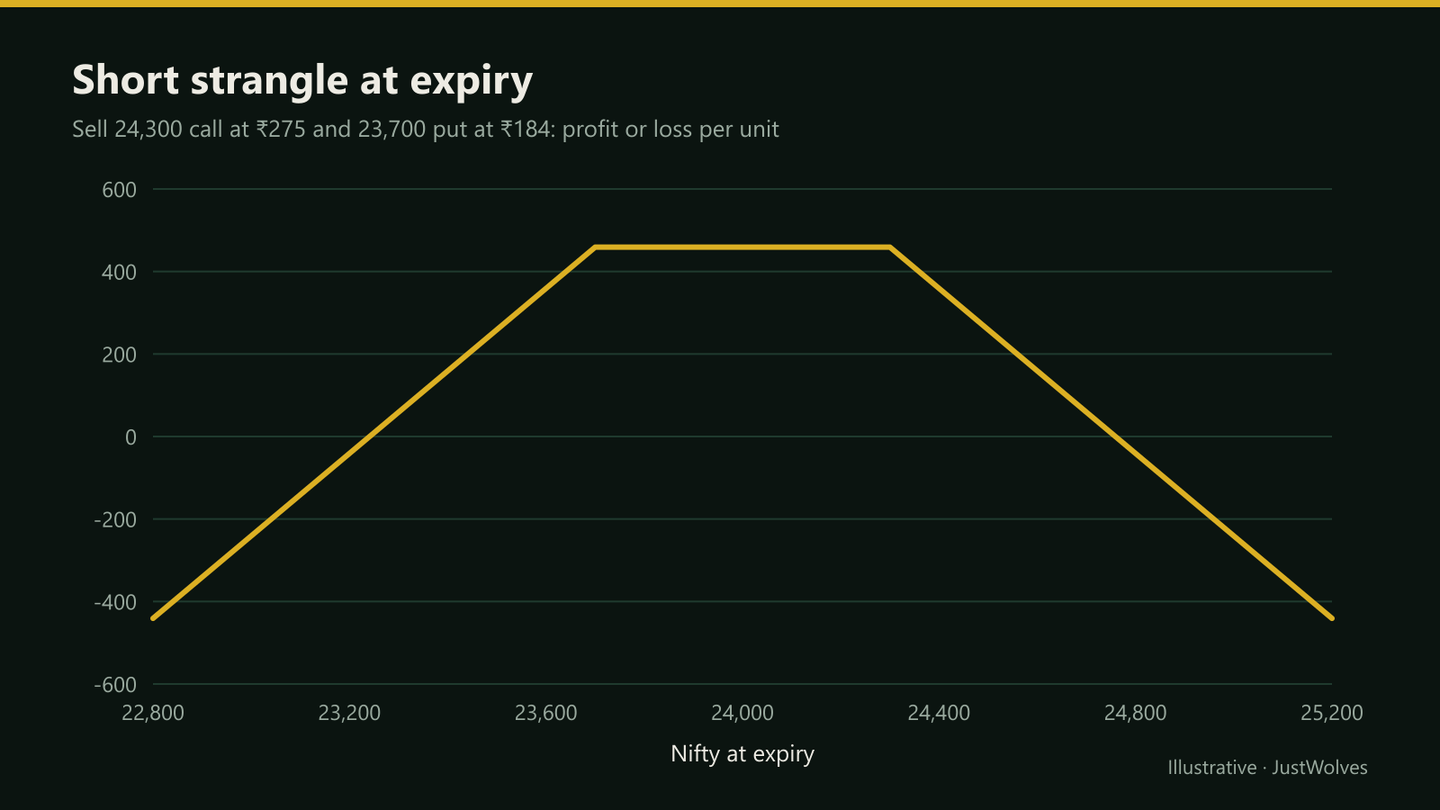
| Premium received (maximum profit) | ₹459 | ₹29,835 |
| Maximum-profit range | 23,700 to 24,300 | — |
| Upper breakeven | 24,759 | — |
| Lower breakeven | 23,241 | — |
| Loss at a 7% fall (22,320) | ₹921 | ₹59,865 |
Straddle vs Strangle
| Short straddle | Short strangle | |
|---|---|---|
| Strikes | Both ATM | Both OTM |
| Premium | Higher | Lower |
| Maximum-profit zone | A single point | A range |
| Breakevens | Closer together | Further apart |
| Gamma at entry | Higher | Lower |
Choosing Strikes
- Outside the expected move: for example, beyond the one-standard-deviation range implied by IV for the period.
- Beyond chart levels: call above resistance, put below support.
- By delta: many sellers use deltas around 0.15–0.25 on each side.
- Balanced or skewed: some sellers place the put further away than the call, reflecting larger downside risk.
Managing a Short Strangle
- Hedge: buy further OTM options to turn it into an iron condor.
- Profit target: close at 50–60% of the premium.
- Loss limit: exit if the combined value reaches, for example, twice the premium, or if either short strike is breached.
- Adjust the untested side: if one side is threatened, some traders roll the other side closer to collect more premium, but this narrows the range and adds risk.
- Events: avoid holding through scheduled high-impact events.
Real Prices: Target, Then a Break
Kavita's example ends at her target. The chart below follows a 0.20-delta strangle with the same rules on real NIFTY 50 prices from December 2025 to January 2026, when the target came early and a slide followed. Option values are modelled each day.
Real NIFTY prices: a short strangle through a slide, December 2025 – January 2026
Step 1 of 4
A wide, quiet strangle
On 24 December 2025 NIFTY closes at 26,142, with recent volatility very low, about 7%. A trader sells the 26,850 call and 25,750 put expiring on 27 January, each about 0.20 delta, for a modelled 139 points: ₹9,020 per lot.
- What to observe
- Low volatility: strikes only about 400 and 700 points away.
- Condition
- Like Kavita in this lesson: target 50%, stop at twice the premium (278).
The Greeks of a Strangle
At entry, a balanced strangle has little delta: the short call's negative delta and the short put's positive delta roughly offset. Its gamma is negative but smaller than a straddle's, because both options are out of the money, and its theta is positive. It's short vega, so rising implied volatility hurts it even without a price move.
As the market moves toward one strike, that side's delta grows and the position becomes directional. A strangle that started neutral can end up behaving like a large short futures position after a rally, or a large long one after a fall. Watching the position's delta is how sellers notice this before the loss becomes severe.
Expiry Choice
Monthly strangles give more room between strikes for the same premium and decay more gradually; weekly strangles decay faster but sit close to the money in percentage terms and carry higher gamma. Many sellers prefer monthly expiries and close several days before expiry to avoid the final days' gamma and the extra expiry-day margin on short options.
Practical Example
Hypothetically, Nifty is in a 23,600–24,350 range with moderate IV. Kavita sells one lot of the 30-day 24,300/23,700 strangle for ₹459, collecting ₹29,835. Her target is ₹200, her stop a combined value of ₹918.
Nifty stays in its range and after 16 days the strangle is worth about ₹247, close to her target; with a holiday weekend ahead, she closes for (459 − 247) × 65 = ₹13,780. Had Nifty instead broken below 23,600 and fallen 5% in a week, the put alone would have pushed the combined value past her stop, for a loss near ₹29,835 plus slippage.
Short Strangles on Two Years of NIFTY: Our Test
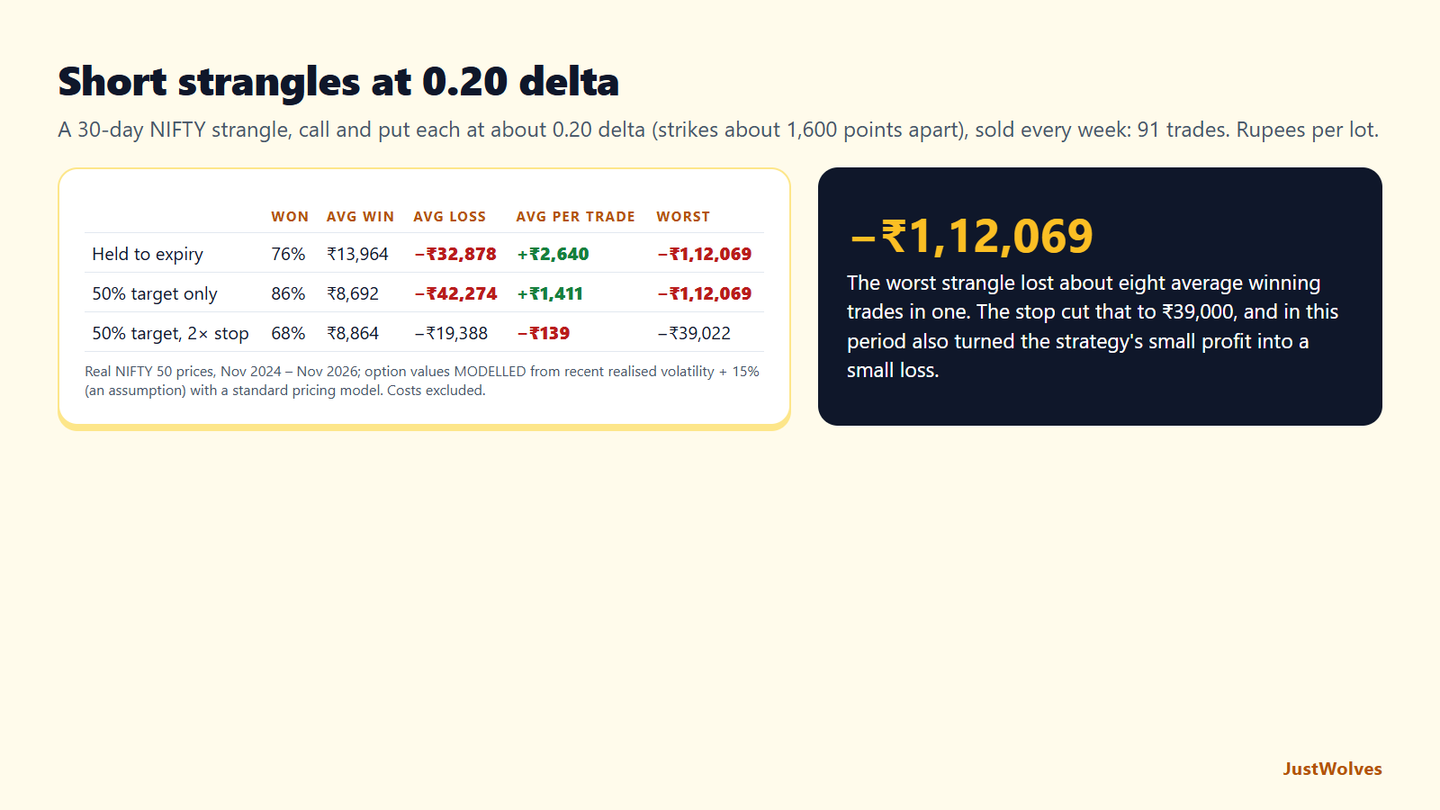
JustWolves sold a 30-day NIFTY strangle every week for about two years (November 2024 to November 2026), with the call and put each at about 0.20 delta: 91 trades, with the strikes about 1,600 points apart on average. We ran it held to expiry, with this lesson's 50% profit target, and with the target plus a stop at twice the premium. Premiums averaged 216 points, modelled from recent realised volatility plus 15%.
| Won | Average win | Average loss | Average per trade | Worst | |
|---|---|---|---|---|---|
| Held to expiry | 76% | ₹13,964 | −₹32,878 | +₹2,640 | −₹1,12,069 |
| 50% target only | 86% | ₹8,692 | −₹42,274 | +₹1,411 | −₹1,12,069 |
| 50% target and 2× stop | 68% | ₹8,864 | −₹19,388 | −₹139 | −₹39,022 |
The strangle won three times in four, and its tail was enormous. The worst trade lost about ₹1,12,000 per lot, about eight average winning trades, and the worst single day about ₹50,000. This lesson's callout is exactly right: the wider range made losses rarer, not smaller.
The profit target raised the win rate to 86% without reducing the worst loss at all, because the trades that went wrong never reached the target first. The stop at twice the premium cut the worst loss to about ₹39,000, and in this period it also turned the strategy's small average profit into a small average loss. As in the Credit Spreads Explained test, a stop as tight as one premium was hit often by moves that later reversed, and when the real break came, as in the chart above, it came in a single session and went straight past the stop.
That is the case for the hedge in this lesson's first management rule. The Iron Condor lesson runs the same short strikes with wings bought, and its worst trade was about a twelfth of the strangle's.
Common Mistakes
- Selling strikes too close for higher premium.
- Selling far OTM strikes in large size for tiny premiums.
- No stop-loss, waiting for the market to return.
- Holding through events and weekends with no hedge.
- Repeatedly rolling the untested side until the range is tiny.
Professional Insight
Experienced strangle sellers spend more time on sizing and exits than on strike selection. They size for the scenario where the market moves two or three times the expected range, because over a long enough period that scenario arrives.
Risk Considerations
- Unlimited upside risk.
- Large downside risk with IV spikes.
- Gaps skip stops.
Important Terminology
| Term | Meaning |
|---|---|
| Short strangle | Selling an OTM call and an OTM put. |
| Profit range | The zone where both options expire worthless. |
| Tested side | The side the market is moving toward. |
| Untested side | The side the market is moving away from. |
| Iron condor | A short strangle with bought wings. |
What is a short strangle?
Selling an OTM call and an OTM put with the same expiry, to profit if the market stays between the strikes.
What is the difference between a short strangle and a short straddle?
A strangle uses OTM strikes, collecting less premium but profiting over a wider range.
What is the maximum loss?
Unlimited on the upside and very large on the downside.
How do I choose strikes?
Commonly outside the expected move implied by IV, or beyond support and resistance.
How can I cap the risk?
Buy further OTM options as wings, turning it into an iron condor.
How often does a short strangle make money?
In our test of 30-day NIFTY strangles at 0.20 delta on two years of real prices with modelled premiums, 76% made money held to expiry and 86% with a 50% profit target. The worst trade still lost about ₹1,12,000 per lot.
Does a stop-loss work on a short strangle?
It limits most losses but not all. In our NIFTY test, a stop at twice the premium cut the worst loss from about ₹1,12,000 to ₹39,000 per lot, but it was triggered in about a third of trades, many of which would have recovered, and one-day breaks went straight past it.
Practical Exercise
Plan a strangle and its hedge.
Your task
Step 1: Find the expected move
For Nifty over the next month from ATM IV.
Step 2: Choose strikes
Just outside that range.
Step 3: Calculate
Premium, breakevens and loss at a 7% move.
Step 4: Add wings
Price the iron condor version and compare.
Check Your Understanding
A short strangle sells:
Related Lessons
Previous: Short Straddle. Next: Iron Condor.