
Implied Volatility and Volatility Crush for Option Sellers
JustWolves is an educational platform and is not a SEBI-registered investment advisor. Trading financial instruments involves significant risk of loss and may not be suitable for all investors. Past performance is not indicative of future results. Read our full disclaimer →
What you'll learn
- Option sellers are short vega: they gain when implied volatility falls and lose when it rises
- IV typically rises ahead of known events and falls sharply after them, a volatility crush
- Selling when IV is high relative to its own history collects more premium, but high IV usually reflects real risk
- A volatility crush can make a seller profitable even after a moderate move
- IV can also spike suddenly in sell-offs, causing losses even before the strike is reached
In this article · 15 sections
For an option seller, implied volatility is the price of the insurance being sold. When IV is high, premiums are rich; when it collapses after an event, those premiums shrink quickly, often to the seller's benefit. But high IV is high for a reason, and a sudden spike can hurt a short position even without a large price move. This lesson looks at volatility from the seller's side.
What You Will Learn
- Why sellers are short vega
- How IV behaves around events
- How a volatility crush helps sellers
- The risks of selling into high IV
Before You Start
Sellers Are Short Vega
A short option loses value, which benefits the seller, when implied volatility falls, and gains value, hurting the seller, when IV rises. A short option with vega of 13 gains about ₹13 per unit for each one-point drop in IV, and loses the same for each one-point rise.
IV Around Events
Ahead of scheduled events such as company results, RBI policy decisions, the Union Budget or election results, demand for options rises and IV climbs. After the event, the uncertainty is resolved and IV usually falls sharply. That fall is the volatility crush.
Sellers who sell before the event collect the inflated premium. Whether they profit depends on whether the actual move is smaller than the move the premium implied.
When Selling High IV Goes Wrong
High IV means the market expects a big move. If the actual move is larger than expected, the seller loses, sometimes heavily, even though IV falls afterwards.
IV can also spike without a scheduled event. In a sharp market sell-off, India VIX often jumps, lifting the value of all options. A short strangle can then show a large mark-to-market loss before either strike is reached, and rising margin requirements can force an exit at the worst time.
Real Prices: A Volatility Jump Against a Short Strangle
Our dataset does not include historical implied volatility or India VIX, so we cannot replay a real volatility crush. What we can show is the other side: a jump in NIFTY's realised volatility and what it did to a short strangle's value. The chart below uses real prices from January and February 2026, with the strangle valued from realised volatility each day.
Real NIFTY prices: a volatility jump against a short strangle, January–February 2026
Step 1 of 4
Selling in a calm market
On 21 January 2026 NIFTY closes at 25,158 after a quiet month: 20-day realised volatility is only about 7.8%. A strangle of the 25,450 call and 24,850 put expiring on 20 February is modelled at about 281 points, ₹18,230 per lot.
- What to observe
- Low volatility means a small premium for the risk.
- Condition
- This lesson warns against selling when volatility is very low.
Comparing IV with Its History
Many sellers look at IV relative to its own recent range, sometimes as an 'IV rank' or 'IV percentile'. Selling when IV is near the top of its range collects relatively rich premium; selling when it's near the bottom collects little and leaves the position exposed to a rise. Neither is a signal on its own, but it helps decide when selling is worth the risk.
The Volatility Risk Premium
Over long periods in many markets, implied volatility has tended to be somewhat higher than the volatility that actually followed. That gap, often called the volatility risk premium, is the economic reason option selling can be profitable on average: buyers pay a little extra for protection.
The premium isn't constant. It shrinks or disappears in calm periods when IV is low, and it reverses violently in crises, when realised volatility far exceeds what options had priced. Selling options harvests the premium in normal times and pays it back, sometimes many times over, in abnormal ones.
Practical Example
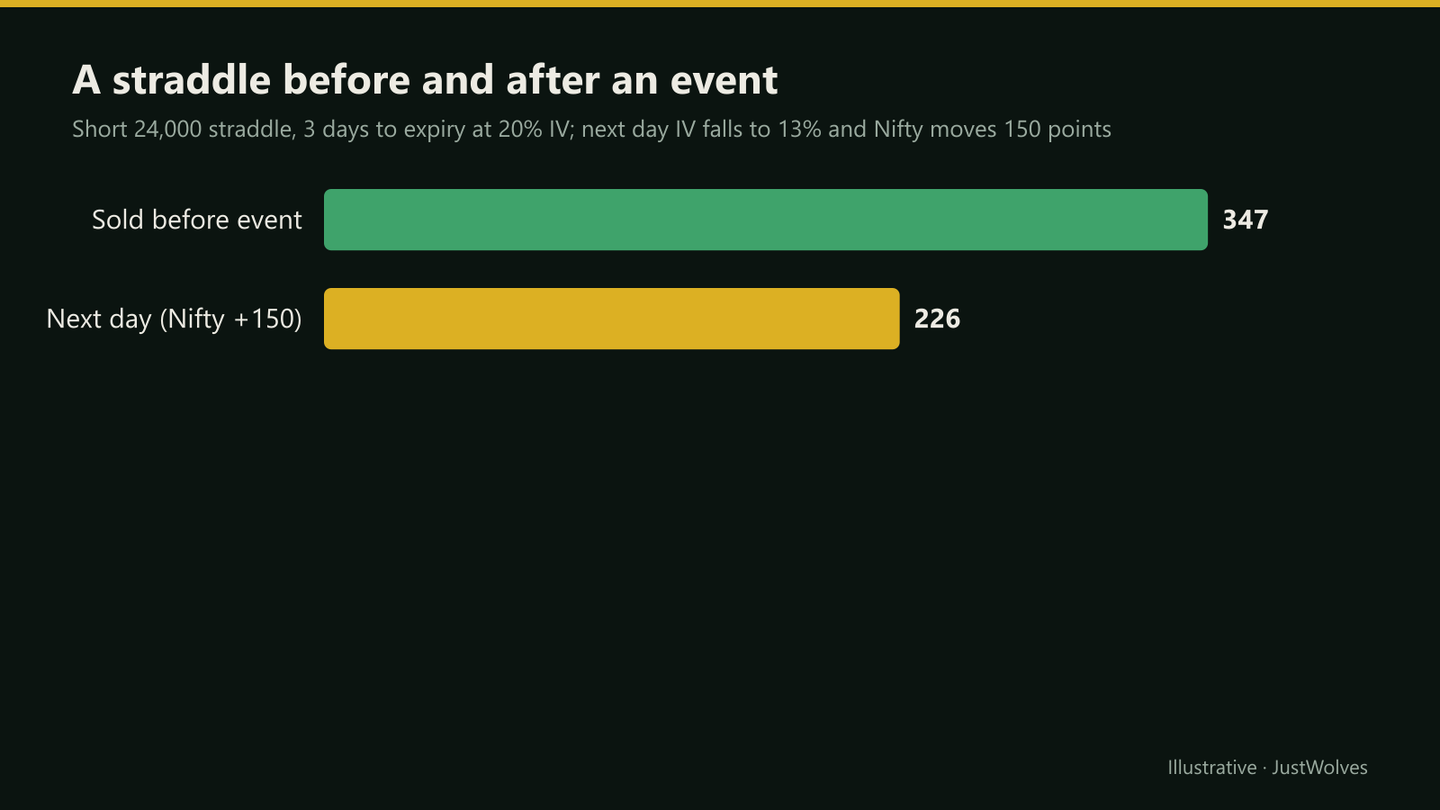
Hypothetically, three days before expiry and one day before an RBI policy decision, the 24,000 Nifty straddle trades at ₹347 with IV at 20%. Priya sells one lot, collecting ₹22,555, with a hedge further out to cap her risk.
The next day, Nifty rises 150 points and IV falls to 13%. The straddle is worth about ₹226, so she buys it back for a gain of about (347 − 226) × 65 = ₹7,865 before hedge costs. Had Nifty moved 500 points instead, the straddle would have been worth far more than she sold it for.
Does High Volatility Fade? A Model-Free Test
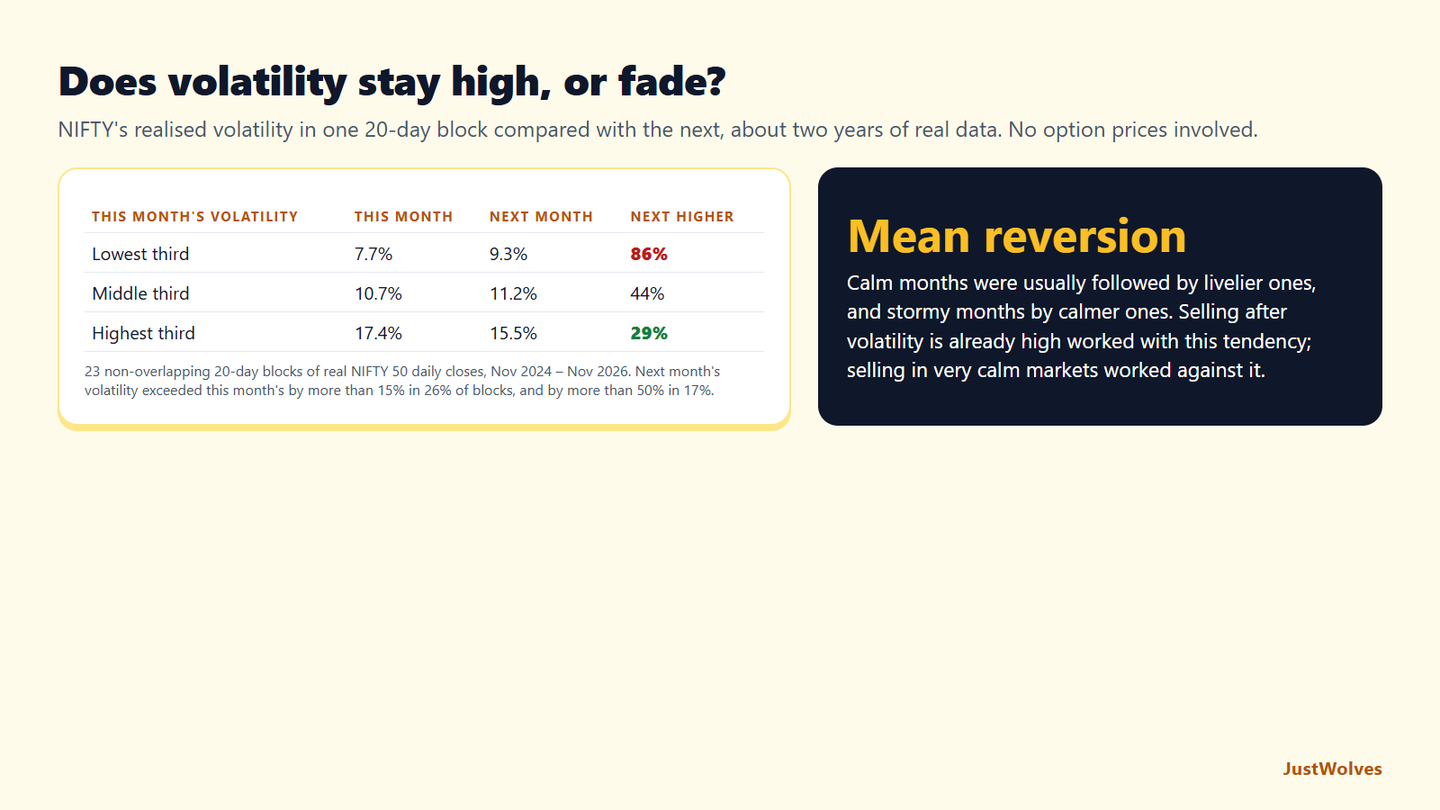
Selling when volatility is high, as this lesson discusses, rests on the idea that high volatility tends to come down and low volatility tends to rise. JustWolves tested that without any option model. We split about two years of real NIFTY 50 daily prices (November 2024 to November 2026) into 23 consecutive blocks of 20 trading days, measured the realised volatility in each block, and compared it with the next block.
| This block's volatility | Average this block | Average next block | Next block higher |
|---|---|---|---|
| Lowest third | 7.7% | 9.3% | 86% |
| Middle third | 10.7% | 11.2% | 44% |
| Highest third | 17.4% | 15.5% | 29% |
| All blocks | 52% |
Volatility mean-reverted. After the calmest months, the next month was livelier 86% of the time; after the most volatile months, it was calmer 71% of the time. That supports two points in this lesson. Selling options when volatility is already high works with this tendency, because the movement that follows is often smaller than what has just happened. And selling in very calm markets, as in the chart above, collects little premium and leaves the position exposed to the rise that usually follows.
But the jumps were large when they came. In 17% of blocks, volatility rose by more than half compared with the block before, including March 2025 (10.5% to 18.2%) and February–March 2026 (14.4% to 25.5%). Those are the episodes this lesson's section on selling into high volatility warns about: in February 2026 volatility was already above its recent average, and it still nearly doubled the next month.
Implied volatility, which sets the actual premium, behaves similarly but is not the same as realised volatility; it usually sits above it, and it jumps faster in a sell-off. Track India VIX alongside realised volatility, as this lesson's exercise suggests, to see the gap between them.
Common Mistakes
- Selling into every event without comparing the expected move.
- Ignoring IV spikes in sell-offs.
- Selling when IV is very low, collecting little premium for the risk.
- Not hedging event positions.
- Forgetting margin rises when volatility jumps.
Professional Insight
Professional volatility sellers compare implied volatility with their estimate of future realised volatility. They sell when they believe IV overstates the coming move and stay small or flat when they think it understates it. Over time, their edge depends on those estimates being right more often than not, and on surviving the times they're wrong. Sizing for the times they're wrong is what keeps them in business.
Risk Considerations
- Short vega loses when IV spikes.
- Event moves can exceed the implied range.
- Margins rise with volatility.
Important Terminology
| Term | Meaning |
|---|---|
| Short vega | A position that gains when IV falls. |
| Volatility crush | A sharp fall in IV after an event. |
| IV rank | Where current IV sits in its recent range. |
| Expected move | The move implied by option prices. |
| India VIX | NSE's index of expected Nifty volatility. |
What is IV crush?
A sharp fall in implied volatility after an event, which reduces option premiums.
Do option sellers benefit from IV crush?
Yes. Short options lose value as IV falls, which benefits the seller, if the underlying's move is not too large.
Should I sell options when IV is high?
High IV means richer premium but also higher expected risk. Size conservatively and hedge.
What happens to short options when VIX spikes?
Their value rises, causing mark-to-market losses and often higher margin requirements.
What is IV rank?
A measure of where current implied volatility sits within its range over a recent period.
Does volatility usually fall after a spike?
Usually, in our data. Across 23 monthly blocks of real NIFTY prices, the month after one of the most volatile third was calmer 71% of the time. But volatility rose by more than half from one month to the next in 17% of blocks, so spikes can also continue.
Is it a mistake to sell options when volatility is very low?
It often is. In our NIFTY data, the month after one of the calmest third of months was more volatile 86% of the time. Selling then collects little premium and leaves a short-vega position exposed to the rise that usually follows.
Practical Exercise
Track an event.
Your task
Step 1: Pick an event
RBI policy or a large company's results.
Step 2: Record before
ATM straddle price and IV the day before.
Step 3: Record after
Straddle price, IV and the underlying's move the day after.
Step 4: Decide
Would a seller have profited? By how much?
Check Your Understanding
Option sellers are:
Related Lessons
Previous: Time Decay (Theta) for Option Sellers. Next: Margin Requirements for Option Sellers in India.