
Swing Trading vs Day Trading
JustWolves is an educational platform and is not a SEBI-registered investment advisor. Trading financial instruments involves significant risk of loss and may not be suitable for all investors. Past performance is not indicative of future results. Read our full disclaimer →
What you'll learn
- Day traders close positions the same day; swing traders hold for days to weeks
- Day trading needs more screen time and faster decisions; swing trading needs tolerance for overnight risk
- Day trading has more trades and higher total costs; swing trading has fewer, larger moves
- Neither style is easier or more profitable by default
- Choose based on your time, temperament and capital, then test before committing
In this article · 16 sections
Day trading and swing trading use many of the same tools, but they demand very different routines and temperaments. A day trader watches screens during market hours and is flat by the close; a swing trader may place orders in the evening and hold through several sessions. This lesson compares the two honestly, so you can choose the style that fits your life rather than the one that sounds more exciting.
What You Will Learn
- The practical differences between the two styles
- Time, cost and risk trade-offs
- Psychological demands of each
- How to choose and test a style
Before You Start
Read What Is Swing Trading? first.
Side by Side
| Day trading | Swing trading | |
|---|---|---|
| Holding period | Minutes to hours | Days to weeks |
| Screen time | Most of market hours | An hour or so per day, often after the close |
| Number of trades | Many | Fewer |
| Typical move per trade | Small | Larger |
| Costs as share of profits | Higher | Lower |
| Overnight risk | None | Gaps, news, global moves |
| Common instruments in India | Index futures and options, liquid stocks intraday | Delivery shares, futures, ETFs |
Time and Lifestyle
Day trading Indian markets means being available from 9:15 am to 3:30 pm IST, or at least during the most active hours. That's difficult alongside a full-time job.
Swing trading fits around other commitments: scanning and planning can happen in the evening, orders can be placed before the open, and stops and targets can be set as orders. It still requires a daily check and a weekly routine.
Costs
Each trade costs brokerage, taxes and the bid-ask spread. Day traders pay these many times a day on small moves, so costs can consume a large share of gross profit. Swing traders pay them less often, on larger moves.
Intraday and delivery trades also attract different securities transaction tax rates in India, and delivery purchases attract stamp duty. Check your broker's charge sheet for current rates and include them in your plan.
Risk
- Day trading: no overnight gaps, but many quick decisions, intraday volatility and a temptation to overtrade.
- Swing trading: fewer decisions, but exposure to overnight news, global markets and gaps that can skip stops.
Real Prices: The Gap a Day Trader Never Holds
This lesson's risk section says the main swing-trading risk is overnight news and gaps that skip stops. The chart below shows that on real Tata Steel prices from April 2025, around the largest overnight gap in our two years of stock data.
Real prices: a weekend gap through a swing stop, Tata Steel, March–April 2025
Step 1 of 4
A stock in an uptrend
In late March 2025 Tata Steel trades between ₹153 and ₹159 after a strong rally, above its rising 20-day and 50-day averages. Daily ranges are about ₹3–4.
- What to observe
- Calm conditions for both styles.
- Condition
- The open questions are overnight and weekend news.
Psychology
Day trading demands fast decisions and emotional control under constant feedback. Losing streaks can happen within a single morning, and revenge trading is a common trap.
Swing trading demands patience: waiting days for setups, and sitting through normal pullbacks without closing too early. Many swing traders struggle more with doing nothing than with doing something.
Capital and Leverage
Intraday trading in India usually involves leverage, either through futures and options or intraday margin on stocks, so small accounts can control large positions for a few hours. That magnifies both gains and losses, and the pace of intraday trading leaves little time to recover from errors.
Swing trading in delivery shares needs the full purchase value, so position sizes are smaller for the same capital. Swing traders who use futures face daily mark-to-market and overnight margin requirements. In both cases, sizing from risk per trade, rather than from the leverage available, is what keeps losses manageable.
Practical Example
Hypothetically, Rahul works 10 am to 6 pm. He tries day trading in his lunch breaks and finds he misses most of his setups and makes rushed decisions. His costs in one month are about a fifth of his gross gains.
He switches to swing trading, scanning daily charts each evening and placing orders before work. His trades fall from about 60 a month to 6, his costs drop sharply, and he can follow his plan without interruptions from work.
Costs and Gaps in Real Numbers: Our Data
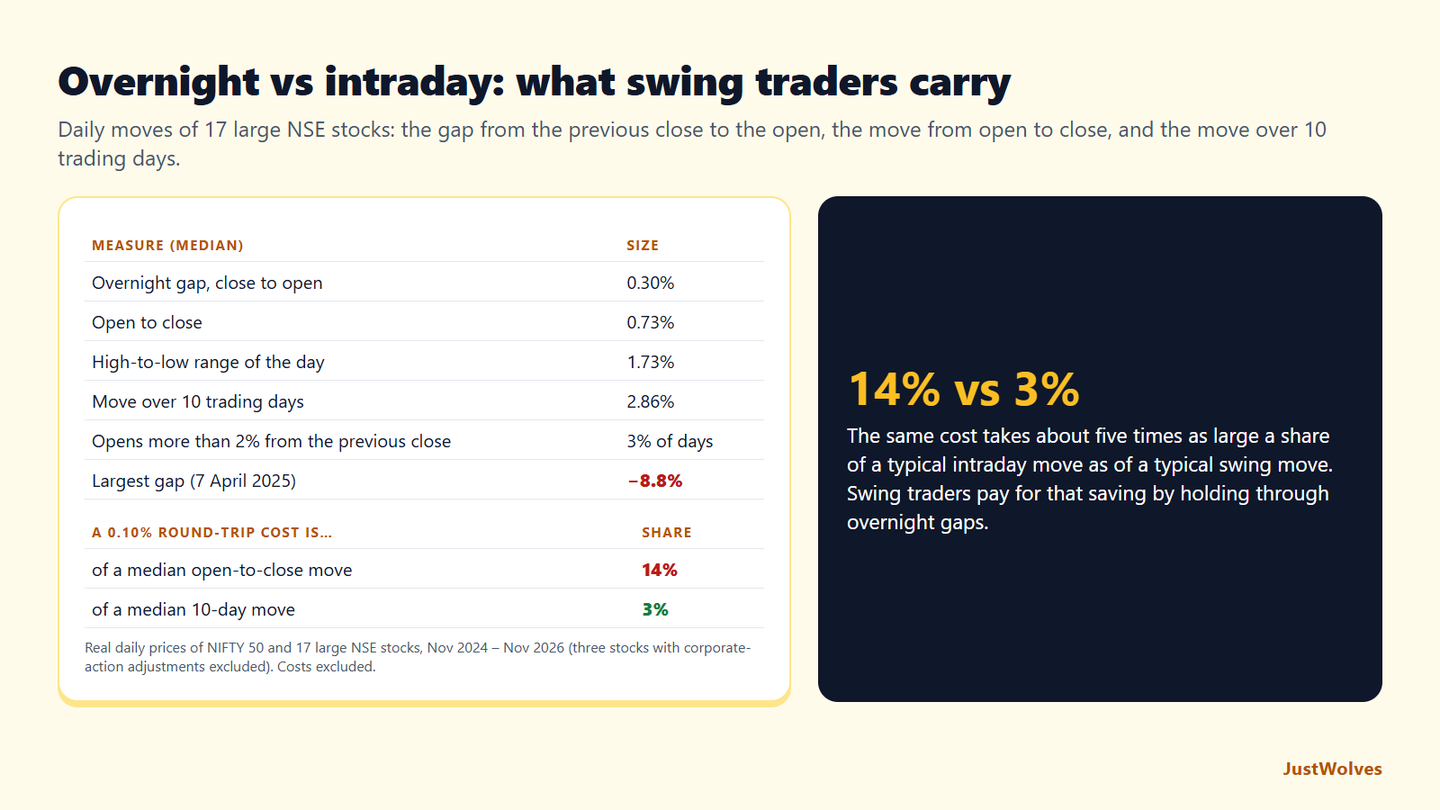
JustWolves measured the two trade-offs in this lesson on about two years of daily prices for 17 large NSE stocks (November 2024 to November 2026). Costs: how large a round-trip cost is compared with a typical intraday move and a typical 10-day move. Gaps: how large the overnight move from close to open typically is, and how often it is large.
| Measure | Median |
|---|---|
| Overnight gap, previous close to open | 0.30% |
| Open to close | 0.73% |
| High-to-low range of the day | 1.73% |
| Move over 10 trading days | 2.86% |
| Opens more than 2% from the previous close | 3% of days (largest −8.8%) |
| Round-trip cost | Share of a median open-to-close move | Share of a median 10-day move |
|---|---|---|
| 0.05% | 7% | 2% |
| 0.10% | 14% | 3% |
| 0.20% | 27% | 7% |
Costs weigh about five times as heavily on day trading. A round-trip cost of 0.10% of the trade value is about 14% of a typical open-to-close move but only 3% of a typical 10-day move. Day traders also trade far more often, so the difference compounds, as in Rahul's example in this lesson.
Gaps are the price swing traders pay. The typical overnight move was small, 0.3%, but 3% of opens were more than 2% away from the previous close, and the largest was 8.8%. None of those is visible to a day trader who is flat by 3:30 pm. For a swing trader, they are the reason position size has to allow for a loss larger than the stop distance.
Neither result makes one style better. They describe the trade-off in this lesson's callout: day trading swaps gap risk for cost and frequency; swing trading swaps cost and frequency for gap risk.
Common Mistakes
- Choosing day trading for excitement rather than fit.
- Mixing styles, holding losing day trades overnight as 'swing trades'.
- Ignoring costs when comparing.
- Assuming swing trading needs no monitoring.
- Judging a style from a few weeks of results.
Professional Insight
Many experienced traders specialise in one style, at least while building their process. Switching styles every few weeks resets the learning curve; sticking with one long enough to collect meaningful records is what reveals whether it works for you.
Risk Considerations
- Overtrading is the main day trading risk.
- Gap risk is the main swing trading risk.
- Leverage amplifies both.
Important Terminology
| Term | Meaning |
|---|---|
| Day trading | Opening and closing positions within the same session. |
| Swing trading | Holding positions for days to weeks. |
| Overnight risk | The risk of price changes between sessions. |
| Overtrading | Trading more than a plan justifies. |
| Charge sheet | A broker's list of fees and taxes. |
Is swing trading better than day trading?
Neither is better overall. Swing trading suits limited screen time; day trading suits those who can watch markets throughout the session.
Which is more profitable?
Neither is inherently more profitable; results depend on the trader's plan, discipline and costs.
Can I do both?
Yes, but keep them separate, ideally with separate rules and records, and avoid turning losing day trades into swing trades.
Which is better for beginners?
Many beginners find swing trading easier to fit around other commitments and less pressured, though it carries overnight risk.
Are costs different?
Yes. Day traders pay costs far more often, and intraday and delivery trades have different tax and stamp duty treatment.
Are trading costs a bigger problem for day traders?
Usually, yes. In our data on 17 large NSE stocks, a round-trip cost of 0.10% of the trade value was about 14% of a typical open-to-close move but about 3% of a typical 10-day move, and day traders also trade more often.
How often do stocks gap overnight?
In our two-year data on 17 large NSE stocks, the typical overnight move was about 0.3%, but about 3% of opens were more than 2% away from the previous close. The largest was −8.8%, on 7 April 2025.
Practical Exercise
Assess your fit.
Your task
Step 1: List your available hours
During and after market hours.
Step 2: Estimate costs
For 60 day trades versus 6 swing trades a month, using your broker's charges.
Step 3: Rate your temperament
Quick decisions versus patience.
Step 4: Choose
One style to paper-trade for a month.
Check Your Understanding
Day traders typically hold positions:
Related Lessons
Previous: What Is Swing Trading?. Next: Market Selection, Scanning and Watchlists for Swing Trading. See also the Day Trading course.