
Entry Confirmation and Timing
JustWolves is an educational platform and is not a SEBI-registered investment advisor. Trading financial instruments involves significant risk of loss and may not be suitable for all investors. Past performance is not indicative of future results. Read our full disclaimer →
What you'll learn
- Every entry trades off price against confirmation: earlier entries get better prices, later ones more evidence
- Common triggers: a reversal candle close, a break of the previous day's high, or a lower-timeframe break of structure
- A buy-stop order above the trigger level enters only if price proves itself
- Gaps beyond the trigger level change the risk; have a rule for them in advance
- Pick one trigger per setup and use it consistently so results can be measured
In this article · 14 sections
A good setup with a careless entry can still lose: entering too early catches the last leg of the pullback, and entering too late leaves a poor reward-to-risk ratio. Entry confirmation is about choosing how much evidence you need before committing, and how to place the order so it executes only when that evidence appears. This lesson compares common triggers and order types, and covers the open and gaps in Indian markets.
What You Will Learn
- The trade-off between price and confirmation
- Common entry triggers
- Which order types to use
- How to handle the open and gaps
Before You Start
Price vs Proof
Every entry sits somewhere on a scale. At one end, you buy at the support zone before any sign of a turn: the best price, the least evidence. At the other, you buy only after price has made a new swing high: strong evidence, but a worse price and a wider stop.
Neither end is right for everyone. What matters is choosing a point on the scale for each setup and staying there, so your results measure the setup rather than a different entry rule each time.
Common Triggers
| Trigger | How it works | Trade-off |
|---|---|---|
| Limit order at the zone | Buy as price reaches support | Best price; no confirmation |
| Reversal candle close | Buy at or near the close of a bullish candle at the zone | Some confirmation; entry near the close |
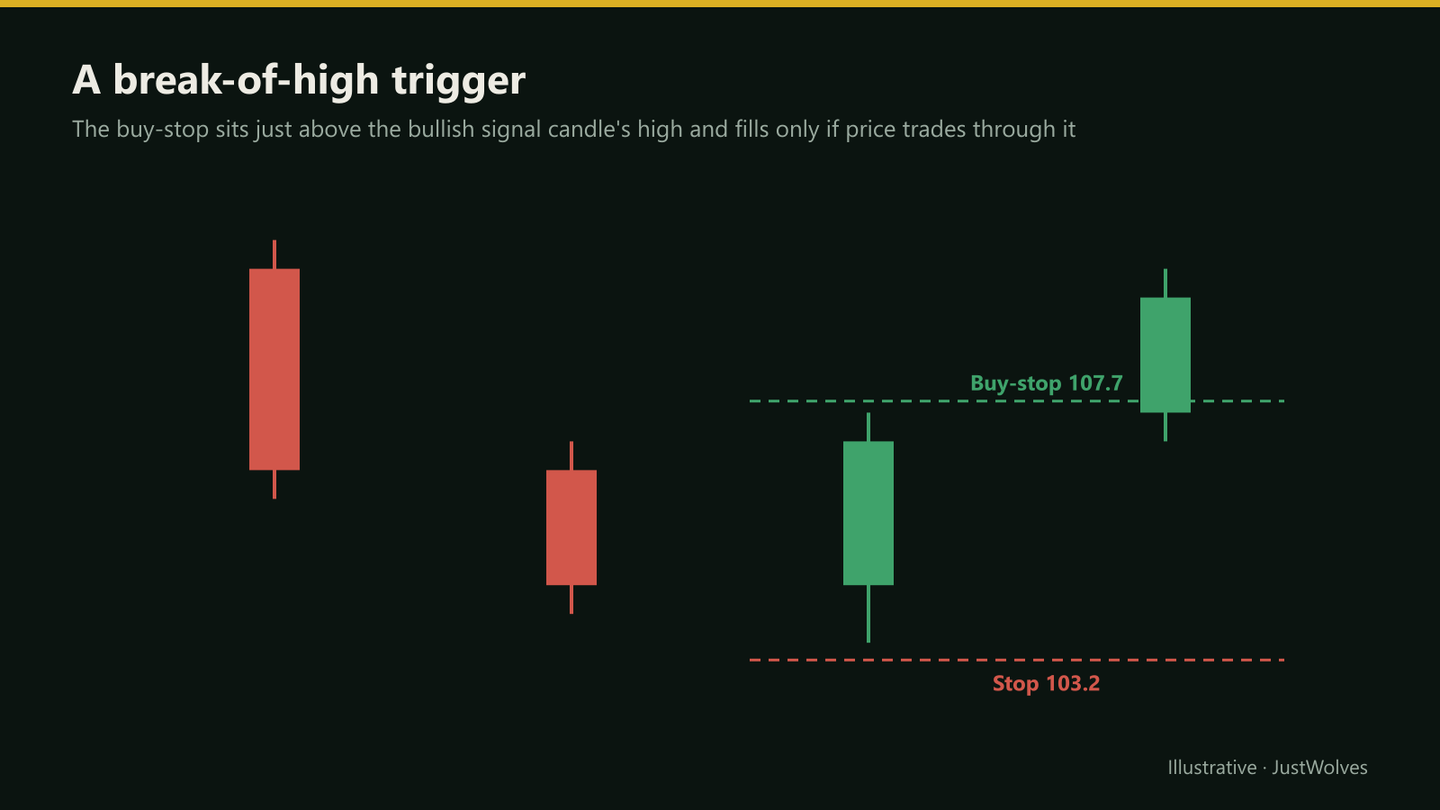
| Break of previous day's high | Buy-stop above the high of the signal candle | Price must prove itself; slightly worse price |
| Lower-timeframe break | Buy when the 60-minute chart breaks its last lower high | Finer timing; more noise |
| Break of swing high | Buy above the last swing high | Strongest proof; widest stop |
Order Types
A limit order buys at your price or better. It suits entries at a zone but may fill in a falling market without any turn.
A stop-limit or stop-loss buy order (often called a buy-stop) becomes active only when price reaches a trigger level above the current price. It suits break-based entries: if price never proves itself, the order never fills. Indian brokers offer stop-loss (SL) and stop-loss market (SL-M) order types; availability can vary by segment and broker, so check what yours supports.
Many brokers also offer good-till-triggered (GTT) orders, which stay active across sessions until the trigger price is reached. They're useful for swing traders who place orders in the evening.
The Open and Gaps
Indian cash markets have a pre-open session from 9:00 to 9:15 am IST, and the opening minutes after 9:15 are often the most volatile of the day. Many swing traders avoid market orders in the first 15 minutes, or let a buy-stop handle the entry so they aren't chasing.
Gaps need a rule decided in advance. If a stock gaps up well above your trigger, the entry is now higher, the stop distance is larger and the reward-to-risk is worse. Common rules: skip if the gap is more than a set fraction of ATR above the trigger, or recalculate size and target with the actual entry and proceed only if the trade still meets your minimum.
Real Prices: A Buy-Stop Filled on a Gap
Lakshmi's example in this lesson shows a buy-stop filled above its trigger after a gap. The chart below shows the same situation on real Infosys prices from December 2025, including the resizing the callout asks for.
Real prices: a buy-stop filled on a gap, Infosys, December 2025
Step 1 of 4
A pullback and a signal
In December 2025 Infosys, in an uptrend above its rising 50-day average, pulls back to about ₹1,580 and holds near its 20-day EMA. On 18 December it closes at ₹1,626.8 near the day's high of ₹1,630: a signal candle above the previous day's high.
- What to observe
- The setup is in place; the entry rule decides the price.
- Condition
- Plan: buy-stop just above the high, stop below the pullback low.
Practical Example
Hypothetically, a chemicals stock pulls back to support at ₹640 and forms a bullish hammer: high ₹652, low ₹636, close ₹650. Lakshmi places a GTT buy-stop at ₹653, just above the high, with a stop at ₹633. Planned risk is ₹20 a share; with ₹4,000 to risk, she plans 200 shares. Her target is ₹700.
The next morning, the stock opens at ₹660, above her trigger, and the order fills at ₹661. Risk is now ₹28 a share, so she trims to 142 shares to stay within ₹4,000, and her reward-to-risk to ₹700 falls from about 2.4R to about 1.4R. Her rule requires at least 1.5R, so under her plan she should have skipped it. She notes the lesson: in future, she'll set the GTT as a stop-limit with a maximum price.
Close, Open or Buy-Stop? Our Test
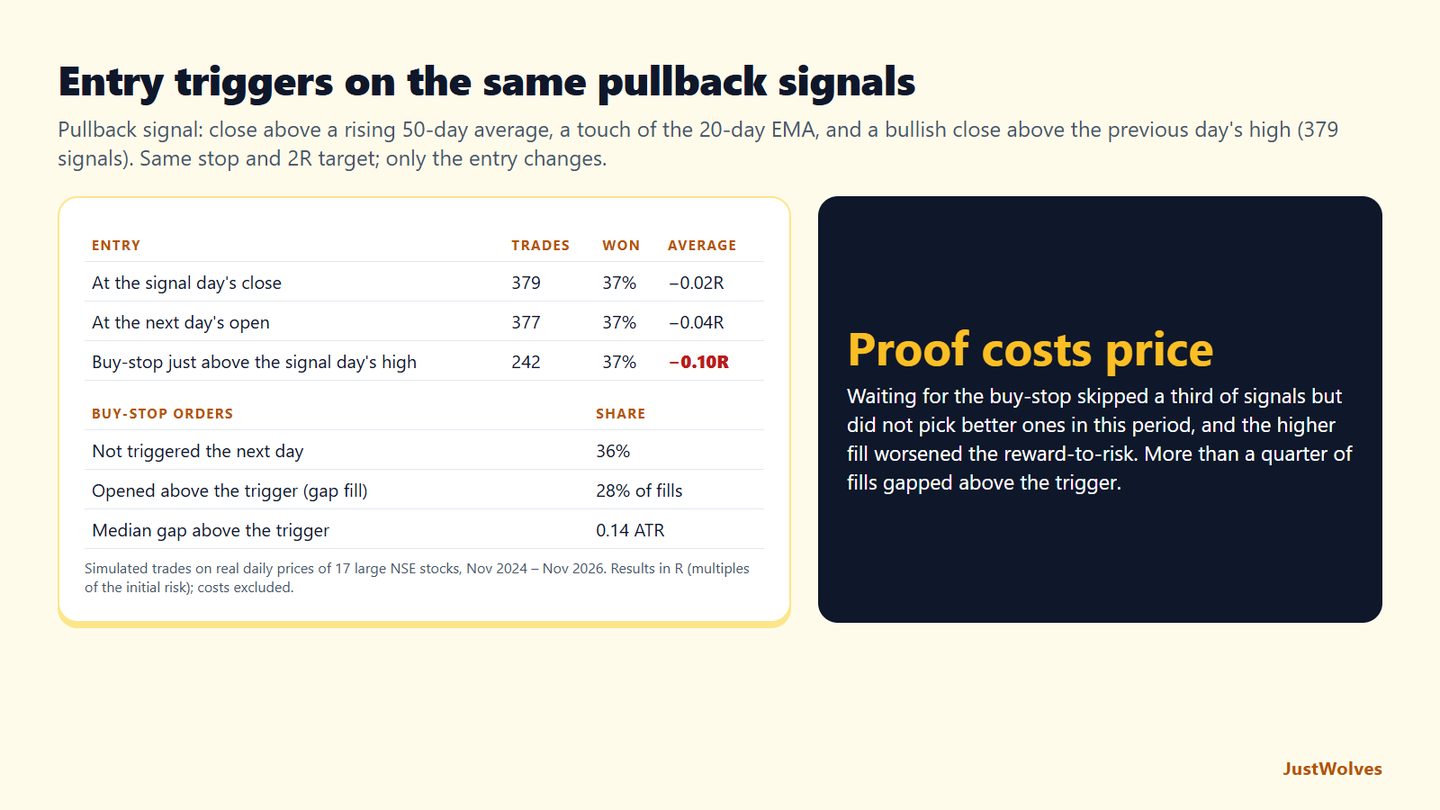
JustWolves took 379 pullback signals on about two years of daily prices for 17 large NSE stocks (November 2024 to November 2026), the same signals as in the Pullback Continuation lesson, and changed only the entry. At the close of the signal day; at the next open; or with a buy-stop just above the signal day's high, filled the next day only if price traded through it. The stop, half an ATR below the pullback low, and a 2R target were the same for all three. We also measured how often the buy-stop was not triggered and how often it filled above the trigger on a gap.
| Entry | Trades | Won | Average |
|---|---|---|---|
| At the signal day's close | 379 | 37% | −0.02R |
| At the next day's open | 377 | 37% | −0.04R |
| Buy-stop just above the signal high | 242 | 37% | −0.10R |
| Measure | Result |
|---|---|
| Not triggered the next day | 36% of signals |
| Filled on a gap above the trigger | 28% of fills |
| Median gap above the trigger | 0.14 ATR |
Proof cost price and did not buy accuracy in this period. The buy-stop skipped about a third of signals, the ones that never traded above the signal high, but the trades it did take won no more often than buying at the close, and the higher entry price made each loss larger relative to the gain. This lesson's price-versus-proof scale is a real trade-off, not a free improvement.
Gaps were common. More than a quarter of buy-stop fills opened above the trigger. The median gap was small, about a seventh of an ATR, but on the larger ones, as in the chart above, the risk per share rose enough to require resizing. This is why this lesson's callout asks you to recalculate the position after a gap fill, rather than accepting the planned quantity at a worse price.
The practical answer is this lesson's own: choose one point on the price-versus-proof scale for each setup, keep it, and let your journal show whether it suits you. In our data, the choice mattered less than the setup and the market.
Common Mistakes
- Changing triggers from trade to trade.
- Chasing gaps without recalculating.
- Market orders at the open.
- Buying before any trigger because the setup 'looks good'.
- Not checking order types your broker supports for the segment.
Professional Insight
Many experienced swing traders prefer orders that require price to prove itself. A buy-stop above the signal candle filters out many of the setups that fail immediately, and it removes the temptation to enter early because a chart looks promising. Missing a trade that never triggered costs nothing.
Risk Considerations
- Slippage on stop orders in fast markets.
- Gap fills above the planned entry.
- Opening volatility in the first minutes.
Important Terminology
| Term | Meaning |
|---|---|
| Trigger | The event that confirms an entry. |
| Limit order | An order to buy at a set price or better. |
| Buy-stop | An order that activates when price rises to a trigger level. |
| GTT order | Good-till-triggered: stays active across sessions until triggered. |
| Slippage | The difference between expected and actual fill price. |
When should I enter a swing trade?
After the trigger defined for your setup, such as a close of a reversal candle or a break of the previous day's high.
Should I use limit or stop orders?
Limit orders suit entries at a zone; buy-stops suit entries that require price to break higher first.
What is a GTT order?
A good-till-triggered order that stays active across sessions until price reaches the trigger.
What if the stock gaps above my entry?
Recalculate size, stop and reward-to-risk with the actual entry, and skip if the trade no longer meets your rules.
Is it better to enter early or late?
It's a trade-off between price and confirmation. Choose one approach per setup and use it consistently.
Are buy-stop entries better than buying at the close?
Not in our test. On 379 pullback signals on 17 NSE stocks, buy-stops above the signal high skipped about a third of signals but won no more often (37%) and averaged −0.10R per trade, against −0.02R for buying at the signal close.
How often do swing entries gap above the trigger?
Often enough to plan for. In our test, 28% of buy-stop fills opened above the trigger price, by a median of about 0.14 ATR. Recalculate the position size whenever the fill is higher than planned.
Practical Exercise
Compare triggers.
Your task
Step 1: Take 20 past setups
Pullbacks from your study charts.
Step 2: Apply three triggers
Limit at the zone, candle close, break of high.
Step 3: Record outcomes
Entry price, stop distance and result for each.
Step 4: Compare
Which trigger gave the best results after missed trades?
Check Your Understanding
An earlier entry usually gives:
Related Lessons
Previous: Reversal Setups for Swing Traders. Next module: Stop Placement for Swing Trades. See also Multi-Timeframe Swing Analysis.