
Targets, Partial Exits and Trailing Stops
JustWolves is an educational platform and is not a SEBI-registered investment advisor. Trading financial instruments involves significant risk of loss and may not be suitable for all investors. Past performance is not indicative of future results. Read our full disclaimer →
What you'll learn
- Exits decide most of a swing trader's results; plan them before entry
- Fixed targets at prior highs or R-multiples capture typical swings; trailing stops capture larger trends
- Many traders combine both: take partial profit at a target, then trail the rest
- Common trailing methods: below each new swing low, below a moving average, or a multiple of ATR from the high
- Moving the stop to breakeven too early can cut good trades short
In this article · 14 sections
Entries get most of the attention, but exits decide how much a winning trade is worth. Take profit too early and the occasional large winner that pays for many losses never arrives; hold too long and good trades turn into scratches. This lesson covers fixed targets, partial exits and trailing stops, how to combine them, and how each choice changes your results.
What You Will Learn
- How to set fixed targets
- When to take partial profits
- Four trailing stop methods
- How exit choices affect results
Before You Start
Read Stop Placement for Swing Trades first. Trailing Stops and Taking Profit in the Risk Management course covers the general principles that this lesson applies to swing trades.
Fixed Targets
| Method | Where | Notes |
|---|---|---|
| Prior swing high | The last high before the pullback | Sellers were active there before |
| Next resistance | A weekly level or old base | Check on the higher timeframe |
| R-multiple | 2R or 3R from entry | Consistent; ignores the chart |
| Measured move | The prior leg's size added to the breakout or pullback low | Common for breakouts and flags |
A useful check is to compare the chart target with the R-multiple. If the nearest resistance is only 1R away, the trade may not be worth taking, however good the setup looks.
Partial Exits
Taking part of the position off at a first target, often a third or a half, locks in some profit and reduces the emotional pressure of holding. The remainder can then be managed with a trailing stop.
The trade-off: partial exits reduce the gain on the trades that become large trends. Whether they improve results overall depends on your setups, which is why your journal, not a rule of thumb, should decide.
Trailing Stop Methods
| Method | How it works | Character |
|---|---|---|
| Swing low | Move the stop below each new higher low | Follows structure; moves in steps |
| Moving average | Exit on a daily close below the 20 or 50-day average | Smooth; lags at turns |
| ATR (chandelier) | Stop at the highest high minus 2–3 ATR | Adapts to volatility |
| Prior day's low | Stop below each day's low | Very tight; for climactic moves |
Tighter trails keep more of each move but exit more often on normal pullbacks. Looser trails stay in longer trends but give back more at the turn. There's no single best choice; what matters is matching the trail to the kind of move you're trying to capture.
The Breakeven Question
Moving the stop to the entry price feels safe: the trade can no longer lose. But if it's done too soon, normal pullbacks stop the trade out at breakeven before the real move begins.
Many traders move to breakeven only after a first target is reached or the price has made a new higher low above entry, so the stop sits behind structure rather than at an arbitrary point.
Real Prices: Three Exit Plans, One Trade
Meera's example in this lesson compares a fixed target with a partial exit and a trail on hypothetical prices. The chart below applies the same three plans to a real trade in Maruti Suzuki from August to October 2025, a trend that kept going for ten weeks.
Real prices: a 2R target vs a trailing stop in a long trend, Maruti Suzuki, August–October 2025
Step 1 of 4
The trade
On 12 August 2025 Maruti Suzuki closes at ₹12,840 after a pullback to its 20-day EMA in an uptrend. The stop goes at ₹12,249, below the pullback low with a half-ATR buffer: 1R is about ₹591 a share. Like Meera in this lesson, the plan is written in advance.
- What to observe
- Three exit plans are compared on the same entry.
- Condition
- Plan A: all at 2R. Plan B: half at 2R, trail the rest. Plan C: trail everything.
Practical Example
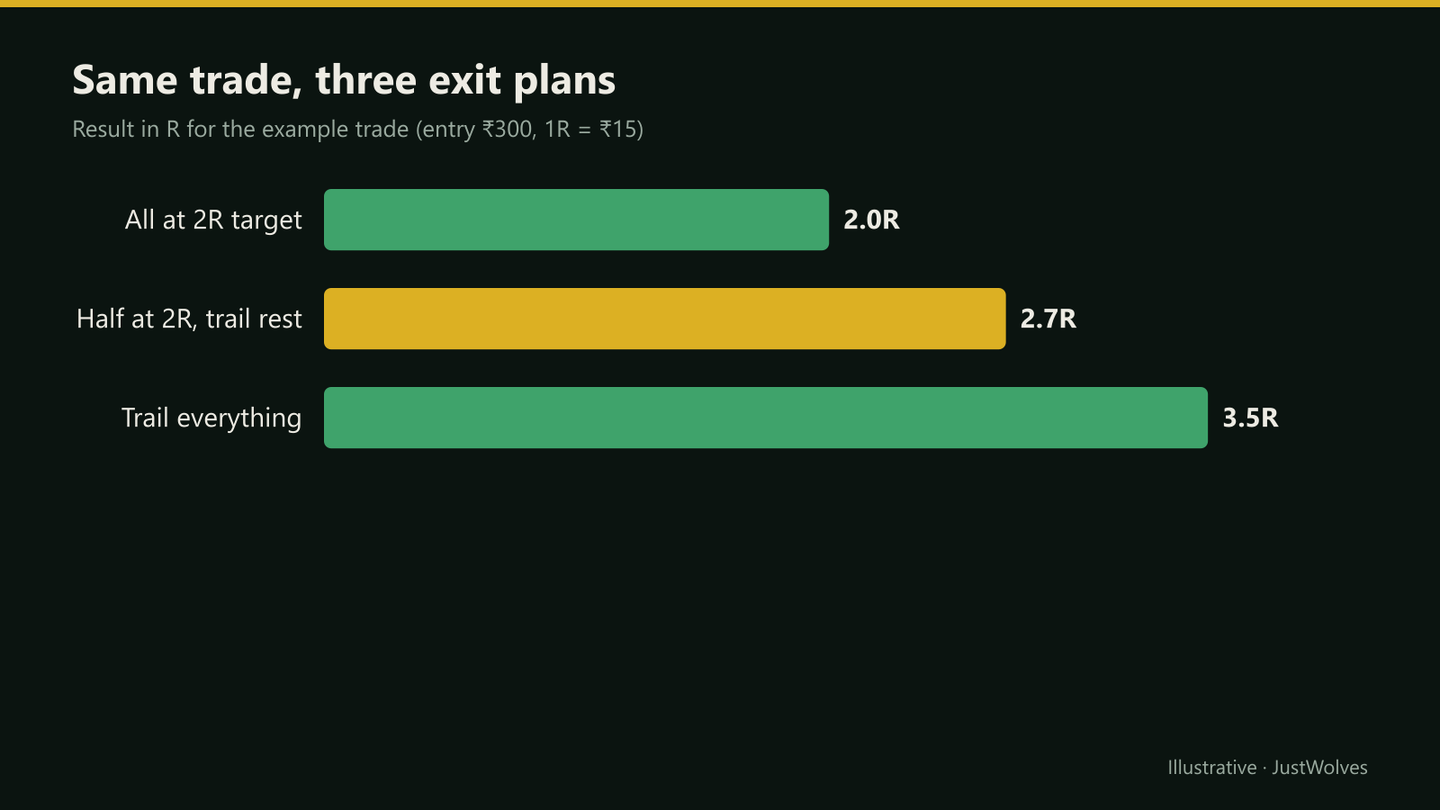
Hypothetically, Meera buys 200 shares at ₹300 with a stop at ₹285, so 1R is ₹15. Her plan: sell half at ₹330 (2R), then move the stop to breakeven and trail the rest with a daily close below the 20-day average.
Price reaches ₹330 in eight sessions and she sells 100 shares. The trend continues for four more weeks before a close below the 20-day average at ₹352, where she sells the rest. The first half earned 2R; the second earned ₹52, about 3.5R. The blended result is about 2.7R, compared with 2R if she had sold everything at the first target.
Which Exit Worked Best? Our Test
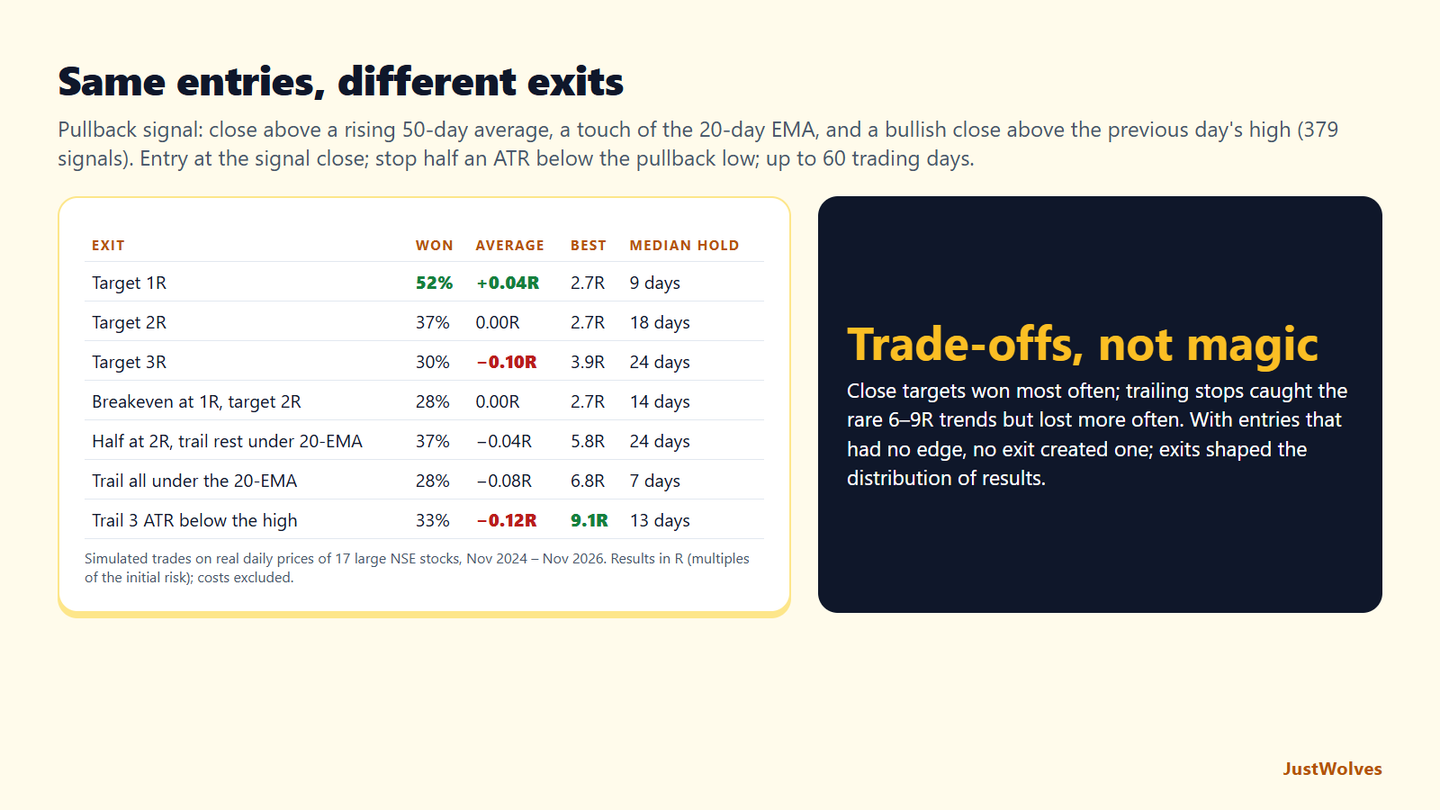
JustWolves took the same 379 pullback signals used in the earlier lessons of this module, on about two years of daily prices for 17 large NSE stocks (November 2024 to November 2026), entered at the signal close with a stop half an ATR below the pullback low, and changed only the exit. We compared targets at 1R, 2R and 3R; breakeven after 1R; half at 2R with the rest trailed under the 20-day EMA; trailing everything under the 20-day EMA; and a trail three ATRs below the highest high. Trades were held for up to 60 trading days.
| Exit | Won | Average | Best | Median hold |
|---|---|---|---|---|
| Target 1R | 52% | +0.04R | 2.7R | 9 days |
| Target 2R | 37% | 0.00R | 2.7R | 18 days |
| Target 3R | 30% | −0.10R | 3.9R | 24 days |
| Breakeven at 1R, then target 2R | 28% | 0.00R | 2.7R | 14 days |
| Half at 2R, trail the rest under the 20-day EMA | 37% | −0.04R | 5.8R | 24 days |
| Trail all under the 20-day EMA | 28% | −0.08R | 6.8R | 7 days |
| Trail 3 ATR below the highest high | 33% | −0.12R | 9.1R | 13 days |
No exit created an edge from entries that had none: every method averaged close to zero. That is the most important lesson in the table. Exits change the shape of results, not their sign: the setup and the market decide whether there is anything to capture.
Within that, the trade-offs were exactly as this lesson describes. Close targets won most often, more than half the time at 1R, but capped every trade near the target. Trailing stops lost more often and exited many trades within a week on normal pullbacks, but kept the rare trends: the best trades reached 6.8R under the 20-day EMA and 9.1R with the 3-ATR trail, like the Maruti trade above. The half-and-trail plan sat in between.
Breakeven stops after 1R did not change the average; they turned some losses into scratches and some winners into scratches, as this lesson's breakeven section warns. The useful rule is the one in this lesson's callout: choose the exit plan before the trade, match it to whether you want frequent small wins or occasional large ones, and keep it long enough for your journal to judge it.
Common Mistakes
- No exit plan before entry.
- Breakeven stops placed after the first green day.
- Selling winners early and holding losers.
- Targets beyond major resistance without adjusting.
- Changing the trailing method mid-trade.
Professional Insight
Many experienced swing traders find that a small number of trades produce most of their annual profit. Their exit rules are designed to stay in those trades, accepting that some profit is given back on others. Reviewing exits in the journal, and asking how much each method would have earned across all trades, is one of the most valuable analyses a swing trader can do.
Risk Considerations
- Trailing stops give back profit at turns.
- Gaps can open below the trailing stop.
- Early partials shrink the largest winners.
Important Terminology
| Term | Meaning |
|---|---|
| R-multiple | Profit or loss expressed in units of initial risk. |
| Partial exit | Selling part of a position at a target. |
| Trailing stop | A stop that moves in the trade's favour. |
| Chandelier stop | A trailing stop a multiple of ATR below the highest high. |
| Breakeven stop | A stop moved to the entry price. |
Where should I take profit on a swing trade?
Commonly at the prior swing high, the next resistance level, or a fixed R-multiple such as 2R.
Should I take partial profits?
Many traders do, to lock in gains and reduce pressure; it reduces gains on the biggest trends. Test it in your records.
What is the best trailing stop?
There's no single best. Swing-low, moving-average and ATR trails suit different moves and temperaments.
When should I move my stop to breakeven?
Many traders wait until a first target is reached or a new higher low forms above entry.
What is an R-multiple?
A result expressed in units of initial risk; a ₹30 gain on ₹15 risk is 2R.
Is a fixed target or a trailing stop better for swing trading?
Neither in general. In our test of 379 simulated NSE pullback trades, a 1R target won 52% of the time but capped each win, while trailing under the 20-day EMA won 28% but caught trends of up to 6.8R. Both averaged close to zero; the entry and the market mattered more.
Do partial profits improve swing trading results?
They change the shape rather than the average. In our test, selling half at 2R and trailing the rest under the 20-day EMA won 37% of trades and caught trends of up to 5.8R, between the results of a fixed 2R target and a full trail.
Practical Exercise
Compare exit methods.
Your task
Step 1: Take 20 past winning setups
From your study or journal.
Step 2: Apply three exits
Fixed 2R, half at 2R plus trail, full trail.
Step 3: Include losers
Apply the same rules to trades that reversed after entry.
Step 4: Total the R
Which method gave the best overall result?
Check Your Understanding
Entry ₹300, stop ₹285. A 2R target is:
Related Lessons
Previous: Stop Placement for Swing Trades. Next: Overnight and Gap Risk. See also Moving Average Swing Strategies.