
Break of Structure vs Change of Character (BOS vs CHoCH)
JustWolves is an educational platform and is not a SEBI-registered investment advisor. Trading financial instruments involves significant risk of loss and may not be suitable for all investors. Past performance is not indicative of future results. Read our full disclaimer →
What you'll learn
- A break of structure (BOS) continues the trend: a close beyond the last external high in an uptrend or low in a downtrend
- A change of character (CHoCH) is the first break against the trend: a close beyond the last external higher low or lower high
- Confirm both with candle closes, not wicks
- A CHoCH warns the trend may be changing; it doesn't guarantee a reversal
- After a BOS, traders look for pullbacks; after a CHoCH, they look for the new direction to be confirmed
In this article · 18 sections
BOS and CHoCH are the two structure signals used throughout SMC. One says the trend is continuing; the other says it may be changing. The difference sounds simple, but most of the confusion around them comes from vague definitions. This lesson defines both precisely, shows how to confirm them, and explains what each one does and doesn't tell you.
What You Will Learn
- The precise definitions of BOS and CHoCH
- How to confirm each with candle closes
- How the pullback rule separates valid breaks from noise
- How traders act after each signal
Before You Start
Read Internal vs External Structure first. BOS and CHoCH are defined on external swings.
Break of Structure (BOS)
A break of structure occurs when price closes beyond the most recent external swing in the direction of the trend. In an uptrend, that's a close above the last swing high; in a downtrend, a close below the last swing low.
A BOS is a continuation signal. It confirms that the trend made progress and, in an uptrend, it confirms the low that the move started from as the new higher low.
A break of structure isn't a sign the trend is ending. It's evidence the trend is still making progress.
Change of Character (CHoCH)
A change of character is the first break against the trend. In an uptrend, it's a close below the most recent higher low, the low that the last BOS was made from. In a downtrend, it's a close above the most recent lower high.
A CHoCH tells you the pattern that defined the trend has been broken. It's an early warning, not proof of a reversal: price often makes a CHoCH and then resumes the original trend, or moves into a range.
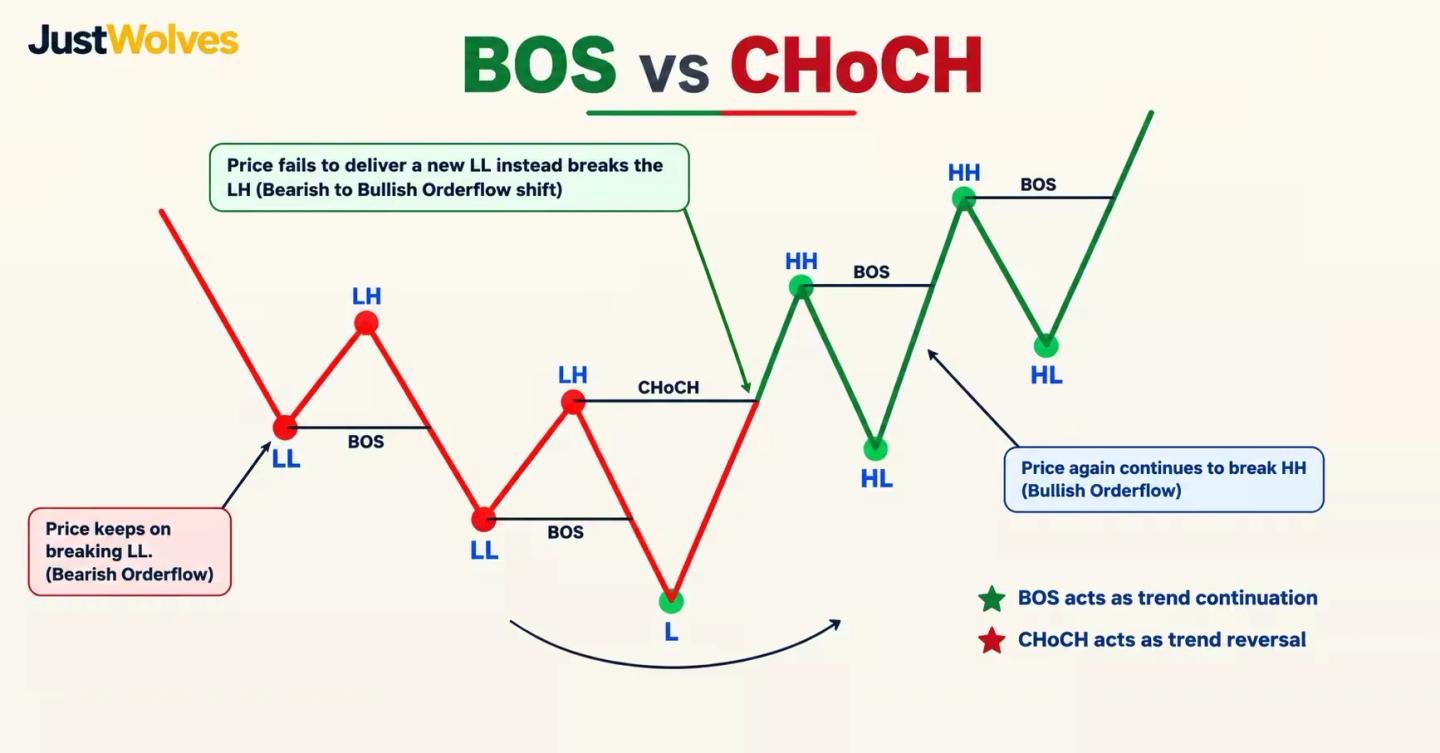
BOS vs CHoCH Side by Side
| BOS | CHoCH | |
|---|---|---|
| Direction | With the trend | Against the trend |
| In an uptrend | Close above the last swing high | Close below the last higher low |
| In a downtrend | Close below the last swing low | Close above the last lower high |
| Meaning | Trend continuing | Trend may be changing |
| Typical next step | Look for a pullback to trade with the trend | Wait for confirmation of the new direction |
The Full Sequence, Step by Step
Definitions are easier to remember once you have watched them happen in order. The chart below runs through an uptrend that becomes a downtrend: two bullish breaks of structure, a sweep that looks like a third, a change of character, and finally a bearish BOS. Step through it with Next, and use the Annotations toggle to hide the labels and test yourself before revealing them.
From uptrend to downtrend: BOS, sweep, CHoCH, BOS
Step 1 of 8
Swing high A
Price rallies to 102.60 and pulls back. That high is the first external swing high. A close above it would be a break of structure.
- What to observe
- A clear swing high with a pullback after it.
- Condition
- Mark A at 102.60.
Look at how the CHoCH level moves. After the first BOS it is 100.60; after the second leg it moves up to 101.80. A CHoCH is always measured against the most recent protected swing, the low that started the leg which made the latest BOS. Traders who keep using an old, lower swing will call the change of character late. Traders who use a minor internal low will call it far too early.
The Candle-Close Rule
Both signals require a candle close beyond the level on the timeframe you're mapping. A wick through a high that closes back below is not a BOS; it's more often a liquidity sweep (lesson 02.02.03). Wait for the candle to close before labelling anything.
The Pullback Rule
Many SMC traders require a meaningful pullback before the next BOS counts. If price breaks a high, pauses briefly and breaks again without a real pullback, the second break is part of the same leg, not a new BOS.
One common definition is a pullback that retraces a reasonable share of the previous leg, often measured as roughly 50% or more of the leg. Treat this as a rule you choose and test, not a law; the important part is that you apply the same rule every time.
Wick or Close? The Definitions Disagree
Not every educator uses the same rule. A minority of SMC material allows a wick beyond a swing to count as a BOS, while requiring a body close for a CHoCH. Others call any close beyond any swing a BOS, including internal ones. This course uses one consistent standard: both BOS and CHoCH need a candle body to close beyond an external swing, on the timeframe you are mapping. A wick that pierces a level and closes back inside is treated as a liquidity sweep.
The reason is practical. Wick-based labels produce many more signals, and a large share of them are exactly the sweeps that trap breakout traders. The close-based rule produces fewer labels, and each one is easier to verify after the fact, which matters when you backtest.
| Variation | What it changes | Effect |
|---|---|---|
| Wick counts for BOS | Signals fire earlier | More false continuation signals |
| Internal swings count | Many more BOS/CHoCH labels | Constant flip-flopping between bullish and bearish |
| MSS used instead of CHoCH | Different name, often with a displacement requirement | See Market Structure Shift vs CHoCH |
| Close beyond by a minimum distance | Filters marginal breaks | Fewer, cleaner labels; some late entries |
What Traders Do After Each Signal
- After a BOS: the trend is intact. Traders wait for a pullback towards a zone (such as an order block or fair value gap, covered in module 02.03) to enter in the trend's direction.
- After a CHoCH: the trend is in question. Traders stop taking with-trend entries, and some look for a setup in the new direction, ideally after the next criteria in lesson 02.01.05 are met.
- After a CHoCH followed by a BOS in the new direction: the new trend has stronger confirmation.
Step by Step: Labelling BOS and CHoCH
On one timeframe
Step 1: Map external structure
Identify the trend and its last external high and low.
Step 2: Watch the with-trend level
A close beyond it is a BOS.
Step 3: Watch the against-trend level
A close beyond it is a CHoCH.
Step 4: Check the close
No close beyond the level, no label.
Step 5: Update the levels
After each BOS, move the protected swing to the start of the new leg.
Practical Example
On the 1-hour chart, AUD/USD is in a downtrend with lower highs at 0.6620 and 0.6595 and a last low at 0.6550. Price closes at 0.6538: a BOS. The lower high that began this leg, 0.6595, is now the CHoCH level.
Price rallies, wicks to 0.6601 but closes at 0.6590: no CHoCH yet. Two candles later it closes at 0.6604: a CHoCH. Meena stops looking for shorts on this timeframe and waits for a pullback and a bullish BOS above the new high before considering longs.
Practise on Real Data
The best way to learn structure is to label it yourself. The chart below shows real NIFTY 50 candles. Start on the daily timeframe: mark each external swing high and low, label every BOS using closes only, and find the first CHoCH after each trend. Then switch to the hourly chart and notice how many more internal swings appear. That is why this course defines BOS and CHoCH on external swings of the timeframe you trade.
Practice chart: NIFTY 50
Loading historical candles…
BOS and CHoCH Across Timeframes
Every timeframe has its own structure, and they frequently disagree. A 15-minute chart can show a bearish CHoCH while the 4-hour trend is still firmly bullish; in that case the 15-minute CHoCH is just a pullback on the higher timeframe. A common framework is to use the higher timeframe for direction and the lower one for timing:
- Higher timeframe (for example 4H): decides the bias. Is the last structural event a bullish BOS, a bearish BOS, or a CHoCH that has not yet been confirmed?
- Lower timeframe (for example 15m): finds the entry. In a bullish 4H trend, a trader waits for price to pull back, then looks for a bullish CHoCH on the 15-minute chart: the pullback ending and the trend resuming.
This is how a lower-timeframe CHoCH becomes an entry signal rather than a warning: it signals the end of a higher-timeframe pullback. Multi-Timeframe SMC Analysis covers the full process.
The Psychology of a CHoCH
A change of character is hardest to accept when you are already in a trade. After several winning trend trades, a CHoCH can feel like noise, and it is tempting to ignore it and keep buying pullbacks. The opposite mistake is just as common: treating every CHoCH as the start of a new trend and flipping your bias on the first sign of weakness.
A simple written rule helps with both. For example: "After a CHoCH on my trading timeframe, I take no new trades in the old direction, and no trades in the new direction until a BOS confirms it." The rule takes the decision away from how you feel about your last few trades.
Common Mistakes
- Labelling wick breaks as BOS or CHoCH.
- Using internal swings for CHoCH and calling every pullback a reversal.
- Treating CHoCH as a guaranteed reversal.
- Counting several breaks in one leg as separate BOS.
- Mixing timeframes: a 5-minute CHoCH inside a 4-hour uptrend is not a 4-hour CHoCH.
Professional Insight
Experienced traders treat a CHoCH as information, not an instruction. On its own it tells you the market's behaviour has changed; they then look for context, such as where in the higher-timeframe range it happened, before acting. The next lesson turns that context into specific criteria.
Risk Considerations
- Many CHoCH signals fail, especially against a strong higher-timeframe trend.
- Breaks during news can be erratic; wait for normal conditions.
- Stops placed just beyond broken levels are often swept; leave a buffer.
Important Terminology
| Term | Meaning |
|---|---|
| BOS | Break of structure: a close beyond the last external swing in the trend's direction. |
| CHoCH | Change of character: the first close beyond the last external swing against the trend. |
| Protected swing | The swing whose break would signal a CHoCH. |
| Candle close | The final price of a candle, used to confirm breaks. |
| Pullback | A counter-trend move between with-trend legs. |
What is the difference between BOS and CHoCH?
A BOS breaks structure in the direction of the trend, signalling continuation. A CHoCH is the first break against the trend, signalling it may be changing.
Does a CHoCH mean the trend has reversed?
Not necessarily. It's an early warning; many CHoCH signals are followed by a return to the original trend or a range.
Do wicks count as a break of structure?
Most traders require a candle close beyond the level. A wick that closes back inside is often a liquidity sweep.
Which timeframe should I use for BOS and CHoCH?
Map them on the timeframe you trade, with the higher timeframe for context. The 1-hour and 4-hour charts are common choices.
What should I do after a BOS?
Look for a pullback to trade in the trend's direction, with a stop beyond the protected swing.
Can a wick create a BOS?
Some educators allow it, but this course does not. A wick beyond a swing that closes back inside is treated as a liquidity sweep. Requiring a body close produces fewer, more reliable labels.
Which swing does a CHoCH have to break?
The most recent protected swing: in an uptrend, the higher low that started the leg which made the latest bullish BOS. Breaking an older, lower swing makes the signal late; breaking a minor internal low makes it premature.
Is a CHoCH the same as a market structure shift (MSS)?
They are closely related and often used interchangeably. Many traders reserve MSS for a break that comes with displacement. The differences are covered in the Market Structure Shift vs CHoCH lesson.
Practical Exercise
Find and label BOS and CHoCH on real charts.
Your task
Step 1: Choose a chart
A 1-hour chart covering a trend that reversed.
Step 2: Label every BOS
Using closes and your pullback rule.
Step 3: Find the CHoCH
Mark the first close against the trend.
Step 4: Track what happened next
Did the trend reverse, range or resume? Record ten examples.
Check Your Understanding
In an uptrend, a close above the last swing high is a:
Related Lessons
Previous: Internal vs External Structure. Next: Valid Change of Character: 3 Criteria. Later: Market Structure Shift vs CHoCH.