
Scalping vs Intraday Trading
JustWolves is an educational platform and is not a SEBI-registered investment advisor. Trading financial instruments involves significant risk of loss and may not be suitable for all investors. Past performance is not indicative of future results. Read our full disclaimer →
What you'll learn
- Both close every position before the session ends; they differ in holding time, trade count and target size
- Scalpers hold for seconds to minutes and take many small trades; intraday traders hold for minutes to hours and take fewer, larger ones
- Scalping is far more sensitive to costs, spreads and execution speed
- Intraday trading leaves more room for analysis but exposes positions to more of the day's swings
- Many traders combine them: an intraday bias from higher timeframes, with scalping-style precision for entries
In this article · 15 sections
Scalping and intraday trading are often used as if they meant the same thing. Both avoid overnight risk by closing positions before 3:30 pm, but they're different ways of working. A scalper might take 20 trades in a session for a few points each; an intraday trader might take two trades and hold each for a couple of hours. This lesson compares the two so you can decide which, if either, fits you.
What You Will Learn
- How scalping and intraday trading differ
- How costs affect each
- The skills each needs
- How the two can be combined
Before You Start
Read What Is Scalping? first.
Side by Side
| Scalping | Intraday trading | |
|---|---|---|
| Holding time | Seconds to minutes | Minutes to hours |
| Trades per day | Many (often 10 or more) | Few (often 1 to 4) |
| Target per trade | Very small | Larger, often a meaningful part of the day's range |
| Main charts | 1 to 5-minute | 5 to 15-minute, with 60-minute or daily context |
| Cost sensitivity | Very high | Moderate |
| Execution needs | Speed critical | Important but less critical |
| Screen time | Continuous during active hours | Focused around setups |
Costs: The Biggest Difference
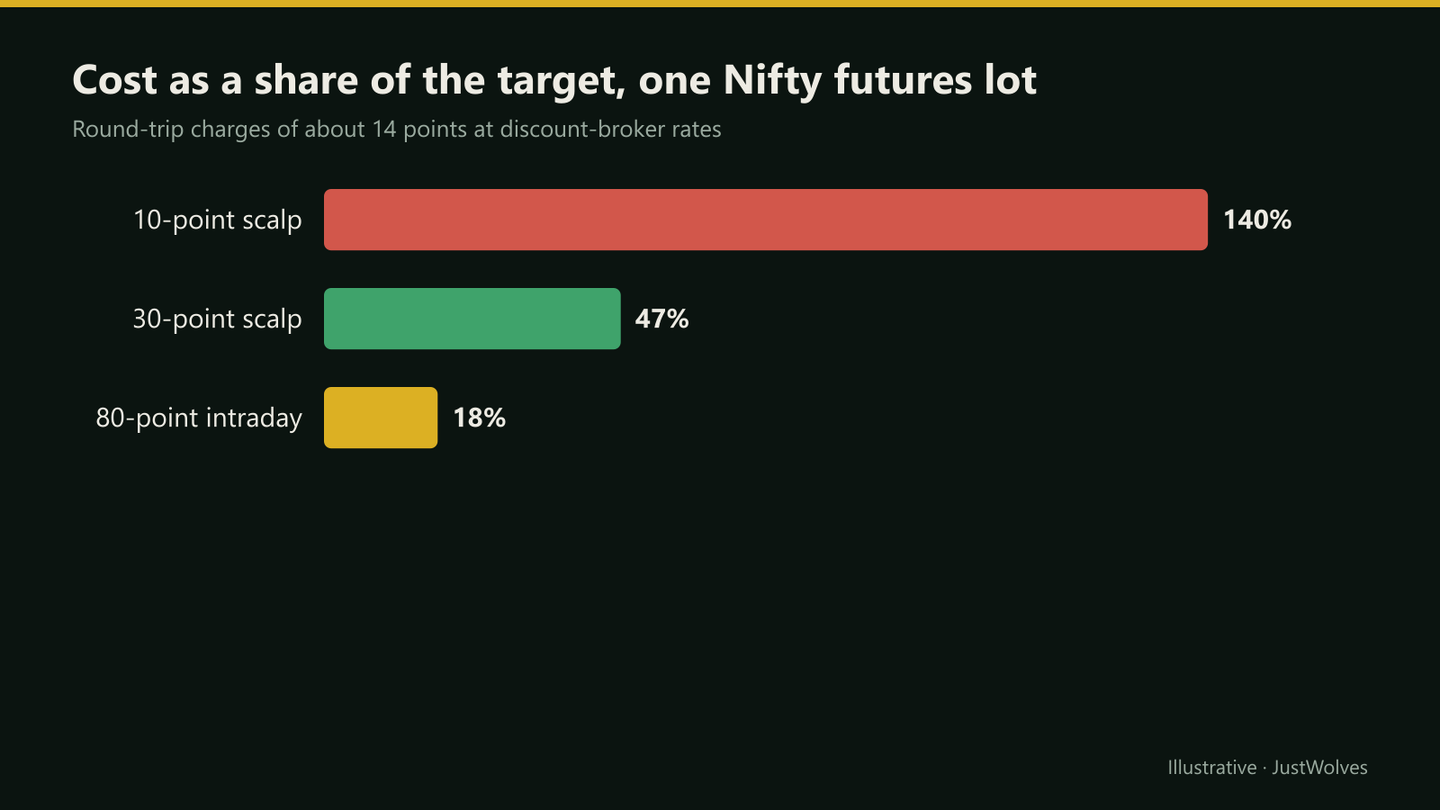
A one-lot Nifty futures round trip costs about 14 Nifty points in charges at discount-broker rates, mostly STT on the sell side. For a scalper aiming for 10 points, that cost is larger than the target: the trade loses money even when it works. For an intraday trader aiming for 80 points, the same cost is less than a fifth of the target.
Options are cheaper to trade in absolute terms (about ₹65 per one-lot round trip, roughly one premium point), but scalpers take many more trades, so costs still add up quickly. The Execution Speed and Transaction Costs lesson works through the numbers.
Real Prices: One Signal, Two Styles
Neha and Amit's day in this lesson is hypothetical. The chart below runs the same comparison on real NIFTY 50 prices from 30 October 2026: one signal, traded once as a 20-point scalp and once as an 80-point intraday trade, with the same futures costs.
Real prices: the same signal as a scalp and as an intraday trade, NIFTY 50, 30 October 2026
Step 1 of 4
A quiet morning
NIFTY 50 drifts lower from the open on 30 October 2026, from about 23,019 to a low near 22,905 at 10:15, then steadies. At 10:40 a 5-minute close above the previous 30 minutes' high triggers a scalp long at 22,955.7; it is stopped out for −20 points by 10:48.
- What to observe
- Scalpers take many signals; some fail fast.
- Condition
- After costs, that loss is about −34.5 points on futures.
Skills and Temperament
- Scalping: reflexes, instant decisions, comfort with many small losses, and the discipline to stop after a loss limit.
- Intraday trading: patience to wait for a few setups, the ability to hold through normal intraday pullbacks, and planning around key levels and events.
Many people who struggle with scalping do better with intraday trading, because there's more time to think and fewer decisions to get wrong. Others find intraday holds stressful and prefer quick, defined scalps.
Risk Profile
Scalpers face many small risks: each trade risks little, but costs, slippage and overtrading accumulate. A bad day is usually many small losses rather than one big one, unless the trader abandons their stops.
Intraday traders face fewer, larger risks per trade, and more exposure to the day's events: an RBI announcement or a sharp move in global markets during the session can hit a position held for hours.
Combining the Two
Many experienced day traders blend the styles: they form a directional bias from the daily and 15-minute charts, as an intraday trader would, and then use 1 or 3-minute charts to time entries precisely, as a scalper would. This keeps the trade count low while improving entry prices.
Practical Example
Hypothetically, on the same day, two traders work Nifty futures. Neha scalps: she takes 12 trades targeting 15 points with 10-point stops, winning 7 and losing 5. Gross, she makes 105 − 50 = 55 points; charges of about 14 points a trade cost 168 points, leaving her about 113 points down.
Amit trades intraday: he takes one long at a key level, targets 90 points with a 40-point stop, and exits at 85 points. After about 14 points of charges, he nets about 71 points. Same market, very different results, driven mainly by costs and trade count.
How Big Are the Moves Each Style Trades? Our Data
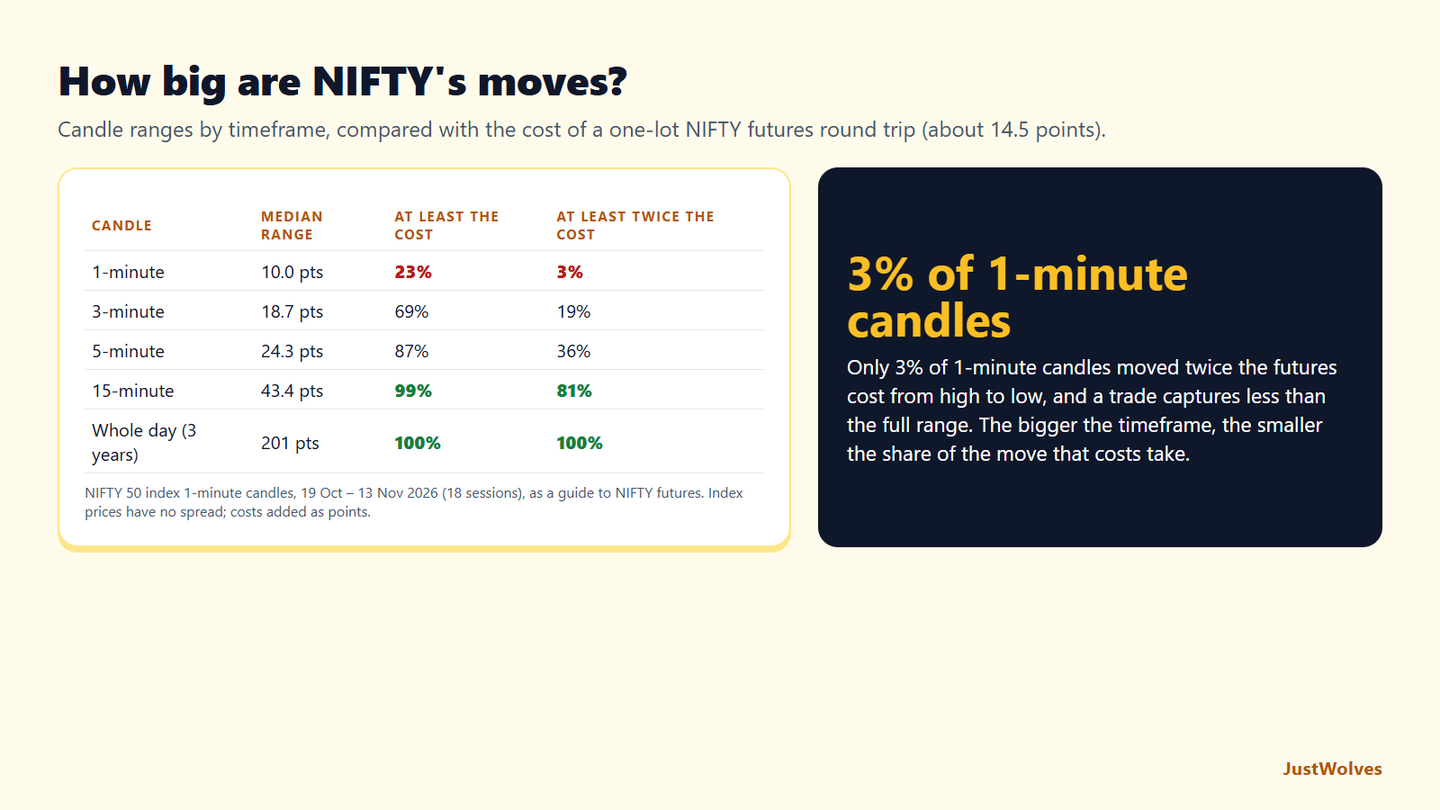
The cost argument in this lesson depends on how far NIFTY actually moves on the timeframes each style uses. JustWolves measured the high-to-low range of every NIFTY 50 candle on 1, 3, 5 and 15-minute charts over 18 sessions (19 October to 13 November 2026), and the daily range over three years of hourly data (November 2023 to November 2026), and compared them with the cost of a one-lot NIFTY futures round trip, about 14.5 points.
| Candle | Median high-to-low range | Range at least the cost | Range at least twice the cost |
|---|---|---|---|
| 1-minute | 10.0 pts | 23% | 3% |
| 3-minute | 18.7 pts | 69% | 19% |
| 5-minute | 24.3 pts | 87% | 36% |
| 15-minute | 43.4 pts | 99% | 81% |
| Whole day (3 years) | 201 pts | 100% | 100% |
On a 1-minute chart, the typical candle is smaller than the cost. The median 1-minute candle moved 10 points from high to low, and only 3% moved twice the futures cost. No trader captures a candle's full range, so a futures scalper working 1-minute moves is trying to beat a cost larger than the typical move.
The intraday trader's moves are many times the cost. A typical 15-minute candle moved 43 points, and a typical day about 200. A trade aiming for a decent part of the day's range, as Amit's does, pays the same 14.5 points but keeps most of the move.
That is why options dominate scalping in India. A one-lot option round trip costs about one premium point, so scalpers use options to shrink the cost per trade. But options add time decay, wider spreads on less liquid strikes, and expiry-day swings, which the What Is Scalping? and Liquidity lessons cover.
Our test of a simple scalping rule in the What Is Scalping? lesson found the same thing from the other side: with futures costs, 10 and 20-point scalps lost almost the whole cost on every trade, while larger targets came closer to breaking even. If you want to scalp, the data argues for fewer trades with larger targets, which is this lesson's point about combining the two styles.
Common Mistakes
- Scalping futures for targets smaller than costs.
- Mixing styles mid-trade: a scalp that becomes an intraday hold.
- Judging a style without counting costs.
- Choosing scalping for excitement.
- No time plan: trading all day without breaks.
Professional Insight
Many experienced traders say the real question isn't scalping versus intraday, but how many decisions you can make well in a day. For most people, that number is small. Styles that require fewer, better decisions tend to suit more traders than those that require constant action. Counting your decisions per session, and your results per decision, is a useful way to find your own limit.
Risk Considerations
- Cost drag is the main scalping risk.
- Event risk during long intraday holds.
- Overtrading in both styles.
Important Terminology
| Term | Meaning |
|---|---|
| Intraday trading | Opening and closing positions within the same session. |
| Scalping | Intraday trading for very small moves over minutes. |
| Bias | The expected direction for the session. |
| Cost drag | The reduction in results caused by charges and slippage. |
| Trade count | Number of trades taken in a period. |
What is the difference between scalping and intraday trading?
Scalpers hold for seconds to minutes and take many small trades; intraday traders hold for minutes to hours and take fewer, larger ones.
Which is more profitable?
Neither by default. Scalping faces much larger cost drag, so it needs a stronger edge per trade.
Can you scalp Nifty futures profitably?
Very small targets struggle: one-lot round-trip charges are about 14 points, so targets need to be well above that.
Which is better for beginners?
Many find intraday trading with few trades easier to learn than scalping.
Can I combine scalping and intraday trading?
Yes. Many traders use an intraday bias with precise, short-timeframe entries.
How many points does NIFTY move in one minute?
In our 18-session sample from October and November 2026, the median NIFTY 50 1-minute candle had a high-to-low range of 10 points; the median 5-minute candle 24 points, and the median 15-minute candle 43 points.
Why is intraday trading cheaper than scalping in practice?
Costs are charged per trade, not per point. A NIFTY futures round trip costs about 14.5 points whether the target is 15 or 80 points, so fewer trades with larger targets lose a much smaller share of each move to charges.
Practical Exercise
Compare the styles on your own data.
Your task
Step 1: Pick five past sessions
On Nifty futures or options.
Step 2: Simulate both styles
Mark realistic scalps and one or two intraday trades per day.
Step 3: Apply costs
Using the brokerage calculator.
Step 4: Compare net results
And how many decisions each required.
Check Your Understanding
Scalpers usually take:
Related Lessons
Previous: What Is Scalping?. Next: Liquidity, Bid-Ask Spreads and Slippage. See also Swing Trading vs Day Trading.