
News-Event Risk for Intraday Traders
JustWolves is an educational platform and is not a SEBI-registered investment advisor. Trading financial instruments involves significant risk of loss and may not be suitable for all investors. Past performance is not indicative of future results. Read our full disclaimer →
What you'll learn
- Scheduled events such as RBI policy decisions, the Union Budget and company results can move markets sharply within minutes
- Around events, spreads widen, slippage grows and stop orders can fill far from their trigger
- Option premiums often carry extra implied volatility before events and lose it quickly afterwards
- Common responses: stand aside, cut size, or widen stops while keeping rupee risk fixed
- Check an economic and results calendar every morning before trading
In this article · 14 sections
An intraday trader's carefully placed stop assumes price moves through it in an orderly way. News breaks that assumption. When the RBI announces a policy decision or a heavyweight stock reports results, prices can jump through several levels in seconds, and stops fill wherever the market lets them. This lesson covers the events that matter most for Indian intraday traders, what they do to spreads, slippage and option premiums, and practical rules for handling them.
What You Will Learn
- Which events move Indian markets intraday
- What events do to spreads, slippage and stops
- How implied volatility behaves around events
- Rules for trading, or not trading, around news
Before You Start
Events That Matter
| Event | Typical timing (IST) | During market hours? |
|---|---|---|
| RBI monetary policy decision | Usually 10:00 am on announcement days | Yes |
| Union Budget | Usually 11:00 am on 1 February | Yes, often a special session if on a weekend |
| Company quarterly results | Often after market hours, sometimes during | Sometimes |
| India CPI inflation data | Usually 4:00 pm around the 12th | No; affects the next open |
| US Federal Reserve decisions and US data | Late evening or night IST | No; affects the next open |
| Weekly and monthly F&O expiry | Nifty weekly options expire on Tuesdays | Yes, especially the afternoon |
Dates and times change; always confirm them on the official source or a reliable economic calendar. Unscheduled news, such as geopolitical events, regulatory announcements or large block deals, can't be calendared, which is why stops and position limits matter on every trade.
What Events Do to Execution
- Spreads widen as market makers step back just before the announcement.
- Depth thins: fewer orders sit near the current price.
- Price jumps: the market can move through several levels in seconds.
- Stop orders slip: a stop-loss market order fills at the next available price, which may be well beyond the trigger.
Real Prices: An RBI Decision Morning
The chart below shows NIFTY 50 around the RBI policy decision scheduled for 10:00 am on 7 October 2026: a quiet market before the release, a sharp dip and recovery, then a 90-point rise and a 78-point fall within 20 minutes.
Real prices: around a 10 am RBI policy decision, NIFTY 50, 7 October 2026
Step 1 of 4
Waiting for the decision
On 7 October 2026 the RBI policy decision is due at 10:00 am. From 9:45 NIFTY 50 goes quiet: three 5-minute candles of 10 to 15 points around 22,610.
- What to observe
- Pre-announcement calm, as this lesson describes: participants step back.
- Condition
- This lesson's rule: don't hold a scalp into the release.
Implied Volatility Around Events
Before a known event, option buyers and sellers price in the possibility of a big move, so implied volatility, and therefore option premiums, often rise. Once the announcement is out, that uncertainty disappears and implied volatility often drops sharply, an effect traders call an IV crush.
This matters for intraday option buyers: an option can lose value after an event even if the index moves in the right direction, because the fall in implied volatility outweighs the move. The Futures & Options course covers implied volatility in detail.
Rules for Event Days
A practical approach
Step 1: Check the calendar every morning
Economic events, results of index heavyweights, and expiry.
Step 2: Decide in advance
Stand aside around the event, or trade it with a written plan.
Step 3: If you trade, cut size
Keep rupee risk fixed while allowing for wider stops and slippage.
Step 4: Flatten before the announcement
Many intraday traders close positions a few minutes before scheduled news.
Step 5: Wait after the release
Let the first spike settle and spreads normalise before trading.
Practical Example
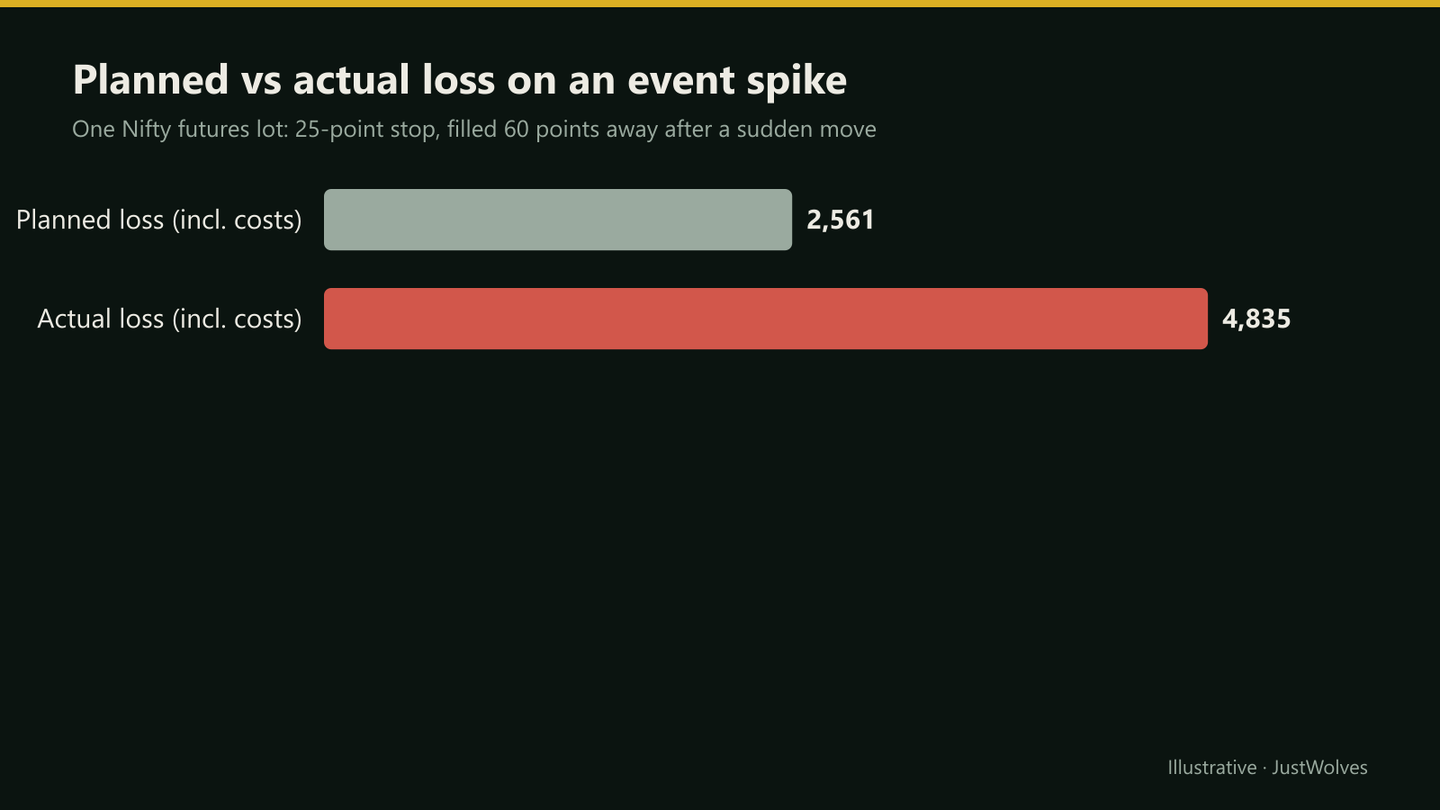
Hypothetically, Vivek is long one Nifty futures lot at 24,200 with a 25-point stop at 24,175, planning a ₹2,561 maximum loss including charges. He forgets that the RBI policy decision is due at 10:00. The announcement surprises the market, and Nifty drops 80 points in under a minute.
His stop-loss market order fills at 24,140, 60 points away. Including charges, his loss is about ₹4,835, nearly twice his plan. Reviewing the trade, he adds a morning calendar check to his routine and a rule to be flat five minutes before any scheduled event.
How Volatile Are Event Days? Our Data
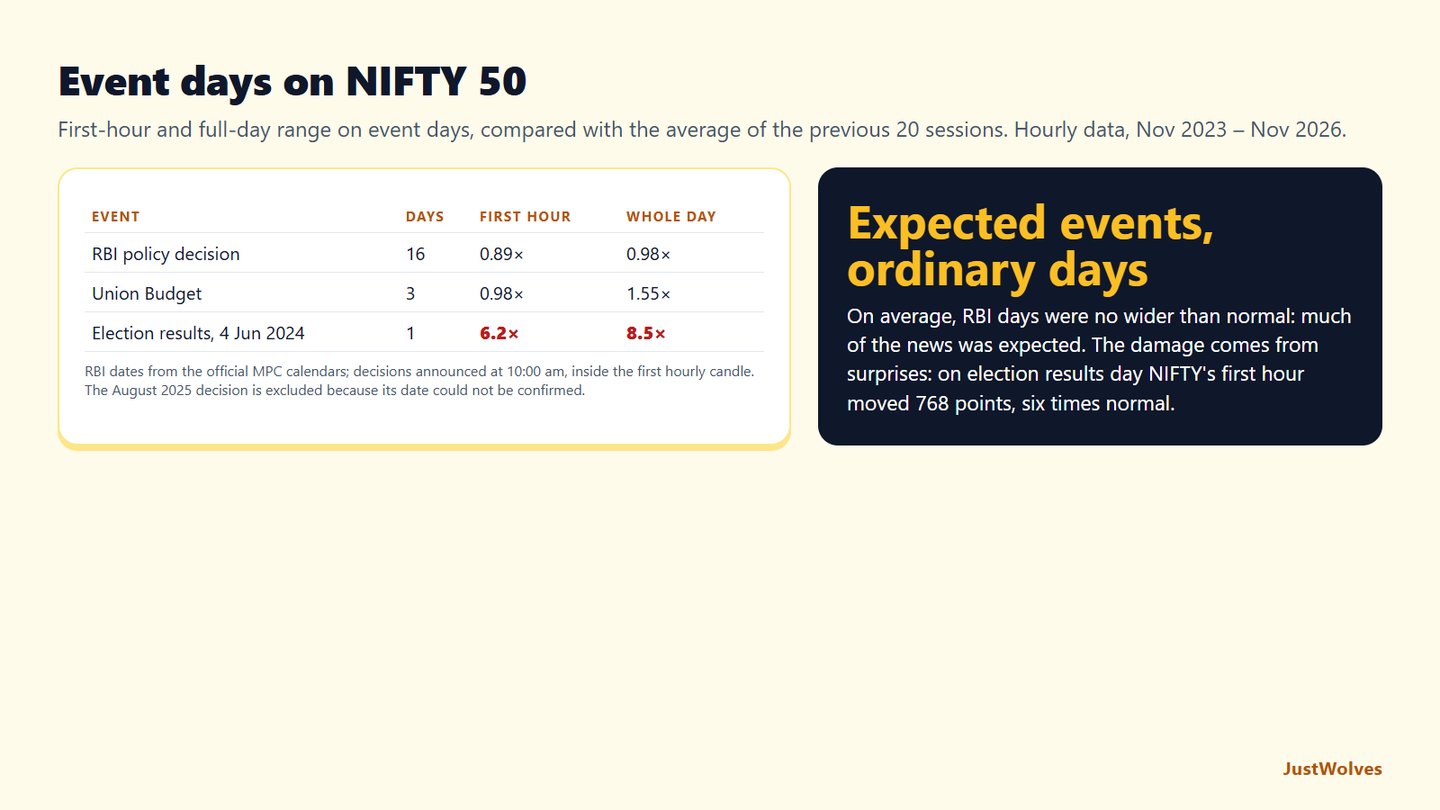
JustWolves compared NIFTY 50's ranges on scheduled event days with the average of the previous 20 sessions, using three years of hourly prices (November 2023 to November 2026). RBI policy days: 16 decision days from the RBI's published MPC calendars, with the decision at 10:00 am inside the first hourly candle (the August 2025 decision is excluded because we could not confirm its date, and two dates fell outside our data). Union Budget days: three. Election results: 4 June 2024. For comparison, we also counted how often any day's first hour was more than 1.5 times its recent average.
| Event | Days | First-hour range vs normal | Whole-day range vs normal |
|---|---|---|---|
| RBI policy decision | 16 | 0.89× | 0.98× |
| Union Budget | 3 | 0.98× | 1.55× |
| Election results, 4 June 2024 | 1 | 6.2× (768 points) | 8.5× (1,877 points) |
Scheduled RBI decisions were not unusually volatile on average. The first hour on RBI days was slightly narrower than normal, and the whole day about normal; not one of the 16 had a first hour above 1.5 times its average, which happened on 10% of ordinary days. Most decisions were broadly expected, so much of the move had already happened.
But averages hide the minutes that matter. As the 7 October 2026 chart shows, a normal-sized hour can contain a whipsaw that stops out a tight scalp in both directions. Hourly data cannot show the seconds after a release, when this lesson's warnings about spreads and slippage apply most.
Budget days moved more over the full day, about one and a half times normal, partly because the speech starts at 11:00 and runs into the session.
Surprises are the real risk. On 4 June 2024, election results day, NIFTY's first hour moved 768 points and the day 1,877, six to eight times normal. No stop placed a few points away behaves as planned on a day like that. This supports the lesson's core rules: know the calendar, close scalps before scheduled releases, keep position sizes small enough that a gap through the stop is survivable, and accept that unscheduled news can't be avoided, only limited.
Common Mistakes
- Not checking the calendar.
- Holding positions into announcements by accident.
- Buying options before events without accounting for IV crush.
- Trading the first spike after a release.
- Full size on event days.
Professional Insight
Many experienced intraday traders simply don't trade the 30 minutes either side of major scheduled news. They accept missing the occasional large move in exchange for avoiding the slippage and whipsaws that come with it. Those who do trade news usually treat it as a separate strategy, with its own rules, sizing and records.
Risk Considerations
- Slippage can multiply planned losses.
- IV crush can hurt option buyers even when direction is right.
- Unscheduled news can arrive at any time.
Important Terminology
| Term | Meaning |
|---|---|
| Scheduled event | News with a known release time, such as RBI policy. |
| Slippage | The difference between the expected and actual fill price. |
| Implied volatility (IV) | The volatility priced into option premiums. |
| IV crush | A sharp fall in implied volatility after an event. |
| Economic calendar | A schedule of upcoming data releases and events. |
What time does the RBI announce policy decisions?
Usually at 10:00 am IST on announcement days, but confirm the date and time on the RBI's website.
Should I trade during news events?
Many intraday traders stand aside; if you trade, reduce size and plan for slippage.
What is IV crush?
A sharp fall in implied volatility after an expected event, which can reduce option premiums even if price moves your way.
Why did my stop fill so far from its price?
In fast moves there may be no trades near your stop, so a market-type stop fills at the next available price.
Which events affect the next day's open?
After-hours results, India CPI data and US events in the evening or night IST.
Is NIFTY more volatile on RBI policy days?
Not on average in our data. Over 16 RBI decision days from 2024 to 2026, NIFTY 50's first-hour range was 0.89 times its previous 20-day average and the full-day range 0.98 times. The risk is concentrated in the minutes after the 10 am release.
How much did NIFTY move on election results day in 2024?
On 4 June 2024, NIFTY 50's first-hour range was 768 points and its full-day range 1,877 points, about 6 and 8.5 times its previous 20-day averages, in our hourly data.
Practical Exercise
Build an event routine.
Your task
Step 1: Choose a calendar source
For Indian and global events, plus results dates.
Step 2: Check it daily for two weeks
Before 9:00 am.
Step 3: Watch an event live
Note spreads and the speed of moves, without trading.
Step 4: Write your event rules
Stand aside window, size cut and flattening time.
Check Your Understanding
Around scheduled news, spreads usually:
Related Lessons
Previous module: Trending vs Sideways Intraday Sessions. Next: Stop-Loss Discipline and Scalping Risk Management. See also Overnight and Gap Risk.