
Intraday Trading Psychology
JustWolves is an educational platform and is not a SEBI-registered investment advisor. Trading financial instruments involves significant risk of loss and may not be suitable for all investors. Past performance is not indicative of future results. Read our full disclaimer →
What you'll learn
- Intraday trading compresses many decisions and outcomes into hours, which intensifies emotional mistakes
- The main traps are revenge trading, FOMO, overtrading and tilt after a run of losses
- Pre-session routines, written rules and scheduled breaks reduce impulsive decisions
- Judge each session by whether you followed your plan, not by its profit or loss
- If trading consistently affects your sleep, mood or finances, step back and reassess
In this article · 15 sections
Intraday trading gives instant feedback: within minutes, every decision becomes a profit or a loss. That speed is part of the appeal, and also the problem. A string of losses before 10 am can make the rest of the day feel like a mission to get even. This final lesson covers the psychological traps specific to intraday trading, the warning signs that you're in one, and the routines and rules that help experienced traders stay in control.
What You Will Learn
- Why intraday trading is psychologically demanding
- The four main traps and their warning signs
- Routines that reduce impulsive decisions
- How to judge a session fairly
Before You Start
Why Intraday Is Harder
A swing trader might make a handful of decisions a week, each with time to think. An intraday trader can make dozens in a morning, each under time pressure and with money visibly changing every second. Fatigue builds, and judgement worsens as the session goes on.
Results also arrive in clusters. Several losses in a row are a normal statistical event for most strategies, but experienced in a single hour they can feel like proof that something must be done immediately.
The Four Traps
| Trap | What it looks like | Warning sign |
|---|---|---|
| Revenge trading | Taking trades to win back a loss | Larger size or lower-quality setups right after a loss |
| FOMO | Chasing a move you missed | Entering far from any level, without your trigger |
| Overtrading | Trading because you're at the screen | Trade count above your daily cap; trades in the midday lull |
| Tilt | Emotional, impulsive decisions after a bad run | Ignoring stops, arguing with the market, physical tension |
Real Prices: A Day of Overtrading
Raj's day in this lesson is hypothetical. The chart below shows a real one on NIFTY 50 on 4 November 2026, traded with a simple scalping rule: a good start, six losses in a row, a comeback, and a day that won more trades than it lost but still lost money.
Real prices: a good start, six losses, and a day of overtrading, NIFTY 50, 4 November 2026
Step 1 of 4
A good start
NIFTY 50 opens lower on 4 November 2026, jumps more than 200 points in the first 15 minutes, then turns down. A scalper using a simple 5-minute breakout rule shorts at 10:15 and 10:20: both reach their 20-point targets by 10:29. Up 40 points.
- What to observe
- Confidence is high.
- Condition
- This lesson's trap: a good start can lead to bigger, looser trading.
Routines That Help
A daily structure
Step 1: Before 9:15
Check the event calendar, mark levels, write your daily risk numbers and the setups you'll trade.
Step 2: During the session
Trade only planned setups; log each trade immediately with a one-line reason.
Step 3: Scheduled breaks
Step away from the screen at set times, and always after a stop-out.
Step 4: Hard stops
Close the platform at your daily loss limit, trade cap or finishing time.
Step 5: After the close
Review: was each trade in the plan? What will you do differently tomorrow?
Judge the Process, Not the Day
A session where you followed every rule and lost money is a good session; losses are part of any method. A session where you broke your rules and made money is a dangerous one, because it rewards the behaviour that eventually causes large losses.
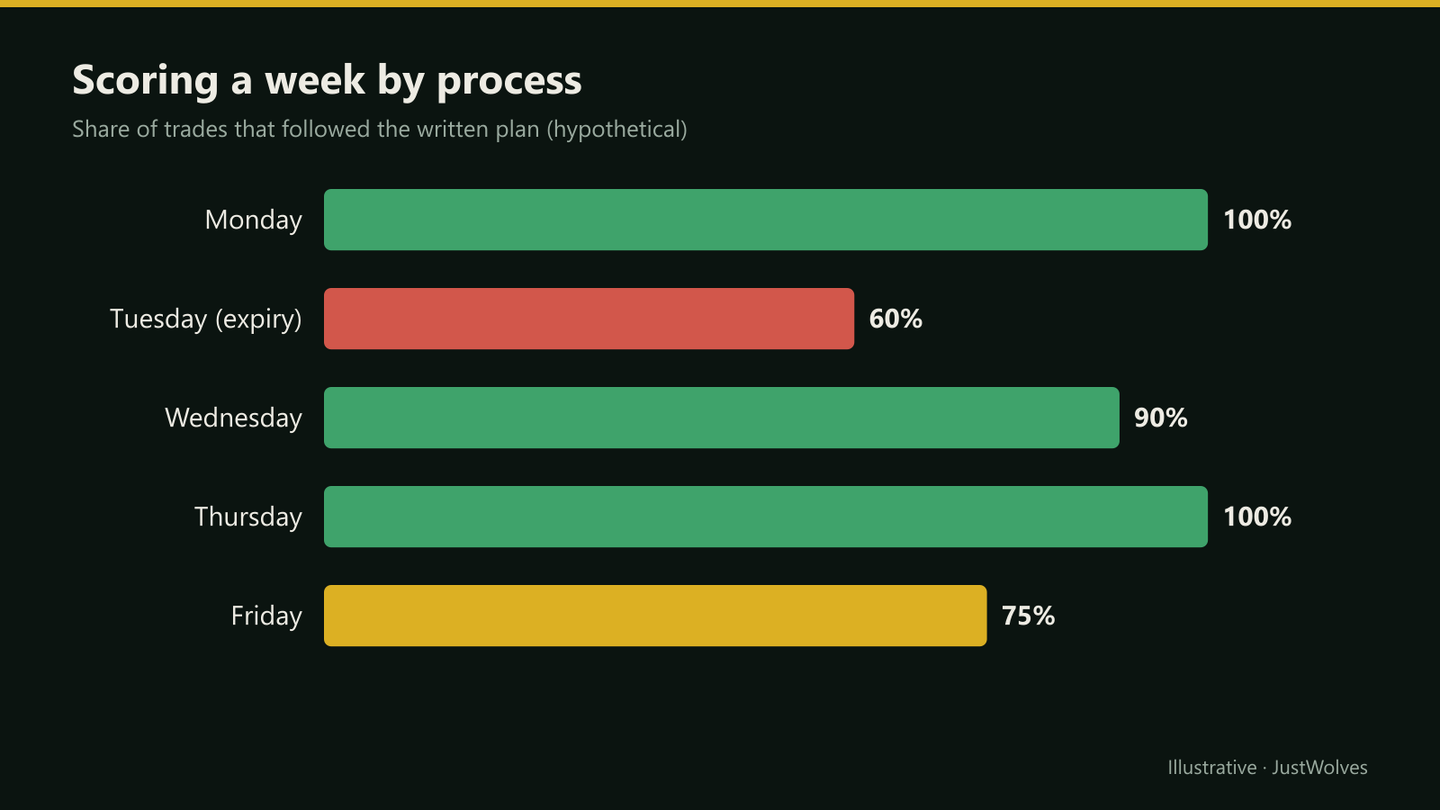
Many traders score each day on plan adherence, for example the percentage of trades that met their rules, and track that score alongside profit and loss. Over time, improving adherence usually does more for results than searching for a new strategy.
When to Step Back
Trading should not take over your life. If losses are affecting your sleep, mood or relationships, if you're trading money you can't afford to lose, or if you can't stop despite repeated rule-breaking, step away and reassess. Taking a break, reducing to paper trading or seeking support are signs of good judgement, not failure.
SEBI's studies show that most individual traders in equity F&O lose money. Choosing not to trade intraday, or to trade much less, is a legitimate and often sensible decision.
Practical Example
Hypothetically, Raj has a daily loss limit of ₹2,000 and a cap of eight trades. On Tuesday, an expiry day, he loses three scalps by 10:15, then enters a fourth outside his plan because 'the market owes him'. It loses too. He breaks his limit and ends the day down ₹4,600.
In his review, he notes his adherence score for the day was 60%, and that every rule-breaking trade came within five minutes of a loss. He adds two rules: the two-minute wait after any loss, and no trading after 2 pm on expiry days. Over the next month, his worst day is a ₹1,900 loss.
Does the Market Owe You a Win? Our Data
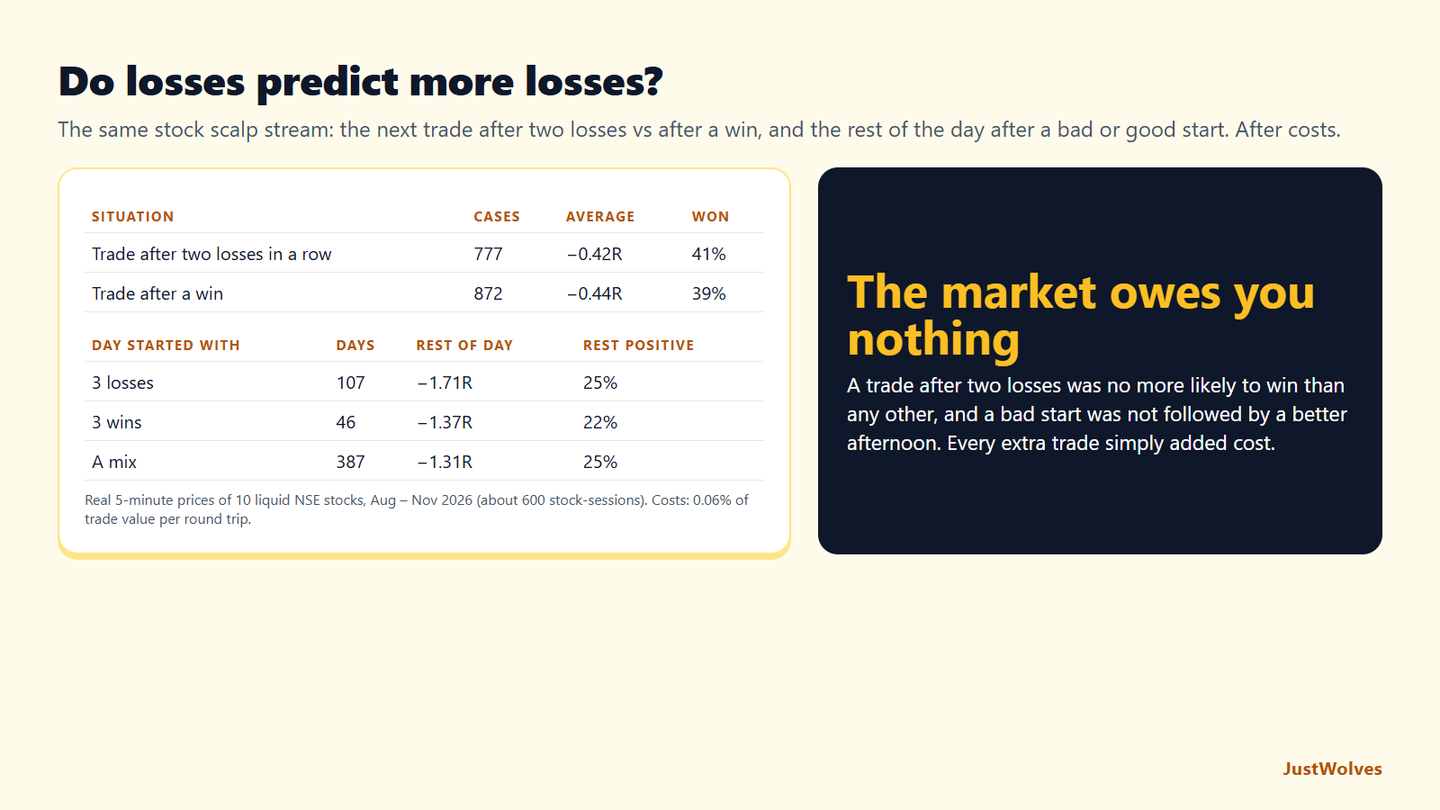
Two beliefs drive revenge trading: that a win is "due" after losses, and that a bad start can be fixed by trading more. JustWolves tested both on a real stream of trades: a simple momentum scalp on 5-minute prices for 10 liquid NSE stocks, about 58 sessions each from August to November 2026, after costs. We compared the trade that followed two losses with the trade that followed a win, and the rest of the day after a start of three losses, three wins or a mix.
| Situation | Cases | Average | Won or positive |
|---|---|---|---|
| Trade after two losses in a row | 777 | −0.42R | 41% |
| Trade after a win | 872 | −0.44R | 39% |
| Rest of the day after a 3-loss start | 107 days | −1.71R | 25% |
| Rest of the day after a 3-win start | 46 days | −1.37R | 22% |
| Rest of the day after a mixed start | 387 days | −1.31R | 25% |
No win was "due". The trade after two losses won 41% of the time, about the same as the trade after a win. Each trade was independent of the last, which is exactly why the feeling that the market owes you a win is a trap, not information.
A bad start was not followed by a better afternoon. After three opening losses, the rest of the day averaged −1.71R and was positive only a quarter of the time, no better than any other day. Trading on to recover simply added more trades, each with its costs. A good start was no better a predictor: the 4 November example above began with two wins and still ended well in the red.
Rules protect you from these beliefs. Because individual trades and starts carry no information about what comes next, the only thing a trader controls is how many trades they take and how much each can lose. This supports the routines in this lesson, the two-minute rule after a loss, the daily loss limit and the end-of-day review, and the warning that a rule-breaking session that makes money is the most dangerous kind.
Common Mistakes
- Trading to recover losses the same day.
- No breaks in a long session.
- Judging days by profit alone.
- Ignoring fatigue late in the session.
- Hiding losses from your own records.
Professional Insight
Experienced intraday traders tend to describe their routines more than their strategies when asked what makes them consistent: the same preparation, the same rules, the same review, every day. Their emotions don't disappear; their routines simply leave fewer moments where emotion can decide.
Risk Considerations
- Emotional decisions cause outsized losses.
- Fatigue degrades judgement through the session.
- Financial stress makes all of the above worse.
Important Terminology
| Term | Meaning |
|---|---|
| Revenge trading | Trading to win back losses quickly. |
| FOMO | Fear of missing out, leading to chasing. |
| Overtrading | Trading more than the plan justifies. |
| Tilt | An emotional state that leads to impulsive decisions. |
| Plan adherence | The share of trades that followed the written rules. |
Why is intraday trading psychologically hard?
It packs many decisions and instant outcomes into a few hours, which intensifies emotional reactions.
How do I stop revenge trading?
Set a daily loss limit, wait after every loss before trading again, and close the platform when the limit is hit.
What is tilt in trading?
An emotional state after losses where decisions become impulsive and rules are ignored.
How should I judge a trading day?
By whether you followed your plan, alongside the profit or loss.
When should I stop trading?
When it affects your sleep, mood, relationships or finances, or you can't follow your own rules. Taking a break is a sensible choice.
Is a winning trade more likely after a string of losses?
No, in our test. On a stream of real NSE stock scalps, the trade after two consecutive losses won 41% of the time, and the trade after a win 39%. Each trade was effectively independent of the previous ones.
Should I keep trading to recover a bad morning?
Our data says it rarely works. After days that started with three losing scalps, the rest of the day averaged −1.71R and ended positive only 25% of the time, no better than other days. More trades mainly added more costs.
Practical Exercise
Track your process.
Your task
Step 1: Write a daily routine
Before, during and after the session.
Step 2: Log every trade
With a note: in plan or not.
Step 3: Score each day
Plan adherence percentage.
Step 4: Review after 20 sessions
Compare adherence with results, and find your triggers.
Check Your Understanding
Revenge trading usually shows up as:
Related Lessons
Previous: Backtesting a Scalping Strategy with Real Costs. This completes the Scalping and Intraday Trading course. See also Trading Discipline and Routines.