
Liquidity, Bid-Ask Spreads and Slippage
JustWolves is an educational platform and is not a SEBI-registered investment advisor. Trading financial instruments involves significant risk of loss and may not be suitable for all investors. Past performance is not indicative of future results. Read our full disclaimer →
What you'll learn
- The bid-ask spread is a cost paid on every round trip, on top of brokerage and taxes
- Liquidity is how easily you can trade a size without moving the price; deep markets have tight spreads
- Slippage is the gap between the price you expected and the price you got, and it's worst in fast markets and on market orders
- Near-the-money Nifty options are usually far more liquid than deep out-of-the-money strikes
- Measure your own slippage: it's one of the few costs you can reduce
In this article · 15 sections
Brokerage and taxes are printed on your contract note. Two other costs aren't: the bid-ask spread and slippage. For swing traders they're minor; for scalpers they can be as large as all the other charges combined. This lesson explains how liquidity, spreads and slippage work in Indian markets, how to read market depth, and how to keep these hidden costs small.
What You Will Learn
- What liquidity and the bid-ask spread are
- How to read market depth
- What causes slippage
- How order type and instrument choice reduce both
Before You Start
Read Scalping vs Intraday Trading. Understanding option strikes and moneyness from the Futures & Options course will also help.
The Bid-Ask Spread
At any moment, the bid is the highest price a buyer is offering and the ask (or offer) is the lowest price a seller will accept. The difference is the spread. If you buy at the ask and immediately sell at the bid, you lose the spread.
For example, if a Nifty option shows a bid of 119.95 and an ask of 120.10, the spread is 0.15 points. On one lot of 65, crossing it once costs about ₹10. That seems small, but a scalper crossing the spread on entry and exit across 20 trades a day pays it 40 times.
Liquidity and Market Depth
Liquidity is how much you can trade without moving the price. Trading platforms show market depth: the best five bid and ask prices with the quantities waiting at each. A deep market has large quantities close to the current price; a thin one has small quantities spread over wider prices.
If you place a market order larger than the quantity at the best price, it fills at the next price levels too, and your average price worsens. That's why size matters: one lot may fill at the best price, while ten lots may not.
| Bid qty | Bid | Ask | Ask qty |
|---|---|---|---|
| 1,950 | 119.95 | 120.10 | 1,300 |
| 3,250 | 119.90 | 120.15 | 2,600 |
| 2,600 | 119.85 | 120.20 | 3,900 |
| 4,550 | 119.80 | 120.25 | 1,950 |
| 3,900 | 119.75 | 120.30 | 5,200 |
In this example, a market buy for 1,300 units (20 lots) would fill at 120.10. A market buy for 3,900 units (60 lots) would fill partly at 120.10 and partly at 120.15 and 120.20, averaging above the best ask.
Slippage
Slippage is the difference between the price you expected and the price you received. It comes from crossing the spread, from moving through depth, and from price moving between your decision and your order reaching the exchange.
Slippage is worst at the open, around news, on expiry-day afternoons in options, and on stop orders that trigger in a fast move. A stop-loss market order in a sharp fall can fill several points beyond its trigger.
Real Prices: Slippage Risk at the Open
We cannot show historical bid-ask quotes, but we can show how fast price moves, which is what turns a market or stop order into slippage. The chart below shows the first 30 minutes on real NIFTY 50 prices on 3 November 2026, a gap-up open: a 124-point first minute, then a market that slowly calmed down.
Real prices: the first 30 minutes after a gap-up open, NIFTY 50, 3 November 2026
Step 1 of 4
The first minute
NIFTY 50 opens on 3 November 2026 at 23,582.3, about 0.6% above the previous close. In the first minute it trades from 23,607.3 down to 23,482.9 and back to 23,533.7: a 124-point range in sixty seconds.
- What to observe
- A stop-market order resting anywhere in that range could fill far from its trigger.
- Condition
- A sell stop at 23,550 could fill anywhere down to about 23,483: up to 67 points, about ₹4,350 on one futures lot.
Choosing Liquid Instruments and Strikes
- Index options: near-the-money strikes in the current expiry are usually the most liquid; deep out-of-the-money and far-expiry strikes often have wider spreads.
- Index futures: the near-month contract is normally far more liquid than later months.
- Stocks: large, actively traded stocks have tighter spreads than small or mid-caps, especially for intraday sizes.
- Time of day: spreads are often wider in the first minutes after 9:15 and can widen during sharp moves.
Order Types and Slippage
Market orders fill immediately at the best available prices, accepting whatever slippage occurs. Limit orders fill only at your price or better, so they avoid slippage but may not fill. Many scalpers enter with limit orders at or near the bid or ask, and accept market-type exits only for stops.
Brokers also apply market protection limits on some market and stop-market orders, which cap how far from the trigger they'll fill. Check your broker's rules and which order types are available in each segment.
Practical Example
Hypothetically, Kavya scalps Nifty options with market orders and records her expected and actual prices for a week. Across 40 round trips on one lot, her average slippage is 0.4 points per side, 0.8 points per round trip, about ₹52 a trade, close to her ₹65 of charges.
She switches entries to limit orders at the ask, uses market orders only for stop exits, and moves from deep out-of-the-money strikes to near-the-money ones. The next week, her average slippage falls to about 0.3 points per round trip. Her charges don't change, but her total cost per trade falls from about ₹117 to about ₹85, a drop of more than a quarter.
When Is Slippage Risk Highest? Our Data
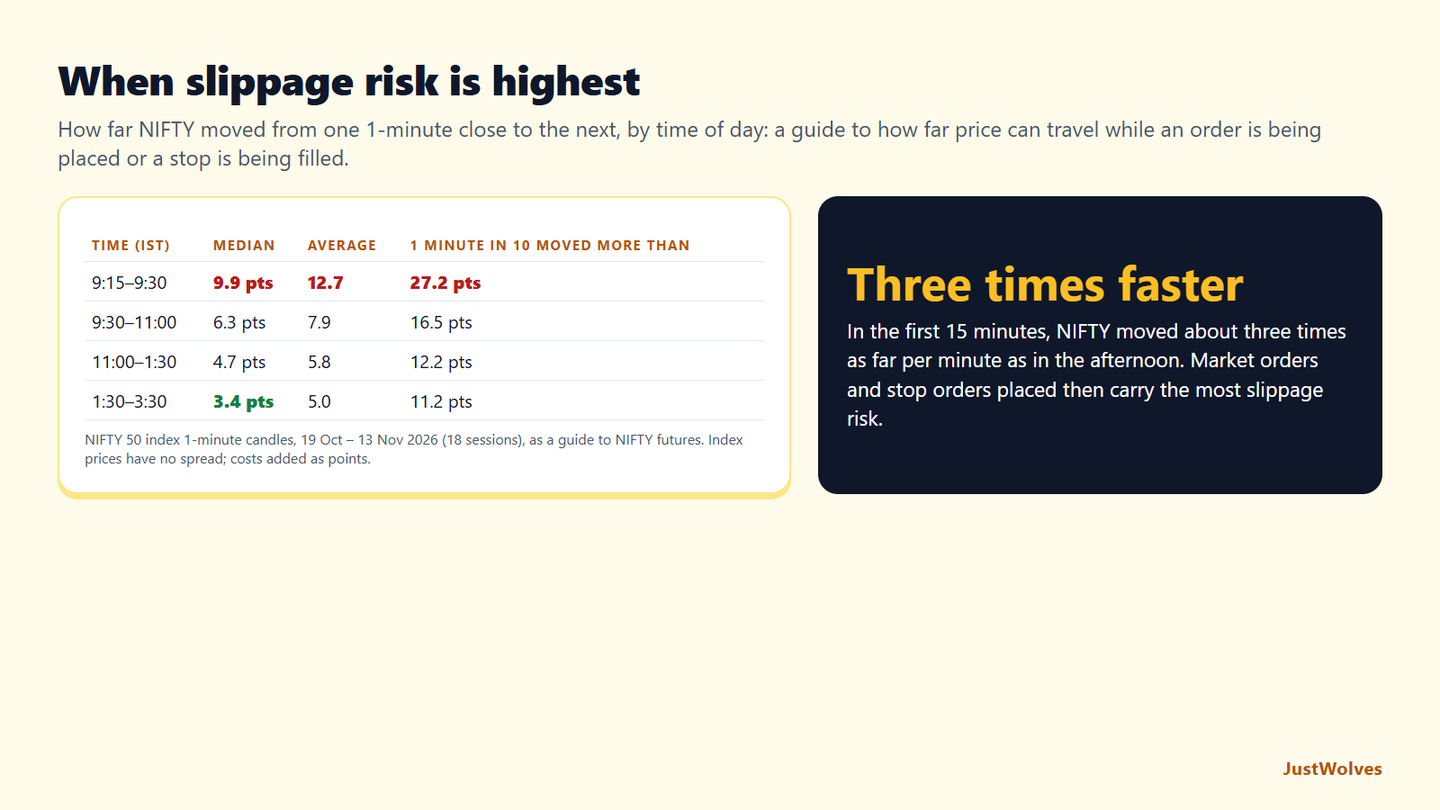
Slippage comes from the spread, from moving through the order book, and from price moving while an order is placed or a stop is filled. Historical spreads for NIFTY options are not in our data, so JustWolves measured the third part directly: how far NIFTY 50 moved from one 1-minute close to the next, by time of day, over 18 sessions from 19 October to 13 November 2026. Larger minute-to-minute moves mean more room for an order to fill away from the expected price.
| Time (IST) | Median move | Average move | One minute in ten moved more than |
|---|---|---|---|
| 9:15–9:30 | 9.9 pts | 12.7 pts | 27.2 pts |
| 9:30–11:00 | 6.3 pts | 7.9 pts | 16.5 pts |
| 11:00–1:30 | 4.7 pts | 5.8 pts | 12.2 pts |
| 1:30–3:30 | 3.4 pts | 5.0 pts | 11.2 pts |
The first 15 minutes moved about three times as fast as the afternoon. The median minute-to-minute move was almost 10 points from 9:15 to 9:30, against 3.4 points after 1:30 pm, and one opening minute in ten moved more than 27 points. A market order or a stop that triggers in that window can fill well away from the price on the screen, which is why this lesson lists trading the first seconds after the open with market orders as a common mistake.
In options, the effect is roughly halved but the spread is added. A near-the-money option with a delta of about 0.5 moves around half as much as the index, so a 10-point index move is about 5 premium points. But option spreads also tend to be wider at the open and in fast moves, and on deep out-of-the-money strikes all day.
Measure your own. Kavya's approach in this lesson, recording expected and actual prices, is the only way to know your real slippage, because it depends on your instrument, size, order type and timing. Our data suggests one simple change that costs nothing: if you must use market orders, avoid the first 15 minutes, and use limit orders when you enter during fast periods.
Common Mistakes
- Ignoring the spread because it isn't on the contract note.
- Trading illiquid strikes because they're cheap.
- Large market orders in thin markets.
- Not recording expected vs actual prices.
- Trading the first seconds after the open with market orders.
Professional Insight
Experienced scalpers often track slippage as carefully as profit and loss. They know their typical cost per trade, including spread and slippage, and only take setups whose expected move is several times larger. When they notice slippage rising, they trade less, not more.
Risk Considerations
- Stop orders can slip badly in fast moves.
- Thin strikes can be hard to exit.
- Expiry days can produce erratic spreads.
Important Terminology
| Term | Meaning |
|---|---|
| Bid | The highest price a buyer is offering. |
| Ask | The lowest price a seller will accept. |
| Spread | The difference between bid and ask. |
| Market depth | Quantities waiting at the best price levels. |
| Slippage | Expected price minus actual fill price. |
What is the bid-ask spread?
The difference between the highest bid and the lowest ask. Buying at the ask and selling at the bid costs you the spread.
What is slippage in trading?
The difference between the price you expected and the price you got.
How can I reduce slippage?
Use limit orders for entries, trade liquid instruments and strikes, avoid the first seconds after the open, and keep size within visible depth.
Which Nifty option strikes are most liquid?
Usually near-the-money strikes in the current expiry.
Does slippage appear on my contract note?
Not as a separate line; it's reflected in your fill prices.
When is slippage worst in Indian markets?
Usually in the first minutes after 9:15 am and during fast moves around news. In our NIFTY 50 data, the median 1-minute move was 9.9 points from 9:15 to 9:30, about three times the 3.4 points typical after 1:30 pm.
Should I use market or limit orders for scalping?
Limit orders avoid slippage but may not fill; market orders fill but accept slippage, which is largest when price moves fast. Many scalpers enter with limits and use market-type orders only for stop exits, and avoid market orders in the opening minutes.
Practical Exercise
Measure your hidden costs.
Your task
Step 1: Watch market depth
On three option strikes: at, near and far from the money.
Step 2: Record spreads
At 9:20, 11:30 and 2:30.
Step 3: Paper-trade 20 round trips
Recording expected and actual prices.
Step 4: Calculate
Average spread and slippage per round trip, in points and rupees.
Check Your Understanding
Bid 119.95, ask 120.10. The spread is:
Related Lessons
Previous: Scalping vs Intraday Trading. Next: Execution Speed and Transaction Costs. See also the Futures & Options course.