
Stop-Loss Discipline and Scalping Risk Management
JustWolves is an educational platform and is not a SEBI-registered investment advisor. Trading financial instruments involves significant risk of loss and may not be suitable for all investors. Past performance is not indicative of future results. Read our full disclaimer →
What you'll learn
- Scalping losses rarely come from one bad trade; they come from a bad day of many trades or one stop that wasn't honoured
- Set risk per trade, a daily loss limit and a maximum number of trades before the session
- Stop for the day after a set number of consecutive losses
- Never average down a losing scalp or move a stop further away
- Use stop orders and any platform loss limits your broker offers, so discipline doesn't depend on willpower
In this article · 14 sections
Scalping strategies differ, but the ways scalpers lose large amounts are remarkably similar: a stop that wasn't placed, a losing trade averaged down, or a bad morning that turned into a revenge-trading afternoon. Good risk management for scalpers is less about clever stop placement and more about rules that cap the damage of a bad trade and a bad day. This lesson sets out those rules and shows how to make them automatic.
What You Will Learn
- How to size scalps from risk per trade
- Daily loss limits and trade caps
- Consecutive-loss and averaging-down rules
- Making the rules automatic
Before You Start
Risk Per Trade
Scalpers often risk less per trade than swing traders because they take many more trades. A common range is 0.25% to 0.5% of the trading account per scalp, including costs. On a ₹2,00,000 account, 0.25% is ₹500.
For an option scalp, rupee risk = (entry − stop) × units + charges. A one-lot Nifty option bought at 140 with a stop at 135 risks 5 points × 65 = ₹325 gross, about ₹393 with charges. That fits inside a ₹500 limit; two lots wouldn't.
The Daily Rules
| Rule | Example setting | Why |
|---|---|---|
| Risk per trade | 0.25% (₹500) including costs | Keeps any single loss small |
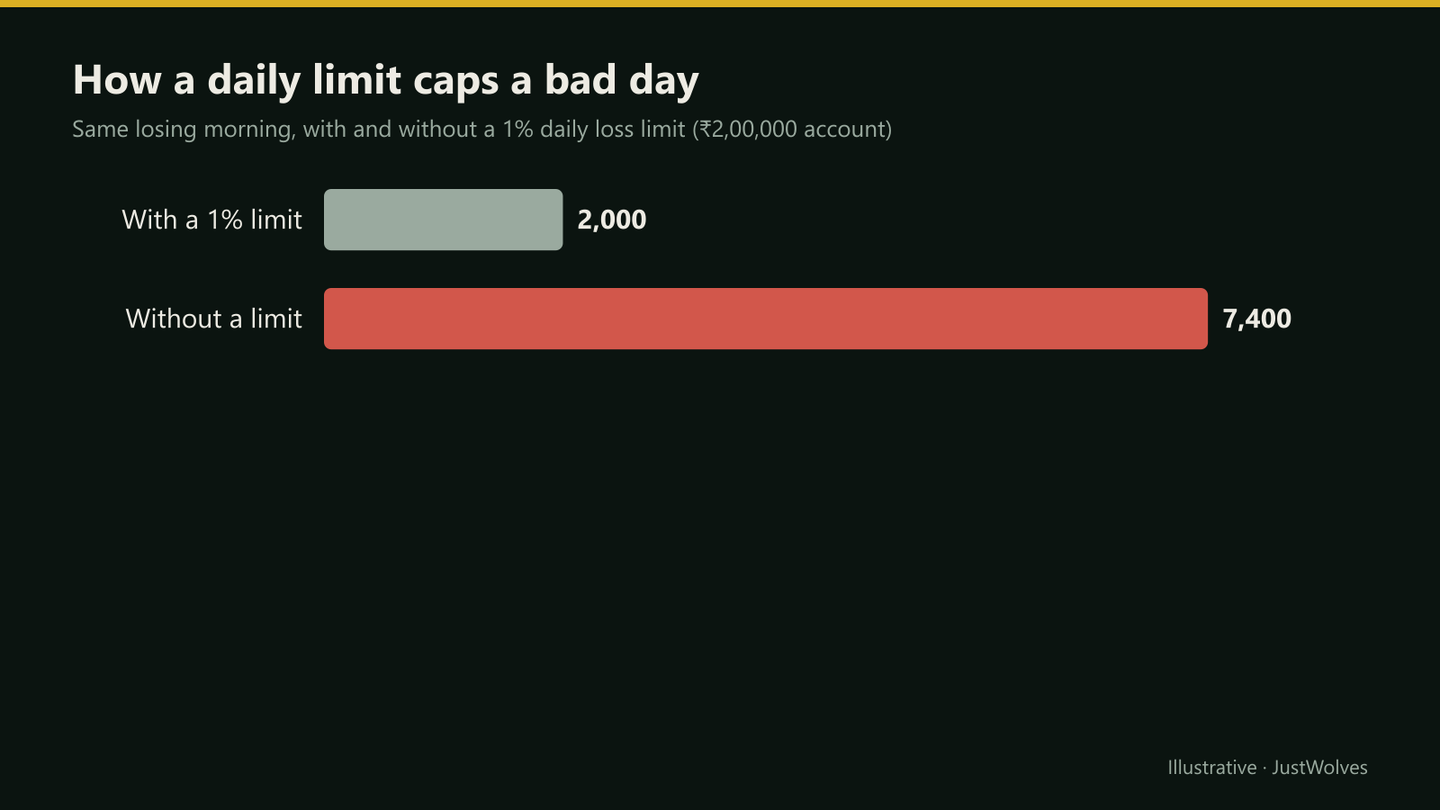
| Daily loss limit | 1% (₹2,000) | Caps a bad day at a recoverable size |
| Maximum trades per day | 8 | Limits overtrading and cost drag |
| Consecutive losses | Stop after 3 in a row | Interrupts tilt before it escalates |
| Profit protection | Stop if half the day's gains are given back | Prevents good days becoming bad ones |
The exact numbers are personal; the point is to decide them before the session and write them down. Rules invented mid-session tend to bend towards whatever you want to do next.
Never Average Down a Scalp
Adding to a losing scalp lowers the average price but increases the position just as the trade is proving wrong. If the stop is eventually hit, the loss is several times the plan. Averaging down turns a small, defined loss into a large, undefined one, and it's one of the most common ways scalping accounts suffer large drawdowns.
The same applies to moving a stop further away. If the setup's invalidation point is hit, the trade is over.
Real Prices: A Day the Rule Mattered
Pooja's morning in this lesson is hypothetical. The chart below shows a real one: a simple NIFTY 50 scalping rule on 27 October 2026, three losses before 11 am, and how much the rest of the day would have cost a trader who kept going.
Real prices: three scalping losses before 11 am, and what came after, NIFTY 50, 27 October 2026
Step 1 of 4
Two quick losses
A rule-based scalper on 27 October 2026 trades NIFTY futures on a simple signal: a 5-minute close beyond the previous 30 minutes' high or low, 20-point target and stop. A long at 10:00 (22,789.2) is stopped out by 10:08; a short at 10:20 (22,699.6) by 10:26 as the index snaps back.
- What to observe
- Two losses in 26 minutes on a choppy morning.
- Condition
- Each costs about 34.5 points including charges.
Making Rules Automatic
- Place the stop order immediately after entry, as an actual order.
- Use bracket or stop-loss orders where your broker supports them for the segment.
- Use broker loss-limit or kill-switch features if available; some brokers let you set a daily loss limit or disable a segment for the day.
- Keep a visible tally of trades and P&L, including costs, during the session.
- Close the platform when a daily limit is hit.
Practical Example
Hypothetically, Pooja trades a ₹2,00,000 account with a ₹500 per-trade limit and a ₹2,000 daily loss limit. By 10:30, she's taken four one-lot option scalps: three losses of about ₹390 each and one win of about ₹320, net about −₹850 including charges. After the third consecutive loss, her rule says stop.
She closes the platform. On a similar morning a month earlier, before she had the rules, she kept trading to win it back, doubled size twice, and finished the day down ₹7,400. The rules didn't make her better at picking trades; they made her bad days much smaller.
How Much Do Risk Rules Help? Our Test
JustWolves applied this lesson's rules to a real stream of trades: a simple momentum scalp on 5-minute prices for 10 liquid NSE stocks, about 58 sessions each from August to November 2026, giving about 5.6 trades per stock-session. Each trade risked 1R (one ATR) with a 1.5R target, after costs of 0.06% per round trip. We then replayed the same trades under different rules: no rules; stop after three losses in a row; a daily loss limit of −3R; a cap of four trades a day; and averaging down, adding an equal position at −0.5R with the same stop.
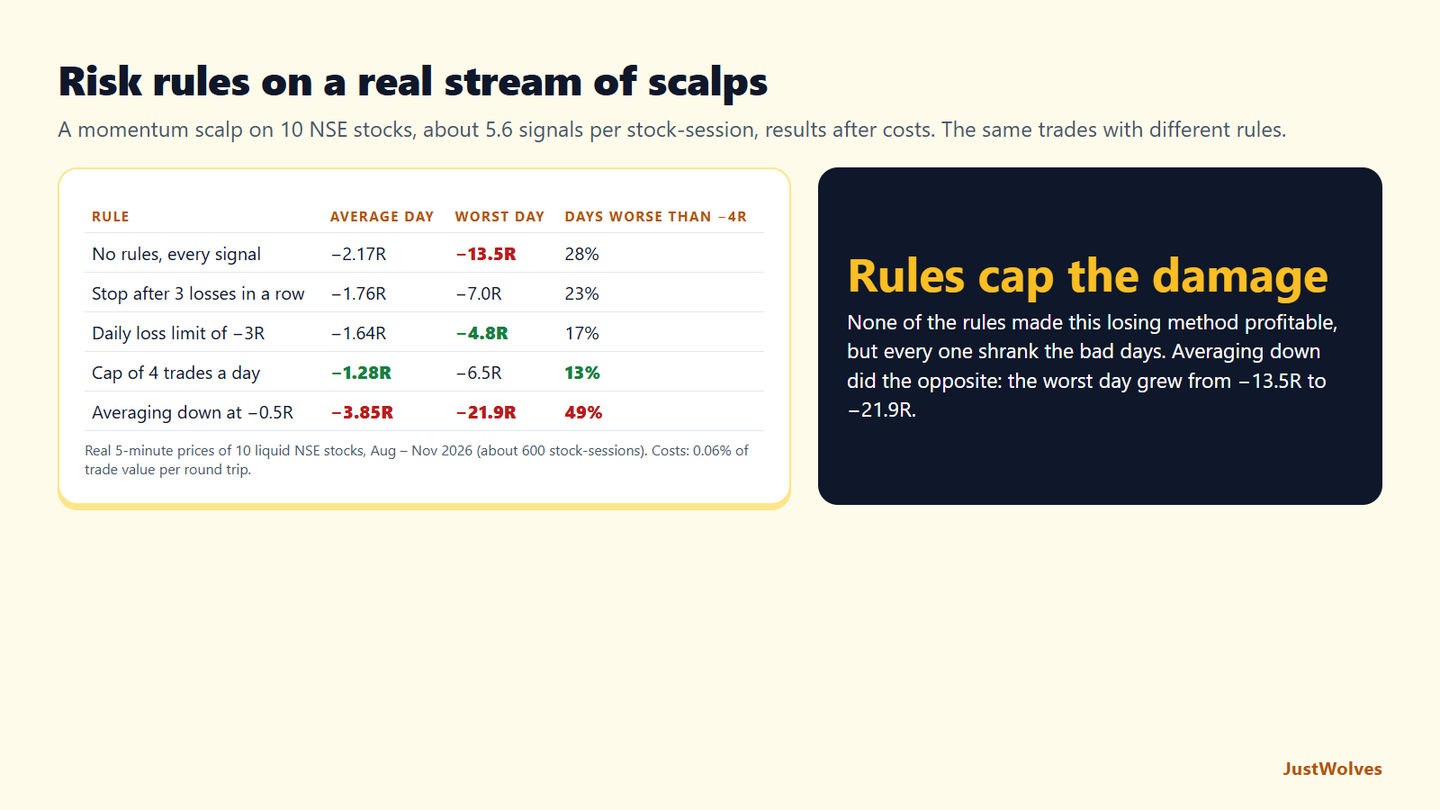
| Rule | Average day | Worst day | Days worse than −4R |
|---|---|---|---|
| No rules, every signal | −2.17R | −13.5R | 28% |
| Stop after 3 losses in a row | −1.76R | −7.0R | 23% |
| Daily loss limit of −3R | −1.64R | −4.8R | 17% |
| Cap of 4 trades a day | −1.28R | −6.5R | 13% |
| Averaging down at −0.5R | −3.85R | −21.9R | 49% |
The method itself lost money, and no rule changed that. The scalp we used was negative after costs, as most simple scalps were in our tests. That makes it a fair test of risk rules: they cannot create an edge, only control the damage.
Every rule shrank the bad days. The −3R daily loss limit cut the worst day from −13.5R to −4.8R, exactly as designed; stopping after three losses roughly halved it. The cap of four trades did best on the average day, because each skipped trade avoided its costs. This supports the professional insight in this lesson: long-run results are shaped by how small the worst days are kept.
Averaging down was the most destructive rule. Adding to losing trades nearly doubled the average losing trade, from −1.39R to −2.28R, and the worst day grew to −21.9R. Almost half of all days lost more than 4R. That is the mechanism this lesson describes: averaging down turns a small, defined loss into a large, undefined one.
The practical message: set the per-trade and daily limits before the session, put the stop in as an order, never add to a loser, and treat the daily limit as the most important number you have.
Common Mistakes
- No daily loss limit, or one set during the session.
- Averaging down losing scalps.
- Mental stops that are never placed.
- Increasing size after losses.
- Ignoring costs in risk calculations.
Professional Insight
Many experienced scalpers describe their daily loss limit as the most important rule they have, more important than any setup. Their results over months are shaped less by their best days than by how small they keep their worst ones. A trader who never has a catastrophic day can survive long enough to improve.
Risk Considerations
- Gaps and slippage can exceed planned risk.
- Platform outages can prevent exits; know your broker's alternatives.
- Rules only work if they're followed every day.
Important Terminology
| Term | Meaning |
|---|---|
| Daily loss limit | The maximum loss after which trading stops for the day. |
| Averaging down | Adding to a losing position at a lower price. |
| Kill switch | A broker feature that disables trading in a segment for the day. |
| Tilt | Emotional, impulsive trading after losses. |
| Bracket order | An entry order with an attached stop and target. |
How much should I risk per scalp?
Many scalpers risk around 0.25% to 0.5% of the account per trade, including costs.
What is a good daily loss limit?
It's personal, but many traders use a small multiple of their per-trade risk, such as 1% to 2% of the account.
Should I average down a losing scalp?
No. It increases size as the trade proves wrong and turns small losses into large ones.
When should I stop trading for the day?
When your daily loss limit or consecutive-loss rule is hit, or your maximum trade count is reached.
Can my broker enforce a loss limit?
Some brokers offer loss-limit or kill-switch features; check what yours provides.
Does a daily loss limit really help?
In our test it capped the bad days without changing the method. On a stream of real NSE stock scalps, a −3R daily loss limit cut the worst day from −13.5R to −4.8R and the share of days worse than −4R from 28% to 17%.
What does averaging down do to scalping results?
It makes losses much larger. In our NSE test, adding an equal position at −0.5R raised the average losing trade from −1.39R to −2.28R and nearly doubled the worst day, to −21.9R.
Practical Exercise
Write your risk card.
Your task
Step 1: Set five numbers
Risk per trade, daily limit, maximum trades, consecutive-loss stop, profit protection.
Step 2: Write them on a card
Keep it beside your screen.
Step 3: Check your broker's tools
Stop orders, bracket orders, loss limits, kill switch.
Step 4: Track compliance
For 20 sessions, record whether each rule was followed.
Check Your Understanding
0.25% of a ₹2,00,000 account is:
Related Lessons
Previous: News-Event Risk for Intraday Traders. Next: Backtesting a Scalping Strategy with Real Costs. See also Daily and Weekly Loss Limits.