
Inversion Fair Value Gaps and the FVG-in-FVG Entry
JustWolves is an educational platform and is not a SEBI-registered investment advisor. Trading financial instruments involves significant risk of loss and may not be suitable for all investors. Past performance is not indicative of future results. Read our full disclaimer →
What you'll learn
- An inversion FVG (IFVG) is a fair value gap that price closed through, after which it's used in the opposite direction
- A bullish FVG closed through to the downside becomes a bearish IFVG, and vice versa
- Trade the retest of the IFVG with a stop beyond the gap, ideally when the inversion coincides with a structure shift
- FVG-in-FVG: inside a higher-timeframe FVG, a lower-timeframe FVG formed by the reversal gives a tighter entry
- Both techniques refine location; neither removes the need for bias, stops and testing
In this article · 14 sections
Fair value gaps don't always hold. When price closes straight through one, ICT doesn't discard it; it often treats the gap as having flipped, now working in the opposite direction. This lesson covers that 'inversion' FVG, and a second advanced technique: refining a large higher-timeframe FVG with a smaller lower-timeframe one to tighten entries and stops.
What You Will Learn
- What an inversion FVG is and how a gap flips polarity
- How to trade the retest of an IFVG
- The FVG-in-FVG entry method and timeframe pairings
- How to handle very small and very large gaps
Before You Start
Read PD Arrays and Fair Value Gap first.
What an Inversion FVG Is
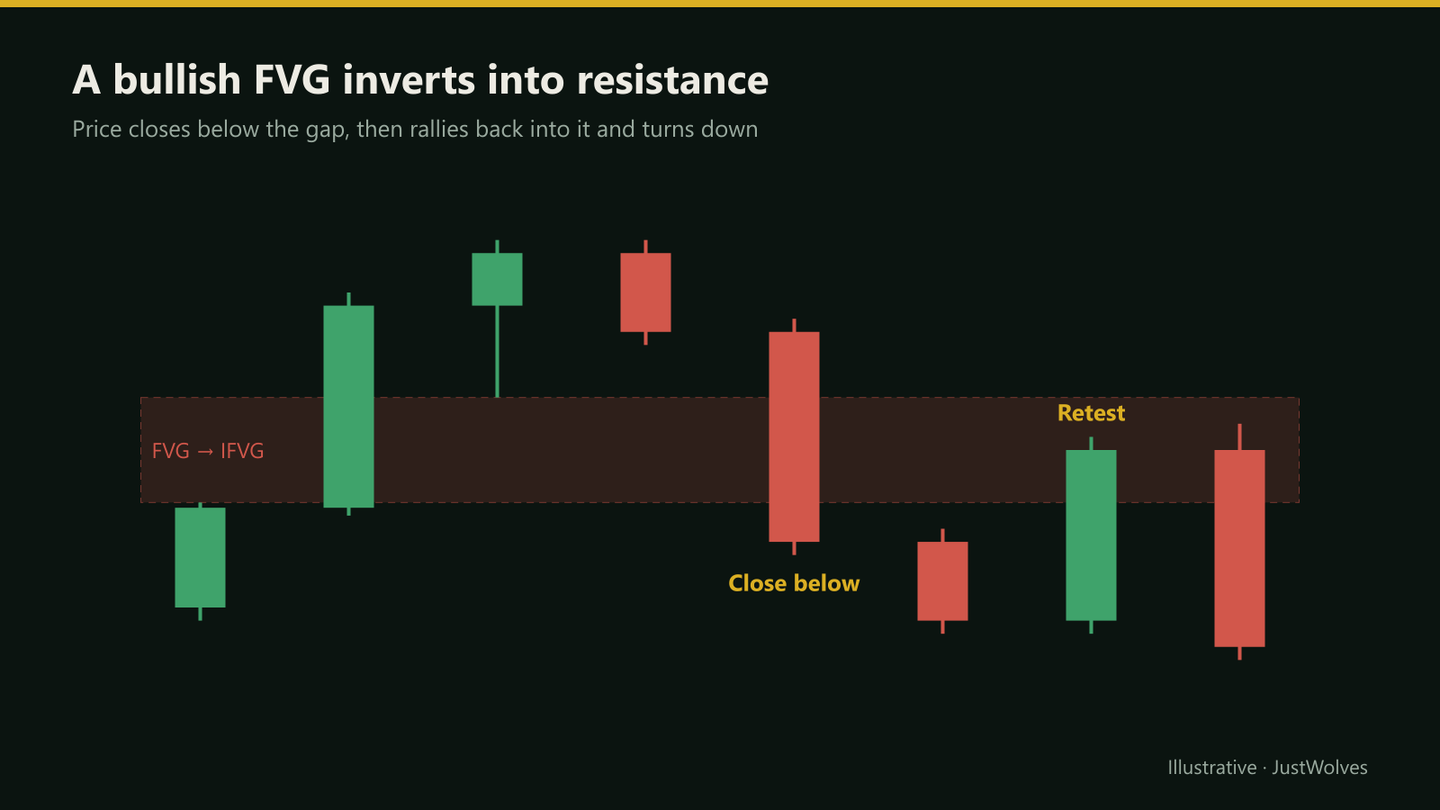
An inversion fair value gap (IFVG), also called an inverse or inverted FVG, is an FVG that price closed through instead of reacting from. After the close through it, the gap is used in the opposite direction.
It's the same idea as broken support becoming resistance, applied to a gap. A bullish FVG closed below becomes a bearish IFVG: on a rally back into it, traders look for shorts. A bearish FVG closed above becomes a bullish IFVG: on a pullback into it, traders look for longs.
An Inversion Step by Step
The chart below shows a bullish gap that fails on a body close and then acts as resistance when price comes back to it from below.
A bullish FVG fails and inverts into resistance
Step 1 of 5
A bullish FVG forms
A strong rally leaves a gap between candle 2's high (1.0815) and candle 4's low (1.0828).
- What to observe
- A normal bullish FVG.
- Condition
- Expected to act as support.
Trading the IFVG Retest
Bearish IFVG example
Step 1: Identify the inversion
A candle body closes below a bullish FVG on your trading timeframe.
Step 2: Check context
Ideally the same move is a bearish MSS, or the higher-timeframe bias is bearish.
Step 3: Wait for the retest
Let price rally back into the gap.
Step 4: Enter
Sell at the gap's near edge or its 50% level, or after a lower-timeframe bearish shift inside it.
Step 5: Risk
Stop above the gap (or the retest high); target the next sell-side liquidity.
Do Failed Gaps Really Flip? Our Test
JustWolves tested inversions on the same set of real 1H fair value gaps used in the PD Arrays lesson (EUR/USD, GBP/USD, USD/JPY and gold, May–November 2026). We took the 460 gaps that failed (a candle closed through the far edge), waited for price to move at least one average candle away, and then looked at what happened when it came back to the gap from the other side.
| Measure | Result |
|---|---|
| Failed gaps that price came back to from the other side | 367 of 460 |
| Acted as the opposite level (price rejected by one average candle) | 57% |
| Reclaimed (price closed back through the whole gap) | 43% |
| For comparison: fresh gaps that held on their first revisit | 60% |
Inverted gaps did lean toward acting as the opposite level, 57% of the time, almost the same rate at which fresh gaps held. In other words, an IFVG is about as reliable as an ordinary FVG: a reasonable place to plan a trade with a defined stop, but far from certain. The callout above, which says inversions that coincide with a structure shift are stronger, is a sensible refinement to test on top of these baseline numbers.
The FVG-in-FVG Entry
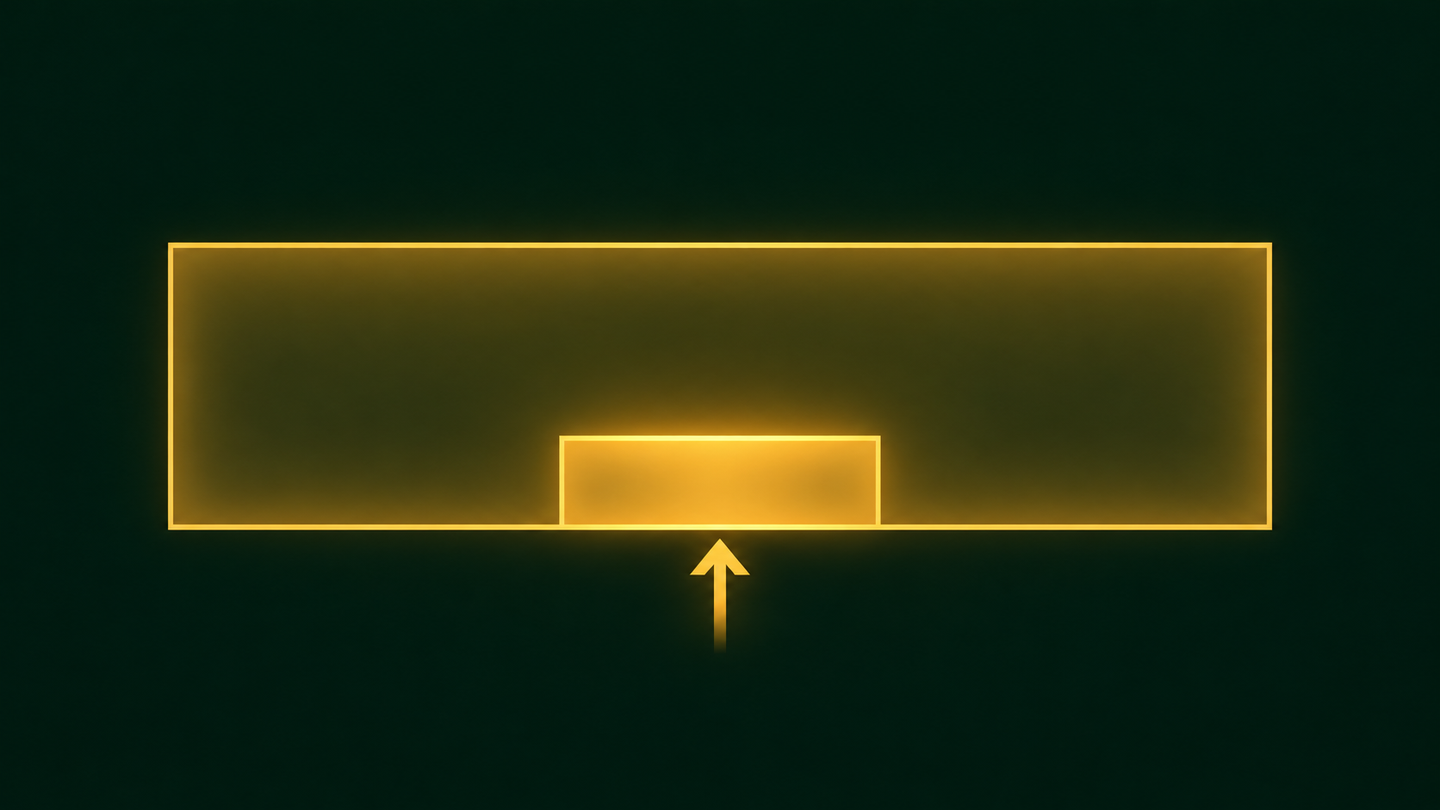
The second technique layers two timeframes. The higher-timeframe FVG tells you where to look; a lower-timeframe FVG, formed inside it by the reversal, tells you when and where precisely to enter.
When price reaches the higher-timeframe gap, you drop down and wait for a sweep of a minor low and a market structure shift (for a long). The displacement of that shift usually leaves a small FVG, inside the larger one. That small gap is your entry zone.
| Style | Zone timeframe | Entry timeframe |
|---|---|---|
| Day trading | 1-hour | 5-minute |
| Swing trading | 4-hour | 15-minute |
| Position trading | Daily | 1-hour |
Handling Gap Size
- Very small entry FVG (a few pips): a stop just outside it can be hit by normal noise. Some traders put the stop beyond the higher-timeframe gap instead, and reduce position size to keep risk constant.
- Very large entry FVG: enter at its 50% level rather than the near edge to shorten the stop.
- Either way: size from the actual stop; never let a tight-looking entry tempt you into a bigger position.
Practical Example
Hypothetically, on the 4-hour EUR/USD chart, a bullish FVG sits at 1.0815–1.0840 in discount. Price reaches it during London. On the 15-minute chart, it sweeps a minor low at 1.0821, then breaks a minor high with displacement, leaving a small FVG at 1.0827–1.0833 inside the 4-hour gap.
Ananya places a buy limit at 1.0831 with a stop at 1.0812, below the 4-hour gap, because the 15-minute gap is only 6 pips. Her target is the 4-hour high at 1.0905: 19 pips of risk for 74 pips. The following week, the same 4-hour FVG is closed through to the downside; she marks it as a bearish IFVG for later.
Testing the FVG-in-FVG Entry
The FVG-in-FVG entry depends on detail inside each higher-timeframe gap, which our six months of hourly data cannot test properly. If you want to know whether it works for you, log these fields for every higher-timeframe gap price reaches, not only the ones that produced a trade:
- Did a lower-timeframe gap form inside the higher-timeframe gap? Many reversals happen without one.
- Did price return to the lower-timeframe gap? If not, the entry was missed.
- Result in R, with misses counted as zero. Compare it with a simpler entry, such as a limit at the higher-timeframe gap's 50% level, on the same setups.
- Stop distance in pips or points. Very small entry gaps produce very tight stops, which spreads and noise hit often.
After 30 to 50 higher-timeframe gaps, the comparison will show whether the extra precision pays for the extra missed trades.
Common Mistakes
- Calling a wick through a gap an inversion. It needs a body close.
- Trading IFVGs against the higher-timeframe trend.
- Entering in the higher-timeframe gap before the lower-timeframe shift.
- Stops inside tiny gaps where noise reaches them.
- Oversizing because the entry looks precise.
Professional Insight
Both techniques are about precision, and precision cuts both ways: tighter stops mean larger winners in R but more frequent stop-outs. Test them with your actual spreads and execution; a refinement that looks excellent on a clean chart may disappoint once real costs are included.
Risk Considerations
- Inversions can fail, with price reclaiming the gap.
- Lower-timeframe entries are sensitive to spreads and news.
- Unfilled limits mean missed trades.
Important Terminology
| Term | Meaning |
|---|---|
| Inversion FVG (IFVG) | An FVG that price closed through, used in the opposite direction. |
| Polarity | Whether a zone acts as support or resistance. |
| FVG-in-FVG | A lower-timeframe FVG forming inside a higher-timeframe FVG, used for entry. |
| Retest | Price returning to a broken zone. |
| Consequent encroachment | The 50% level of an FVG. |
What is an inverse fair value gap?
A fair value gap that price closed through, after which traders use it in the opposite direction, like broken support becoming resistance.
What does IFVG mean?
Inversion fair value gap: an FVG whose polarity has flipped after a close through it.
What is the FVG-in-FVG strategy?
Using a lower-timeframe FVG that forms inside a higher-timeframe FVG, after a structure shift, as a precise entry zone.
Does a wick through an FVG invert it?
Generally no. Most definitions require a candle body to close through the gap.
Where does the stop go on an IFVG trade?
Beyond the far side of the inverted gap, plus a small buffer. If price closes back through the whole gap, the inversion has failed, which happened in about 43% of retests in our test, so size the trade for that distance.
How reliable is an inversion fair value gap?
In our test of 367 retests of failed 1H gaps on four markets, the inverted gap acted as the opposite level 57% of the time and was reclaimed 43% of the time, about the same as fresh gaps holding (60%).
Does a wick through a gap count as an inversion?
No. An inversion needs a candle body to close beyond the far edge of the gap. A wick through and close back inside means the gap was tested, not broken.
How is an inverse fair value gap different from a normal fair value gap?
A normal fair value gap is expected to act as support (bullish) or resistance (bearish) in the direction of the move that created it. An inverse fair value gap is one that price has closed through, after which traders expect it to act in the opposite role, for example a failed bullish gap becoming resistance.
Practical Exercise
Find inversions and nested gaps.
Your task
Step 1: Find ten inversions
FVGs closed through on 1-hour charts.
Step 2: Track retests
Did price retest them, and did they hold in the new direction?
Step 3: Find five FVG-in-FVG setups
On a 4-hour/15-minute pairing.
Step 4: Compare stops
Stop size using the entry gap vs the higher-timeframe gap, in pips and R.
Check Your Understanding
A bullish FVG closed through to the downside becomes:
Related Lessons
Previous: PD Arrays. Next: Optimal Trade Entry. See also Fair Value Gap.