
ICT Kill Zones in IST: London, New York and Asian Windows
JustWolves is an educational platform and is not a SEBI-registered investment advisor. Trading financial instruments involves significant risk of loss and may not be suitable for all investors. Past performance is not indicative of future results. Read our full disclaimer →
What you'll learn
- Kill zones are time windows, defined in New York time, when ICT expects setups to form
- Asian 8 pm–midnight, London 2–5 am, New York open 7–10 am, London close 10 am–noon (New York time)
- In IST that's London 12:30–3:30 pm and New York 5:30–8:30 pm in northern winter, an hour earlier in summer
- India doesn't change its clocks, so IST kill zone times move twice a year with US daylight saving
- Kill zones concentrate your trading; they don't guarantee setups
In this article · 16 sections
ICT puts as much weight on when to trade as where. Its kill zones are short windows each day when it expects liquidity to be taken and moves to start, so it suggests concentrating on those times. They're defined in New York time, which makes them confusing from India. This lesson converts each kill zone to IST for summer and winter, explains what each is used for, and shows how to build them into a routine.
What You Will Learn
- What ICT kill zones are and why they're time-based
- Each kill zone in New York time and IST
- How daylight saving moves the IST times
- How to choose and use a kill zone
Before You Start
Read Forex Trading Sessions and Market Hours in IST first. Kill zones sit inside those sessions.
What Kill Zones Are
A kill zone is a time window, usually two to four hours, around the opening of a major session. ICT's reasoning is that liquidity and volatility are highest then, and that the day's significant highs and lows, and the moves that follow, often form in these windows.
The practical value is focus: instead of watching charts all day, you look for setups only in one or two defined windows.
Kill Zone Times
| Kill zone | New York time | IST: northern winter (US on EST) | IST: northern summer (US on EDT) |
|---|---|---|---|
| Asian | 8:00 pm – midnight | 6:30 am – 10:30 am | 5:30 am – 9:30 am |
| London | 2:00 am – 5:00 am | 12:30 pm – 3:30 pm | 11:30 am – 2:30 pm |
| New York open | 7:00 am – 10:00 am | 5:30 pm – 8:30 pm | 4:30 pm – 7:30 pm |
| London close | 10:00 am – noon | 8:30 pm – 10:30 pm | 7:30 pm – 9:30 pm |
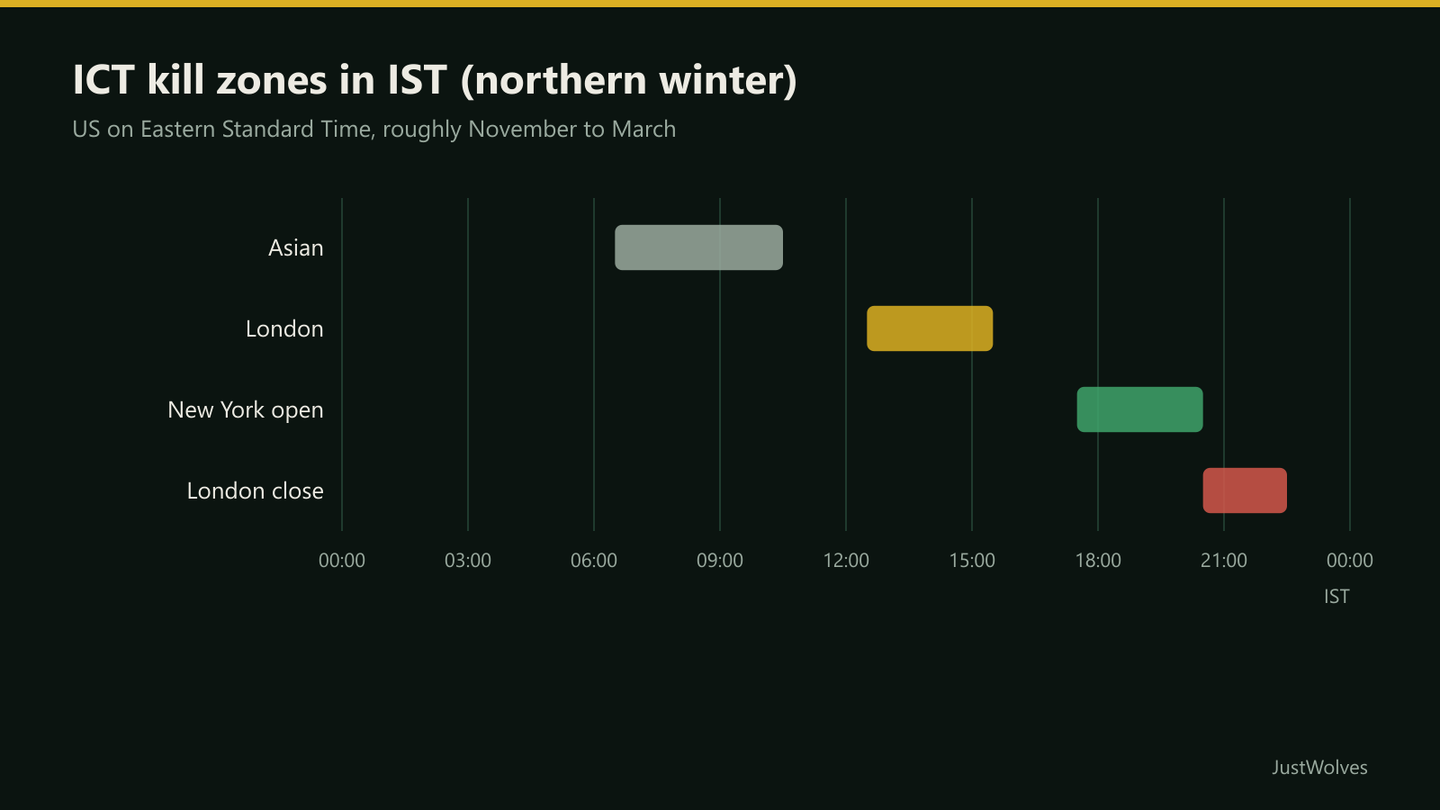
The site's market hours tool shows the kill zones live in your timezone, adjusted for daylight saving automatically.
What Each Kill Zone Is Used For
- Asian: usually quieter. Its main role is forming the Asian range, whose high and low become liquidity targets for London and New York (lesson 03.02.02).
- London: a common window for the day's first major move, often starting with a sweep of the Asian high or low. Convenient for Indian traders in the early afternoon.
- New York open: overlaps the London session and major US data releases (8:30 am New York). Often the most volatile window; can continue or reverse the London move.
- London close: activity fades as London winds down; sometimes used for retracements of the day's move. Many traders stop here.
What the Data Says About Kill Zones
ICT makes two claims about kill zones: that they are the most active hours, and that the day's significant highs and lows tend to form in them. JustWolves tested both on about six months of real hourly candles (May–November 2026) for EUR/USD, GBP/USD, USD/JPY and gold. All times are New York time; the table above converts them to IST.
1. Are kill zones the most active hours?
We measured the average size of each hourly candle, relative to the average hour, and scaled the busiest hour to 100%.
Average hourly activity, as % of the busiest hour (New York time)
Yes, broadly. The three busiest hours of the day were 08:00–10:00 New York, which covers the New York kill zone, the overlap with London and the main US data releases at 08:30. The London kill zone (02:00–05:00) was the second most active block. The quietest stretch ran from the New York close through the hour before Tokyo opens. For traders in India, that means the most active hour usually falls around 6:30–7:30 pm IST in winter (when New York is on standard time) and 5:30–6:30 pm IST in summer.
2. Does the day's high or low form in a kill zone?
| Window (New York time) | Share of the 24-hour day | Day's high formed here | Day's low formed here |
|---|---|---|---|
| Asian session, 20:00–00:00 | 17% | 18% | 17% |
| London kill zone, 02:00–05:00 | 13% | 12% | 12% |
| New York kill zone, 07:00–10:00 | 13% | 15% | 16% |
| Rest of the day | 58% | 55% | 55% |
Not much more often than chance. Each window produced the day's high or low roughly in proportion to how many hours it covers. The New York kill zone was slightly above its share and the London kill zone slightly below. More than half of daily highs and lows formed outside all three windows.
So kill zones are a sound way to decide when to be at the screen, because that is when price moves most. They are not evidence that the day's turning points cluster inside them. Use them to manage attention and screen time, not as a signal on their own.
See the hourly rhythm: EUR/USD 1H
Loading historical candles…
Daylight Saving Traps
India doesn't change its clocks. Because kill zones are defined in New York time, their IST times move by an hour when the US changes clocks, in March and November. The UK changes on different dates, so for a few weeks a year London and New York are only four hours apart instead of five.
The safest approach is to anchor everything to New York time and convert, or to use a tool that does it for you, rather than memorising fixed IST times.
Step by Step: Building a Kill Zone Routine
For traders in India
Step 1: Pick one kill zone
London (early afternoon IST) or New York open (evening IST) suit most schedules.
Step 2: Prepare 30 minutes before
Higher-timeframe bias, dealing range, PD arrays and the Asian range marked.
Step 3: Check the calendar
Note high-impact news inside the window.
Step 4: Trade only inside the window
If no setup appears, no trade.
Step 5: Stop at the end
Manage open trades by plan; don't look for new ones.
Practical Example
In December, Rahul works until 5:00 pm IST. He chooses the New York open kill zone, 5:30–8:30 pm IST. At 5:00 pm he marks the Asian and London highs and lows, checks the 4-hour bias and notes US data at 7:00 pm IST.
In April, after the US clocks change, the same kill zone runs 4:30–7:30 pm IST, which clashes with his work. He switches to the last two hours of the window, 5:30–7:30 pm, and accepts that he'll miss some early setups.
What Drives the 08:30 Spike
The jump in activity at 08:00–09:00 New York is not only about the session opening. Many of the most market-moving US economic releases are published at 08:30 New York time, including the monthly jobs report, consumer inflation (CPI) and retail sales. On those days, the first minutes after the release can move further than whole sessions on quiet days, and spreads can widen sharply.
For kill-zone traders, that has three practical consequences:
- Check the economic calendar every morning. Know whether a major release falls inside your window.
- Avoid entering in the minutes just before a release. Price can spike through both sides of a setup.
- Treat release-day sweeps with extra caution. A move through a level driven by data is not the same as a liquidity sweep in normal trading.
For a full explanation of the most important release, see What Is NFP in Trading?. The site's economic calendar lists upcoming events in Indian time.
Common Mistakes
- Forgetting daylight saving and trading the wrong hour.
- Trading every kill zone and wearing yourself out.
- Forcing trades because it's 'the kill zone'.
- Ignoring news inside the window.
- Mixing definitions from different sources.
Professional Insight
Whatever you think of ICT's explanations, time-boxing your trading is a well-established professional habit. It reduces overtrading, makes your results comparable from day to day, and protects your sleep and concentration, which matter as much as any setup.
Risk Considerations
- Volatility is highest in London and New York windows; stops can be hit fast.
- News releases inside kill zones cause spikes.
- Late-night trading in India can lead to tired decisions.
Important Terminology
| Term | Meaning |
|---|---|
| Kill zone | A time window in which ICT expects setups to form. |
| New York time | The reference timezone for ICT times (EST/EDT). |
| EST / EDT | US Eastern Standard / Daylight Time. |
| Asian range | The high and low formed in the Asian kill zone. |
| Time-boxing | Limiting trading to fixed windows. |
What are ICT kill zones?
Time windows around major session opens, defined in New York time, when ICT expects setups and significant moves to form.
What time is the London kill zone in India?
2–5 am New York time: 12:30–3:30 pm IST in northern winter and 11:30 am–2:30 pm IST in summer.
What time is the New York kill zone in IST?
7–10 am New York time: 5:30–8:30 pm IST in winter and 4:30–7:30 pm IST in summer.
Why do kill zone times change in India?
Because the US uses daylight saving and India doesn't, so the IST equivalents shift by an hour twice a year.
Which kill zone is best for Indian traders?
London (early afternoon IST) or New York open (evening IST) usually fit Indian schedules best.
What is the most active kill zone?
In our data for EUR/USD, GBP/USD, USD/JPY and gold, the busiest hours were 08:00–10:00 New York time, inside the New York kill zone, followed by the London kill zone (02:00–05:00). In IST, the busiest hour is around 6:30–7:30 pm in winter and 5:30–6:30 pm in summer.
Does the daily high or low usually form in a kill zone?
Not much more often than chance in our test of about 520 trading days. The London and New York kill zones produced the day's high or low roughly in proportion to the hours they cover, and more than half of daily highs and lows formed outside all kill zones.
Practical Exercise
Set up your kill zone schedule.
Your task
Step 1: Check today's times
Using the market hours tool, write today's kill zones in IST.
Step 2: Choose one
Based on your daily schedule.
Step 3: Diary dates
Note the next US clock change and your new IST times.
Step 4: Observe a week
Record whether the day's high or low formed inside your kill zone.
Check Your Understanding
Kill zones are defined in which timezone?
Related Lessons
Previous module: Optimal Trade Entry. Next: Asian Range, London and New York Sessions. See also Forex Trading Sessions in IST.