
The ICT Silver Bullet Setup: Rules, Times in IST and Examples
JustWolves is an educational platform and is not a SEBI-registered investment advisor. Trading financial instruments involves significant risk of loss and may not be suitable for all investors. Past performance is not indicative of future results. Read our full disclaimer →
What you'll learn
- The Silver Bullet is a time-based model: setups only in three one-hour windows, defined in New York time
- The windows are 3–4 am, 10–11 am and 2–3 pm New York time; in IST, 1:30–2:30 pm, 8:30–9:30 pm and 12:30–1:30 am in winter
- Inside the window: liquidity is taken, price displaces the other way, and you enter on the FVG it leaves
- Stops go beyond the swing that created the FVG; targets are the next liquidity in the trade's direction
- The tight time filter reduces trades; it doesn't guarantee them
In this article · 15 sections
The Silver Bullet is probably the most widely shared ICT model, partly because it's simple: one setup, three short windows a day. Inside a window, you wait for price to take some liquidity, shift direction with displacement, and leave a fair value gap to enter from. This lesson sets out the rules precisely, converts the windows to IST, and covers the mistakes that make it fail.
What You Will Learn
- The three Silver Bullet windows in New York time and IST
- The setup rules step by step
- Stop and target placement
- How to adapt the model for traders in India
Before You Start
Read ICT Kill Zones in IST, Change in State of Delivery and Fair Value Gap first.
The Three Windows
| Window | New York time | IST, northern winter | IST, northern summer |
|---|---|---|---|
| London | 3:00 – 4:00 am | 1:30 – 2:30 pm | 12:30 – 1:30 pm |
| New York AM | 10:00 – 11:00 am | 8:30 – 9:30 pm | 7:30 – 8:30 pm |
| New York PM | 2:00 – 3:00 pm | 12:30 – 1:30 am (next day) | 11:30 pm – 12:30 am |
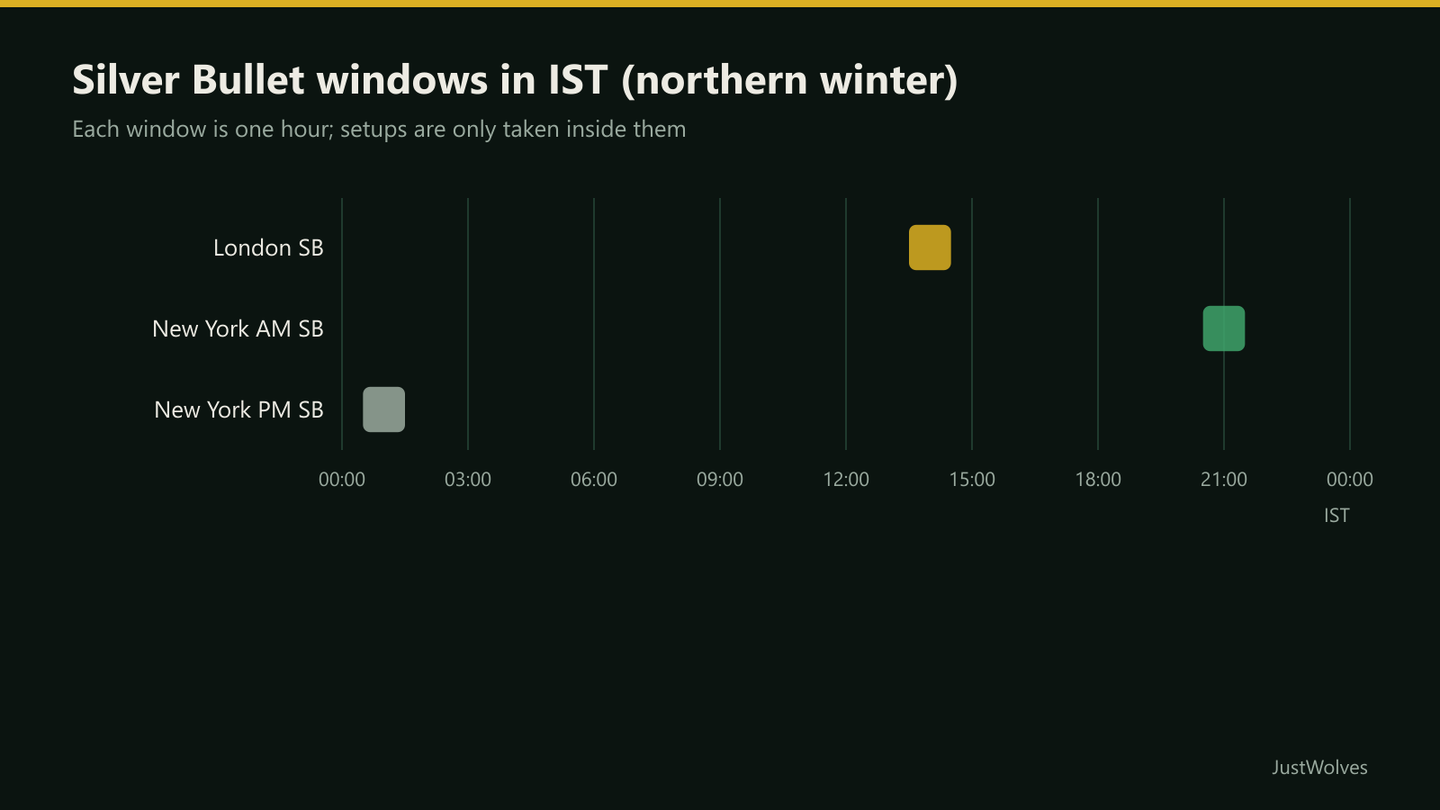
For most traders in India, the London window (early afternoon) and the New York AM window (evening) are the practical choices.
The Setup Rules
Inside the window
Step 1: Bias and draw
Before the window: higher-timeframe bias and the draw on liquidity (lesson 03.02.05).
Step 2: Liquidity taken
In or just before the window, price takes an obvious level against your bias: a recent high or low, the Asian or London level.
Step 3: Displacement
Price moves sharply back in the bias direction, breaking short-term structure (an MSS or CISD).
Step 4: FVG
That move leaves a fair value gap on a low timeframe (1- to 5-minute).
Step 5: Entry
Limit order in the FVG, placed while still inside the window.
The Setup on a Chart
The chart below follows a New York AM Silver Bullet from the window opening to the target.
A New York AM Silver Bullet, step by step
Step 1 of 4
The window opens
At 10:00 New York (8:30 pm IST in winter), price dips below the London low at 1.0868, sweeping sell-side liquidity in line with a bullish bias.
- What to observe
- Liquidity taken inside the window.
- Condition
- Only setups that form between 10:00 and 11:00 count.
Stops and Targets
- Stop: beyond the swing that created the FVG, or beyond the liquidity sweep, plus a buffer.
- Target: the next obvious liquidity in the trade's direction, such as the session high or low, the PDH or PDL.
- Minimum reward: many traders require a minimum distance to the target (for example 2R or a fixed number of pips) before taking the trade.
- Time: if the FVG isn't filled during the window, cancel the order.
A First Test of the Silver Bullet Windows
JustWolves ran a mechanical version of the Silver Bullet on real 15-minute data for EUR/USD, GBP/USD, USD/JPY and gold. Important limit: free 15-minute history only covers about one month (mid-October to mid-November 2026), so this is a small, early sample. Rule: the first fair value gap (at least 30% of an average 15-minute candle) that formed inside a window (03:00–04:00, 10:00–11:00 or 14:00–15:00 New York); a limit order at its midpoint, valid for 90 minutes; stop beyond the gap's first candle; target 2R; trades closed after three hours. For comparison, we applied the identical rule to gaps that formed at every other hour. There was no bias filter. Costs were excluded.
| FVG formed | Setups | Filled | Winning trades | Average per trade |
|---|---|---|---|---|
| Inside a Silver Bullet window | 116 | 47% | 33% | −0.22R |
| At any other hour (same rule) | 727 | 49% | 38% | −0.04R |
In this short sample, gaps formed inside the Silver Bullet windows did worse than gaps formed at other hours, not better. With around 55 filled trades in the windows, that difference could be chance, and one month is far too short to judge a model. What the result does show is that the window by itself is not doing the work. It matches what we found for kill zones: these hours are the most active, which means larger moves in both directions, and a gap formed in a fast market is more likely to be run through.
If you trade the Silver Bullet, two practical points follow. Keep the bias and draw-on-liquidity steps; the version tested here had neither. And because the stops are tight, include your real spread in every result: a one-pip spread on a ten-pip stop costs 0.1R per trade before anything else.
Adapting the Silver Bullet for India
- Choose one window you can trade alert. For most people that's London (early afternoon IST) or New York AM (evening IST). The New York PM window falls after midnight IST in winter and is best skipped unless you're a night owl.
- Know the news timing. Major US data at 8:30 am New York time comes out at 7:00 pm IST in winter, before the New York AM window opens at 8:30 pm IST. The window often trades in the aftermath of that release, so check the calendar every day.
- Mind the spread. One-minute FVGs can be only a few pips tall; a wide spread can turn a valid setup into a loss. Prefer the most liquid pairs and avoid the first minutes after news.
- Change times twice a year. Recheck the IST windows when US clocks change in March and November.
Practical Example
Hypothetically, in winter, EUR/USD's daily bias is bullish with the PDH at 1.0912 as the draw. At 8:35 pm IST (10:05 am New York), price dips below the London low at 1.0861 to 1.0856, then rallies sharply through a minor high at 1.0872, leaving a 1-minute FVG at 1.0866–1.0870.
Vikram places a buy limit at 1.0869 at 8:42 pm IST. It fills at 8:51 pm. His stop is 1.0852, below the sweep low; his target is 1.0912: 17 pips of risk for 43 pips. Had the order not filled by 9:30 pm IST, he'd have cancelled it.
A Simple Window Routine
Because the Silver Bullet is defined by the clock, a fixed routine matters more than for most setups. Fifteen minutes before your window, mark the session highs and lows and write your bias. During the window, only look for the sequence: liquidity taken against the bias, displacement, a fair value gap. When the window closes, stop, whether or not you traded. Record every window, including the empty ones; a model that produces a setup on only some days needs those days in its statistics too.
Common Mistakes
- Wrong window after a daylight saving change.
- No liquidity taken before the displacement.
- Trading against the bias because a gap appeared.
- Holding unfilled orders after the window closes.
- Tiny targets that costs make unprofitable.
Professional Insight
The Silver Bullet's appeal is that it's specific enough to backtest cleanly: a fixed window, a fixed sequence, a fixed entry. That's also its test. Run it on your pair, in the window you'd actually trade, with real spreads, over at least 50 instances, before deciding it deserves money.
Risk Considerations
- Low-timeframe gaps produce tight stops that spreads can hit.
- News in the window (for example 8:30 am New York data) can overwhelm the pattern.
- Late-night windows in India can lead to tired decisions.
Important Terminology
| Term | Meaning |
|---|---|
| Silver Bullet | An ICT model trading FVGs in three one-hour windows. |
| Window | The one-hour period in which the setup must form. |
| Displacement | A sharp move breaking short-term structure. |
| Draw on liquidity | The target level price is expected to reach. |
| Sweep | Price taking an obvious level before reversing. |
What is the ICT Silver Bullet?
A time-based setup traded only in three one-hour windows: after a liquidity sweep and displacement, enter on the fair value gap the move leaves.
What are the Silver Bullet times in India?
In northern winter, 1:30–2:30 pm, 8:30–9:30 pm and 12:30–1:30 am IST; one hour earlier in summer. In New York time the windows are 03:00–04:00, 10:00–11:00 and 14:00–15:00.
Which timeframe is used for the Silver Bullet?
Typically 1- to 5-minute charts for the FVG, with higher timeframes for bias.
Where does the stop go?
Beyond the swing that created the FVG or beyond the liquidity sweep, with a buffer.
Does the Silver Bullet work every day?
No. Many days have no valid setup in the window, and valid setups still fail.
Does the Silver Bullet work?
In our early test on about one month of real 15-minute data, gaps formed inside the Silver Bullet windows did slightly worse than the same rule at other hours (−0.22R vs −0.04R per trade, before costs), without any bias filter. The sample is small; test it with your full rules before trading it.
Do the Silver Bullet times change in India during the year?
Yes. The windows are fixed in New York time, and India does not use daylight saving, so they move by one hour in IST when US clocks change in March and November. Check the date and the IST conversion before each session rather than relying on a remembered time.
Practical Exercise
Backtest one window.
Your task
Step 1: Pick a window
London or New York AM.
Step 2: Review 30 days
Candle by candle, only inside the window.
Step 3: Record setups
Bias, sweep, displacement, FVG, filled or not, result in R.
Step 4: Summarise
Setups per week, win rate, average R, after spreads.
Check Your Understanding
The New York AM Silver Bullet window in New York time is:
Related Lessons
Previous: Advanced CISD. Next: Turtle Soup. See also ICT Kill Zones in IST.