
What Is a Pip in Forex? Pips, Pipettes and Pip Value Explained
JustWolves is an educational platform and is not a SEBI-registered investment advisor. Trading financial instruments involves significant risk of loss and may not be suitable for all investors. Past performance is not indicative of future results. Read our full disclaimer →
What you'll learn
- A pip is the standard unit of price movement: 0.0001 for most pairs and 0.01 for yen pairs
- A pipette is a tenth of a pip, the extra decimal most platforms show
- Pip value depends on the pair and the position size: $10 per pip on a standard lot of a dollar-quoted pair
- Pip value lets you turn a stop distance in pips into a loss in money
- Indian exchange contracts move in ticks: ₹0.0025 per USD on USD/INR, ₹2.50 per contract
In this article · 14 sections
Forex prices move in tiny increments, often only a few hundredths of a percent in an hour. Traders needed a common unit to talk about those moves, set stops and calculate risk, and that unit is the pip. Once you know what a pip is and what it's worth on your position, you can translate any chart distance into money, which is the first step in managing risk.
What You Will Learn
- What a pip and a pipette are
- Why yen pairs use a different decimal place
- How to calculate pip value for any pair and position size
- How price increments work on Indian exchange-traded currency futures
Before You Start
Read Currency Pairs Explained first. You need to know which currency in a pair is the quote currency, because pip value is first measured in it.
What a Pip Is
A pip (short for 'percentage in point' or 'price interest point') is the standard unit for measuring how much a currency price moves. For most pairs it is the fourth decimal place, 0.0001.
If EUR/USD moves from 1.0850 to 1.0875, it has moved 25 pips (0.0025 ÷ 0.0001). If GBP/USD falls from 1.2710 to 1.2690, it has fallen 20 pips.
Yen pairs are different
Pairs quoted in Japanese yen, such as USD/JPY or EUR/JPY, have larger numbers, so a pip is the second decimal place, 0.01. USD/JPY moving from 150.20 to 150.45 is 25 pips.
Pipettes
Most platforms show one extra decimal, for example EUR/USD at 1.08503. That last digit is a pipette, a tenth of a pip. 1.08503 to 1.08528 is 2.5 pips. Pipettes make spreads and small moves more precise, but risk is still discussed in pips.
| Pair type | Example quote | One pip | One pipette |
|---|---|---|---|
| Most pairs | EUR/USD 1.08503 | 0.0001 | 0.00001 |
| Yen pairs | USD/JPY 150.203 | 0.01 | 0.001 |
Pip Value: What a Pip Is Worth
A pip only becomes money when you multiply it by your position size. The formula, in the quote currency, is: pip value = pip size × number of units.
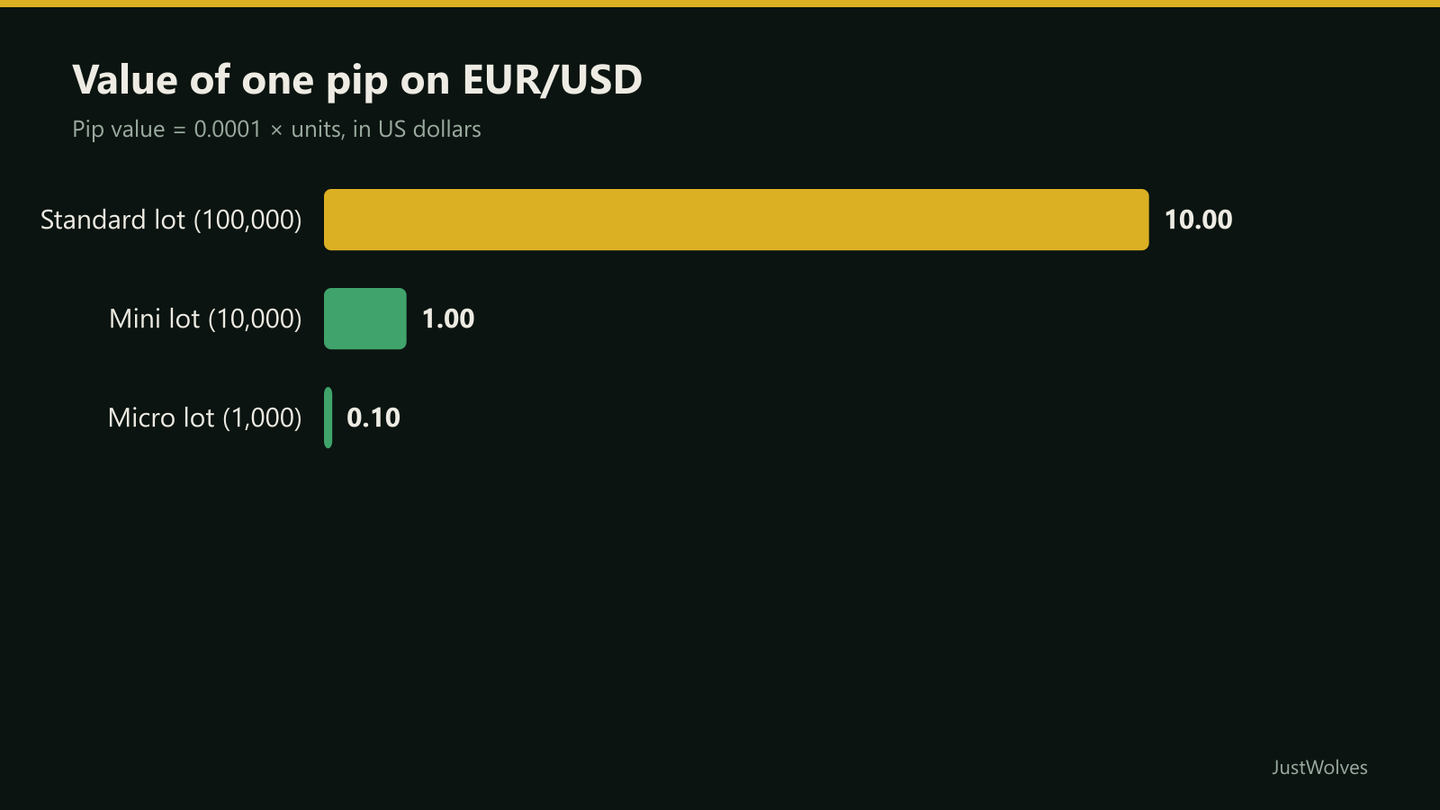
For EUR/USD on a standard lot of 100,000 euros: 0.0001 × 100,000 = $10 per pip. Because the quote currency is the dollar, that's already in dollars. For smaller positions the value scales down: $1 per pip on a mini lot (10,000) and $0.10 on a micro lot (1,000). Lesson 01.01.05 covers lot sizes.
When the quote currency isn't your account currency
For USD/JPY, pip value is first in yen: 0.01 × 100,000 = ¥1,000 per pip on a standard lot. To express it in dollars, divide by the USD/JPY rate. At 150.00, that's 1,000 ÷ 150 ≈ $6.67 per pip. Pip value for yen pairs therefore changes slightly as the exchange rate moves. Most platforms calculate this for you, as does the site's pip calculator, but it's worth knowing where the number comes from.
Real Data: Counting Pips on USD/JPY
The chart below shows real hourly USD/JPY candles for 30 July 2026, with times in IST. It is a good exercise in yen pips, because the day contained both very quiet hours and some of the largest hourly moves in our data. Step through it and check each pip count yourself.
Real data: counting yen pips on a 580-pip day, USD/JPY, 30 July 2026
Step 1 of 4
A quiet morning: count in 0.01s
From 00:30 to 13:30 IST, USD/JPY trades between 163.20 and 163.74. For a yen pair a pip is 0.01, so that range is 0.54 yen, or 54 pips, over thirteen hours.
- What to observe
- Yen pips are the second decimal place.
- Condition
- Count the pips, then turn them into money.
Step by Step: From Pips to Money
Working out profit, loss or risk
Step 1: Count the pips
Price change ÷ pip size. EUR/USD 1.0850 to 1.0875 = 25 pips.
Step 2: Find the pip value for your size
0.3 lots of EUR/USD = 30,000 units, so 0.0001 × 30,000 = $3 per pip.
Step 3: Multiply
25 pips × $3 = $75 gained (or lost, if the trade went the other way).
Step 4: Convert if needed
If your account is in rupees, convert at the current USD/INR rate.
Ticks on Indian Exchange-Traded Currency Futures
Exchange-traded currency contracts in India use ticks rather than pips. On NSE, USD/INR moves in ticks of ₹0.0025 (a quarter of a paisa), and one contract is 1,000 US dollars. One tick is therefore worth ₹0.0025 × 1,000 = ₹2.50 per contract, and a one-paisa move is worth ₹10 per contract.
If USD/INR futures rise from 83.20 to 83.35, that's 15 paise, or ₹150 per contract. The same arithmetic, price change × contract size, applies to the other rupee and cross-currency contracts; take the contract size and tick from the exchange's current specification.
Practical Example
Simran plans a EUR/USD trade with a stop 25 pips from entry. She wants to risk no more than $50. With $10 per pip per standard lot, a 25-pip stop costs $250 per standard lot. $50 ÷ $250 = 0.2 lots, so she trades 0.2 lots, worth $2 per pip.
If the stop is hit she loses 25 × $2 = $50, exactly as planned. If the trade reaches a 50-pip target, she makes $100. This is the same position-sizing logic as Position Sizing and the 1% Rule, expressed in pips.
How Many Pips Is a Normal Day? Our Data
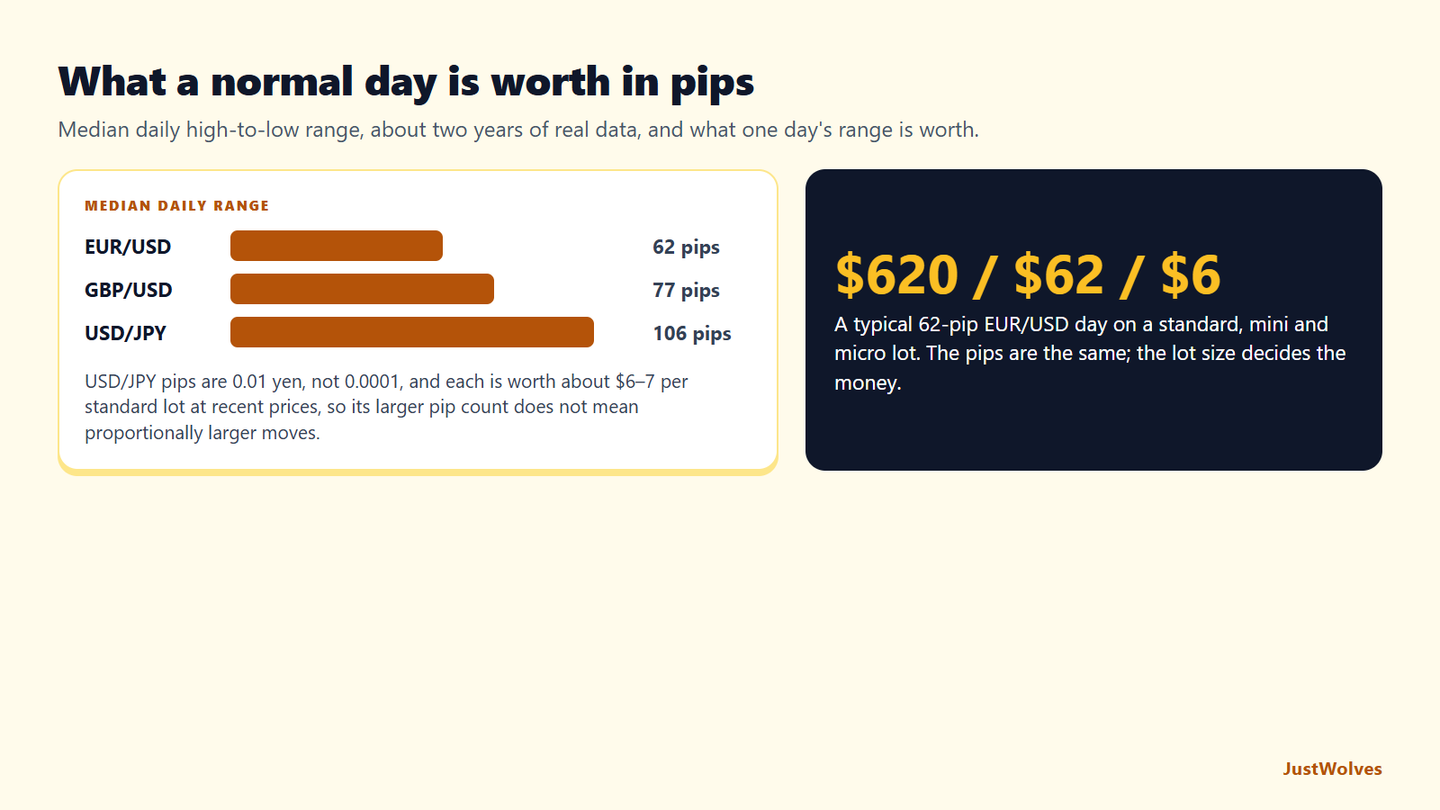
JustWolves measured about two years of real daily candles (November 2024 to November 2026) for the three most traded major pairs. The range is the distance from the day's high to its low, in pips.
| Pair | Median daily range | Days of 50+ pips | Days of 100+ pips | Largest close-to-close move |
|---|---|---|---|---|
| EUR/USD | 62 pips | 71% | 16% | 252 pips (10 Apr 2025) |
| GBP/USD | 77 pips | 86% | 26% | 199 pips (4 Apr 2025) |
| USD/JPY | 106 pips | 92% | 57% | 386 pips (30 Apr 2026) |
Two lessons are hidden in this table.
Pip counts are not comparable between pairs. USD/JPY's median day was 106 pips against EUR/USD's 62, but in percentage terms the two were much closer (0.70% against 0.55%). A yen pip is a smaller amount of money: about $6–7 per standard lot at recent rates, compared with $10 on EUR/USD. That is why this lesson's professional insight recommends thinking in R rather than pips once a position is sized.
A stop of a few pips sits inside normal noise. On the median EUR/USD day, price travelled 62 pips from high to low, and within single hours it often moved 10 to 15 (see How the Forex Market Works). A 10-pip stop can be hit by an ordinary wiggle. Stops are usually set from the chart and from typical range, and the position size adjusted to fit, which the next lesson covers.
| Pair | Median range | Standard lot | Mini lot | Micro lot |
|---|---|---|---|---|
| EUR/USD | 62 pips | about $620 | about $62 | about $6.20 |
| GBP/USD | 77 pips | about $770 | about $77 | about $7.70 |
| USD/JPY (at 155) | 106 pips | about $684 | about $68 | about $6.80 |
Common Mistakes
- Using the wrong decimal for yen pairs. A yen pip is 0.01, not 0.0001.
- Counting pipettes as pips. 1.08503 to 1.08513 is 1 pip, not 10.
- Assuming every pip is worth $10. Only on a standard lot of a dollar-quoted pair.
- Forgetting conversion. For non-dollar quote currencies, pip value changes with the exchange rate.
- Mixing offshore lots with Indian contract sizes. Calculate from the exchange's specification.
Professional Insight
Experienced traders rarely think in pips for long. They convert stop distances straight into R (lesson 12.01.04) so that a 15-pip stop on EUR/USD and a 40-pip stop on GBP/JPY represent the same risk once sizes are adjusted. Pips are the measuring unit; R is the decision unit.
Risk Considerations
- Slippage can add pips to a loss beyond your stop.
- Spreads are measured in pips and are paid on every trade (lesson 01.01.06).
- Large positions make each pip expensive; always know your money per pip before entering.
Important Terminology
| Term | Meaning |
|---|---|
| Pip | The standard unit of price movement: 0.0001 for most pairs, 0.01 for yen pairs. |
| Pipette | A tenth of a pip; the fifth (or third, for yen) decimal. |
| Pip value | The money value of a one-pip move for a given position size. |
| Tick | The minimum price increment on an exchange-traded contract. |
| Contract size | The number of currency units in one exchange-traded contract, e.g. 1,000 USD for USD/INR. |
What is a pip in forex?
The standard unit of price movement in a currency pair: 0.0001 for most pairs and 0.01 for pairs quoted in Japanese yen.
How much is one pip worth?
It depends on the pair and your position size. On a standard lot of EUR/USD, one pip is worth $10; on a micro lot, $0.10.
What is the difference between a pip and a pipette?
A pipette is one-tenth of a pip, the extra decimal place many platforms display.
How do I calculate pip value?
Multiply the pip size by the number of units you're trading. Convert to your account currency if the quote currency is different.
What is a pip in USD/INR?
On Indian exchange futures, prices move in ticks of ₹0.0025, worth ₹2.50 per 1,000-dollar contract; a one-paisa move is ₹10 per contract.
How many pips does EUR/USD move in a day?
In our data from November 2024 to November 2026, EUR/USD's median daily range was about 62 pips. About 71% of days had a range of at least 50 pips and 16% at least 100 pips.
How much is one pip worth on USD/JPY?
One pip on USD/JPY is 0.01 yen, worth ¥1,000 per standard lot. In dollars that depends on the rate: about $6.45 at 155 and $6.29 at 159. On 0.1 lots it is ¥100 per pip.
Practical Exercise
Work these out on paper before checking the answers.
Your task
Step 1: Count pips
GBP/USD moves from 1.2655 to 1.2611. How many pips?
Step 2: Yen pips
USD/JPY moves from 149.80 to 150.35. How many pips?
Step 3: Pip value
What is one pip worth on 0.5 lots of EUR/USD?
Step 4: Rupee futures
USD/INR futures fall from 83.40 to 83.28. What is the change per contract?
Check Your Understanding
EUR/USD moves from 1.0920 to 1.0955. How many pips?
Related Lessons
Previous: Currency Pairs Explained. Next: Lot Size in Forex. See also Position Sizing and the 1% Rule.