
Interest Rates and Inflation: What Moves Currency Prices
JustWolves is an educational platform and is not a SEBI-registered investment advisor. Trading financial instruments involves significant risk of loss and may not be suitable for all investors. Past performance is not indicative of future results. Read our full disclaimer →
What you'll learn
- Currencies respond to the difference in expected interest rates between two countries
- Inflation matters mainly through what it means for future central bank decisions
- Real interest rates, nominal rates minus inflation, show the true return
- The carry trade earns the rate gap but can unwind sharply in risk-off markets
- The rupee is also driven by oil prices, foreign investment flows and RBI intervention
In this article · 17 sections
Ask why a currency moved and you'll hear many answers: data, politics, risk sentiment, flows. Underneath many of them is one central idea: money moves towards where it expects to earn more, adjusted for risk and inflation. This lesson explains how interest rates and inflation interact to move currencies, and why expectations matter more than today's numbers.
What You Will Learn
- How interest rate differentials affect exchange rates
- How inflation feeds into interest-rate expectations
- What real interest rates are and why they matter
- How the carry trade works and its risks, and what moves the rupee
Before You Start
Read Central Banks and Monetary Policy first.
Interest Rate Differentials
Every currency pair compares two currencies, so it's the difference in interest rates that matters, not either rate alone. If one country's short-term rates are expected to rise relative to another's, investors can earn more by holding that currency's deposits or bonds, and demand for the currency tends to rise.
This is why EUR/USD often responds to changes in the expected gap between US and euro-area rates, and why two-year government bond yields, which reflect expected policy rates, are closely watched by currency traders.
Inflation and Expectations
Inflation affects currencies in two ways that pull in opposite directions. Over the long run, persistently higher inflation erodes a currency's purchasing power, so it tends to weaken. In the short run, though, a higher-than-expected inflation reading often strengthens a currency, because traders expect the central bank to respond with higher rates.
That's why a CPI release that comes in above forecast can lift a currency within seconds. The market isn't celebrating inflation; it's pricing in tighter policy.
Real Interest Rates
The real interest rate is the nominal rate minus inflation. A country with a 6% rate and 5% inflation offers a real return of about 1%; a country with a 3% rate and 1% inflation offers about 2%. Despite the lower headline rate, the second may attract more long-term capital.
Real rates help explain why high nominal rates don't always mean a strong currency: if they only keep pace with high inflation, investors aren't actually earning much.
The Carry Trade
In a carry trade, a trader buys a higher-yielding currency against a lower-yielding one to earn the interest difference. With a 4 percentage point gap, a $100,000 position would earn about $4,000 a year in interest before broker markups, roughly $11 a day, paid as a positive swap (lesson 01.02.03).
The risk is the exchange rate. A 4% move against the position wipes out a year of interest. Carry trades tend to do well in calm markets and can unwind violently when investors become risk-averse, as many rush to sell high-yielders and buy back the funding currencies at once.
Real Data: A Carry Trade Unwinding
The chart below uses real USD/JPY prices, condensed into weekly candles, from December 2024 to May 2025. It shows the risk this lesson describes: a long USD/JPY position earned a steady interest credit, while the exchange rate moved against it many times faster.
Real data: when the carry trade hurts, USD/JPY weekly, December 2024 – May 2025
Step 1 of 4
A popular carry trade
In December 2024 USD/JPY rises from about 150 to 158. US interest rates are far above Japanese rates, so a long USD/JPY position earns a positive overnight swap: the classic carry trade, borrowing in a low-yielding currency to hold a higher-yielding one.
- What to observe
- Rising price plus a daily interest credit.
- Condition
- Assume a 4% a year interest gap for the arithmetic.
Risk Sentiment
When markets are calm and optimistic (risk-on), higher-yielding and commodity-linked currencies often do well. When fear rises (risk-off), traders tend to buy currencies seen as safe havens, traditionally the US dollar, Japanese yen and Swiss franc. Risk sentiment can overwhelm interest-rate logic for days or weeks.
What Moves the Rupee
- Interest rate differentials between India and the US, through RBI and Federal Reserve policy.
- Oil prices: India imports most of its crude oil, so higher oil prices raise demand for dollars.
- Foreign investment flows: foreign portfolio investors buying or selling Indian stocks and bonds.
- The trade and current account balance.
- RBI intervention, which smooths volatility.
Step by Step: Reading a Rate Story
For any pair
Step 1: Current rates
Note both central banks' policy rates.
Step 2: Expected path
Which is expected to raise or cut, and by how much? Two-year yields help.
Step 3: Inflation trend
Is inflation above or below target in each country?
Step 4: Real rates
Policy rate minus inflation for each.
Step 5: Risk mood
Is the market risk-on or risk-off this week?
Practical Example
Hypothetically, Country A's inflation comes in at 3.5% against a forecast of 3.0%. Traders now expect A's central bank to raise rates sooner, so A's two-year yield rises and its currency strengthens against Country B's.
A month later, a global sell-off hits stocks. Despite A's higher rates, investors buy safe havens and A's currency falls back. Lakshmi, who had bought A's currency on the inflation surprise, had a stop below the pre-release level and was stopped out with a small loss rather than holding through the reversal.
Carry, Risk Sentiment and Real Prices: Our Data
JustWolves tested two ideas from this lesson on about two years of real daily data (November 2024 to November 2026).
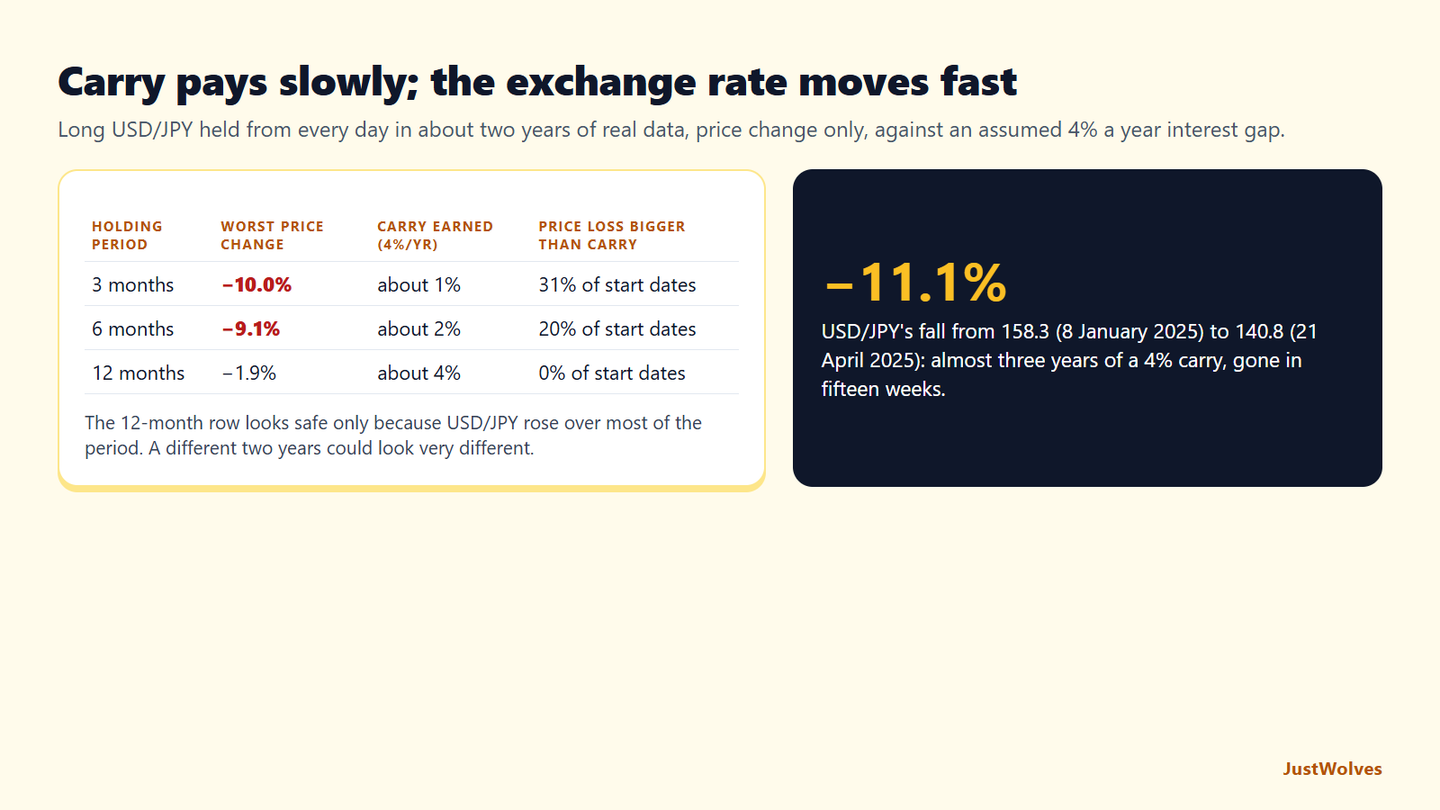
Carry. We measured the price change of a long USD/JPY position opened on every day in the period and held for three, six and twelve months, and compared it with an assumed 4% a year interest gap. This ignores the actual swap credited, so it isolates the exchange-rate risk.
| Holding period | Median change | Worst change | Price loss bigger than the carry earned |
|---|---|---|---|
| 3 months | +0.9% | −10.0% | 31% of start dates |
| 6 months | +2.5% | −9.1% | 20% of start dates |
| 12 months | +5.7% | −1.9% | none |
Over three months, the exchange rate wiped out the interest in nearly one start date out of three. Over twelve months it never did, but only because USD/JPY rose over most of this particular two-year period. That is the honest lesson about carry: it looks safe in hindsight when the trend happened to agree, and dangerous for anyone who entered near a turning point, as the chart above shows.
Risk sentiment. This lesson describes the yen, the dollar and gold as traditional safe havens in risk-off markets. We checked what they did on NIFTY 50's 15 worst days in the period, seven of them during sharp falls in March 2026.
| Market | Average move on those days | Rose on | Average move on all days |
|---|---|---|---|
| USD/JPY | +0.07% | 10 of 15 days | +0.01% |
| EUR/USD | −0.03% | 6 of 15 days | +0.003% |
| Gold | −1.33% | 3 of 15 days | +0.11% |
The textbook did not hold on these days. The yen weakened slightly more often than it strengthened, and gold fell on 12 of the 15 days, by 1.3% on average. Possible reasons include falls driven mainly by Indian factors, which need not move global havens, and sharp global sell-offs in which traders sell whatever they hold, including gold, to raise cash. Safe-haven behaviour is a tendency in some kinds of stress, not a rule, which is why this lesson's risk considerations warn that one release or event can flip expectations quickly.
Common Mistakes
- Looking at one country's rates only. It's the differential that matters.
- Reading inflation as always bad for a currency. In the short run, it often signals higher rates.
- Ignoring real rates.
- Treating carry as free money. Exchange-rate moves can erase it quickly.
- Ignoring risk sentiment when it dominates.
Professional Insight
Professional macro traders think in terms of relative change: they ask how expectations for each economy are shifting, and whether the market has priced that in yet. A good central bank or inflation story is only tradable if it's not already in the price.
Risk Considerations
- Expectations can flip quickly on one data release.
- Carry unwinds can be fast and large.
- Fundamentals can take weeks to show in price, while your stop is days away.
Important Terminology
| Term | Meaning |
|---|---|
| Interest rate differential | The difference between two countries' interest rates. |
| Real interest rate | The nominal rate minus inflation. |
| Carry trade | Buying a high-yield currency against a low-yield one to earn the rate gap. |
| Two-year yield | The yield on two-year government bonds, a gauge of expected policy rates. |
| Risk-on / risk-off | Market moods favouring riskier or safer assets. |
| Safe-haven currency | A currency investors tend to buy in times of stress. |
What moves currency prices?
Mainly expected interest rate differentials, inflation, economic growth, risk sentiment and capital flows.
Do higher interest rates strengthen a currency?
Often, if they're higher than expected and relative to the other currency in the pair, but risk sentiment and inflation can override it.
Is inflation good or bad for a currency?
In the long run it erodes value; in the short run an upside surprise often strengthens a currency by raising rate expectations.
What is a carry trade?
Buying a higher-yielding currency against a lower-yielding one to earn the interest difference, with the risk of exchange-rate losses.
Why do oil prices affect the rupee?
India imports most of its crude oil, so higher prices increase demand for dollars to pay for it.
How risky is the carry trade?
The interest is earned slowly while the exchange rate can move quickly. In our data, a long USD/JPY position held for three months lost more in price than a 4% a year carry would have earned in 31% of start dates, and USD/JPY fell 11.1% between January and April 2025.
Do the yen and gold always rise when markets fall?
No. On NIFTY 50's 15 worst days between November 2024 and November 2026, USD/JPY rose (a weaker yen) on 10 of them and gold fell on 12, by 1.3% on average.
Practical Exercise
Write a one-paragraph rate story for USD/INR.
Your task
Step 1: Rates
Find the current Fed and RBI policy rates.
Step 2: Inflation
Find the latest US and Indian CPI inflation.
Step 3: Real rates
Subtract inflation from each policy rate.
Step 4: Other drivers
Note the recent trend in oil prices and foreign portfolio flows.
Step 5: Conclusion
Which way do these factors point for the rupee, and how strongly?
Check Your Understanding
For EUR/USD, what matters most from interest rates?
Related Lessons
Previous: Central Banks and Monetary Policy. Next: Fundamental Analysis for Forex Traders (01.03.04). See also Forex Trading Costs for how swaps work.