
Central Banks and Monetary Policy: How They Move Currencies
JustWolves is an educational platform and is not a SEBI-registered investment advisor. Trading financial instruments involves significant risk of loss and may not be suitable for all investors. Past performance is not indicative of future results. Read our full disclaimer →
What you'll learn
- Central banks set short-term interest rates and influence a currency's attractiveness
- Markets react to surprises and to changes in expected future policy, not to the decision alone
- Tools include the policy rate, forward guidance, balance-sheet policy and currency intervention
- The RBI's Monetary Policy Committee targets 4% CPI inflation within a 2–6% band
- Know each central bank's decision times in IST and avoid being caught unprepared
In this article · 16 sections
If one group of institutions has the most influence on currency prices, it's central banks. Their decisions on interest rates, and their hints about future decisions, change how attractive it is to hold a currency, and the largest single-day moves in major pairs often come on central bank days. You don't need to be an economist to trade forex, but you do need to know who the central banks are, what they're trying to do, and when they speak.
What You Will Learn
- What central banks do and what they target
- The main tools of monetary policy
- Why markets react to expectations and surprises
- The major central banks, including the RBI, and when they announce
Before You Start
Read How the Forex Market Works first. It introduces central banks as one of the market's participants.
What Central Banks Do
A central bank manages a country's money: it sets short-term interest rates, oversees the banking system and, in most major economies, aims to keep inflation low and stable. Many have an explicit inflation target, often around 2% for advanced economies.
Because interest rates affect what investors earn by holding a currency, central bank policy has a strong influence on exchange rates. Higher rates, or the expectation of them, tend to attract capital and support a currency; lower rates tend to weigh on it, all else being equal. All else is rarely equal, which is why the next lesson looks at inflation and expectations in detail.
The Tools of Monetary Policy
- Policy rate: the main short-term interest rate, such as the US federal funds target range or the RBI's repo rate.
- Forward guidance: statements about the likely path of future policy.
- Balance-sheet policy: buying bonds to push longer-term rates down (quantitative easing) or letting holdings shrink (quantitative tightening).
- Liquidity operations: lending to banks and absorbing excess cash to keep short-term rates near the policy rate.
- Currency intervention: buying or selling its own currency in the market, used by some central banks, including the RBI, to smooth excessive volatility.
Why Markets React to Surprises
Markets price in expected decisions well before they happen. If everyone expects a 0.25 percentage point cut and the central bank cuts by 0.25, the currency may barely move, because the news is already in the price. The big moves come from surprises: a different decision than expected, or a change in guidance about what comes next.
That's why traders read the statement, the press conference and the projections as closely as the decision itself. A rate hold accompanied by hints of future cuts can weaken a currency as much as a cut would.
Real Data: A Fed Decision, Hour by Hour
The chart below uses real hourly EUR/USD candles for 16–17 September 2026, in IST, around a US Federal Reserve decision. It shows the pattern described in this lesson: a quiet market waiting for the announcement, then a large move when the decision and guidance are compared with what was expected.
Real data: EUR/USD on a US Federal Reserve decision day, 16–17 September 2026 (IST)
Step 1 of 3
Waiting for the decision
Through the afternoon and evening of 16 September 2026 in IST, EUR/USD trades in a tight band, about 1.1534 to 1.1551 from 13:30 to 22:30. Even the London–New York overlap is quiet: the market is waiting for the US Federal Reserve's decision, due at 2:00 pm New York time (23:30 IST).
- What to observe
- Volatility often drops before a major scheduled decision.
- Condition
- Positions are reduced; spreads widen just before the release.
The Major Central Banks
| Central bank | Currency | Decision body | Usual announcement (IST) |
|---|---|---|---|
| US Federal Reserve | USD | Federal Open Market Committee (FOMC), 8 scheduled meetings a year | 11:30 pm (summer) / 12:30 am (winter) |
| European Central Bank | EUR | Governing Council, about every six weeks | 5:45 pm (summer) / 6:45 pm (winter) |
| Bank of England | GBP | Monetary Policy Committee, 8 times a year | 4:30 pm (summer) / 5:30 pm (winter) |
| Bank of Japan | JPY | Policy Board, 8 meetings a year | No fixed time; usually during the Tokyo session |
| Reserve Bank of India | INR | Monetary Policy Committee, usually 6 meetings a year | 10:00 am |
The Reserve Bank of India
The RBI's Monetary Policy Committee has six members: three from the RBI, including the Governor, and three external members appointed by the government. It sets the repo rate, the rate at which the RBI lends to banks overnight.
Its legal objective is price stability while keeping growth in mind. The government has set the inflation target at 4% CPI inflation, with a tolerance band of 2% to 6%, for April 2026 to March 2031. The RBI also manages the rupee's volatility: it buys and sells dollars in the market and says it intervenes to curb excessive volatility rather than to defend a particular level.
Recent and upcoming MPC decisions are listed on the site's India economic calendar.
Step by Step: Preparing for a Central Bank Day
Before the decision
Step 1: Know the time in IST
From the economic calendar, adjusted for daylight saving.
Step 2: Know the expectation
What decision does the consensus expect, and what's priced in?
Step 3: Decide your exposure
Reduce or close positions in that currency, or accept the gap risk deliberately.
Step 4: Don't trade the first seconds
Spreads widen and prices whip; wait for them to settle.
Step 5: Read the statement
Look for changes in guidance compared with the previous meeting.
Practical Example
Hypothetically, markets expect a central bank to hold rates. It does hold, but its statement drops a line saying rates will stay high 'for an extended period' and the governor says cuts are being discussed. Traders who only saw 'rates unchanged' expected no reaction; instead, the currency falls because the expected future path of rates has moved lower.
Vikram, holding a long position in that currency, had cut his size before the announcement and set his stop beyond the recent range. The fall cost him less than half the loss it would have caused at full size.
How Much Do Central Bank Decisions Move Currencies? Our Data
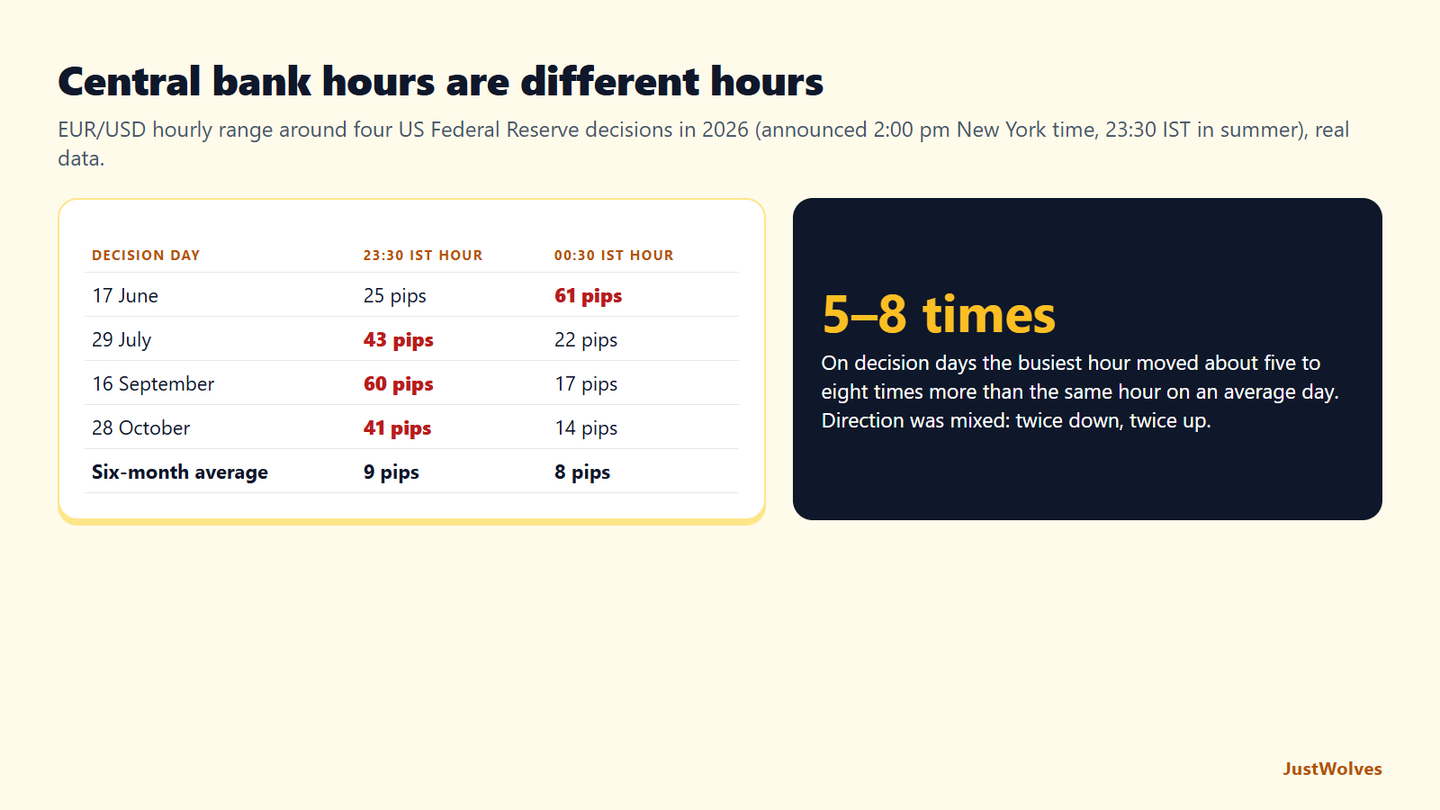
Our six months of real hourly EUR/USD data (May to November 2026) include four US Federal Reserve decision days. The Fed publishes its decision at 2:00 pm New York time, which was 23:30 IST during US daylight saving, followed by a press conference half an hour later. JustWolves compared the hourly ranges at 23:30 and 00:30 IST on those days with the six-month average for the same hours.
| Decision day | 23:30 IST hour | 00:30 IST hour | Direction of the bigger hour |
|---|---|---|---|
| 17 June | 25 pips | 61 pips | Down 46 pips |
| 29 July | 43 pips | 22 pips | Up 35 pips |
| 16 September | 60 pips | 17 pips | Down 60 pips |
| 28 October | 41 pips | 14 pips | Up 14 pips |
| Six-month average, same hours | 9 pips | 8 pips |
Three observations line up with this lesson.
Decision hours were five to eight times busier than normal. On every one of the four days, the busiest hour around the announcement moved 41 to 61 pips, against an average of about 8 to 9 pips for those hours on other days.
The direction was not predictable from the calendar alone. Two decisions sent EUR/USD down and two sent it up. Knowing that a decision is coming tells you volatility will rise, not which way. That is the point of this lesson's section on surprises: the move depends on the decision and guidance compared with expectations.
The biggest hour was not always the decision itself. On 17 June the larger move came in the 00:30 IST hour, during the press conference. Traders who closed or reduced positions only for the announcement minute, and reopened straight after, were still exposed to the bigger move.
For traders in India, these announcements land late at night, and around midnight in winter. Vikram's approach in the example below, reducing size before the event and placing the stop beyond the recent range, is the practical response, together with checking the IST time on the calendar for every meeting.
Common Mistakes
- Trading the headline decision without comparing it with expectations.
- Ignoring guidance in the statement and press conference.
- Holding full-size positions through announcements unknowingly.
- Getting the time wrong because of daylight saving.
- Entering in the first seconds, when spreads are widest.
Professional Insight
Professional currency traders spend more time on central bank communication than on almost anything else: speeches, minutes and projections as well as decisions. Their main question is how the expected path of rates differs between two central banks, because that relative path is a major driver of a currency pair over weeks and months.
Risk Considerations
- Announcement volatility can gap price past stops.
- Unscheduled actions such as emergency cuts or intervention are rare but happen.
- Conflicting signals between the decision and guidance can cause whipsaws.
Important Terminology
| Term | Meaning |
|---|---|
| Central bank | The institution that manages a country's money and short-term interest rates. |
| Policy rate | The central bank's main short-term interest rate. |
| Repo rate | The RBI's policy rate: the rate at which it lends to banks. |
| Forward guidance | Communication about likely future policy. |
| Hawkish / dovish | Leaning towards higher rates / towards lower rates. |
| Intervention | A central bank buying or selling currency in the market. |
How do central banks affect forex?
By setting interest rates and signalling future policy, which changes the return on holding a currency and so its demand.
What does hawkish mean?
Leaning towards higher interest rates or tighter policy, usually supportive for the currency. Dovish means the opposite.
When does the RBI announce its policy?
Usually at 10:00 am IST on the last day of the MPC meeting. Check the India economic calendar for dates.
What is the RBI's inflation target?
4% CPI inflation with a tolerance band of 2% to 6%, set for April 2026 to March 2031.
Why did a currency fall when rates were unchanged?
Because the statement or guidance pointed to lower future rates than the market expected.
What time are US Federal Reserve decisions in India?
The Fed announces at 2:00 pm New York time: 23:30 IST during US daylight saving (roughly March to early November) and 00:30 IST in winter, with a press conference 30 minutes later.
How much does EUR/USD move on a Fed decision day?
On four 2026 decision days in our data, the busiest hour around the announcement moved 41 to 61 pips, about five to eight times the usual range for those hours. The direction varied: twice down, twice up.
Practical Exercise
Build a central bank watch list.
Your task
Step 1: List the next meetings
For the Fed, ECB, BoE and RBI, from the economic calendar.
Step 2: Convert to IST
Note whether daylight saving applies on each date.
Step 3: Note expectations
For the next meeting, write the expected decision from news coverage.
Step 4: Review after
Note the decision, the guidance and how the currency reacted in the first hour.
Check Your Understanding
A central bank does exactly what markets expected. What usually happens?
Related Lessons
Previous: Forex Trading Sessions and Market Hours in IST. Next: Interest Rates and Inflation (01.03.03). See also the India economic calendar.