
Is Forex Trading Legal in India? RBI Rules, FEMA and the Alert List
JustWolves is an educational platform and is not a SEBI-registered investment advisor. Trading financial instruments involves significant risk of loss and may not be suitable for all investors. Past performance is not indicative of future results. Read our full disclaimer →
What you'll learn
- Under FEMA, Indian residents may deal in forex only with authorised persons and for permitted purposes
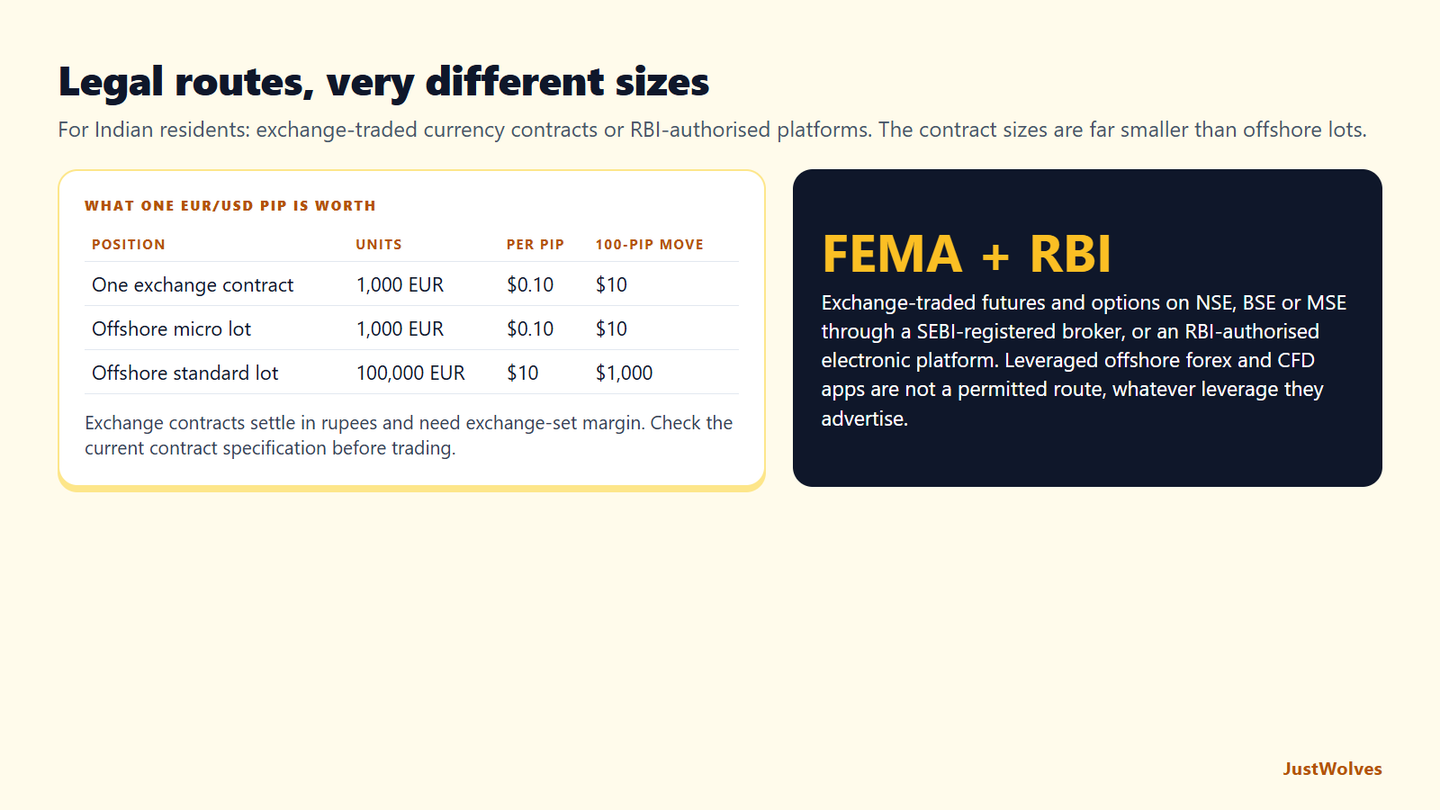
- The legal routes are currency futures and options on NSE, BSE or MSE, or an RBI-authorised electronic trading platform
- Rupee pairs (USD/INR, EUR/INR, GBP/INR, JPY/INR) are for hedging; exchange-traded cross pairs such as EUR/USD have no purpose restriction
- Trading with unauthorised offshore forex or CFD platforms exposes residents to penal action under FEMA
- LRS remittances cannot be used for margin or margin calls to overseas forex accounts
- The RBI Alert List is not exhaustive: check the RBI's lists of authorised persons and platforms before funding anything
In this article · 16 sections
Yes, but only in a narrow form. Indian residents can trade currencies legally through currency futures and options on the NSE, BSE and Metropolitan Stock Exchange, or on electronic platforms the Reserve Bank of India has authorised. The offshore forex and CFD apps advertised on social media are a different matter: trading on them breaks the Foreign Exchange Management Act (FEMA), and the RBI publishes an Alert List naming many of them.
What You Will Learn
- Which forex trading is legal for Indian residents, and which is not
- The currency pairs you can trade on Indian exchanges, and the rule attached to each
- Why offshore brokers and the Liberalised Remittance Scheme (LRS) don't make overseas trading legal
- How to check whether a platform is authorised, and where to report one that isn't
Before You Start
You don't need any trading experience for this lesson. It helps to know what a currency pair is, which Understanding Currency Pairs explains, but every term used here is defined in the terminology table near the end.
The Short Answer
Forex trading in India is governed by the Foreign Exchange Management Act, 1999 (FEMA) and regulated by the Reserve Bank of India. The RBI's position is simple: resident individuals may undertake forex transactions only with authorised persons and only for permitted purposes. For trading, that leaves two legal routes:
- Currency derivatives on recognised Indian exchanges: futures and options on the NSE, BSE and Metropolitan Stock Exchange (MSE), traded through a SEBI-registered broker.
- Electronic trading platforms (ETPs) authorised by the RBI: the RBI publishes the list of authorised ETPs on its website.
Everything else, including margin trading on overseas forex and CFD platforms, is outside the rules for Indian residents, however professional the app looks.
| Activity | Allowed? | Why |
|---|---|---|
| USD/INR, EUR/INR, GBP/INR or JPY/INR futures and options on NSE, BSE or MSE | Yes | Exchange-traded, through a SEBI-registered broker |
| EUR/USD, GBP/USD or USD/JPY futures and options on NSE, BSE or MSE | Yes | Cross-currency contracts on a recognised Indian exchange |
| Forex on an RBI-authorised electronic trading platform | Yes | Platform authorised by the RBI, used for permitted purposes |
| Leveraged forex or CFD trading with an offshore broker | No | Unauthorised platform: penal action under FEMA |
| Sending money abroad under LRS to fund forex margin | No | LRS does not permit remittances for margins or margin calls |
| Binary-options apps | No | Several are named on the RBI Alert List |
The Currency Pairs You Can Trade in India
Indian exchanges list two families of currency contracts. Both are futures and options rather than the spot or CFD trading offered by offshore brokers, and both are settled in rupees.
Rupee pairs (foreign currency against INR)
USD/INR, EUR/INR, GBP/INR and JPY/INR. The RBI lists their permitted purpose as hedging exchange-rate risk. Exchange-traded rupee contracts are available to individuals through brokers, but the rules on underlying exposure and position limits are set by the RBI and the exchanges and they do change, so ask your broker what applies to you before you trade.
Cross-currency pairs (one foreign currency against another)
EUR/USD, GBP/USD and USD/JPY. For these exchange-traded contracts the RBI's FAQ states there is no restriction in terms of purpose, which makes them the closest legal equivalent to the major pairs traded around the world.
Real Data: The Same Move on a Legal Contract and an Offshore Lot
The chart below uses real daily EUR/USD prices from October and November 2026. Exchange-traded EUR/USD contracts in India follow the same underlying exchange rate as the global market. What differs is the contract size, the margin rules and the protections, which is easiest to see on a real move.
Real data: the same EUR/USD move on a legal contract and an offshore lot, October–November 2026
Step 1 of 3
A month of EUR/USD
From mid-October to early November 2026, EUR/USD moves between about 1.1114 and 1.1273. These are the same prices that the EUR/USD contracts on Indian exchanges follow.
- What to observe
- The world's most traded pair, available legally in India as an exchange contract.
- Condition
- The contract size is what differs.
Why Offshore Forex Brokers Aren't Legal for Indian Residents
Offshore brokers advertise heavily in India through social media, influencers and signal groups. Many accept rupee deposits by UPI or into local bank accounts, which makes them look local. They are not.
The RBI states that residents who trade forex on unauthorised electronic platforms render themselves liable for penal action under FEMA. Operating or promoting such a platform can also attract action under the Prevention of Money Laundering Act, 2002.
The Liberalised Remittance Scheme doesn't change this
LRS lets residents send money abroad, up to an annual limit, for permitted current and capital account transactions. The RBI's FAQ is explicit that LRS remittances cannot be made for margins or margin calls to overseas exchanges or counterparties, so using LRS to fund an overseas forex account doesn't make the trading legal.
Licensed abroad is not authorised in India
A broker may be properly licensed in another country. That licence protects its customers there; it doesn't authorise the broker to offer forex trading to Indian residents. The question to ask is whether the RBI has authorised it, not whether some regulator somewhere has.
The RBI Alert List
Since 2022 the RBI has published an Alert List of entities that are neither authorised to deal in forex under FEMA nor authorised to run a forex electronic trading platform. It is updated from time to time; the update of November 19, 2025 added seven more names. The list includes several heavily advertised international brokers and binary-options apps.
Two points are easy to miss. The list is not exhaustive, so an entity missing from it is not thereby authorised. And it also covers websites and apps that promote unauthorised platforms.
How to Check a Platform Before You Fund It
Five checks before you deposit money
Step 1: Ask what you are actually trading
Exchange-listed currency futures and options from a SEBI-registered broker are one thing; leveraged spot forex or CFDs are another. If an app offers 1:500 leverage on EUR/USD, it is not selling an Indian exchange product.
Step 2: Check the RBI's authorised lists
The RBI publishes lists of authorised persons and authorised ETPs on its website. If the platform isn't on them, it isn't authorised to offer forex in India.
Step 3: Search the RBI Alert List
If the name appears, stop. Remember the list is not exhaustive, so a clean result is not an approval.
Step 4: Confirm the broker's SEBI registration
For exchange-traded currency derivatives the broker must be a SEBI-registered member of NSE, BSE or MSE. Check the registration number on SEBI's website, not the one shown in an advert.
Step 5: Follow the money
Legitimate Indian brokers take client money into a designated bank account in the broker's name. Requests to pay a personal UPI ID, a third party or a crypto wallet are a warning sign.
Practical Examples
Example 1: a trader who wants to trade EUR/USD
Asha has learned price action on EUR/USD charts and wants to trade it. The legal route is the EUR/USD futures or options contract on the NSE or BSE, through her existing SEBI-registered broker. Contract size, tick value, margins and trading hours differ from a spot forex account, so she reads the contract specification first and works out her position size for that contract before placing a trade.
Example 2: an influencer's 'zero-commission forex app'
Ravi sees a video promoting a forex app with 1:1000 leverage and instant UPI deposits. He checks: the app is not on the RBI's list of authorised ETPs, and its name appears on the Alert List. Depositing would expose him to penal action under FEMA, and if the platform stopped paying out there would be little an Indian regulator could do to get his money back.
Example 3: hedging a real exposure
Meera runs a small business that imports parts priced in US dollars and pays suppliers every quarter. Buying USD/INR futures on an exchange lets her lock in an exchange rate for those payments. This is the use the RBI intends rupee-pair derivatives for: hedging a genuine currency risk.
Why the Legal Route Is Smaller, in Numbers
This lesson's professional insight says the modest leverage and fixed contract sizes of Indian currency derivatives are a feature, not a flaw. Real price data shows why. JustWolves measured about two years of daily EUR/USD candles (November 2024 to November 2026): the median day moved 0.23% and the median daily range was about 62 pips, while the worst day moved about 2.6% against one side.
| Move | One exchange contract (1,000 EUR) | Offshore standard lot (100,000 EUR) | Five offshore standard lots |
|---|---|---|---|
| Median daily range (62 pips) | about $6 | about $620 | about $3,100 |
| November 2026 fall (207 pips) | about $21 | about $2,070 | about $10,350 |
| Worst day in two years (about 290 pips) | about $29 | about $2,900 | about $14,500 |
The point is not that small contracts make trading safe. A trader can still buy many exchange contracts, and exchange margins still create leverage, as Leverage and Margin in Forex explains. The point is that the legal route makes very large positions harder to open by accident, while offshore platforms make them easy: a beginner with $1,500 on a 1:500 app can open five standard lots, and a single bad day in our data would have cost several times the deposit.
Combined with this lesson's legal points, that is the full case for the legal route: the law, the protection of your money, and position sizes that a beginner is less likely to get catastrophically wrong.
Common Mistakes
- Assuming 'not on the Alert List' means safe. The list is not exhaustive; check the authorised lists instead.
- Trusting a foreign licence. Regulation in another country doesn't authorise a broker to serve Indian residents.
- Using LRS to fund a trading account abroad. LRS cannot be used for overseas margin.
- Confusing currency futures with spot forex. Exchange contracts have fixed lot sizes, expiries and exchange margins, and far lower leverage than offshore apps advertise.
- Paying into personal accounts or crypto wallets. No legitimate Indian broker asks for this.
Professional Insight
Professional currency traders in India work through exchange-traded contracts or, for business hedging, through banks that are authorised dealers. The modest leverage and fixed contract sizes of Indian currency derivatives are a feature, not a flaw: they make it much harder to lose more than you can afford in a single move, which is how most retail accounts on high-leverage offshore platforms are wiped out.
The question isn't whether a broker is regulated somewhere. It's whether the RBI has authorised it to deal with you.
Risk Considerations
- Legal risk: trading on unauthorised platforms can lead to penal action under FEMA, on top of any trading loss.
- Counterparty risk: money held by an unauthorised offshore platform has little protection if it freezes withdrawals or shuts down.
- Market risk: legal currency derivatives are still leveraged, and a small rupee move can be a large share of your margin. The Risk Management course covers position sizing.
- Tax: profits and losses from currency derivatives are taxable, and how they are treated depends on your circumstances. Speak to a tax professional.
Where to Report an Unauthorised Platform
The RBI's FAQ names three places: the National Cyber Crime Reporting Portal (cybercrime.gov.in), the Enforcement Directorate, and your state or union territory police. Include the platform's name, its website or app link, how it was promoted to you, and any payment details.
Important Terminology
| Term | Meaning |
|---|---|
| FEMA | Foreign Exchange Management Act, 1999: the law that governs foreign exchange transactions by Indian residents. |
| RBI | Reserve Bank of India: regulates foreign exchange under FEMA and publishes the authorised lists and the Alert List. |
| Authorised person | An entity the RBI has authorised to deal in foreign exchange, such as an authorised dealer bank. |
| ETP | Electronic trading platform. Forex ETPs must be authorised by the RBI to offer forex transactions to residents. |
| Recognised stock exchange | In this context, NSE, BSE or the Metropolitan Stock Exchange (MSE), which list currency futures and options. |
| Alert List | The RBI's published list of entities not authorised to deal in forex or run a forex ETP. It is not exhaustive. |
| LRS | Liberalised Remittance Scheme: lets residents send money abroad for permitted purposes, but not for margin trading. |
| Cross-currency pair | A pair of two foreign currencies, such as EUR/USD, with no rupee leg. |
Is forex trading legal in India?
Yes, within limits. Residents can trade currency futures and options on the NSE, BSE and MSE through a SEBI-registered broker, or use an RBI-authorised electronic trading platform. Trading forex on unauthorised platforms, which includes most offshore brokers, is not permitted under FEMA.
Can I trade EUR/USD from India?
Yes, through EUR/USD futures and options listed on Indian exchanges. You cannot legally trade it as leveraged spot forex or a CFD with an offshore broker.
Is it legal if the broker is regulated in another country?
No. A foreign licence doesn't authorise a broker to offer forex trading to Indian residents. What matters is RBI authorisation, or trading on a recognised Indian exchange.
Can I use the Liberalised Remittance Scheme for forex trading abroad?
Not for margin trading. The RBI states that LRS remittances cannot be made for margins or margin calls to overseas exchanges or counterparties.
What should I do if I've already traded with an offshore broker?
The RBI says residents trading on unauthorised platforms are liable to penal action under FEMA. Stop adding money, withdraw what you can, keep records of every transaction, and take advice from a lawyer or chartered accountant who knows FEMA.
How do I know if a forex app is authorised?
Check the RBI's published lists of authorised persons and authorised ETPs, then search the RBI Alert List. If the app isn't on the authorised lists, don't fund it, even if it isn't on the Alert List either.
How much is one EUR/USD contract worth on Indian exchanges?
The cross-currency contracts are 1,000 units of the base currency, so one EUR/USD contract is 1,000 euros and a one-pip move is worth about $0.10, settled in rupees. Check the exchange's current specification, as contract terms can change.
Practical Exercise
Use this checklist on one forex app, broker or 'signal' service you have seen advertised. The point is to practise the checks, not to find a particular answer.
Your task
Step 1: Name the product
Write down exactly what it offers: exchange-traded currency futures and options, or leveraged spot forex and CFDs. Note the maximum leverage it advertises.
Step 2: Check the RBI's authorised lists
Search the RBI's lists of authorised persons and authorised ETPs for the company name. Record whether it appears.
Step 3: Search the Alert List
Search the current RBI Alert List for the name and any brand names it trades under.
Step 4: Check SEBI registration (exchange brokers only)
If it claims to offer NSE, BSE or MSE currency derivatives, find its SEBI registration number on SEBI's website, not in its advert.
Step 5: Write a one-line verdict
Legal route, not a legal route, or unclear. If unclear, the answer for your money is the same as 'no' until it is resolved.
Check Your Understanding
Under FEMA, resident individuals may undertake forex transactions:
Related Lessons
Next: Understanding Currency Pairs. The pairs listed on Indian exchanges follow the same base-and-quote logic as every pair traded worldwide.