
Choosing a Forex Broker in India: Regulation, Costs and Red Flags
JustWolves is an educational platform and is not a SEBI-registered investment advisor. Trading financial instruments involves significant risk of loss and may not be suitable for all investors. Past performance is not indicative of future results. Read our full disclaimer →
What you'll learn
- For Indian residents, the broker must be a SEBI-registered stockbroker offering exchange currency derivatives
- Check registration on SEBI's website and check the RBI Alert List yourself
- Compare total costs: brokerage, exchange and regulatory charges, and taxes
- Guaranteed returns, very high leverage, personal payment accounts and pressure to deposit are red flags
- Complaints about SEBI-registered brokers can be escalated through SEBI's SCORES system
In this article · 16 sections
Choosing a broker is the most important decision you make before trading, and the one beginners spend the least time on. A good broker won't make you profitable, but a bad one can take your money regardless of how well you trade. In India, the first filter is simple and non-negotiable: the broker must be authorised for the trading you intend to do.
What You Will Learn
- What makes a broker legal for Indian residents' currency trading
- How to verify a broker yourself
- How to compare costs and service
- The red flags that signal a scam
Before You Start
Read Spot Forex vs CFDs vs Currency Futures first.
Step 1: Regulation Comes First
For Indian residents, legal currency trading happens on recognised exchanges (NSE, BSE, MSE) through a SEBI-registered stockbroker that is a member of the exchange's currency derivatives segment. Any firm offering leveraged forex or CFDs from abroad, whatever licence it shows from another country, isn't a permitted route for residents.
The RBI publishes an Alert List of entities that aren't authorised to deal in forex or operate forex trading platforms. The list isn't exhaustive: a firm missing from it isn't automatically legitimate.
Step 2: Verify It Yourself
Five checks
Step 1: SEBI registration
Search the broker's name and registration number in SEBI's list of registered intermediaries on sebi.gov.in.
Step 2: Exchange membership
Check the exchange's member directory for the currency derivatives segment.
Step 3: RBI Alert List
Search the name, website and app on the RBI's Alert List.
Step 4: Contact details
A registered office address in India, a compliance officer and a grievance email should be published.
Step 5: Payment route
Deposits should go only to the broker's designated client bank account, never to an individual.
Step 3: Compare Costs
Among legitimate brokers, compare the total cost of a typical trade, not just the headline brokerage. For currency derivatives, that includes brokerage, exchange transaction charges, the SEBI fee, stamp duty and GST. The site's brokerage calculator estimates the total; Forex Trading Costs explains each item.
Step 4: Compare Service and Tools
- Platform reliability, especially during busy sessions.
- Order types supported for currency contracts, including stop-loss orders.
- Charting, or integration with the charting tools you use.
- Margin information shown clearly before you place a trade.
- Support that you can reach by phone if the app fails while you have open positions.
Red Flags
| Red flag | Why it matters |
|---|---|
| Guaranteed or fixed returns | No legitimate trading offers guaranteed profits. |
| Leverage of 1:500 or more advertised to Indians | A sign of offshore leveraged forex, not a permitted route. |
| Deposits to a personal UPI ID or individual's account | Legitimate brokers use designated client bank accounts. |
| Recruitment through WhatsApp, Telegram or influencers | A common route for unauthorised platforms. |
| An 'account manager' who trades for you or pushes deposits | Pressure and control are hallmarks of scams. |
| Deposit bonuses with withdrawal conditions | Often used to trap funds. |
| Withdrawal delays or new 'fees' to withdraw | A frequent final stage of fraud. |
Real Data: A Month Against a "3% a Day" Promise
Guaranteed or very high returns are the first red flag in the table above, and the one most often used to recruit Indian traders into unauthorised platforms through social media and messaging groups. The chart below checks a typical claim, "3% a day", against a real month of GBP/USD.
Real data: a month of GBP/USD against a "3% a day" promise, October 2026
Step 1 of 3
A normal month
In the first half of October 2026, GBP/USD moves between 1.3139 and 1.3285. Most days the close changes by 0.1% to 0.4%.
- What to observe
- Ordinary daily moves are a fraction of a percent.
- Condition
- Compare that with a promise of 3% a day.
If Something Goes Wrong
With a SEBI-registered broker, raise the complaint with the broker first, then escalate through SCORES, SEBI's online complaints system, and the exchange's investor grievance cell. With an unauthorised offshore platform, those protections don't apply, which is a major reason to avoid them. If you suspect fraud, report it to the police cybercrime portal and your bank promptly.
Practical Example
Karan is added to a Telegram group promising '3% a day from forex'. The 'mentor' recommends a platform with 1:1000 leverage and asks for deposits to a UPI ID. Karan checks: the platform isn't SEBI-registered, it isn't an exchange member, and a similar name appears on the RBI Alert List. He leaves the group.
Instead, he enables the currency segment with his existing SEBI-registered broker, checks its registration number on SEBI's website, and estimates his costs per contract with the brokerage calculator before placing his first trade.
Testing Return Claims Against Real Prices: Our Data
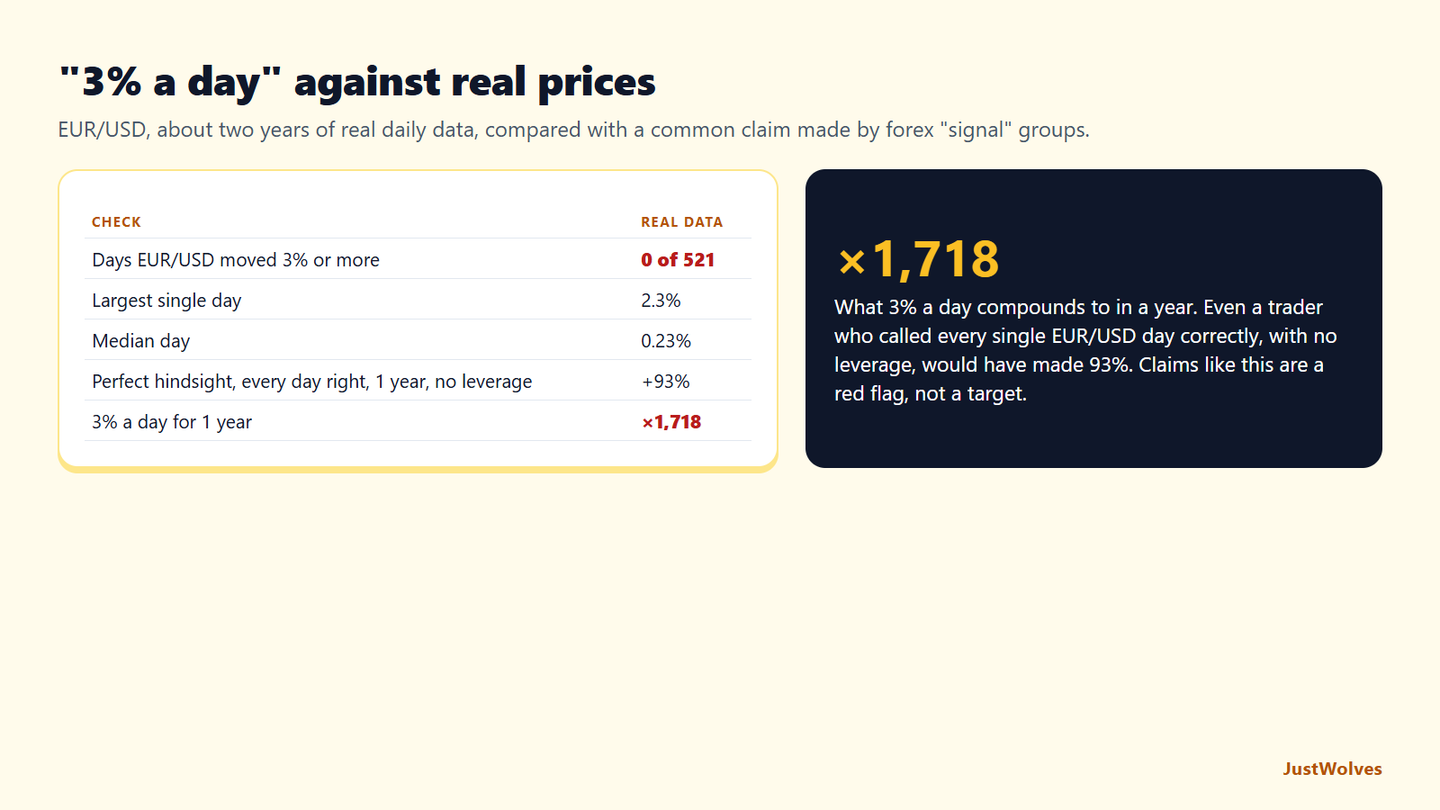
JustWolves measured about two years of real daily EUR/USD data (November 2024 to November 2026), the most traded currency pair in the world, to see what a "3% a day" claim would actually require.
| Check | Result |
|---|---|
| Days on which EUR/USD moved 3% or more | 0 of 521 |
| Largest single-day move | 2.3% (10 April 2025) |
| Median daily move | 0.23% |
| Leverage needed to make 3% on a median day, even when right | about 13x |
| Calling every day correctly for one year, no leverage | +93% |
| 3% a day compounded for one year | about 1,718 times the starting amount |
The arithmetic is decisive. EUR/USD did not move 3% in a single day once in two years. To earn 3% on an account from a typical day's move, a trader needs about 13x leverage and must also be right, every day; on the wrong days, the same leverage loses 3% or more. A perfect forecaster with no leverage would have made 93% in a year, an extraordinary result that nobody achieves, while 3% a day compounds to more than a thousand times the starting money.
So a promise of steady, high daily returns can only be true if it is not really trading, and Karan's example below shows how such promises usually work: deposits to personal UPI IDs, unregistered platforms, and names on the RBI Alert List. The legitimate route described in this lesson never comes with guaranteed returns, because no regulated broker can offer them.
Common Mistakes
- Choosing a broker by advertising or platform features.
- Trusting a foreign licence as proof of legality in India.
- Assuming absence from the Alert List means safe.
- Paying into personal accounts.
- Ignoring total costs in favour of 'zero brokerage' headlines.
Professional Insight
Professional traders evaluate brokers the way a business evaluates a bank: regulation, financial strength, operational reliability and how problems are resolved. Pricing comes after those. A slightly higher cost with a reliable, regulated broker is cheap insurance.
Risk Considerations
- Fraud risk with unauthorised platforms can mean losing the entire deposit.
- Legal risk: penalties can apply under FEMA for unauthorised forex trading.
- Operational risk even with legitimate brokers; know your backup way to manage positions.
Important Terminology
| Term | Meaning |
|---|---|
| SEBI-registered stockbroker | A broker registered with SEBI to deal on recognised exchanges. |
| Exchange member | A broker admitted to trade on an exchange segment. |
| RBI Alert List | The RBI's list of entities not authorised to deal in forex or run forex platforms. |
| SCORES | SEBI's online complaints redress system. |
| Client bank account | The broker's designated account for client funds. |
Which forex broker is legal in India?
A SEBI-registered stockbroker offering currency derivatives on NSE, BSE or MSE. Offshore leveraged forex brokers aren't a permitted route for residents.
How do I check if a broker is SEBI-registered?
Search its name or registration number in SEBI's list of registered intermediaries on sebi.gov.in, and check the exchange member directory.
What is the RBI Alert List?
A list published by the RBI of entities not authorised to deal in forex or operate forex trading platforms. It isn't exhaustive.
Is a broker with a foreign licence legal in India?
Not for Indian residents' leveraged forex trading. Indian law applies regardless of the broker's licence elsewhere.
Where can I complain about a broker?
First to the broker, then through SEBI's SCORES system and the exchange's grievance cell for SEBI-registered brokers.
Is 3% a day possible in forex?
Not consistently. In our data, EUR/USD did not move 3% in a single day once in two years, and making 3% from a typical day would need about 13x leverage plus a correct call every day. 3% a day for a year compounds to about 1,700 times the starting amount; claims like this are a red flag for fraud.
Practical Exercise
Verify your own broker.
Your task
Step 1: Find the registration number
On your broker's website or contract note.
Step 2: Check SEBI
Confirm it on sebi.gov.in.
Step 3: Check the segment
Confirm currency derivatives are enabled on your account.
Step 4: Estimate costs
Use the brokerage calculator for one EUR/USD futures round trip.
Check Your Understanding
What is the first thing to check about a broker?
Related Lessons
Previous: Spot Forex vs CFDs vs Currency Futures. Next: Forex Trading Risks (01.04.06). See also Is Forex Trading Legal in India?.