
What Is Forex Trading? A Beginner's Guide to the Currency Market
JustWolves is an educational platform and is not a SEBI-registered investment advisor. Trading financial instruments involves significant risk of loss and may not be suitable for all investors. Past performance is not indicative of future results. Read our full disclaimer →
What you'll learn
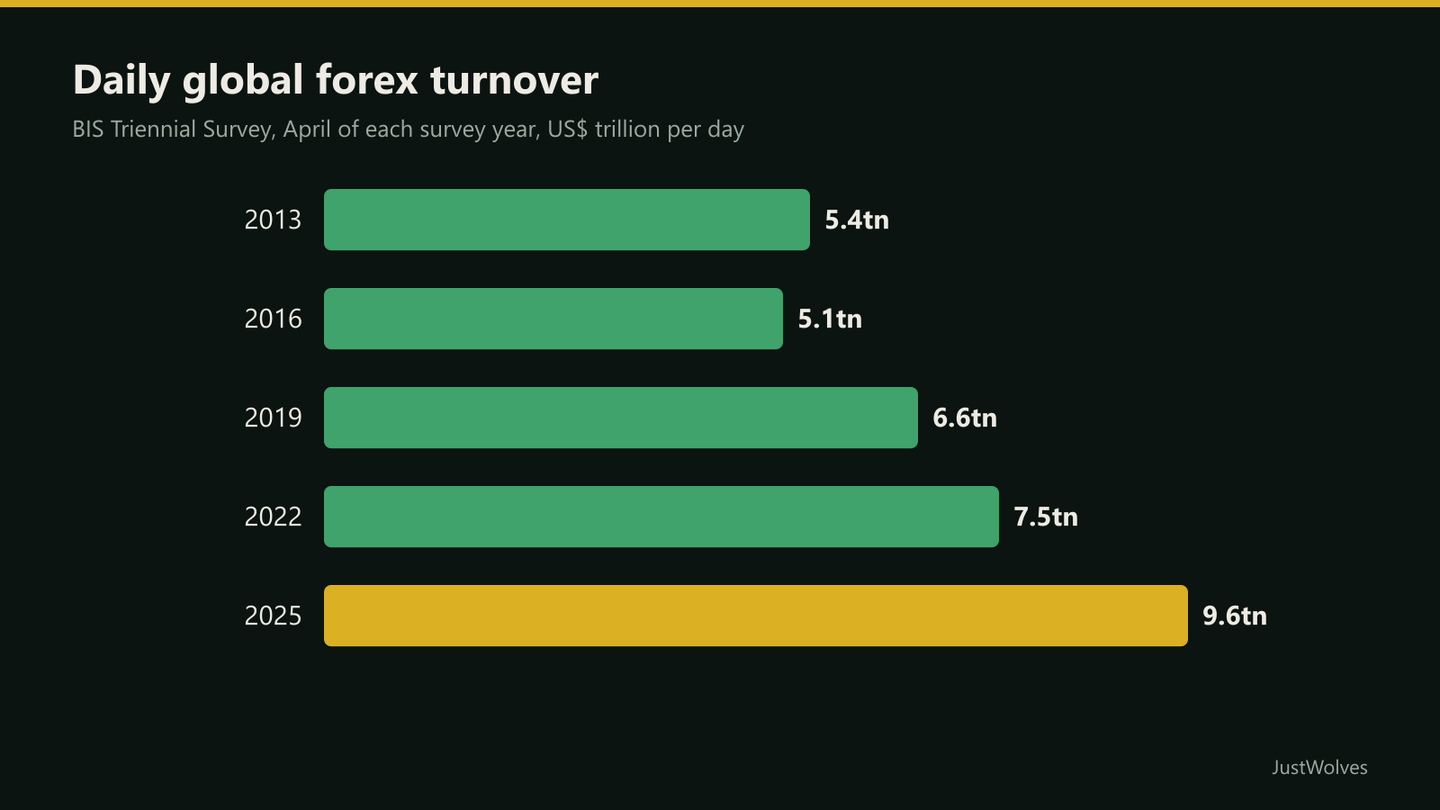
- Forex is the global market for exchanging one currency for another, averaging about $9.6 trillion of turnover a day (BIS, April 2025)
- Currencies always trade in pairs: buying one means selling the other
- Traders aim to profit from changes in exchange rates, and lose when rates move against them
- Most forex trading is done by banks and institutions; retail trading is a small, high-risk slice
- In India, residents may trade only permitted currency contracts on recognised exchanges or RBI-authorised platforms
In this article · 16 sections
Every time a company in India pays a supplier in Germany, a tourist changes rupees into dollars, or a fund in London buys Indian shares, someone is exchanging one currency for another. Together, those exchanges form the foreign exchange market, usually shortened to forex or FX: the largest financial market in the world. Forex trading means taking positions in that market to profit from changes in exchange rates. This lesson explains what that involves before any strategy.
What You Will Learn
- What the forex market is and how large it is
- Why currencies trade in pairs and what an exchange rate means
- How a forex trade makes or loses money
- Who trades forex, what moves prices, and the main risks for beginners
Before You Start
This is the first lesson of the Forex course and needs no prior knowledge. If you're in India, read Is Forex Trading Legal in India? early: the rules decide which kinds of forex trading you can do.
The Forex Market in One Paragraph
The forex market is a global network of banks, companies, investment funds, central banks, brokers and individuals exchanging currencies. It has no single building or exchange for spot trading: most transactions happen electronically between participants, which is called over-the-counter (OTC) trading. Because financial centres in Asia, Europe and North America overlap, the market trades around the clock from Monday morning in Asia to Friday evening in New York.
According to the Bank for International Settlements' Triennial Survey, turnover averaged about $9.6 trillion per day in April 2025, up 28% from 2022. Most of that is banks and institutions trading with each other, not individual traders.
Why Currencies Trade in Pairs
A currency has no price on its own; it only has a price in terms of another currency. So forex is always quoted as a pair, such as EUR/USD or USD/INR. The first currency is the base, the second is the quote. The price tells you how much of the quote currency buys one unit of the base.
If EUR/USD is 1.0850, one euro costs 1.0850 US dollars. If USD/INR is 83.20, one US dollar costs ₹83.20. Buying a pair means buying the base currency and selling the quote currency at the same time; selling the pair means the opposite. Lesson 01.01.03 covers pairs in detail.
How a Forex Trade Makes or Loses Money
A trader who expects the base currency to rise against the quote currency buys the pair (goes long). One who expects it to fall sells (goes short). The profit or loss is the change in the exchange rate multiplied by the position size.
A simple illustrative trade
Step 1: The view
A trader expects the euro to strengthen against the dollar.
Step 2: The entry
They buy 10,000 euros' worth of EUR/USD at 1.0850, i.e. they pay $10,850.
Step 3: The outcome if right
EUR/USD rises to 1.0900. The euros are now worth $10,900: a $50 gain, before costs.
Step 4: The outcome if wrong
EUR/USD falls to 1.0800. The euros are now worth $10,800: a $50 loss, before costs.
Step 5: The costs
Every trade also pays the spread between the buying and selling price, and sometimes commission and overnight financing (lessons 01.01.06 and 01.02.03).
Moves in major currency pairs are usually small in percentage terms, a fraction of a percent on a typical day, which is why retail forex is often traded with leverage: borrowed exposure that magnifies both gains and losses (lesson 01.01.07). Leverage is also the main reason most retail forex accounts lose money.
Real Data: What a Day in EUR/USD Is Worth
The chart below uses real daily EUR/USD candles from March and April 2025. Step through it to see what normal days and unusual days meant for the same 10,000-euro position used in the example above, and how leverage changes the picture.
Real data: ordinary days and extraordinary days, EUR/USD, March–April 2025
Step 1 of 5
Ordinary days
In late March 2025, EUR/USD stays between 1.0736 and 1.0921. Most days the close changes by 10 to 50 pips. On 26 March, for example, it closes at 1.0755, 41 pips below the previous close: a loss of about $41 on a 10,000-euro position.
- What to observe
- Small daily changes, a fraction of a percent.
- Condition
- This is what most forex days look like.
Who Trades Forex
- Banks and dealers: the core of the market, trading with each other and providing prices to clients.
- Companies: exchanging currency for imports, exports and overseas investment, often hedging future payments.
- Asset managers and hedge funds: buying foreign assets and taking currency views.
- Central banks: managing reserves and occasionally intervening to influence their currency.
- Retail traders: individuals trading through brokers or exchanges, a small share of total turnover.
Lesson 01.01.02 explains how these participants connect and why liquidity is so deep in the major pairs.
What Moves Exchange Rates
Exchange rates move with supply and demand for each currency. The biggest long-term drivers are interest rates (higher rates tend to attract capital), inflation, economic growth, trade and capital flows, and central bank policy. In the short term, economic data releases, news and shifts in risk appetite cause most of the movement. The Sessions and Fundamentals module (01.03) covers each one.
Forex Trading in India
Indian residents can trade currency futures and options on recognised Indian exchanges (NSE, BSE and MSE), in rupee pairs such as USD/INR and in permitted cross pairs such as EUR/USD, or use platforms authorised by the RBI. Leveraged spot forex and CFD trading with offshore brokers is not permitted for residents under FEMA, and many such platforms appear on the RBI's Alert List.
This course teaches forex using the major pairs because they're the clearest way to learn how currency markets behave. The skills transfer directly to exchange-traded currency contracts. Is Forex Trading Legal in India? covers the rules in full.
How Much Do Currencies Move? Our Data
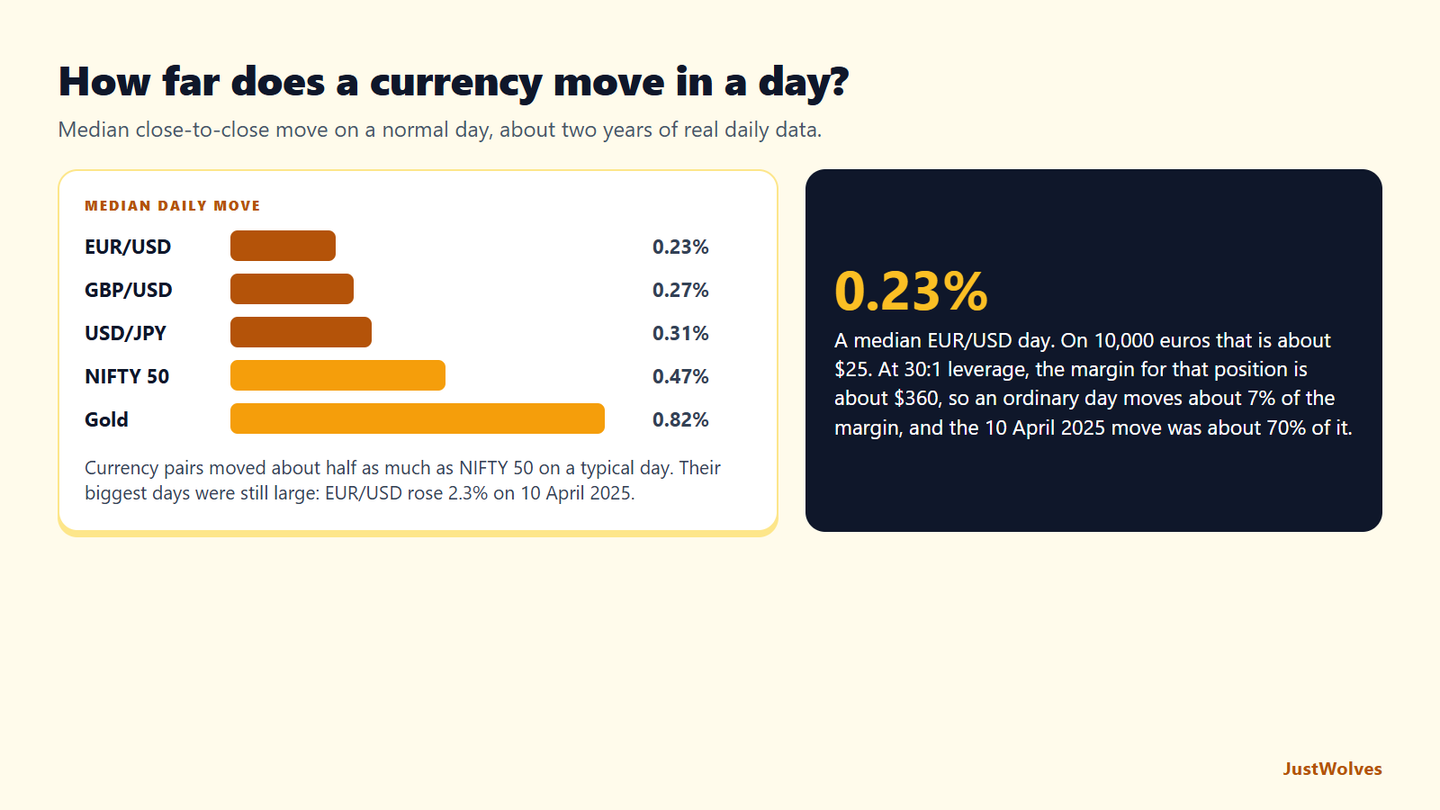
JustWolves measured about two years of real daily candles (November 2024 to November 2026) for the three most traded major pairs, with NIFTY 50 and gold for comparison. The "close-to-close move" is how far the closing price changed from one day to the next; the range is the distance from the day's high to its low.
| Market | Median close-to-close move | Median daily range | Largest daily move |
|---|---|---|---|
| EUR/USD | 0.23% | 0.55% (62 pips) | 2.30% (10 April 2025) |
| GBP/USD | 0.27% | 0.58% (77 pips) | 1.52% |
| USD/JPY | 0.31% | 0.70% (106 pips) | 2.41% |
| NIFTY 50 | 0.47% | 0.85% | 3.82% |
| Gold | 0.82% | 1.86% | 10.8% (30 January 2026) |
Three practical points follow.
Major currency pairs move less than shares on a typical day. EUR/USD's median day was about half of NIFTY 50's and less than a third of gold's. That is why this lesson says moves are "usually small in percentage terms", and why the retail forex industry relies so heavily on leverage: without it, most days would produce tiny profits or losses.
The unusual days are much larger than the usual ones. EUR/USD's biggest day was about ten times its median day. A plan that only works on normal days will eventually meet a 2% day, usually after news nobody could time.
Leverage turns small moves into large ones. At 30:1, a median EUR/USD day equals about 7% of the margin on the position; the 10 April 2025 move equalled about 70%. The same price change is mild for an unleveraged holder and severe for a leveraged trader. Lesson 01.01.07 covers how margin and leverage work, and the Risk Management course shows how to size positions so that no single day can do serious damage.
Common Beginner Mistakes
- Starting with leverage before understanding it. Learn pips, lots and margin first.
- Believing forex is an easy income. Most retail traders lose money; it's a skill that takes time and risk control.
- Using unauthorised offshore apps. Beyond the legal issue, your money has little protection.
- Trading every session. The market is open 24 hours, but liquidity and opportunity are not constant.
- Skipping risk management. Read the Risk Management course before placing real trades.
Working Out Real Results
| Day | Close-to-close change | Result on 10,000 euros | As a share of 30:1 margin (about $370) |
|---|---|---|---|
| 26 March | −41 pips (−0.38%) | about −$41 | about −11% |
| A median day | about ±25 pips (0.23%) | about ±$25 | about ±7% |
| 3 April | +200 pips (+1.84%) | about +$200 | about +54% |
| 10 April | +252 pips (+2.30%) | about +$252 | about +68% |
The arithmetic is the same as in this lesson's step-by-step example: price change × position size. What changes the experience is the amount of money behind the position. A trader holding 10,000 euros' worth with their own $11,000 would see a 2% day as a 2% day. A trader who put up only $370 of margin would see the same day as most of their deposit, gained or lost. The direction of the move, not the trader's skill, decided which.
Professional Insight
For most participants in the forex market, the currency trade isn't the goal; it's a by-product of business, investment or policy. A company converting export earnings or a fund buying foreign bonds isn't trying to predict the next move. That's one reason short-term currency moves can look random: much of the flow isn't driven by forecasts at all.
Risk Considerations
- Leverage risk: small moves can produce large losses relative to your deposit.
- Event risk: central bank decisions and economic data can move prices sharply in seconds.
- Counterparty and legal risk: trading with unauthorised platforms puts your money and legal standing at risk.
- Overnight and weekend gaps: prices can open far from Friday's close.
Important Terminology
| Term | Meaning |
|---|---|
| Forex (FX) | The global market for exchanging currencies. |
| Exchange rate | The price of one currency in terms of another. |
| Currency pair | Two currencies quoted together, e.g. EUR/USD. |
| Base / quote currency | The first / second currency in a pair; the price is quote units per one base unit. |
| Long / short | Buying a pair (expecting the base to rise) / selling it (expecting it to fall). |
| OTC | Over-the-counter: traded directly between participants rather than on an exchange. |
| Leverage | Controlling a position larger than the money deposited, magnifying gains and losses. |
What is forex trading in simple words?
Buying one currency and selling another at the same time, aiming to profit if the exchange rate moves in your favour.
How big is the forex market?
The BIS 2025 Triennial Survey put average daily turnover at about $9.6 trillion in April 2025, later revised to $9.5 trillion.
Is forex trading profitable?
It can be for a minority, but most retail traders lose money, mainly because of leverage, costs and poor risk management.
Can I trade forex in India?
Yes, through currency futures and options on NSE, BSE or MSE, or RBI-authorised platforms. Leveraged trading with offshore forex brokers is not permitted for residents.
When is the forex market open?
Around the clock from Monday morning in Asia to Friday evening in New York, though activity varies by session (lesson 01.03.01).
How much does a currency pair move in a day?
In our data from November 2024 to November 2026, EUR/USD's median close-to-close move was 0.23% and its median daily range was about 62 pips. Its largest single-day move was 2.3%, on 10 April 2025.
Why is forex traded with leverage?
Because major currency pairs usually move only a fraction of a percent a day, so unleveraged positions produce small gains and losses. Leverage magnifies those moves in both directions: at 30:1, a median EUR/USD day equals about 7% of the margin.
Practical Exercise
Practise reading exchange rates and working out results.
Your task
Step 1: Read a quote
Look up today's USD/INR and EUR/USD rates. Write down, in words, what each number means.
Step 2: Work out a result
If you bought 10,000 euros' worth of EUR/USD at today's rate and it rose by 0.0040, what would the gain be in dollars?
Step 3: Reverse it
What would the loss be if it fell by the same amount?
Step 4: List the costs
Name two costs your answer leaves out.
Check Your Understanding
EUR/USD is quoted at 1.0850. What does that mean?
Related Lessons
Next: How the Forex Market Works (01.01.02). Then Currency Pairs and Is Forex Trading Legal in India?. Before trading, work through the Risk Management course.