
Trading Psychology: The 5 Mental Traps Every Trader Faces
JustWolves is an educational platform and is not a SEBI-registered investment advisor. Trading financial instruments involves significant risk of loss and may not be suitable for all investors. Past performance is not indicative of future results. Read our full disclaimer →
What you'll learn
- Most costly trading mistakes come from predictable mental biases, not a lack of knowledge
- Loss aversion makes losses feel about twice as painful as equal gains feel good, so traders cut winners and hold losers
- Confirmation bias, overconfidence and herd behaviour all distort how you read the chart
- Revenge trading turns a normal loss into a bad day; a hard stop rule prevents it
- Rules written in advance work better than willpower in the moment
In this article · 17 sections
You can know every setup and still lose money, because the decisions that matter most are made when a trade is moving against you, money is on the line and your judgment is at its least reliable. Trading psychology is the study of those moments. This lesson names the five mental traps that cause most avoidable losses and gives a concrete rule for each.
What You Will Learn
- Why knowing what to do and doing it under pressure are different skills
- The five mental traps: loss aversion, confirmation bias, overconfidence, herd behaviour and revenge trading
- How each one shows up in a real trade
- Simple, written rules that defuse each trap before it costs you
Before You Start
No prior knowledge is needed, though Risk Management: Why It Comes First is a useful companion: several of the fixes below rely on keeping each loss small.
Why Psychology Matters as Much as Strategy
After the market closes, analysis is calm and slow. During a live trade it isn't. Psychologists describe two modes of thinking: a fast, automatic, emotional mode and a slow, deliberate one (often called System 1 and System 2). Under stress and time pressure, the fast mode takes over, and it is exactly the mode that is worst at weighing probabilities.
That's why traders who plan sensibly in the evening often do something else at 10:15 the next morning. The aim of trading psychology isn't to remove emotion, which is impossible. It is to make the important decisions in advance, when you're calm, so that fewer decisions are left for the moment you're not.
Trap 1: Loss Aversion
Research on decision-making known as prospect theory has found that people feel losses more strongly than gains of the same size. A widely cited 1992 estimate put the ratio at a little over two: losing ₹1,000 feels roughly as bad as gaining ₹2,000 feels good. Individuals vary, but the asymmetry is one of the best-established findings in behavioural economics.
In trading it produces a well-documented pattern called the disposition effect: selling winners too early to lock in the good feeling, and holding losers too long to avoid the bad one. Both habits damage expectancy at once.

How to defuse it
- Pre-accept the loss. When you place the stop, treat that amount as already spent: it's the cost of finding out whether the trade works.
- Keep each loss small. At 0.5–1% risk, a stop-out is an inconvenience rather than a threat, and the fear response stays quiet.
- Decide the exit plan before entry. Fixed target, partials or trail (lesson 12.02.02), then follow it rather than reacting to every tick.
- Step away after entry. Use price alerts at the stop and target instead of watching the P&L.
Real Prices: The Urge to Exit Early
Vikram's trade in this lesson is hypothetical. The chart below shows the same situation on a real trade: a Hindustan Unilever breakout in July 2025 that reached +0.5R within two days, fell back below the entry, and then hit its 2R target.
Real prices: the trade loss aversion wants you to exit early, Hindustan Unilever, July 2025
Step 1 of 4
The trade
Hindustan Unilever closes at ₹2,423.4 on 9 July 2025, above its 20-day high. The stop goes below the recent lows at ₹2,279.9; 1R is about ₹143, and the 2R target is ₹2,710.
- What to observe
- A plan with a stop and a target.
- Condition
- Now the emotions start.
Trap 2: Confirmation Bias
Once you've formed a view, you tend to notice evidence that supports it and discount evidence that doesn't. Decide Nifty is bullish and every green candle looks like confirmation while the lower highs go unnoticed. It shows up in research (following only analysts who agree with you), during trades (hunting for reasons to stay in) and after losses (blaming 'manipulation' instead of reviewing the setup).
How to defuse it
- Argue the other side. Before entry, spend one minute making the strongest case against the trade. What level could stop it? What would prove it wrong?
- Write both scenarios. "If price does X, I'll do this; if it does Y, I'll do that." A plan for being wrong makes it easier to accept.
- Define invalidation in advance. Your stop-loss is the point where the chart, not your opinion, decides.
Trap 3: Overconfidence
A run of winning trades feels like skill even when much of it is luck, and the mind quickly concludes it has cracked the market. Overconfident traders trade more, size up faster and skip their own rules.
The cost is measurable. Brad Barber and Terrance Odean's well-known studies of US brokerage accounts found that the households that traded most earned noticeably lower returns after costs than those that traded least, and they linked the excess trading to overconfidence.
How to defuse it
- Think in probabilities. Say "higher-probability setup", never "it's definitely going up" (lesson 12.03.05).
- Review weekly from the journal, counting winners and losers and looking for patterns, especially after a good run.
- Increase size only by rule, for example after a set number of trades with results in line with your plan, never because you feel sure.
Trap 4: Herd Behaviour
When everyone in your feed is in the same trade, it feels safer to join them. But crowded trades are fragile: when many traders hold the same position with stops in the same place, a modest move against them can trigger a cascade of exits.
Social media makes this worse. Screenshots show winning trades, rarely losing ones, and SEBI's 2024 study found that about nine in ten individual F&O traders lost money between FY22 and FY24. A tip shared by thousands is not an edge.
How to defuse it
- Close social media during market hours. Make it a rule, not a preference.
- Write one reason for every trade. If the honest reason is "someone in a group posted it", don't take it.
- Ask who is on the other side. When a move feels universally obvious, pause and look for what the crowd might be missing.
Trap 5: Revenge Trading
Revenge trading is taking impulsive trades to win back a loss quickly. Several forces combine: the urge to recover sunk costs, the wish to prove you were right, and plain frustration. Each new loss deepens it, and a normal losing morning becomes a damaging day. It's the most expensive trap because it strikes when your judgment is at its weakest.
How to defuse it
- Use a hard stop rule. For example, two or three consecutive losses, or a 3R daily loss, ends the day. No exceptions (lesson 12.02.04).
- Treat losses as business costs. Log each one, find the lesson if there is one, and don't try to recover it in the same session.
- Have a reset routine. Close the platform, walk away, write in your journal. Physically breaking the loop works better than arguing with yourself.
Step by Step: Build Your Pre-Market Psychology Checklist
Five minutes before the open
Step 1: State today's risk limits
Risk per trade, daily loss limit and maximum number of trades.
Step 2: Write your plan for each setup you're watching
Entry, stop, target, and what would make you skip it.
Step 3: Check your state
Tired, angry, distracted or chasing yesterday's loss? Trade smaller or not at all.
Step 4: Silence the noise
Close social media and trading groups until the session ends.
Step 5: Name today's likeliest trap
Pick the one you're most prone to and write its fix where you can see it.
Practical Example
Vikram buys a stock at ₹500 with a stop at ₹490 and a target at ₹525. It rises to ₹512 and starts to dip. Loss aversion says *take the profit before it disappears*, so he sells at ₹508 for less than 1R. Two days later it hits ₹525.
His next trade goes against him. This time loss aversion says *don't take the loss*, so he moves the stop to ₹480 and then ₹470, and finally exits at ₹468: a 3.2R loss. Frustrated, he takes two impulsive trades that afternoon and loses 2R more.
None of this was a strategy problem. With his original plan and a two-loss stop rule, the same week would have produced roughly +2.5R, −1R and no afternoon trades.
What the Traps Cost on Real Trades: Our Test
JustWolves tested two of this lesson's traps on a real trade stream: every close above the prior 20-day high on 17 large NSE stocks from November 2024 to November 2026, with a stop below the previous five days' low, a 2R target and delivery costs of 0.25% per round trip. For loss aversion, we compared holding to plan with exiting every trade at the first +0.5R. For streaks, behind both overconfidence and revenge trading, we looked at the trade that followed three wins in a row and three losses in a row.
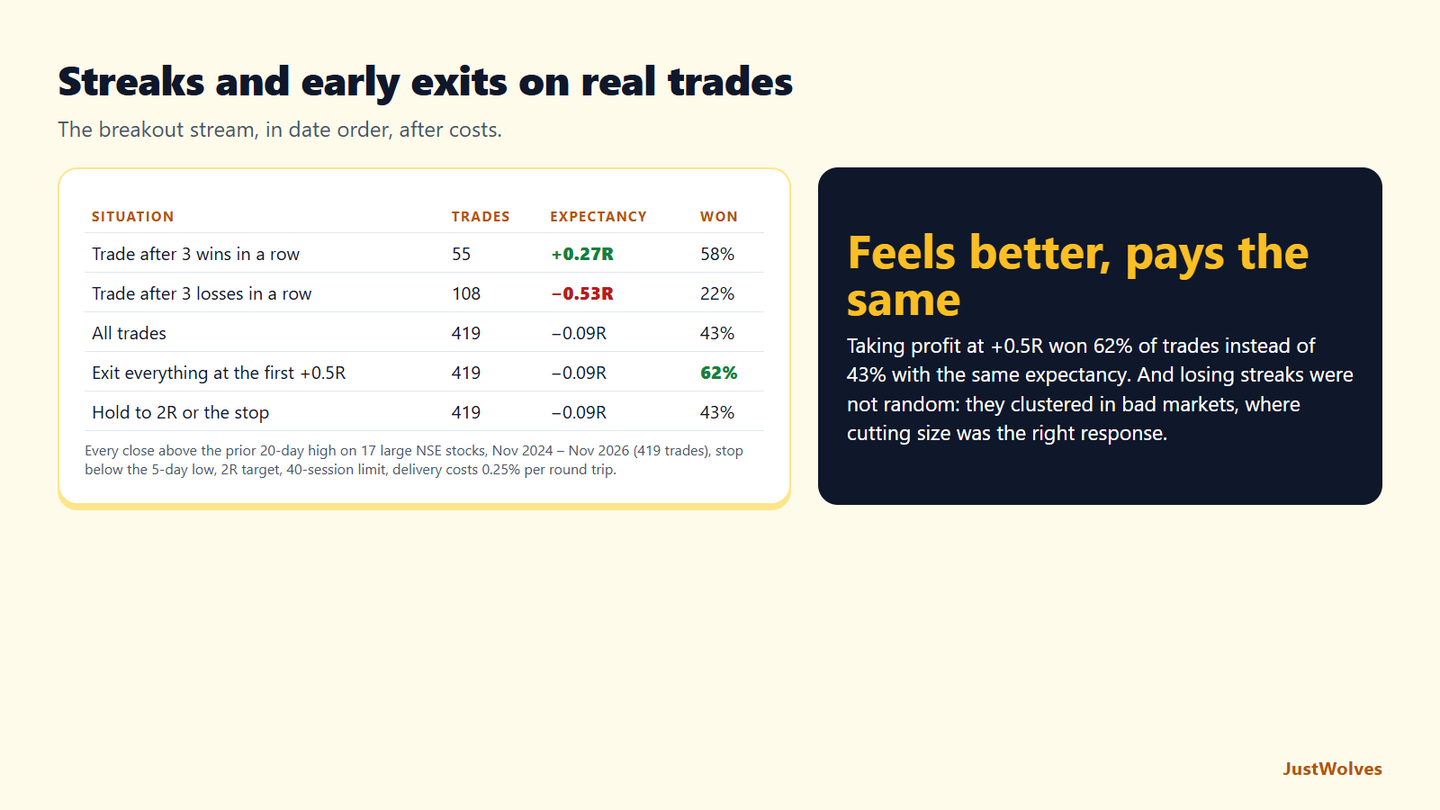
| Behaviour | Trades | Expectancy | Won |
|---|---|---|---|
| Hold to the 2R target or the stop | 419 | −0.09R | 43% |
| Exit everything at the first +0.5R | 419 | −0.09R | 62% |
| Trade after 3 wins in a row | 55 | +0.27R | 58% |
| Trade after 3 losses in a row | 108 | −0.53R | 22% |
Loss aversion bought comfort, not profit. Exiting every trade at the first +0.5R raised the win rate from 43% to 62%, because so many trades touched that level. But the result per trade was identical, −0.09R. The urge this lesson describes produces a record that feels better without being better, and it removes the occasional large winner that a profitable strategy depends on.
Streaks carried information here, but not the kind traders assume. After three losing trades in a row, the next trade averaged −0.53R; after three wins, +0.27R. On daily swing trades, losses clustered because the market environment persisted, not because a win was "due" or a loss "deserved". The revenge trader adds size after losses, exactly when the conditions were worst; the overconfident trader adds size after wins, which in this sample happened to help but feeds the habit that causes damage when conditions turn.
The fix is the same for both: fixed rules for size and exits, written before the trade. This lesson's recommended responses, pre-accepting the loss and using a hard stop rule after consecutive losses, are supported by this data: reducing activity after a losing run avoided the weakest trades.
Common Mistakes
- Relying on willpower. Rules written in advance work far better than resolve in the moment.
- Blaming the market. Reviewing your own decisions is uncomfortable but the only way to improve.
- Trading while emotional. Anger, euphoria and exhaustion all degrade decisions.
- Watching every tick. Constant monitoring invites impulsive changes to a sound plan.
- Learning from single trades. Judge decisions by whether you followed the plan, not by one outcome.
Professional Insight
Professional traders don't claim to be free of these biases; they build systems around them. Risk limits are enforced by software or a risk manager, size changes need a rule, and every trade is reviewed. The goal is to make the right behaviour the default, so it doesn't depend on how you feel that day.
Risk Considerations
- Biases compound: overconfidence after a win often leads to oversized trades, which then make loss aversion and revenge trading more expensive.
- Stress outside trading matters: money pressure, sleep and health all affect decisions; trade smaller when they're poor.
- Trading with money you need makes every trap stronger. Only trade capital you can afford to lose.
Important Terminology
| Term | Meaning |
|---|---|
| Loss aversion | Feeling losses more strongly than gains of the same size. |
| Disposition effect | Selling winners too early and holding losers too long. |
| Confirmation bias | Favouring information that supports what you already believe. |
| Overconfidence | Overestimating your skill or the accuracy of your forecasts. |
| Herd behaviour | Following what others are doing instead of your own analysis. |
| Revenge trading | Impulsive trading to recover losses quickly. |
| Prospect theory | A model of how people actually weigh gains, losses and probabilities. |
What is trading psychology?
The study of how emotions and mental biases affect trading decisions, and the rules and habits that reduce their impact.
Why do traders cut winners and hold losers?
Because of loss aversion: losses feel more painful than equal gains feel good, so traders lock in small gains quickly and avoid taking losses. Researchers call this the disposition effect.
How do I stop revenge trading?
Set a hard rule before the session, such as stopping after two or three consecutive losses or a fixed daily loss, and follow a reset routine when it triggers.
Can you remove emotions from trading?
No, but you can reduce their influence by keeping risk small, deciding exits in advance and limiting the decisions you make during a live trade.
Do professional traders feel fear and greed?
Yes. The difference is that they build rules, limits and reviews around those feelings rather than relying on willpower.
Does taking profits early improve trading results?
In our test on 419 real NSE breakout trades, exiting at the first +0.5R raised the win rate from 43% to 62% but left the expectancy unchanged at −0.09R per trade. It made results feel better without making them better.
Should I trade bigger after a losing streak to recover?
No. In our daily NSE breakout data, the trade after three consecutive losses averaged −0.53R and won only 22% of the time, because losses clustered in poor market conditions. A losing run is a reason to reduce size or pause.
Practical Exercise
Run a short trap audit on your last 20 trades (or your next 10 if you're just starting).
Your task
Step 1: Tag each trade
Mark any trade where you exited a winner early, moved a stop, entered on someone else's idea, traded right after a loss, or increased size because you felt sure.
Step 2: Count by trap
Which of the five traps appears most often?
Step 3: Price it
Estimate the R you lost on those trades compared with following your plan.
Step 4: Write one rule
Pick your most expensive trap and write one specific rule against it for the next 20 trades.
Check Your Understanding
According to research on loss aversion, how does a ₹1,000 loss feel compared with a ₹1,000 gain?
Related Lessons
This lesson opens the Trading Psychology module. Next: Fear and Greed in Trading (12.03.02). See also Daily and Weekly Loss Limits for the rule that stops revenge trading.