
How to Write a Trading Plan: A Professional Template and Worked Example
JustWolves is an educational platform and is not a SEBI-registered investment advisor. Trading financial instruments involves significant risk of loss and may not be suitable for all investors. Past performance is not indicative of future results. Read our full disclaimer →
What you'll learn
- A trading plan is the written rulebook for your trading business
- It covers why you trade, what and when you trade, how you enter and exit, how you manage risk, and how you review
- Every rule should be specific enough that you can check whether you followed it
- Risk rules and stop rules matter more than entry rules
- Review the plan monthly, not in the middle of a trading session
In this article · 14 sections
Every lesson in this course has ended with a rule: risk a fixed percentage, place stops beyond structure, stop after a daily loss limit, journal every trade. A trading plan puts all of those rules in one document, specific enough that you can check every trade against it. It's the difference between trading as a business with an operating manual and trading as a series of decisions made on the spot.
What You Will Learn
- What a trading plan is and why it matters
- The sections every plan should include
- How to write rules that are specific and checkable
- A complete filled-in example you can adapt
Before You Start
This lesson pulls together the whole course. In particular, use Position Sizing, Daily and Weekly Loss Limits, Trading Discipline and Routines and Strategy Evaluation.
What a Trading Plan Is
A trading plan is a written document that defines how you trade: what you trade, when, with which setups, how you size and manage positions, how you control risk, and how you review your performance. It's written in advance, when you're calm, and followed during the session.
Its value comes from being specific. "Trade carefully" is not a rule. "Risk 0.5% of account equity per trade, rounded down to whole lots" is.
The Sections of a Trading Plan
| Section | What to write |
|---|---|
| 1. Purpose and expectations | Why you trade, time available, and realistic expectations based on measured results |
| 2. Capital | Trading capital, money that is off-limits, and whether you'll add or withdraw |
| 3. Markets and timeframes | Exactly which instruments and timeframes you trade, and when you don't (e.g. around major events) |
| 4. Setups | Each setup with conditions, entry trigger, stop placement and exit method |
| 5. Position sizing | Risk per trade, how size is calculated, rounding, maximum exposure |
| 6. Risk limits | Daily, weekly and drawdown limits, trade caps, portfolio heat and sector caps |
| 7. Routines | Pre-session, in-session and post-session checklists |
| 8. Journal and review | What you record, and the weekly and monthly review process |
| 9. Stop rules | Conditions for reducing size, pausing or ending a strategy |
| 10. Change process | How and when the plan itself may be changed |
Step by Step: Writing Your Plan
One evening, ten sections
Step 1: Start with risk
Write sections 5 and 6 first. They protect you even if everything else is imperfect.
Step 2: Limit your scope
One or two markets, one or two timeframes, two or three setups. You can add later.
Step 3: Write each setup as a checklist
Conditions you can tick off, not descriptions you can interpret.
Step 4: Add routines and review
Use the templates from lessons 12.03.05 and 12.04.01.
Step 5: Write stop rules and the change process
Decide now how the plan can change, so it doesn't change in the middle of a bad day.
Step 6: Test every rule for checkability
For each line, ask: after a trade, could I say yes or no to whether I followed it? Rewrite any that fail.
A Filled-In Example
Here is a compact plan for a part-time swing trader. Treat it as a format, not a recommendation: every number should come from your own testing.
| Section | Rules |
|---|---|
| Purpose | Grow capital alongside my salary. Review results against a Nifty index fund yearly. No income needed from trading. |
| Capital | ₹4,00,000 trading capital. Emergency fund and long-term investments are separate and off-limits. |
| Markets | Nifty 100 stocks, daily chart; weekly chart for trend. No new entries in the week of company results. |
| Setups | A) Pullback to rising 20 EMA in uptrend; B) Breakout from 4+ week range with volume above 20-day average. Stop below the swing low; first target at prior high; trail the rest below higher lows. |
| Sizing | Risk 0.75% (₹3,000) per trade from the structural stop; round down; no position over 25% of capital. |
| Risk limits | Maximum 5 open positions; portfolio heat ≤ 4%; ≤ 2 positions per sector; halve risk at −10% from peak; stop and review at −15%. |
| Routines | Scan after 3:30 pm on weekdays; set entries and alerts in the evening; check positions once daily after the close. |
| Journal and review | Log every trade with screenshot; weekly 20-minute review; monthly scorecard vs backtest. |
| Stop rules | Pause a setup if 50+ trades show negative expectancy after costs with adherence above 90%, or if drawdown exceeds 1.5 × backtest maximum. |
| Changes | Plan changes only at the monthly review, written and dated; never during a trade. |
Practical Example: The Plan in Use
On a Tuesday evening, Ananya's scan shows a breakout candidate. She checks it against the plan: setup B conditions met, volume above average, stop below the range low gives a ₹14 distance, so ₹3,000 ÷ ₹14 = 214 shares. Portfolio heat would rise to 3.75%, within the 4% cap. It's her second banking stock, which is allowed.
She places the order with its stop and alerts. Three weeks later the trade is stopped out for −1R. In her weekly review it scores 5/5 on rules: a good trade with a losing outcome. Nothing in the plan changes.
Real Prices: A Plan Rule at Work
Ananya's evening check in this lesson is hypothetical. The chart below shows one plan rule working on real NIFTY 50 prices in 2026: a market filter that switched off on 26 August, kept the plan out of a falling market until 12 November, and avoided a long run of losing trades.
Real prices: a written plan's market filter switching off, NIFTY 50, May–November 2026
Step 1 of 4
The rule in the plan
A written plan allows new long trades only when NIFTY 50 closes above a rising 50-day average. Through July and much of August 2026 the index hovers around its average, and the filter switches on and off.
- What to observe
- A rule in the plan, checkable every evening.
- Condition
- Plus: at most six open trades, one per stock, a pause after three losses.
A Written Plan vs Taking Every Signal: Our Test
JustWolves tested the value of the rules in a written plan on real signals: every close above the prior 20-day high on 17 large NSE stocks from November 2024 to November 2026, with a stop below the previous five days' low, a 2R target, a 40-session limit and delivery costs of 0.25% per round trip. Trades were taken in date order at 1% risk each. We compared taking every signal with a market filter alone, and with a written plan that added three rules from this course: at most six open positions, one position per stock, and a five-session pause after three losses in a row.
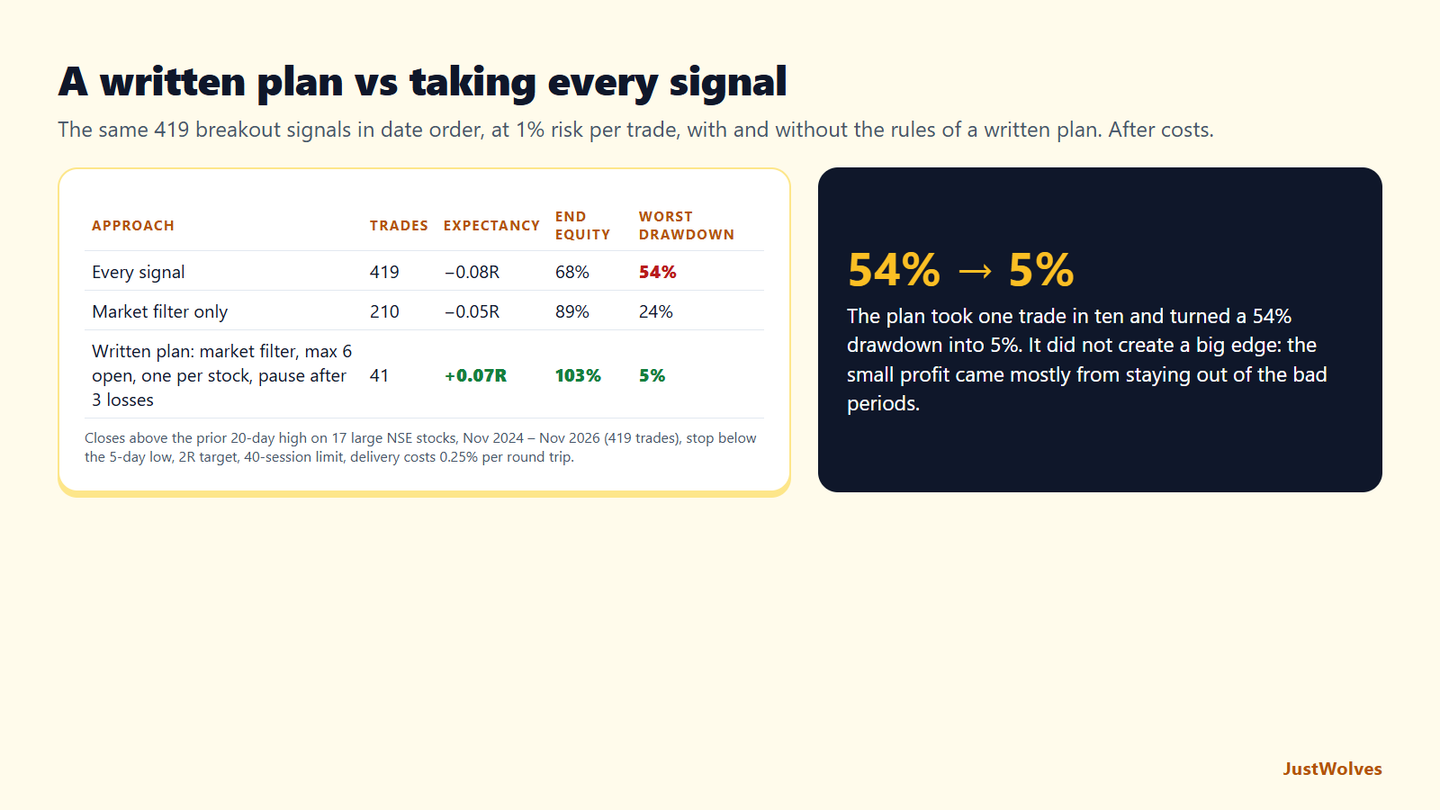
| Approach | Trades | Expectancy | Ending equity | Worst drawdown |
|---|---|---|---|---|
| Every signal | 419 | −0.08R | 68% | 54% |
| Market filter only | 210 | −0.05R | 89% | 24% |
| Written plan: market filter, max 6 open, one per stock, pause after 3 losses | 41 | +0.07R | 103% | 5% |
The plan's rules did more than the setup. The breakout signal itself had a slightly negative edge. Taking every signal would have cost a third of the account with a 54% drawdown along the way. The same signals under a written plan finished slightly up, with a worst drawdown of 5%.
It worked by refusing trades. The plan took only 41 of 419 signals: the market filter removed the weakest periods, the position cap and one-per-stock rule limited correlated exposure, and the pause after three losses stopped trading during losing clusters. This is the professional insight in this lesson: a plan is a mandate that controls exposure, not a forecast.
It did not create a reliable edge. Forty-one trades at +0.07R is far too few to prove anything, as the Strategy Evaluation lesson shows. The lesson in this lesson's risks section holds: a plan doesn't create an edge; it lets you trade one consistently and survive the periods when it doesn't work. That alone turned a 54% drawdown into 5%.
Common Mistakes
- Writing a plan you can't check. Vague rules can always be argued around.
- Starting with entries. Risk rules protect you first.
- Too many setups and markets. Depth beats breadth while you're building evidence.
- Never reviewing the plan. Markets and your own skills change.
- Rewriting it after every loss. Changes belong at the scheduled review.
Professional Insight
Professional trading desks operate under written mandates: what can be traded, maximum position sizes, loss limits and escalation rules. Your trading plan is your personal mandate. Its job isn't to predict the market; it's to make sure that whatever the market does, your response has already been decided.
Risk Considerations
- A plan doesn't create an edge. It only lets you trade an edge consistently and measure it.
- Unrealistic expectations in section 1 undermine every other section.
- Plans age: revisit position sizing and limits whenever your capital or circumstances change.
Important Terminology
| Term | Meaning |
|---|---|
| Trading plan | The written rulebook for how you trade, manage risk and review. |
| Checkable rule | A rule specific enough that you can say yes or no to whether you followed it. |
| Mandate | A professional trader's written limits on what and how much they can trade. |
| Change process | The defined, scheduled way a trading plan may be updated. |
| Scorecard | The set of metrics used to review a strategy's performance. |
What should a trading plan include?
Your goals and expectations, capital, markets and timeframes, setups with entry and exit rules, position sizing, risk limits, daily routines, journaling and review, stop rules for strategies, and how the plan can be changed.
How long should a trading plan be?
Long enough to cover every section with specific rules, often one to three pages. A short plan you follow beats a long one you don't.
Do I need a trading plan as a beginner?
Yes. It matters most at the start, when habits form and experience can't yet guide decisions.
How often should I update my trading plan?
At a scheduled monthly or quarterly review, based on journal evidence, and never in the middle of a trade or a bad day.
Is there a trading plan template?
Yes: the ten-section table in this lesson can be copied into a document and filled in, using the worked example as a guide.
Does a trading plan improve results?
In our NSE test it mainly reduced risk. The same 419 breakout signals had a 54% worst drawdown when every signal was taken, against 5% under a written plan with a market filter, a position cap, one position per stock and a pause after three losses.
What rules should a trading plan include?
At minimum: what you trade, your setups, risk per trade, a cap on total open risk or positions, daily and weekly loss limits, a market or regime filter if you use one, and how and when you review results. Every number should come from your own testing.
Practical Exercise
Write version 1 of your trading plan this week.
Your task
Step 1: Copy the ten-section template
Into a document you'll keep open while trading.
Step 2: Fill in risk first
Sizing, limits and stop rules, using numbers from your own testing where possible.
Step 3: Add one or two setups
Written as checklists.
Step 4: Run the checkability test
Rewrite any rule you couldn't score yes or no after a trade.
Step 5: Date it and schedule a review
Put the first monthly review in your calendar.
Check Your Understanding
Which of these is a checkable rule?
Related Lessons
Previous: Strategy Evaluation and Performance Analysis. This completes the Risk Management & Trading Psychology course. Start applying it in any strategy course, for example What Is Swing Trading?.