
CRT with ICT Concepts: Sessions, Kill Zones and Daily Bias
JustWolves is an educational platform and is not a SEBI-registered investment advisor. Trading financial instruments involves significant risk of loss and may not be suitable for all investors. Past performance is not indicative of future results. Read our full disclaimer →
What you'll learn
- A popular variant uses a higher-timeframe candle (often daily or 4-hour) as C1 and looks for C2 behaviour within a kill zone
- Session ranges (Asian, London, New York) can serve as C1-style ranges
- Kill zones mark periods when sweeps and reversals are commonly watched for
- The midnight New York opening price is used by some traders as a premium/discount reference
- Timing filters reduce the number of setups; they don't guarantee outcomes
In this article · 15 sections
CRT is often taught alongside ICT concepts, especially session timing. In one common version, a higher-timeframe candle is the range, and traders watch for its high or low to be swept during a specific time window, a kill zone, before price moves to the other side. This lesson shows how session ranges, kill zones and the midnight opening price fit with the CRT model taught in this course, with times converted to IST.
What You Will Learn
- Higher-timeframe C1 with session timing
- Session ranges as CRT ranges
- Kill zones and the midnight opening price
- How to use timing without overfitting
Before You Start
Read CRT with SMC, and from the ICT course, the lessons on kill zones and the daily bias. All times below are New York time with IST equivalents; they shift by an hour when US daylight saving time changes.
Higher-Timeframe C1, Lower-Timeframe Timing
In this variant, C1 is a 4-hour or daily candle. Traders then watch the next candle (C2) on that timeframe, but time their attention to specific sessions on a lower timeframe. For a daily C1, they look for the previous day's high or low to be swept during London or New York hours and for price to close back inside the range.
The underlying model is unchanged: sweep beyond C1's range, close back inside, move toward the other side.
Session Ranges
| Session range | New York time | IST (winter / summer) |
|---|---|---|
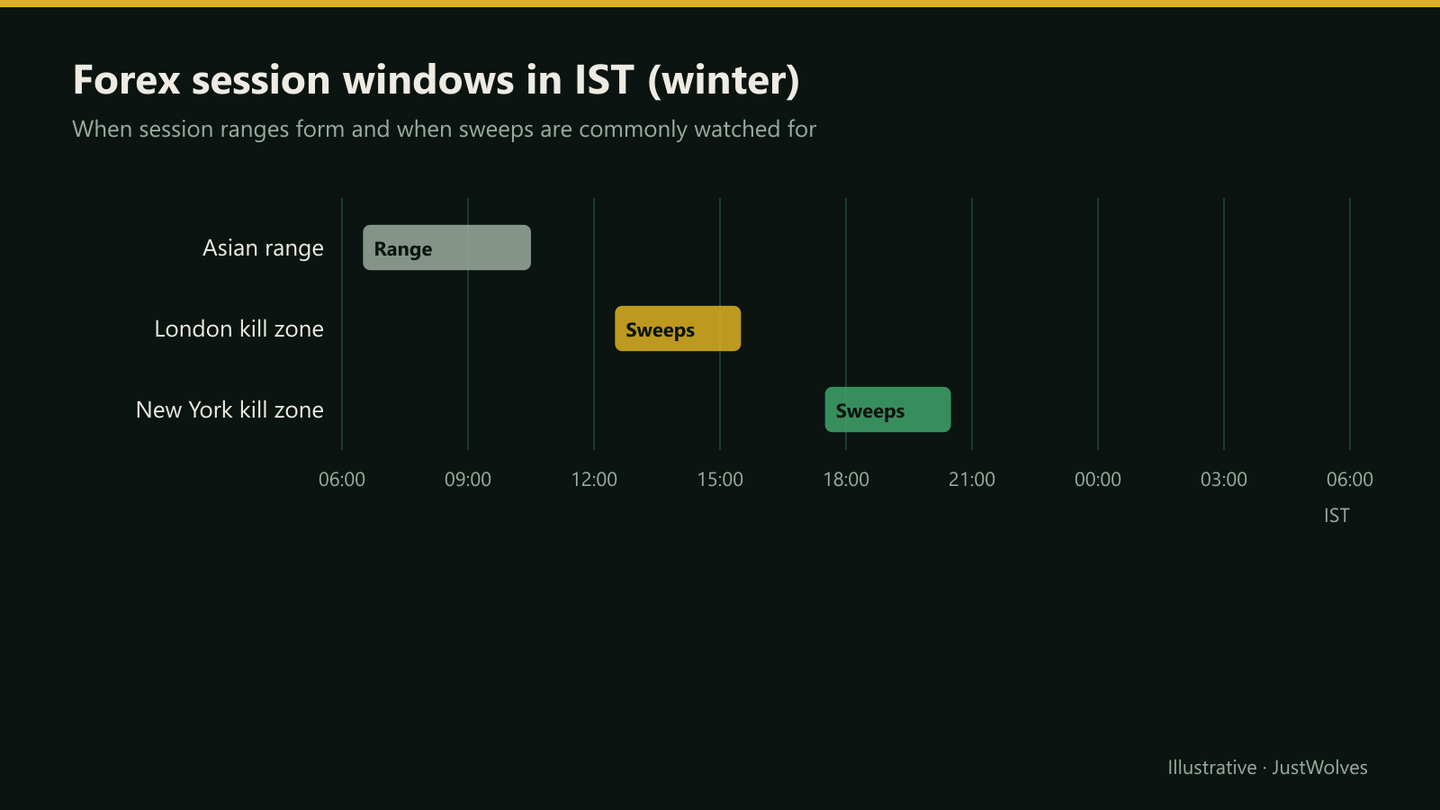
| Asian session (often used as a range) | 8 pm – midnight | 6:30–10:30 am / 5:30–9:30 am |
| London kill zone | 2–5 am | 12:30–3:30 pm / 11:30 am–2:30 pm |
| New York kill zone | 7–10 am | 5:30–8:30 pm / 4:30–7:30 pm |
A common intraday pattern: the Asian session forms a range (treated like C1); London sweeps one side of it (C2-like behaviour) and closes back inside on the hourly chart; the move then heads toward the other side.
A Real Asian-Range Sweep, Step by Step
Here is the session pattern described above on real gold data. Step through it, and pay attention to the last step: it puts this one example in the context of every similar case we found.
Real case: London sweeps the Asian high. Gold 1H, 13 October 2026
Step 1 of 6
The Asian range
From 20:00 to midnight New York time (00:00–04:00 UTC), gold ranged between 4173.7 and 4211.7. This range plays the role of C1.
- What to observe
- A 38-point overnight range.
- Condition
- Mark the Asian high and low.
What Our Data Showed About Timing
Time-of-day rules are central to ICT-style CRT. JustWolves tested three of them on real data (EUR/USD, GBP/USD, USD/JPY and gold). All used the course's standard stop (beyond the sweep with a small buffer) and target (the opposite side of the range), with costs excluded.
| C2 start time (New York) | Session it covers | Setups | Winning trades | Average result |
|---|---|---|---|---|
| 17:00 | Late New York / pre-Asia | 93 | 46% | −0.01R |
| 21:00 | Asia | 158 | 47% | −0.04R |
| 01:00 | Late Asia / London open | 131 | 47% | −0.05R |
| 05:00 | London morning | 136 | 46% | −0.01R |
| 09:00 | New York open / overlap | 117 | 44% | −0.15R |
| 13:00 | New York afternoon | 140 | 39% | −0.15R |
| Variant | Sample | Winning trades | Average result |
|---|---|---|---|
| Daily candle as C1 (trades managed on 4H candles, up to 2 days) | 579 setups, Nov 2024 – Nov 2026 | 46% | +0.01R |
| London (02:00–05:00 NY) sweep of the Asian range, target the other side by 17:00 NY | 250 setups, May – Nov 2026 | 35% | −0.25R |
Three conclusions:
- No time window made 4H CRT profitable on its own. The differences between windows were modest, with one notable pattern: setups whose C2 formed during the New York session (09:00 and 13:00) did clearly worse than the others. That runs against the common idea that the most active sessions give the best signals.
- The daily C1 was break-even. Over two years and 579 setups, the daily version averaged almost exactly zero before costs. Because daily stops are wide, costs take a smaller share, so it is a reasonable framework to test further. It is not an edge in itself.
- The Asian-range sweep did poorly in this sample. It is one of the most frequently taught intraday patterns, and it lost about a quarter of the risk per trade on average. Many London sweeps of the Asian range turned out to be the start of a real move, not a false break.
Session behaviour changes from year to year, and six months is a short window. The point is not that timing never helps. It is that time-of-day rules need testing like any other filter, and the popular ones did not survive this test.
The Midnight Opening Price
Some ICT-influenced traders mark the price at midnight New York time (10:30 am IST in winter, 9:30 am in summer) and treat levels above it as premium and below it as discount for that day.
Applied to CRT, a bullish setup whose sweep happens below the midnight opening price is considered better placed than one above it. This is a convention rather than a proven effect, so test it before relying on it.
Using Timing Sensibly
- As a filter: only take CRT setups whose C2 sweep happens in your chosen window.
- Not as a trigger: a sweep inside a kill zone still needs the close-back-inside rule, trend and location.
- Test it: compare results inside and outside the window on your market.
The Daily Candle as C1
Using the previous day's candle as C1 gives the most widely watched range of all. A sweep of yesterday's low that closes back inside on the hourly chart, during an active session, is a common setup in this variant, with yesterday's high as the target. Because daily ranges are large, many traders refine entries on the 15-minute chart to keep stops reasonable.
Practical Example
Hypothetically, in a bullish daily trend, a currency pair's Asian session range runs from 1.0848 to 1.0872. During the London kill zone, around 1 pm IST, price sweeps to 1.0839, below the Asian low, then the hourly candle closes at 1.0856, back inside.
The sweep is also below the midnight opening price of 1.0860. Ritu buys at 1.0857 with a stop at 1.0834 and a first target at the Asian high of 1.0872, adding a runner toward the previous day's high.
Common Mistakes
- Using kill zones as signals rather than filters.
- Forgetting daylight saving shifts in IST conversions.
- Applying forex sessions to Indian indices.
- Adding timing rules until the backtest is perfect.
- Ignoring trend because the timing looks right.
Professional Insight
Time-of-day filters are popular because they reduce screen time and focus attention on more active periods. Their value varies by market and year, so traders who rely on them re-test them periodically rather than treating them as permanent.
Risk Considerations
- Session behaviour changes over time.
- News inside kill zones produces violent moves.
- Overfitting with many timing rules.
Important Terminology
| Term | Meaning |
|---|---|
| Kill zone | A time window when sweeps and reversals are commonly watched for. |
| Session range | The high and low of a trading session. |
| Midnight opening price | The price at midnight New York time, used as a daily reference. |
| Daily bias | The expected direction for the day from higher-timeframe analysis. |
| Opening range | The high and low of the first part of a session. |
How does CRT relate to ICT?
Many traders apply CRT with ICT timing concepts, such as kill zones and higher-timeframe candles as ranges.
What are the kill zone times in IST?
In winter, London is about 12:30–3:30 pm and New York about 5:30–8:30 pm IST; subtract an hour during US daylight saving time.
What is the midnight opening price?
The price at midnight New York time, which some traders use to divide the day into premium and discount.
Can I use kill zones for Nifty?
Not directly; Indian traders often use the opening range and previous day's high and low instead.
Do timing filters improve CRT?
They can reduce noise, but their value should be tested on your market.
Which session is best for CRT?
In our test of 830 real 4H setups, no session made CRT profitable on its own. Setups whose C2 formed during the New York session did worst (about −0.15R before costs); the London morning and late New York candles were closest to break-even.
Does the Asian range London sweep work?
In our sample of 250 London sweeps of the Asian range across four markets (May–November 2026), it won 35% of the time and averaged −0.25R before costs. Clear winning examples exist, but the pattern did not hold up across the full sample.
Practical Exercise
Test a timing filter.
Your task
Step 1: Pick a market
A major currency pair, or Nifty with an opening-range version.
Step 2: Collect CRT setups
For one month.
Step 3: Tag timing
Inside or outside your chosen window.
Step 4: Compare
Did timing change the results in your sample?
Check Your Understanding
In the HTF variant, C1 is often:
Related Lessons
Previous: CRT with SMC. Next module: CRT Strategy.