
How to Build a Business That Runs Without You: Systems First

JustWolves is an educational platform and is not a SEBI-registered investment advisor. Trading financial instruments involves significant risk of loss and may not be suitable for all investors. Past performance is not indicative of future results. Read our full disclaimer →
In this article · 10 sections
About 20% of small businesses fail in their first year. By year five, nearly half are gone. By year ten, only 35% survive. The reason is almost never a bad idea, insufficient passion, or lack of hard work. As a classic small-business book argues, it usually comes down to something far more fixable: the business was built around the owner's personal effort rather than around repeatable systems.
Why Most Small Businesses Fail
US government data on business survival is sobering. Twenty percent of small businesses do not make it past year one. Fifty percent are gone by year five. Only thirty-five percent are still operating after a decade. These are not outlier failures or unusually complicated situations. They happen to passionate, intelligent, hard-working people — and they happen because of a single structural mistake.
The mistake is not insufficient effort. Most failing business owners work themselves to exhaustion. The mistake is building a business that cannot function without constant personal involvement from its owner. When the owner steps away — for a holiday, an illness, or even a long weekend — orders back up, quality slips, and customers leave. A business that only works when you work is not a business. It is a job with extra paperwork and no employment protections.
Small Business Survival Rates (US government data)
80%
Survive Year 1 — initial momentum carries most businesses through the first twelve months
50%
Survive Year 5 — half of all businesses are gone within five years of opening
35%
Survive Year 10 — only one-in-three businesses reaches a decade of operation
The Craft Myth: The Dangerous Business Lie
A classic small-business book calls it the entrepreneurial myth; we call it the craft myth. It is the widely held belief that if you are skilled at a craft, you are naturally equipped to run a business doing that craft. This belief is nearly universal among first-time founders. It is also almost entirely wrong.
Consider someone who makes beautiful handmade soaps. Friends rave about them. She opens a shop. Six months in, she is drowning — exhausted, managing erratic staff, fighting inventory problems, watching sales stall — and she has started to hate soap. She did not start a business. She added a dozen jobs she never trained for on top of the one she loved.
Doing the work and running a business that does the work are two entirely different skills. The craftsperson who confuses the two does not build a business — they build themselves an extremely demanding job with no paid leave, no employment safety net, and no clear exit.
The Three Roles Every Business Owner Must Play

The same book identifies three distinct roles that coexist inside every business owner. The conflict between them is at the root of most operational chaos.
The Three Roles Inside Every Business Owner
Entrepreneur
The dreamer and visionary. Thinks in possibilities, imagines what the business could become, and generates ideas. Focused on the future.
Manager
The organiser. Creates order from chaos, builds schedules and processes, and ensures yesterday's commitments are met today.
Technician
The doer. The one who bakes, codes, cleans, or builds — whoever is actually performing the core work the business sells.
Most people start businesses as Technicians. They are good at a craft, decide they would rather do it for themselves, and launch. But ownership immediately demands all three roles simultaneously: the Entrepreneur to build vision, the Manager to create order, and the Technician to produce the actual work.
The result is constant internal conflict. The Entrepreneur wants to experiment and grow. The Manager wants stability and routine. The Technician just wants to get work done without being interrupted. When there is no deliberate balance, the Technician wins almost every time — because the work is urgent and visible, while building systems feels abstract and optional.
That is how owners end up spending twelve-hour days doing tasks they once loved, with no room to build the business that was supposed to give them freedom.
The Three Phases of Business Growth
It also maps every small business through three recognisable phases. Knowing which phase you are in determines which actions will actually move you forward.
Business Growth Phases
Infancy
The owner and the business are indistinguishable. You handle every task personally — every order, every email, every customer problem. You have full control and full exhaustion. The business cannot survive a single day without you. Most businesses spend years here without realising it.
Adolescence
You hire someone to help. But instead of delegating properly, you micromanage — because no one does it quite the way you do. You have transferred tasks without transferring responsibility. You are stressed about standards slipping and still doing most of the real work yourself. Many businesses stall here permanently.
Maturity
Instead of hiring people to replicate what you personally do, you build systems so the work happens consistently without depending on any one individual. The business has documented processes, trained roles, and operational independence. This is where real scale begins — and where your time becomes your own.
Maturity is not about the age of the business. A ten-year-old company can be permanently trapped in Infancy. A two-year-old business can reach Maturity quickly if the owner deliberately designs systems from the start. The phase is determined by structure, not by time in operation.

Franchise Thinking: Build Systems, Not Dependencies
The most actionable idea in that framework is franchise thinking — and it applies whether or not you ever intend to franchise your business.
The biggest fast-food chains did not become global because they had exceptional burgers. They scaled because they built a system so clear and complete that a sixteen-year-old with no prior cooking experience can produce a consistent product by following a defined process. The business does not depend on any individual employee being extraordinary. It depends on the system being excellent.
Every process in your business — taking orders, handling customer questions, onboarding a new team member, managing returns — should be documented in enough detail that someone else could follow the steps and produce the same outcome every time. You are not writing a memo. You are writing the operating manual for a machine that will eventually run without you at the controls.
You are not building a business for yourself to work in. You are building a business for a customer to be served by — and it needs to work whether you are there or not.
How to Build a Business That Runs Without You
The transition from a business that depends entirely on you to one that runs without you is not a single decision. It is a sequence of deliberate steps applied consistently over time.
Building Your Self-Running Business
Step 1: Stop trying to do everything yourself
Your personal effort is the bottleneck, not the solution. The goal is to move your involvement from producing outputs to producing systems. You are not meant to be the machine — you are meant to build it.
Tip: Identify the three tasks that consume the most of your working hours. These are your first documentation priorities. Once documented, they become delegatable.
Step 2: Document every process as a step-by-step recipe
For every recurring task, write out every step as if explaining it to a capable person who has never done it before. Avoid vague instructions like "make it look professional." Instead, write specific actions: how you photograph a product, how you respond to a refund request, how you send a client welcome email. Each process should produce a consistent, predictable result regardless of who follows it.
Step 3: Build systems before hiring people
The most common hiring mistake is bringing someone on board and expecting them to figure it out. Document the role first, then hire the person to follow the documented system. This way the business does not depend on that individual's memory or personal style — it depends on the process.
Tip: When a new person joins, have them follow your documentation without your guidance and ask them to note anything unclear or missing. Their questions improve the system for everyone who follows.
Step 4: Test and refine until the output is consistent
A process that has never been tested by anyone other than the person who wrote it is not yet a system. Have someone else follow your documentation without your assistance. Where they get stuck or produce a different result, the documentation needs improvement. Iterate until the output is consistent regardless of who runs the process.
Step 5: Graduate from player to coach
Once systems are in place and people are trained to follow them, your role shifts fundamentally. You are no longer the star player executing every move. You are the coach who designs the plays, monitors the scoreboard, develops the team, and continuously improves the strategy. That is when the business starts growing because of your thinking — not despite the limits of your time.
The 7-Step Business Growth Blueprint
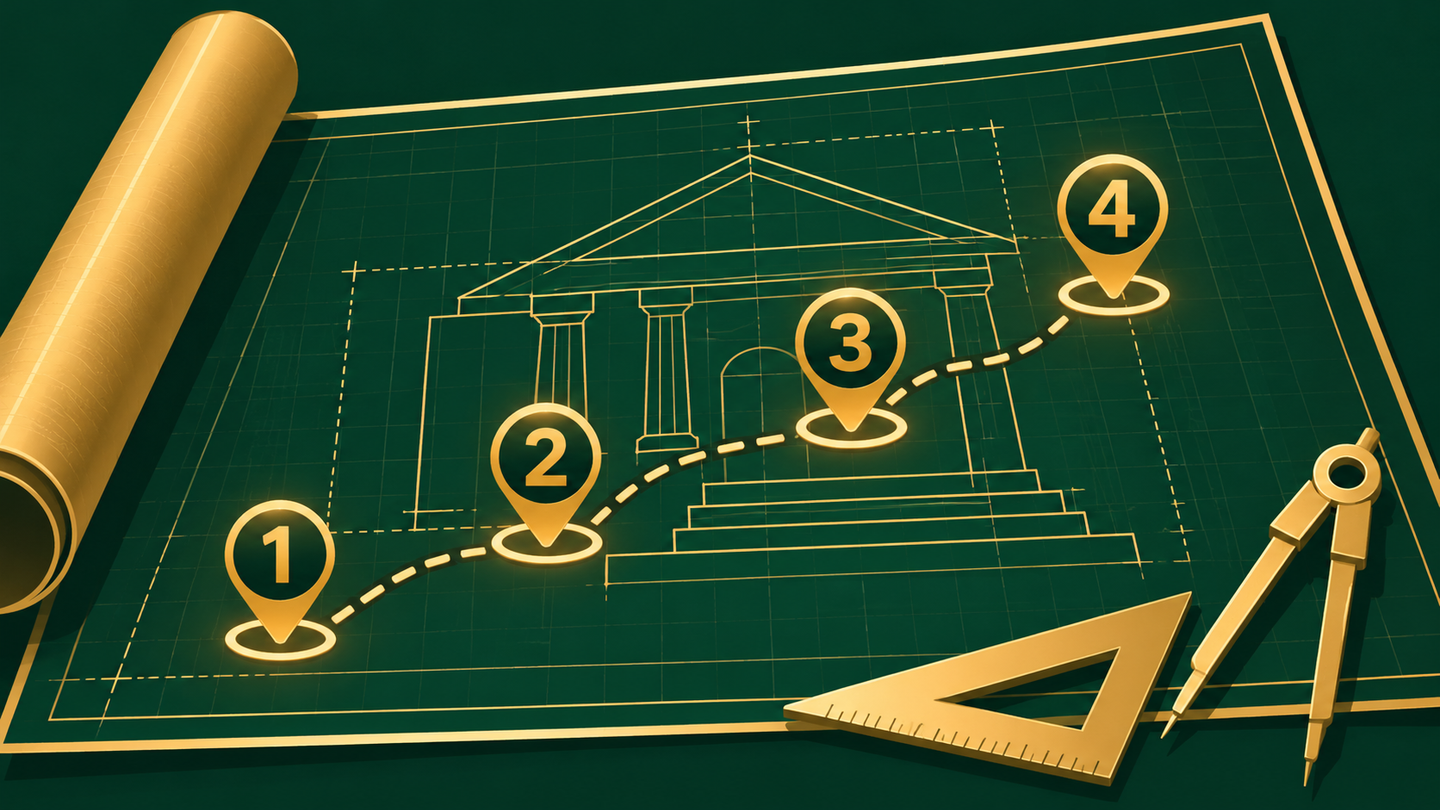
The framework maps a seven-stage progression from a personal operation to a genuinely scalable enterprise. These stages build on each other sequentially — the foundations of each step support the ones that follow.
The 7-Step Business Growth Blueprint
Entrepreneurial Vision
Define where the business is going. What is the mission? What problem does this business solve better than anyone else? What does success look like in five years? This is the GPS destination — every operational decision should point toward it.
Organising for Success
Map out the structure: roles, responsibilities, workflow, and how decisions get made. Even if you are currently filling every role yourself, define them as separate functions. This is building the frame of the house before any walls go up.
Building Systems
Document every repeatable process — the playbooks and procedures that make the business run consistently. These are the recipes in the cookbook. Anyone following them should produce the same result every time, whether it is you or someone hired last week.
Staffing Smart
Hire for the systems you have already built, not based on hope. Train people thoroughly, give them ownership of their defined role, and measure results against the system — not against subjective personal expectations.
Marketing with Meaning
Attract the right customers consistently. Identify who you serve, where they are, and what message makes them choose you — then systematise that outreach so it runs reliably without requiring your personal involvement in every campaign.
Financial Mastery
Know exactly where the money goes. Track revenue, costs, margins, and cash flow. Understand whether you are actually profitable after paying yourself a fair salary. Financial clarity is not optional — it is the scoreboard that tells you whether the business is winning or slowly bleeding out.
Continuous Improvement
No system stays optimal forever. Markets shift, customers change, processes develop gaps. Build a regular review cycle — monthly or quarterly — to audit what is working, what has drifted, and what needs upgrading. This is the step that separates businesses that compound over time from those that gradually decay.
A Worked Example: A Home Bakery in Pune
The ideas in this guide are easiest to see in a real-life shape. Here is an illustrative example, typical of many small Indian businesses: a home bakery in Pune run by its founder, who bakes custom cakes and sells through messaging apps and word of mouth. Business is good, and she is working 50 hours a week.
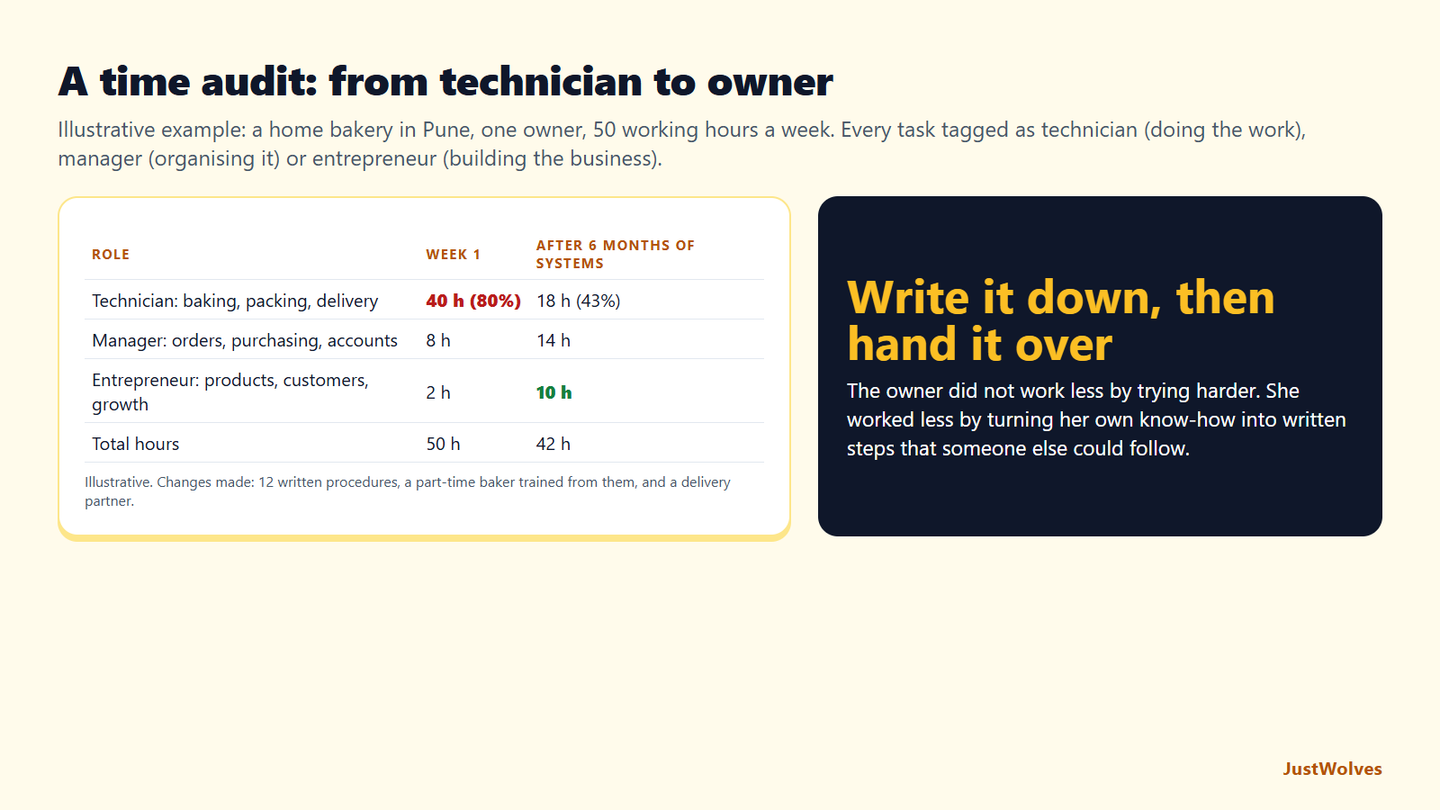
| Role | Week 1 | After 6 months |
|---|---|---|
| Technician: baking, packing, delivery | 40 hours (80%) | 18 hours (43%) |
| Manager: orders, purchasing, accounts | 8 hours | 14 hours |
| Entrepreneur: new products, customers, growth | 2 hours | 10 hours |
| Total working hours | 50 hours | 42 hours |
Step 1: the time audit. For one week she writes down every task and tags it technician, manager or entrepreneur. Eighty per cent of her time is technician work. She has almost no time to think about the business, and if she falls ill, orders stop.
Step 2: write the recipes, literally. Over two months she turns her own know-how into 12 written procedures: the three best-selling cake recipes with exact weights and oven settings, how to take an order, how to quote a custom cake, how to pack for delivery, how to handle a complaint. Each is written so that a capable person who has never worked with her could follow it.
Step 3: hire to the system. She hires a part-time baker and trains her from the procedures, not from memory, and agrees a fixed rate with a local delivery partner. Quality stays consistent because the standard is on paper.
Step 4: work on the business. Six months later she works 42 hours instead of 50, but the real change is in the mix. Ten of those hours now go to new products, corporate orders and pricing, the work that grows the business. The bakery can now run for a week without her.
Key Takeaways
How to Build a Business That Runs Without You — Summary
- 50% of small businesses fail by year five — almost always because the business depends entirely on the owner's personal effort rather than on systems
- The craft myth: being skilled at a craft does not make you equipped to run a business doing that craft — they are completely different skill sets
- Every owner plays three roles simultaneously: Entrepreneur (visionary), Manager (organiser), Technician (doer) — most get permanently trapped as Technicians
- The three business phases are Infancy (owner does everything), Adolescence (owner micromanages), and Maturity (documented systems run the business)
- Maturity is determined by structure, not by the age of the business — a two-year-old business can be more mature than a ten-year-old one
- Franchise thinking: build systems so complete that a capable person with no prior experience can follow them and produce consistent results every time
- Document every repeatable process as a step-by-step recipe before attempting to delegate it to anyone
- Systems first, then people — hire someone to follow your documented system, not to figure out the role from scratch
- Your goal is to shift from player to coach — designing and improving the game, not running every play yourself
- The 7-step blueprint: Vision → Organisation → Systems → Staffing → Marketing → Financials → Continuous Improvement
Frequently Asked Questions
What is the craft myth and why does it matter for small business owners?
The craft myth, also called the entrepreneurial myth, is the false belief that being skilled at a craft automatically makes someone capable of running a business doing that craft. A classic small-business book argues this is a primary reason many small businesses fail — founders are expert Technicians but have no training in building or running a business. Recognising the myth is what allows you to stop working in the business and start working on it.
How do I know which of the three roles I am stuck in?
Track your time for a full week and categorise every task as Entrepreneur (big-picture strategy and vision), Manager (organising, scheduling, overseeing), or Technician (doing the actual core work). If more than 60–70% of your hours are Technician hours — and especially if the business stops functioning when you take a day off — you are operating as a Technician rather than as a business owner.
What does franchise thinking mean and do I need to actually franchise my business?
Franchise thinking means designing your business so it could be replicated by someone else following your documented systems, even if you never plan to franchise it. Large fast-food chains are the classic example: the business does not depend on any individual being exceptional — it depends on the system being excellent. You apply this by documenting every process in enough detail that a capable new hire could follow it without your supervision.
What is the most important process to systemise first?
Start with the task that consumes the most of your time and is most directly replaceable by a clear, written process. In most service businesses, this is customer communication — how you respond to enquiries, how you onboard new clients, how you handle complaints. Once communication is systemised and delegatable, you recover significant hours to reinvest in building other systems.
Can I apply these principles as a solopreneur, or is this only for larger businesses?
The principles apply at any size. Even as a solopreneur, documenting your processes means you can bring in a part-time contractor or virtual assistant quickly when needed, because the system already exists. Documentation also protects you — if you are ill or need time away, someone can step in. The goal is not a large team; it is a business that does not collapse the moment you step back from it.
How long does it take to build a business that genuinely runs without you?
There is no fixed timeline — it depends on how many processes your business has and how much time per week you invest in documentation. A small service business with ten to fifteen core processes might have a working operations manual within three to six months if the owner commits one to two focused hours per week to the project. Consistency matters far more than intensity — system-building works best as a regular ongoing activity rather than a one-off project.
How do I start building systems in a small business in India?
Start with a one-week time audit, tagging every task as doing the work, organising it or growing the business. Then write down your most repeated task as a step-by-step procedure, train someone to follow it, and repeat. In our illustrative home-bakery example, 12 written procedures and one part-time hire cut the owner's hands-on work from 40 to 18 hours a week.
Topics